Behaviour of gases
NCERT Class 11 Physics Chapter 12 Section 12.3
Quick answer
Dilute classical gases approximately obey PV = μRT = NkB T, relating pressure, volume, absolute temperature and particle count. For a fixed amount, Boyle’s law holds at constant temperature and Charles’ law at constant pressure. An ideal mixture’s total pressure is the sum of partial pressures calculated from its current composition.
With your textbook
NCERT Physics Part II (Class 11), Chapter 12 “Kinetic Theory”, Section 12.3 “Behaviour of gases”, pages 246–248.
Open the official NCERT chapter (PDF, 1.5 MB, ncert.nic.in) (opens in a new tab)
Checked against the 2026-27 reprint on .
How do gases behave?
The ideal-gas equation and the gas laws
At low pressure and at temperatures well above the point where they liquefy, dilute classical gases approximately obey (NCERT Section 12.3, pages 246–247)
where μ is the number of moles, N the number of molecules, R = 8.314 J mol K the universal gas constant, kB = 1.38 × 10 J K the Boltzmann constant (both numerical values are rounded), and R = NAkB. A gas that obeys this exactly at all pressures and temperatures is an ideal gas. Boyle’s law, Charles’ law, Avogadro’s hypothesis and Dalton’s law of partial pressures all follow from it.
An ideal gas is a simple theoretical model of a gas. No real gas is truly ideal.
NCERT Physics Part II (Class 11), Section 12.3, page 247
In plain words: gases are the simplest state of matter because their molecules are far apart and hardly affect one another. In the dilute classical approximation, gases follow the same rule linking pressure, volume, temperature and the number of molecules. You met this rule as the ideal-gas equation; kinetic theory now explains it in terms of molecules.
The equation in terms of molecules
For a given sample, PV/T is a constant K (NCERT Eq. 12.1, page 246). NCERT’s text says K “varies with the volume of the gas”; it means the amount of gas, since for a given sample K stays the same as the volume changes. Bringing in molecules, K is proportional to the number of molecules N: K = NkB, and observation shows that kB is the same for every gas. So
P1V1/(N1T1) = P2V2/(N2T2) = kB (NCERT Eq. 12.2).
Useful forms of the equation (pages 246–247):
- PV = μRT (NCERT Eq. 12.3), with μ = M/M0 = N/NA (NCERT Eq. 12.4), where M is the mass of gas and M0 its molar mass;
- P = kBnT, where n = N/V is the number density, the number of molecules per unit volume;
- P = ρRT/M0 (NCERT Eq. 12.5), where ρ is the mass density (Example 5).
Avogadro’s hypothesis and Avogadro’s number
If P, V and T are the same for two gases, NCERT Eq. 12.2 shows that N is the same too. This is Avogadro’s hypothesis: equal volumes of ideal gases at the same temperature and pressure contain the same number of molecules (page 246). Avogadro guessed it from chemical reactions between gases; kinetic theory justifies it.
One mole contains exactly 6.022 140 76 × 10 specified elementary entities; this modern SI definition is a particle count, not a gas-volume definition. Using NCERT’s STP convention (approximately 273 K and 1 atm), one mole of an ideal gas occupies about 22.4 L. Its mass in grams is approximately the numerical molecular mass in unified atomic mass units.
Real gases and the ideal gas
NCERT Fig. 12.1 plots PV/(μT) against pressure for a real gas at three temperatures: all the curves approach the ideal value R at low pressure and high temperature.
At low pressures or high temperatures the molecules are far apart and molecular interactions are negligible.
NCERT Physics Part II (Class 11), Section 12.3, page 247
The spacing claim needs a constraint: at fixed amount and volume, heating does not move molecules farther apart on average. Higher temperature makes interaction energies less significant relative to thermal energy; low density reduces both interaction and finite-size effects.
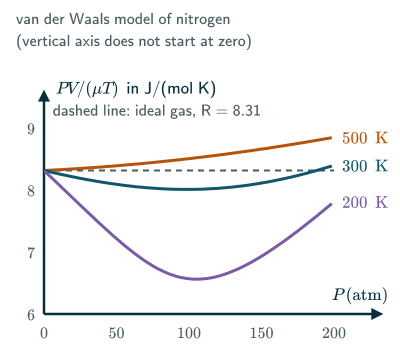
The figure uses the van der Waals equation, a simple model for real gases that is beyond the NCERT text. Where attraction dominates at moderate pressure, it makes PV smaller than ideal. This effect weakens as the temperature rises; for the parameters plotted at 500 K, the molecules’ own volume already wins, so that curve stays just above R. At very high pressures the molecules’ own volume makes PV larger than ideal.
The gas laws (page 247).
- Boyle’s law: at fixed μ and T, PV = constant (NCERT Eq. 12.6). Experimental P–V curves for steam agree with it best at high temperature and low pressure (NCERT Fig. 12.2).
- Charles’ law: at fixed pressure and amount of gas, V ∝ T (NCERT Fig. 12.3, for carbon dioxide).
Dalton’s law of partial pressures
For a mixture of non-interacting ideal gases, μ1 moles of gas 1, μ2 of gas 2 and so on, in a volume V at temperature T (page 247):
Dalton’s law of partial pressures (NCERT Eqs. 12.7–12.9)
Here P1 = μ1RT/V is the partial pressure of gas 1: the pressure it would exert if it alone filled the vessel at the same temperature. Dividing by P = μRT/V, where μ = μ1 + μ2 + …, gives P1 = (μ1/μ)P: each gas’s share of the pressure equals its share of the moles (its mole fraction). Kinetic theory derives the same law from the motion of the molecules (Dalton’s law from kinetic theory, NCERT Eq. 12.21).
Thus, the total pressure of a mixture of ideal gases is the sum of partial pressures.
NCERT Physics Part II (Class 11), Section 12.3, page 247
Solved examples
Take R = 8.314 J mol K, kB = 1.38 × 10 J K, NA = 6.02 × 10 mol.
Example 1: How empty is steam? (NCERT Example 12.1)
Water has a density of 1000 kg m; water vapour at 100 °C and 1 atm has 0.6 kg m. Estimate the fraction of the vapour’s volume taken up by the molecules themselves.
The same mass of vapour takes up 1000/0.6, about 1667 times the volume of the liquid. For this rough packing estimate, identify the total molecular volume with the bulk liquid volume; a molecule has no sharply defined hard boundary.
Answer: about 0.6/1000 = 6 × 10: the molecules fill only about 0.06% of the vapour (page 248).
Example 2: Size of a water molecule (NCERT Example 12.2)
Estimate the radius of a water molecule, taking its density equal to that of liquid water.
Mass of one molecule: 0.018/(6.02 × 10) ≈ 3 × 10 kg (NCERT uses 6 × 10). Volume: 3 × 10/1000 = 3 × 10 m = (4/3)πr.
r = (3 × 3 × 10/(4π))1/3, about 1.9 × 10 m.
Answer: an effective spherical radius of about 2 Å (page 248), a density-based estimate rather than a measured molecular boundary.
Example 3: Spacing in water vapour (NCERT Example 12.3)
Using Examples 1 and 2, estimate the average distance between molecules in water vapour at 100 °C.
The volume per molecule grows about 1667 times, so the distance between neighbours grows by 16671/3 ≈ 11.86 times. NCERT treats each molecule in the liquid as a sphere of radius 2 Å, so neighbours are about 4 Å apart. It rounds the volume ratio to 10, a factor of 10, and gets 10 × 4 = 40 Å (page 248). The unrounded factor gives 4 × 11.86 ≈ 47 Å. Giving each molecule a cube of volume 1667 × 3 × 10 m instead gives a side of about 37 Å.
Answer: about 40 Å, roughly ten times the size of a molecule; only the order of magnitude matters.
Example 4: Neon and oxygen (NCERT Example 12.4)
A vessel holds neon (atomic mass 20.2 u) and oxygen (molecular mass 32.0 u), with partial pressures in the ratio 3 : 2. Find the ratio of (i) their numbers of molecules and (ii) their mass densities.
Same V and T, so P1/P2 = μ1/μ2 = 3/2.
(i) N1/N2 = μ1/μ2 = 3/2.
(ii) ρ1/ρ2 = (μ1M1)/(μ2M2) = (3/2) × (20.2/32.0), about 0.947.
Answer: 3 : 2 by number and about 0.947 by mass density (page 248).
Example 5: Density of nitrogen
Find the density of nitrogen (M0 = 0.028 kg mol) at 300 K and 1 atm (101 325 Pa).
ρ = PM0/(RT) = 101 325 × 0.028/(8.314 × 300), about 1.14 kg m.
Answer: about 1.14 kg m, close to the density of air.
Example 6: A mixture of gases
1.0 mol of nitrogen and 0.50 mol of oxygen are in a 0.050 m vessel at 300 K. Find the partial pressures and the total pressure.
PN₂ = 1.0 × 8.314 × 300/0.050, about 4.99 × 10 Pa. PO₂ = 0.50 × 8.314 × 300/0.050, about 2.49 × 10 Pa.
Answer: total about 7.48 × 10 Pa; each gas exerts the pressure it would alone.
Common mistakes to avoid
Common mistake
Using Celsius in PV = μRT
T is the absolute temperature, in kelvin.
Common mistake
Confusing the Boltzmann constant with R
kB goes with the number of molecules (PV = NkBT); R goes with the number of moles (PV = μRT). R = NAkB.
Common mistake
Thinking equal volumes mean equal masses
Equal ideal-gas volumes at the same T and P hold equal numbers of molecules, not equal masses: 22.4 L at STP is 2 g of hydrogen but 32 g of oxygen.
Common mistake
Expecting real gases to be ideal at high pressure
The approximation improves at low density and temperatures sufficiently high relative to interaction and quantum energy scales; pressure and temperature alone should not be used without considering density.
Quick revision summary
- Ideal-gas equation: PV = μRT = NkBT, with R = 8.314 J mol K, kB = 1.38 × 10 J K and R = NAkB.
- Other forms: P = kBnT (n = number density) and P = ρRT/M0.
- Avogadro: equal ideal-gas volumes at the same T and P contain equal numbers of particles; about 22.4 L at NCERT STP holds one mole.
- Real gases approach ideal behaviour at low pressure and high temperature, where molecular interactions are negligible.
- For a fixed amount of ideal gas, Boyle: PV = constant at fixed T; Charles: V ∝ T at fixed P; Dalton: P = P1 + P2 + … .
Formula sheet
- PV = μRT = NkB T
- P = kB nT (n = N/V)
- P = ρRT/M
- kB = 1.38 × 10⁻²³ J K−1; R = NA kB = 8.314 J mol−1 K−1
- μ = M/M0 = N/NA
- P = P + P + … (Dalton)
Questions students ask
What is the difference between an ideal gas and a real gas?
An ideal gas is a model whose molecules have negligible size and exert no forces on one another except in collisions, so it obeys PV = μRT exactly; a real gas has molecules of finite size that attract one another, so it obeys the equation only approximately, best at low pressure and high temperature. A real gas can therefore be liquefied by cooling and compressing it, while an ideal gas, with no attraction between its molecules, never could. The internal energy of an ideal gas depends only on its temperature, whereas that of a real gas also changes with its volume, because the potential energy of attraction changes as the molecules move apart.
Is an ideal gas the same as a perfect gas?
Yes, an ideal gas and a perfect gas are the same thing in Class 11 physics: a gas that obeys PV = μRT exactly, with molecules of negligible size and no forces between them except during collisions. ‘Perfect gas’ is simply another name, common in British textbooks; the JEE Main 2027 and NEET (UG) 2026 syllabuses use it in ‘equation of state of a perfect gas’, which means the ideal-gas equation.
Does Dalton’s law of partial pressures apply to every mixture of gases?
For an ideal-gas mixture, total pressure equals the sum of partial pressures calculated from the amounts actually present at the common temperature and volume. A reaction changes those amounts: after ammonia and hydrogen chloride form solid ammonium chloride, use the remaining gas amounts, not the initial amounts. Reactions do not invalidate the ideal-mixture sum itself. Real-gas interactions can make the ideal calculation inaccurate, especially at high density.
Practice questions
Try each question first, then open the answer to check your working.
-
Q1. Under what conditions does a real gas behave most like an ideal gas, and why?
Show answerHide answer
At low pressure and high temperature. Then the molecules are far apart and fast, so the forces between them and their own volume hardly matter.
-
Q2. How many moles of gas are in a 10 L cylinder at 2.0 atm and 300 K?
Show answerHide answer
μ = PV/(RT) = 2 × 101 325 × 0.010/(8.314 × 300), about 0.81 mol.
-
Q3. State Dalton’s law of partial pressures.
Show answerHide answer
The total pressure of a mixture of non-reacting ideal gases is the sum of their partial pressures, each being the pressure that gas would exert if it alone filled the vessel at the same temperature.