Molecular nature of matter
NCERT Class 11 Physics Chapter 12 Section 12.2
Quick answer
Ordinary solids, liquids and gases consist of atoms, molecules or ions in thermal motion. Particles in solids vibrate about mean positions; those in liquids move past nearby neighbours, while molecules in a dilute gas travel much farther between collisions. Gas spacing depends on number density, with a characteristic estimate 1/∛n.
With your textbook
NCERT Physics Part II (Class 11), Chapter 12 “Kinetic Theory”, Section 12.2 “Molecular nature of matter”, pages 244–246.
Open the official NCERT chapter (PDF, 1.5 MB, ncert.nic.in) (opens in a new tab)
Checked against the 2026-27 reprint on .
What is the molecular nature of matter?
The atomic hypothesis
Ordinary solids, liquids and gases consist of atoms, molecules or ions. Their particles undergo thermal motion; for neutral atoms and molecules, a useful model has attraction at intermediate separation and strong repulsion at very short separation. (NCERT Section 12.2, pages 244–246.)
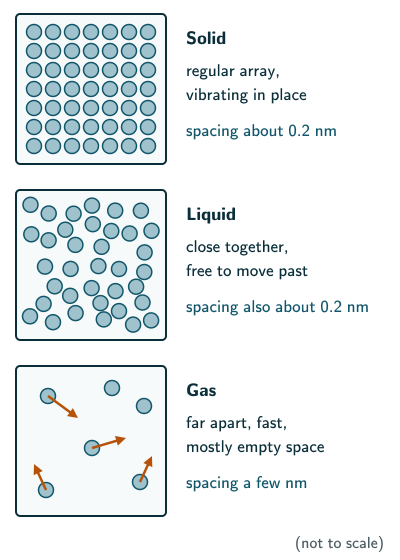
- In solids the atoms are tightly packed, a few ångströms apart (1 Å = 10 m = 0.1 nm), and vibrate about their mean positions.
- In liquids they are about as close, but free to move past one another, so a liquid flows.
- In gases near ordinary atmospheric conditions they are typically tens of ångströms apart and move freely, travelling far between collisions.
Atomic theory is not the end of our quest, but the beginning.
NCERT Physics Part II (Class 11), Section 12.2, page 246
In plain words: if you could keep zooming in on a drop of water, it would stop looking smooth and turn into a jostling crowd of molecules. Everything we see, the hardness of ice, the flow of water and the springiness of air, comes from how close those particles are and how hard they pull or push on one another.
NCERT opens Section 12.2 with Richard Feynman’s view (page 244): if all of scientific knowledge were destroyed, the idea Feynman would want passed on to the next generation is the atomic hypothesis, that all things are made of atoms, little particles in perpetual motion, attracting each other when a little distance apart and repelling when squeezed into one another.
Ideas of atoms, old and new
Ancient speculation (NCERT box, page 245). The idea that matter is not continuous arose in many cultures:
- In India, the Vaiseshika school founded by Kanada (which NCERT places in the sixth century B.C.) described atoms (paramanu) as eternal, indivisible and the ultimate parts of matter, with four kinds: Bhoomi (earth), Ap (water), Tejas (fire) and Vayu (air). Atoms combined into molecules: two into a dvyanuka, three into a tryanuka. NCERT notes that the Lalitavistara, a biography of the Buddha, gives an estimate of atomic size close to the modern 10 m.
- In Greece, Democritus is best known for his atomic hypothesis; the word ‘atom’ means ‘indivisible’ in Greek. He imagined the atoms of water as smooth and round, unable to ‘hook’ on to each other, so that water flows easily.
These were inspired guesses. They could not develop much further, perhaps because they were not tested and refined by quantitative experiments, the hallmark of modern science (page 245).
Dalton’s atomic theory. The scientific atomic theory is usually credited to John Dalton, about 200 years ago (page 245). He used it to explain two laws of chemical combination:
- the law of definite proportions: a given compound always contains its elements in a fixed proportion by mass;
- the law of multiple proportions: when two elements form more than one compound, the masses of one that combine with a fixed mass of the other are in a ratio of small whole numbers (Example 4).
Dalton suggested that the smallest constituents of an element are atoms: atoms of one element are identical but differ from those of other elements, and a small number of atoms of each element combine to form a molecule of a compound (page 245). These are historical postulates: isotopes of an element have different masses, and ionic or network solids do not consist of separate molecules.
Gay-Lussac and Avogadro. Gay-Lussac’s law says that when gases combine to give another gas, their volumes, measured at the same temperature and pressure, are in ratios of small integers. Avogadro’s law, combined with Dalton’s atomic theory, explains it (Example 5):
Avogadro’s law (or hypothesis) says: Equal volumes of all gases at equal temperature and pressure have the same number of molecules.
NCERT Physics Part II (Class 11), Section 12.2, page 245
Even at the end of the nineteenth century some famous scientists did not accept atoms (page 245). Today, electron microscopes and scanning tunnelling microscopes let us see them.
Solids, liquids and gases at the molecular level
NCERT gives these illustrative orders of magnitude (page 245); gas spacings and paths depend strongly on density:
- An atom is about an ångström across (10 m).
- In solids, atoms are tightly packed, about 2 Å apart, held near fixed positions.
- In liquids the separation is about the same, but the atoms are not rigidly fixed and can move around, so the liquid flows.
- In gases the distance between molecules is tens of ångströms (Example 1). The average distance a molecule travels between collisions, the mean free path, is of the order of thousands of ångströms. A gas not enclosed spreads out.
The force between atoms. In solids and liquids the atoms are close enough for the interatomic force to matter. For the neutral-particle model used here, it is attractive at intermediate separation and strongly repulsive at shorter separation (page 245). Charged particles also require electrostatic forces, so this is not a universal description of every pair of particles. This balance is what makes a solid spring back when deformed. In a gas the molecules are usually too far apart for this force to matter, except during collisions.
Dynamic equilibrium. A gas in a closed container looks still, but it is not:
The gas is full of activity and the equilibrium is a dynamic one.
NCERT Physics Part II (Class 11), Section 12.2, page 246
Molecules keep colliding and changing speed; only the average properties, such as pressure and temperature, stay constant. And atoms themselves are not the end of the story: they are made of a nucleus and electrons, the nucleus of protons and neutrons, and these of quarks (page 246).
Solved examples
Take kB = 1.38 × 10 J K and NA = 6.02 × 10 mol.
Example 1: How far apart are gas molecules?
Estimate the average spacing of molecules in a gas at 273 K and 1.013 × 10 Pa. The number of molecules per cubic metre is n = N/V = P/(kBT), from the ideal-gas equation PV = NkBT.
n = 1.013 × 10/
Dividing the volume equally among molecules gives a characteristic cell volume 1/n and spacing n−1/3, about 3.34 × 10 m. This is a spacing estimate, not an exact mean nearest-neighbour distance.
Answer: about 3.3 nm, that is about 33 Å: “tens of ångströms”, as NCERT says.
Example 2: How far apart are water molecules?
Liquid water has a density of 1000 kg m and a molar mass of 0.018 kg mol. Estimate the spacing of its molecules.
Molecules per cubic metre: (1000/0.018) × 6.02 × 10, about 3.34 × 10 m.
Spacing: n−1/3, about 3.10 × 10 m.
Answer: about 0.31 nm, that is about 3 Å, a few ångströms, close to the size of the molecules themselves (NCERT’s round figure is 2 Å; both are ‘a few ångströms’).
Example 3: Liquid against gas
Compare the spacings found in Examples 1 and 2. How much more volume does a gas take up than the same number of molecules in a liquid?
Spacing ratio: 3.34 × 10 m divided by 3.10 × 10 m, about 10.8. Volume ratio: 3.34 × 10 divided by 2.69 × 10, about 1240 (the cube of the spacing ratio).
Answer: gas molecules are about 11 times farther apart, so the same molecules fill about 1200 times the volume. This compares liquid-water number density with a generic ideal-gas number density; it is not an equilibrium conversion of water to vapour at 273 K and 1 atm. The large spacing explains why a dilute gas is easy to compress.
Example 4: The law of multiple proportions
In carbon monoxide, 12 g of carbon combines with 16 g of oxygen; in carbon dioxide, 12 g of carbon combines with 32 g of oxygen. Show that this obeys the law of multiple proportions.
For the same 12 g of carbon, the masses of oxygen are 16 g and 32 g, in the ratio 1 : 2.
Answer: a ratio of small whole numbers, as Dalton’s theory explains: one oxygen atom per carbon atom in CO and two in CO.
Example 5: Gay-Lussac’s law and Avogadro
2 volumes of hydrogen combine with 1 volume of oxygen to give 2 volumes of water vapour (at the same temperature and pressure). Explain the ratio 2 : 1 : 2 with Avogadro’s law.
Equal volumes hold equal numbers of molecules, so 2 molecules of hydrogen + 1 molecule of oxygen → 2 molecules of water.
Answer: the volume ratio is just the ratio of numbers of molecules. Each water molecule contains oxygen, yet 1 oxygen molecule gives 2 water molecules, so the oxygen molecule must split: it has at least two atoms. The simplest choice, O, gives 2H + O → 2HO, something Dalton’s theory alone could not tell.
Common mistakes to avoid
Common mistake
Thinking atoms are indivisible
The name means “indivisible”, but atoms have a nucleus and electrons, and the nucleus has protons and neutrons, made of quarks.
Common mistake
Picturing a gas at rest as having still molecules
A gas in equilibrium is in dynamic equilibrium: its molecules keep moving and colliding; only the averages stay constant.
Common mistake
Thinking the interatomic force is only attractive
It attracts at a few ångströms but repels at shorter distances. Without the repulsion, matter would collapse.
Common mistake
Thinking liquid molecules are far apart because liquids flow
Liquid molecules are about as close as in a solid; a liquid flows because its molecules can move past one another, not because they are far apart.
Quick revision summary
- Atomic picture: ordinary solids, liquids and gases contain atoms, molecules or ions in thermal motion. Neutral-particle forces are often modelled as attractive at intermediate separation and repulsive at very short separation.
- Ancient ideas (Kanada, Democritus) were untested speculation; Dalton’s theory explained the laws of definite and multiple proportions.
- Avogadro: equal volumes of gases at the same temperature and pressure hold equal numbers of molecules; with Dalton’s theory, this explains Gay-Lussac’s law of combining volumes.
- Atom size about 1 Å; spacing about 2 Å in solids and liquids, tens of ångströms in gases; mean free path in gases of the order of thousands of ångströms.
- A gas is in dynamic equilibrium: molecules keep moving and colliding, while the averages stay constant.
Formula sheet
- 1 Å = 10 m = 0.1 nm
- Molecules per m3 in a gas: n = P/(kB T)
- Average spacing ≈ n−1/3
Questions students ask
How many molecules are there in a drop of water?
A drop of water of about 0.05 mL, that is 0.05 g, contains about 1.7 × 10 water molecules: 0.05 g is 0.05/18 ≈ 2.8 × 10 mol, and each mole holds 6.02 × 10 molecules. Each molecule has three atoms, so the drop holds about 5 × 10 atoms. The exact count depends on the size of the drop, but any ordinary drop holds of the order of 10 molecules, each only a few ångströms from its neighbours, which is why water looks continuous although it is made of separate molecules.
Is all matter made up of molecules?
Not all matter consists of separate molecules: water, oxygen and carbon dioxide consist of separate molecules, but metals, ionic solids such as sodium chloride and covalent solids such as diamond are giant arrays of atoms or ions with no separate molecules. Noble gases such as helium and argon consist of single atoms, which kinetic theory treats as monatomic molecules, in this model. Plasmas also contain free electrons and ions; the ordinary neutral-gas model here does not cover every form of matter.
Is the molecular nature of matter in the JEE Main 2027 and NEET (UG) 2026 syllabuses?
The molecular nature of matter (NCERT Class 11 Physics, Section 12.2) is not named separately in Physics Unit 9, Kinetic Theory of Gases, of the JEE Main 2027 or NEET (UG) 2026 syllabus, which starts with the equation of state of a perfect gas. That does not exclude questions using this background. Part of it is examined in Chemistry instead: Unit 1 of both syllabuses lists Dalton’s atomic theory and the laws of chemical combination. The sizes and spacings of molecules it describes are also used in kinetic theory and the mean free path.
Practice questions
Try each question first, then open the answer to check your working.
-
Q1. State the atomic hypothesis in your own words.
Show answerHide answer
Ordinary solids, liquids and gases contain atoms, molecules or ions in thermal motion. For neutral particles, attraction at intermediate separation and repulsion at short separation provide a useful interaction model.
-
Q2. How many gas molecules are there in 1 L of a gas at 273 K and 1.013 × 10 Pa?
Show answerHide answer
From Example 1, n ≈ 2.69 × 10 m. 1 L is 10 m, so there are about 2.69 × 10 molecules.
-
Q3. Why can a gas be compressed easily, but a liquid hardly at all?
Show answerHide answer
In a gas the molecules are tens of ångströms apart, so there is plenty of empty space to squeeze out. In a liquid they are already only a few ångströms apart, and pushing them closer meets the strong short-range repulsion between atoms.