Kinetic theory of an ideal gas
NCERT Class 11 Physics Chapter 12 Section 12.4
Quick answer
The classical kinetic theory of gases relates pressure to molecular momentum transfer: P = (1/3)nm⟨v2⟩ for an isotropic gas in its rest frame. Average translational energy per particle is (3/2)kB T, giving vrms = √(3kB T/m). Internal molecular modes can add energy without contributing directly to this translational pressure relation.
With your textbook
NCERT Physics Part II (Class 11), Chapter 12 “Kinetic Theory”, Section 12.4 “Kinetic theory of an ideal gas”, pages 248–252.
Open the official NCERT chapter (PDF, 1.5 MB, ncert.nic.in) (opens in a new tab)
Checked against the 2026-27 reprint on .
What is the kinetic theory of an ideal gas?
Kinetic theory of an ideal gas
Kinetic theory explains a gas’s pressure and temperature in terms of its molecules. For an ideal gas of N molecules, each of mass m, in classical thermal equilibrium in the gas rest frame, with no preferred direction, in a volume V (number density n = N/V) (NCERT Section 12.4, pages 248–252):
- pressure: P = (1/3)nm⟨v⟩, where ⟨v⟩ is the mean of the squared speeds;
- temperature: the average translational kinetic energy of a molecule is ½m⟨v⟩ = (3/2)kBT;
- rms speed: vrms = √⟨v⟩ = √(3kBT/m) = √(3RT/M0), with M0 the molar mass.
the average kinetic energy of a molecule is proportional to the absolute temperature of the gas; it is independent of pressure, volume or the nature of the ideal gas.
NCERT Physics Part II (Class 11), Section 12.4.2, page 250
In plain words: the pressure of a gas is the steady drumming of countless molecules bouncing off the walls, and its temperature measures average random translational kinetic energy per particle. For a fixed gas at fixed volume, raising temperature increases typical speeds, collision rates at the walls and pressure.
Assumptions of kinetic theory
The model rests on a few simple assumptions (NCERT, pages 248–250):
- A gas is a very large number of molecules (of the order of Avogadro’s number) in constant random motion.
- At ordinary pressure and temperature, the average distance between molecules is 10 or more times their size (about 2 Å), so the molecules’ own volume and the forces between them are negligible.
- Between collisions the molecules move freely in straight lines, as Newton’s first law requires.
- In the simplest particle model, intermolecular collisions are elastic and stationary smooth walls reverse the normal velocity component. Momentum is conserved for the combined molecule–wall system, not for the molecule alone. Real polyatomic collisions can exchange translational and internal energy while conserving total energy.
- Collisions are not too frequent, and the time spent in a collision is negligible compared with the time between collisions.
The collisions are considered to be elastic.
NCERT Physics Part II (Class 11), Section 12.4, page 249
Pressure of an ideal gas
Take a gas in a cube of side l, with the axes along its edges (NCERT Fig. 12.4, page 249).
One collision. A molecule with velocity (vx, vy, vz) hits the wall of area A = l at right angles to the x-axis. The collision is elastic, so it rebounds with velocity (−vx, vy, vz). Its momentum changes by −2mvx, so the wall receives momentum 2mvx.
Many collisions. First group molecules with the same magnitude of x-component, |v|, including both signs equally; n in this step denotes that group’s density and v denotes its positive magnitude. In a short time Δt, only molecules within a distance vxΔt of the wall can reach it: those in a volume AvxΔt. On average half of them are moving towards the wall, so ½nAvxΔt molecules hit it. The momentum they give the wall is
Q = (2mvx)(½nAvxΔt) (NCERT Eq. 12.10).
Force is the rate of transfer of momentum, and pressure is force per unit area, so P = Q/(AΔt) = nmvx2 (NCERT Eq. 12.11).
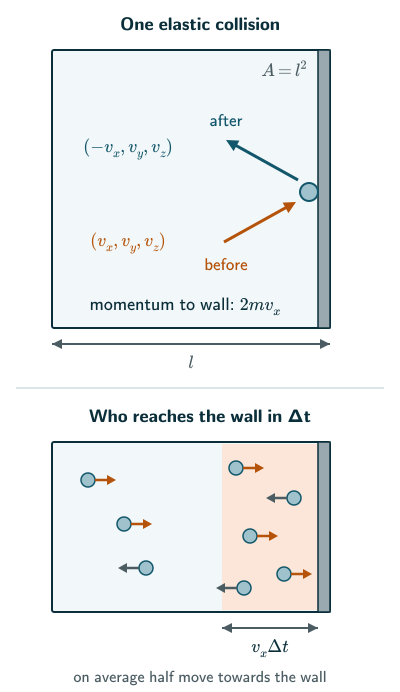
Averaging. Not all molecules have the same velocity. NCERT Eq. 12.11 is the pressure from one group of molecules with the same |v| and both signs represented, with n the number density of that group. Adding all groups gives P = nm⟨vx2⟩ (NCERT Eq. 12.12), where n is now the total number density. The gas has no preferred direction, so ⟨vx2⟩ = ⟨vy2⟩ = ⟨vz2⟩; since v = vx2 + vy2 + vz2, each is ⟨v⟩/3 (NCERT Eq. 12.13). Hence
Pressure of an ideal gas (NCERT Eq. 12.14)
Since nm is the mass density ρ, this is also P = (1/3)ρ⟨v⟩ (Example 4).
Two remarks from NCERT (pages 249–250). The shape of the vessel does not matter: any small piece of wall gives the same result, giving an isotropic pressure at each point. Pressure is uniform here because external fields such as gravity are neglected; hydrostatic equilibrium can have a pressure gradient. Collisions preserve the equilibrium velocity distribution statistically: averaged populations entering and leaving a velocity range balance, not necessarily one-for-one in each collision. NCERT calls this a qualitative argument, valid if collisions are not too frequent and each lasts a negligible time. How often molecules collide is worked out with the mean free path.
Kinetic interpretation of temperature
Multiply NCERT Eq. 12.14 by V. With N = nV molecules,
PV = (2/3)N × (½m⟨v⟩) (NCERT Eq. 12.15).
(NCERT’s text on page 250 introduces this step as coming from “Equation (13.14)”; it means Eq. 12.14.) The term in brackets is the average translational kinetic energy of a molecule. Here E = N × ½m⟨v⟩ is only the translational energy, as NCERT’s footnote specifies. Ideal polyatomic gases can also have rotational and vibrational energy, including intramolecular vibrational potential energy; ideality neglects intermolecular interaction energy. So PV = (2/3)E (NCERT Eqs. 12.16–12.17). Comparing with the ideal-gas equation PV = NkBT:
Average kinetic energy and temperature (NCERT Eqs. 12.18–12.19)
This is the kinetic meaning of temperature: the absolute temperature measures the average translational kinetic energy of the molecules, and kB links the two (page 250). For a fixed amount and composition of ideal gas, total internal energy depends on temperature, not independently on pressure or volume; the translational formula alone does not count internal molecular modes.
Dalton’s law from kinetic theory. For a mixture of gases, P = (1/3)n1m1⟨v12⟩ + (1/3)n2m2⟨v22⟩ + … (NCERT Eq. 12.20). In equilibrium every gas has the same average translational kinetic energy (3/2)kBT, so P = (n1 + n2 + …)kBT (NCERT Eq. 12.21): Dalton’s law of partial pressures.
RMS speed of gas molecules
The square root of ⟨v⟩ is the root mean square (rms) speed:
RMS speed
For nitrogen at 300 K it is about 517 m s (Example 1).
The speed is of the order of the speed of sound in air.
NCERT Physics Part II (Class 11), Section 12.4.2, page 250
At the same temperature all gases have the same average kinetic energy per molecule, so lighter molecules move faster: vrms ∝ 1/√m (page 250). For effusion through a small hole into vacuum, with hole size much smaller than the mean free path and equal upstream number densities, particle flux is proportional to the mean speed and hence to 1/√m (Graham’s law). Bulk diffusion through another gas also depends on collisions and is not universally determined by this mass ratio alone.
Why a gas warms when compressed. NCERT Example 12.7 (pages 251–252) starts with a ball arriving at speed u at a massive bat moving towards it at speed V. Relative to the bat it arrives and leaves at V + u, so relative to the ground it rebounds at 2V + u, faster than it came. A piston is massive, so molecules bouncing off a piston being pushed in gain speed, and, if heat loss is negligible, the gas warms. When the gas does positive work pushing a piston out with negligible heat input, molecules lose energy and the gas cools. Heat exchange can instead maintain constant temperature; rapid motion alone does not establish a reversible adiabatic path.
Solved examples
Take kB = 1.38 × 10 J K, R = 8.314 J mol K, NA = 6.02 × 10 mol.
Example 1: How fast are nitrogen molecules? (NCERT, page 250)
Find the rms speed of nitrogen molecules (molar mass 28 g mol) at 300 K.
Mass of a molecule: m = 0.028/(6.02 × 10), about 4.65 × 10 kg.
⟨v⟩ = 3kBT/m = 3 × 1.38 × 10 × 300/(4.65 × 10), about 2.67 × 10 m s.
Answer: vrms ≈ 517 m s (NCERT rounds this down to 516), of the same order as, but larger than, the approximately 343 m s speed of sound in air near room temperature.
Example 2: Argon and chlorine (NCERT Example 12.5)
A flask holds argon (39.9 u) and chlorine (70.9 u) in the mass ratio 2 : 1 at 27 °C. Find the ratio of (i) the average kinetic energy per molecule and (ii) the rms speeds.
(i) Both gases are at the same temperature, so the average translational kinetic energy per particle is the same for the two species, (3/2)kBT: the ratio is 1 : 1. (Chlorine molecules also rotate, so their total kinetic energy is larger; equipartition of energy, NCERT Section 12.5, covers this.)
(ii) ½mvrms2 is the same for both, so (vrms,Ar/vrms,Cl) = MCl/MAr = 70.9/39.9, about 1.78 (NCERT writes 1.77).
Answer: 1 : 1 and about 1.33 : 1 (page 251). The mass ratio 2 : 1 makes no difference.
Example 3: Comparing isotopic molecular speeds (NCERT Example 12.6)
Uranium hexafluoride (UF) gas contains molecules made with uranium-235 and with uranium-238; fluorine is 19 u. Which molecule is faster, and by how much?
Molecular masses: 235 + 6 × 19 = 349 u and 238 + 6 × 19 = 352 u.
v349/v352 = √(352/349), about 1.0043.
Answer: the lighter molecule, UF, is faster by about 0.43%. NCERT gives 1.0044 and 0.44% (page 251); the square root is 1.0043. This compares equilibrium mean or rms speeds at the same temperature.
Example 4: Pressure from molecular speed
Nitrogen at 300 K has a density of about 1.14 kg m and an rms speed of about 517 m s. Find its pressure from kinetic theory.
P = (1/3)ρ⟨v⟩ = (1/3) × 1.14 × 517, about 1.016 × 10 Pa.
Answer: about 1.0 × 10 Pa, one atmosphere, as it should be.
Example 5: Hydrogen against oxygen
Find the rms speeds of hydrogen (2 g mol) and oxygen (32 g mol) at 300 K, and their ratio.
Hydrogen: √(3 × 8.314 × 300/0.002), about 1934 m s. Oxygen: √(3 × 8.314 × 300/0.032), about 484 m s.
Answer: about 1.93 km s and 484 m s; the ratio is √(32/2) = 4.
Example 6: Doubling the speed
A gas is at 300 K. At what temperature will the rms speed of its molecules be twice as large?
vrms ∝ √T, so doubling it needs four times the absolute temperature: 4 × 300 = 1200 K.
Answer: 1200 K (927 °C).
Common mistakes to avoid
Common mistake
Using Celsius in the rms speed or the average kinetic energy
Both need the absolute temperature in kelvin.
Common mistake
Taking the rms speed as the average speed
⟨v⟩ is the mean of the squares. For speeds of 1, 2 and 3 m s the average speed is 2 m s, but the rms speed is √(14/3), about 2.16 m s.
Common mistake
Thinking the rms speed changes with pressure
vrms = √(3P/ρ), but at a fixed temperature doubling P doubles ρ, so vrms = √(3RT/M0) is unchanged.
Common mistake
Using the molar mass in grams
In √(3RT/M0) the molar mass must be in kg mol: 0.028, not 28, for nitrogen.
Common mistake
Thinking heavier molecules have more kinetic energy
At the same temperature each classical gas species has the same average translational kinetic energy per particle, (3/2)kBT; heavier species have lower characteristic speeds. Individual molecules still have a distribution of instantaneous energies.
Common mistake
Thinking the rms speed doubles when T doubles
vrms ∝ √T: doubling the absolute temperature multiplies it by √2, about 1.41.
Quick revision summary
- Assumptions: many molecules in random motion; negligible forces except in collisions; straight-line motion between collisions; elastic collisions; collision time negligible.
- Pressure: P = (1/3)nm⟨v⟩ = (1/3)ρ⟨v⟩.
- Temperature: ½m⟨v⟩ = (3/2)kBT, so PV = (2/3)E with E = (3/2)NkBT; E is translational energy; total ideal-gas internal energy depends only on T for fixed amount and composition.
- RMS speed: vrms = √(3kBT/m) = √(3RT/M0); about 517 m s for nitrogen at 300 K.
- Lighter molecules move faster at the same temperature: vrms ∝ 1/√m.
Formula sheet
- P = (1/3)nm⟨v2⟩ = (1/3)ρ⟨v2⟩
- ½ m ⟨v2⟩ = (3/2) kB T
- E = (3/2) N kB T; PV = (2/3)E
- vrms = √(3kB T/m) = √(3RT/M0)
Questions students ask
Is kinetic theory of gases in the JEE Main 2027 and NEET (UG) 2026 syllabuses?
Yes, kinetic theory of gases is in both syllabuses: it is Unit 9, Kinetic Theory of Gases, of the JEE Main 2027 syllabus (NTA) and of the NEET (UG) 2026 syllabus (NMC), so it has not been dropped from NEET. Both list the equation of state of a perfect gas, work done on compressing a gas, the assumptions of kinetic theory, the concept of pressure, the kinetic interpretation of temperature, rms speed, degrees of freedom, the law of equipartition of energy and its use for the specific heats of gases, mean free path and Avogadro’s number. In NCERT it is Chapter 12 of Class 11 Physics Part II.
Which gas laws can be derived from the kinetic theory of gases?
The kinetic theory of gases gives all the ideal-gas laws once temperature is identified with the average translational kinetic energy of a molecule: it leads to PV = (2/3)N × ½m⟨v⟩, and ½m⟨v⟩ = (3/2)kBT depends only on the absolute temperature. So for a fixed number of molecules N, PV is constant at fixed T (Boyle’s law) and V ∝ T at fixed P (Charles’ law); equal P, V and T mean equal N (Avogadro’s law); and adding the pressures of each gas in a mixture gives Dalton’s law of partial pressures. It also gives the inverse-square-root mass dependence of effusion under molecular-flow conditions; general bulk diffusion needs collision information.
What is the difference between rms speed, average speed and most probable speed?
The rms speed, average speed and most probable speed are three measures of molecular speed in a gas: vrms = √(3RT/M0), ⟨v⟩ = √(8RT/(πM0)) and vmp = √(2RT/M0), the speed at the peak of the distribution. They are in the ratio √3 : √(8/π) : √2 ≈ 1.73 : 1.60 : 1.41, so vmp < ⟨v⟩ < vrms for a classical Maxwell–Boltzmann equilibrium gas. NCERT derives only the rms speed, since pressure and kinetic energy depend on ⟨v⟩; the other two come from Maxwell’s speed distribution, beyond the NCERT text, and the JEE Main 2027 and NEET (UG) 2026 syllabuses name only the “RMS speed of gas molecules”.
Does the temperature of a gas rise if its container moves faster?
Uniform translation of the whole gas does not by itself change its temperature: temperature measures the molecules’ random motion relative to the gas’s centre of mass, and moving the container only adds the same velocity to every molecule. A sudden stop may transfer some ordered kinetic energy into the gas, the container or its surroundings. In an idealised estimate where all the gas’s initial bulk kinetic energy becomes its own internal energy, with no heat loss and negligible container heat capacity, the ordered kinetic energy ½μM0v becomes internal energy μCvΔT, so ΔT = M0v/(2Cv): argon (M0 = 0.040 kg mol, Cv = (3/2)R) stopped from 100 m s warms by 0.040 × 100/(3 × 8.314) ≈ 16 K.
Why is there almost no hydrogen in the Earth’s atmosphere?
Low particle mass helps hydrogen escape, but molecular speed alone does not explain its atmospheric abundance. Atmospheric chemistry and upward transport determine how much hydrogen reaches the upper atmosphere, where both thermal and nonthermal escape operate. As a speed comparison only, H at 1000 K has an rms speed of about 3.5 km s, below Earth’s surface escape speed of 11.2 km s; neither this average nor the surface escape speed is a complete escape calculation. The Moon’s tenuous exosphere also requires considering sources and loss processes.
Practice questions
Try each question first, then open the answer to check your working.
-
Q1. What does kinetic theory say temperature measures?
Show answerHide answer
The average translational kinetic energy of the molecules: ½m⟨v⟩ = (3/2)kBT, which is proportional to the absolute temperature and is the same for every ideal gas at that temperature.
-
Q2. Find the rms speed of helium atoms (4 g mol) at 300 K.
Show answerHide answer
vrms = √(3 × 8.314 × 300/0.004), about 1368 m s.
-
Q3. Why does a gas exert the same pressure on every wall of its container?
Show answerHide answer
The molecules move at random with no preferred direction, so ⟨vx2⟩ = ⟨vy2⟩ = ⟨vz2⟩, giving equal pressure in all directions at a point. With external body forces neglected, the equilibrium pressure is also spatially uniform; gravity can produce a pressure gradient.