Specific heat capacity from kinetic theory
NCERT Class 11 Physics Chapter 12 Section 12.6
Quick answer
For an ideal gas with a fixed count f of active classical quadratic energy terms, molar Cv = fR/2, Cp = Cv + R and γ = Cp/Cv. A rigid monatomic gas has f = 3 and a rigid diatomic gas f = 5; vibrational excitation can increase heat capacity. The classical solid limit is Cv = 3R per mole of atoms, with quantum deviations at low temperatures.
With your textbook
NCERT Physics Part II (Class 11), Chapter 12 “Kinetic Theory”, Section 12.6 “Specific heat capacity”, pages 253–254.
Open the official NCERT chapter (PDF, 1.5 MB, ncert.nic.in) (opens in a new tab)
Checked against the 2026-27 reprint on .
How does kinetic theory predict specific heats?
Specific heats from equipartition
By the law of equipartition, one mole of ideal gas with a fixed count f of active classical quadratic energy terms has thermal internal energy U = (f/2)RT, up to a constant reference offset. Differentiating with f constant gives its molar heat capacities (NCERT Section 12.6, pages 253–254):
- monatomic (f = 3): Cv = (3/2)R, Cp = (5/2)R, γ = 5/3;
- rigid diatomic (f = 5): Cv = (5/2)R, Cp = (7/2)R, γ = 7/5;
- solids: the classical harmonic limit is C = 3R per mole of atoms; C is often close when thermal-expansion corrections are small.
The law of equipartition of energy is, thus, well verified experimentally at ordinary temperatures.
NCERT Physics Part II (Class 11), Section 12.6, page 254
In plain words: the more ways a molecule has of storing energy, the more heat it takes to raise its temperature, because the heat is shared among all those ways. Count the ways, multiply by ½R per mole, and you have predicted its molar specific heat at constant volume without measuring it.
Monatomic gases
A monatomic molecule (He, Ne, Ar) has only 3 translational degrees of freedom, so its average energy is (3/2)kBT. For a mole, U = (3/2)kBT × NA = (3/2)RT (NCERT Eq. 12.27). Then (NCERT Eqs. 12.28–12.31):
- Cv = dU/dT = (3/2)R;
- for an ideal gas Cp − Cv = R, so Cp = (5/2)R;
- γ = Cp/Cv = 5/3.
The relation Cp − Cv = R is the one derived from the first law in the previous chapter (Mayer’s relation); NCERT notes that it holds for any ideal gas, whether monatomic, diatomic or polyatomic (page 253).
Diatomic gases
A diatomic molecule treated as a rigid rotator, like a dumbbell, has 5 degrees of freedom: 3 translational and 2 rotational. So U = (5/2)RT per mole (NCERT Eq. 12.32), and
Cv = (5/2)R, Cp = (7/2)R, γ = 7/5 (NCERT Eqs. 12.33–12.34).
If its harmonic vibration is fully excited in the classical limit, the vibration adds kBT per molecule: U = (7/2)RT, so Cv = (7/2)R, Cp = (9/2)R and γ = 9/7 (NCERT Eq. 12.35).
Polyatomic gases
In general a polyatomic molecule has 3 translational, 3 rotational degrees of freedom and a certain number (f) of vibrational modes.
NCERT Physics Part II (Class 11), Section 12.6.3, page 253
Each fully excited classical vibrational mode adds kBT, so per molecule the energy is (3/2)kBT + (3/2)kBT + fkBT, and a mole has U = (3 + f)kBTNA = (3 + f)RT, giving (NCERT Eq. 12.36)
Cv = (3 + f)R, Cp = (4 + f)R, γ = (4 + f)/(3 + f).
Careful: in NCERT’s formula f counts only the vibrational modes. It is not the f in Cv = (f/2)R at the top of this page, which counts every squared term. The two agree: 3 translations + 3 rotations + 2 terms per vibration make 6 + 2f terms, and (6 + 2f)/2 × R = (3 + f)R.
The 3 rotational degrees of freedom apply to non-linear molecules such as HO and CH. A linear molecule such as CO rotates about only two axes, like a diatomic one: rotation about the line of atoms does not count, for the reason NCERT gives for O (footnote, page 252). This point is beyond the NCERT text.
Theory and experiment
NCERT Table 12.1 (page 254) gives the predictions ignoring vibration: monatomic Cv = 12.5 J mol K and γ = 1.67; diatomic 20.8 and 1.40; triatomic 24.93 and 1.33 (this row counts 3 rotations, so it fits non-linear molecules). NCERT Table 12.2 gives illustrative measured values (do not treat them as universal constants at every temperature), for example: He 12.5, Ne 12.7, Ar 12.5; H 20.4, O 21.0, N 20.8; HO 27.0 and CH 27.1 J mol K.
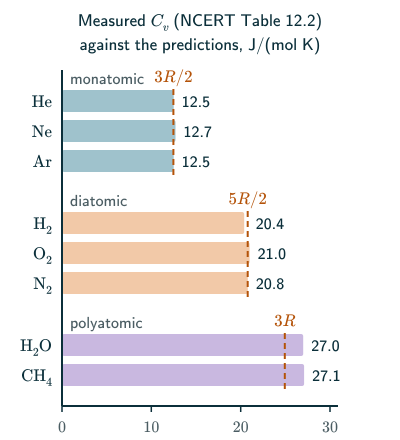
The monatomic and diatomic gases agree well with the predictions. For some other gases, such as Cl (diatomic), CH and many other polyatomic gases, the measured values are usually larger than the predictions of NCERT Table 12.1, which suggests including vibrational modes (page 254).
Specific heat capacity of solids
In the classical high-temperature harmonic model, picture a solid as N atoms, each vibrating about its mean position. A vibration in one dimension has average energy 2 × ½kBT = kBT, and in three dimensions 3kBT. For a mole of atoms, U = U + 3RT, where U is a temperature-independent offset. Thus C = 3R. NCERT additionally neglects thermal expansion to approximate C by the same value; small boundary work alone is not a general proof that C = C. In that model,
Molar specific heat of a solid (NCERT Eq. 12.37)
NCERT Table 12.3 (page 254) shows approximate agreement for several listed solids near room temperature, with carbon an exception. At low temperatures quantum effects suppress heat capacity; 3R is a classical limit, not a rule for every solid. The same result appears in the Thermodynamics chapter.
Solved examples
Take R = 8.31 J mol K.
Example 1: Helium in a cylinder (NCERT Example 12.8)
A cylinder of fixed capacity 44.8 L contains helium at standard temperature and pressure. How much heat is needed to raise its temperature by 15.0 °C?
At NCERT STP (approximately 273 K and 1 atm), one mole of ideal gas occupies about 22.4 L, so the cylinder holds 2 mol. The volume is fixed, so Cv = (3/2)R applies. A rise of 15.0 °C is a rise of 15.0 K.
Heat = 2 × 1.5R × 15.0 = 45R = 45 × 8.31, about 374 J.
Answer: about 374 J (page 254).
Example 2: Nitrogen at constant pressure
1 mol of nitrogen (a rigid diatomic gas) is heated by 10 K at constant pressure. Find the heat taken in, the work done and the rise in internal energy.
Q = CpΔT = (7/2) × 8.31 × 10, about 291 J. W = PΔV = RΔT = 8.31 × 10 = 83.1 J (1 mol of ideal gas at constant pressure). ΔU = CvΔT = (5/2) × 8.31 × 10, about 208 J.
Answer: 291 J in, 83 J of work done by the gas, 208 J into internal energy; 291 = 83 + 208, as the first law requires.
Example 3: γ of a mixture
1 mol of helium is mixed with 1 mol of oxygen (rigid). Find γ for the mixture.
Average Cv per mole: [(3/2)R + (5/2)R]/2 = 2R, about 16.6 J mol K. Then Cp = 2R + R = 3R.
Answer: γ = 3R/(2R) = 1.5. Simply averaging the two γ values, (5/3 + 7/5)/2, would give about 1.53, which is wrong.
Example 4: Specific heat of copper from 3R
Predict the specific heat of copper (molar mass 0.0635 kg mol) from the 3R rule.
s = 3R/M, where M is the molar mass: 3 × 8.31/0.0635, about 393 J kg K.
Answer: about 393 J kg K, close to the measured 386.4 in NCERT Table 12.3.
Common mistakes to avoid
Common mistake
Using the constant-pressure value when the volume is fixed
In a rigid container pressure–volume work is zero. If there is no other work such as stirring or electrical input, the heat needed is μCvΔT, where μ is the number of moles (Example 1).
Common mistake
Giving every polyatomic molecule 3 rotations
Non-linear molecules have 3 rotational degrees of freedom; linear ones, like CO, have only 2 (beyond NCERT: NCERT Table 12.1 gives 3R for triatomic gases, which holds for non-linear ones).
Common mistake
Averaging γ directly for a mixture
For a mixture, add up the heat capacities first, then take γ = Cp/Cv; do not average the γ values (Example 3).
Common mistake
Expecting the predictions to fit every gas
The rigid-molecule predictions ignore vibration. Many polyatomic gases have larger specific heats because some vibrational modes are excited.
Quick revision summary
- Compact notation: C_v = fR/2, C_p = C_v + R, γ = C_p/C_v, with f = 3 for monatomic and f = 5 for rigid diatomic gases in the stated classical regime. For a classical harmonic solid, C_v = 3R per mole of atoms.
- In the classical ideal-gas model with fixed f active quadratic terms per molecule: U = (f/2)RT per mole, Cv = (f/2)R, Cp = Cv + R.
- Monatomic: Cv = (3/2)R, Cp = (5/2)R, γ = 5/3 ≈ 1.67.
- Rigid diatomic: Cv = (5/2)R, Cp = (7/2)R, γ = 7/5 = 1.40; with vibration, (7/2)R, (9/2)R, 9/7.
- Polyatomic (non-linear, f vibrational modes): Cv = (3 + f)R, Cp = (4 + f)R.
- γ = 1 + 2/f for f energy modes: 5/3, 7/5 and 9/7 for f = 3, 5 and 7.
- Solids: C = 3R per mole of atoms in the classical harmonic limit, often approximately C when expansion corrections are small.
Formula sheet
- Cv = (f/2)R; Cp = Cv + R (f = all energy modes; U = (f/2)RT per mole)
- Cv = (3/2)R, Cp = (5/2)R, γ = 5/3 (monatomic)
- Cv = (5/2)R, Cp = (7/2)R, γ = 7/5 (rigid diatomic)
- Cv = (3 + f)R, Cp = (4 + f)R (non-linear polyatomic; here f = vibrational modes only)
- Cp − Cv = R (any ideal gas)
- γ = 1 + 2/f (f = all energy modes)
- C = 3R (classical solid, per mole of atoms, neglecting thermal expansion)
Questions students ask
How do you find the degrees of freedom of a gas from γ?
An effective quadratic-term count for an ideal gas follows from γ as f = 2/(γ − 1), found by rearranging γ = Cp/Cv = 1 + 2/f, where f counts every energy mode (squared term) of a molecule. For example, a gas with γ = 4/3 has f = 2/(1/3) = 6, consistent with a rigid non-linear molecule with 3 translations and 3 rotations, but not uniquely identifying that molecular structure. Mixtures and partly excited modes can give the same heat-capacity ratio. A value of f that is not a whole number points to partly excited vibrations or to a mixture of gases: carbon dioxide at room temperature has γ ≈ 1.29, so f ≈ 2/0.29 ≈ 6.9.
What is the specific heat capacity of helium gas?
Kinetic theory gives helium, a monatomic gas, a specific heat capacity of about 3.12 kJ kg K at constant volume and 5.20 kJ kg K at constant pressure, close to the measured values. These come from dividing the molar values (3/2)R and (5/2)R by the molar mass, 0.004 kg mol: 1.5 × 8.314/0.004 ≈ 3118 J kg K and 2.5 × 8.314/0.004 ≈ 5196 J kg K. At constant pressure that is more than water’s 4186 J kg K, not because each helium atom needs much energy but because a kilogram of helium holds 250 mol of atoms.
Can the specific heat of a gas be zero, negative or infinite?
A process heat capacity C = ΔQ/(μΔT) can be zero or negative, or undefined when ΔT = 0. It is distinct from the material heat capacities C and C. In an adiabatic process no heat flows while T changes, so C = 0; in an isothermal step with nonzero heat transfer the ratio is undefined (often described as formally infinite), not an infinite material C; and if a gas does more work than the heat it takes in, it cools while gaining heat, so C is negative. For a fixed amount of ideal gas following a quasi-static path PV = constant with constant C and only pressure–volume work (beyond NCERT), C = Cv + R/(1 − n), which is Cp for n = 0, zero for n = γ and negative for 1 < n < γ.
Practice questions
Try each question first, then open the answer to check your working.
-
Q1. Why is Cv for oxygen larger than for helium?
Show answerHide answer
An oxygen molecule can also rotate about two axes, so it has 5 degrees of freedom against helium’s 3. More modes share the energy, so more heat is needed per kelvin: (5/2)R against (3/2)R.
-
Q2. Find Cp for argon from kinetic theory.
Show answerHide answer
Argon is monatomic, so Cp = (5/2)R = 2.5 × 8.31, about 20.8 J mol K, matching NCERT Table 12.2.
-
Q3. What value of γ does kinetic theory predict for a rigid diatomic gas, and how could γ tell you whether a gas is monatomic or diatomic?
Show answerHide answer
γ = 7/5 = 1.40 for a rigid diatomic gas, against 5/3 ≈ 1.67 for a monatomic one. If these are the only two candidate ideal-gas models under the stated conditions, γ distinguishes them. In general, mixtures or thermally changing internal modes prevent unique molecular identification.