Law of equipartition of energy
NCERT Class 11 Physics Chapter 12 Section 12.5
Quick answer
Classical equipartition assigns average energy ½kB T to each independent quadratic energy term in thermal equilibrium. Translation or rotation contributes one such term per active degree of freedom; a fully excited harmonic vibration contributes two, totalling kB T. Quantum energy-level spacing can suppress these contributions at low temperatures.
With your textbook
NCERT Physics Part II (Class 11), Chapter 12 “Kinetic Theory”, Section 12.5 “Law of equipartition of energy”, pages 252–253.
Open the official NCERT chapter (PDF, 1.5 MB, ncert.nic.in) (opens in a new tab)
Checked against the 2026-27 reprint on .
What is the law of equipartition of energy?
Law of equipartition of energy
In classical thermal equilibrium at absolute temperature T, when the relevant motions are thermally active, the energy of a molecule is shared equally among all its independent modes of energy, the squared (quadratic) terms in its energy. Each such term has an average energy of ½kBT. (NCERT Section 12.5, pages 252–253.)
- each translational degree of freedom contributes ½kBT;
- each rotational degree of freedom contributes ½kBT;
- each vibrational mode contributes 2 × ½kBT = kBT, because it has both kinetic and potential energy.
Each quadratic term occurring in the expression for energy is a mode of absorption of energy by the molecule.
NCERT Physics Part II (Class 11), Section 12.5, page 253
In plain words: heat a gas and the energy you put in does not go only into making the molecules fly about faster. It is shared out: some goes into their straight-line motion, some into spinning them, and some, when vibrational levels are thermally populated, into vibration. Each independent quadratic term gets the same classical average share; a complete harmonic vibration has two such terms.
Degrees of freedom
A molecule free to move in space needs three coordinates to fix its position; one confined to a plane needs two; one confined to a line, one. We say it has three, two or one degrees of freedom for motion in space, in a plane or along a line (page 252).
Motion of a body as a whole from one point to another is called translation.
NCERT Physics Part II (Class 11), Section 12.5, page 252
Translation. A molecule free to move in space has three translational degrees of freedom. Its translational kinetic energy is ½mvx2 + ½mvy2 + ½mvz2 (NCERT Eq. 12.22). From kinetic theory, its average is (3/2)kBT (NCERT Eq. 12.23). Since no direction is special, each term separately averages ½kBT (NCERT Eq. 12.24).
Rotation. A monatomic molecule such as argon has only translation. A diatomic molecule such as O or N can also rotate about its centre of mass, about two independent axes at right angles to the line joining the atoms (NCERT Fig. 12.6, page 252). That adds two rotational degrees of freedom, each with an energy term ½Iω, the rotational kinetic energy about that axis (NCERT Eq. 12.25). Rotation about the line joining the atoms does not count: its moment of inertia is so small that, for quantum mechanical reasons, it does not come into play (NCERT footnote, page 252).
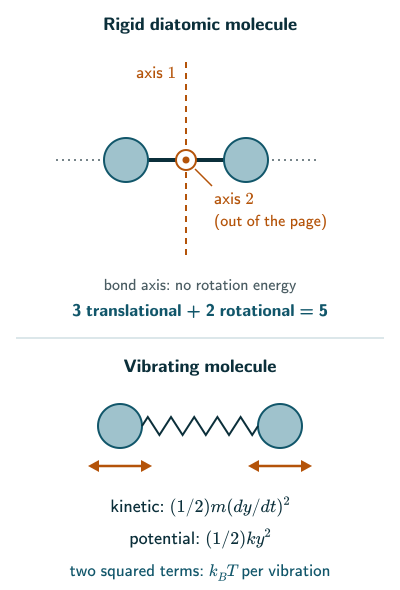
Vibration. NCERT treats O at moderate temperatures as a rigid rotator, with no vibration. It adds that this is not always valid and gives CO as a molecule that vibrates even at moderate temperatures, its atoms oscillating along the bond like a one-dimensional oscillator (page 252). That example is misleading: CO’s ideal-gas molar C near room temperature is close to the rigid value (5/2)R (C is near (7/2)R). Its vibrational thermal contribution is small, although quantum zero-point vibration remains; “frozen out” does not mean the bond is motionless. Vibration matters at high temperatures and for molecules such as Cl, whose measured specific heat is larger than the rigid prediction (NCERT page 254). Use a full k_B T per vibrational mode when the problem assumes classical, fully excited vibration. Partial excitation does not give the full classical contribution. A vibration adds the energy term
εv = ½m(dy/dt) + ½ky (NCERT Eq. 12.26),
where k is the force constant and y the vibrational coordinate. If y is the bond extension, m denotes the effective reduced mass of the two atoms. This has two squared terms, one for kinetic energy and one for potential energy, like a mass on a spring.
Energy per degree of freedom
That is, in equilibrium, the total energy is equally distributed in all possible energy modes
NCERT Physics Part II (Class 11), Section 12.5, page 253
Each independent quadratic term has classical average energy ½k_B T. A harmonic vibrational mode has two terms and therefore contributes k_B T in this limit. NCERT credits Maxwell with the first proof of this principle of classical statistical mechanics; the proof is beyond the book (page 253). So the average energy of a molecule is ½kBT times the number of squared terms:
Average energy per molecule
Here f counts each translational and rotational degree of freedom once and each vibrational mode twice (a counting beyond NCERT’s wording, but the same rule). Careful: in NCERT Section 12.6.3, f stands for the number of vibrational modes only, not this total. For a mole, multiply by N_A: U = (f/2)RT for the thermal energy in this model, choosing an energy reference that omits temperature-independent offsets. Use constant f over the temperature interval when computing ΔU from this expression.
| Molecule | Terms (trans + rot + vib) | Energy |
|---|---|---|
| Monatomic (He, Ar) | 3 + 0 + 0 = 3 | (3/2)kBT |
| Rigid diatomic (O, N) | 3 + 2 + 0 = 5 | (5/2)kBT |
| Vibrating diatomic | 3 + 2 + 2 = 7 | (7/2)kBT |
The next section of the chapter uses these values to predict the specific heats of gases.
Solved examples
Take kB = 1.38 × 10 J K and R = 8.314 J mol K.
Example 1: A helium atom
Find the average energy of a helium atom at 300 K, and its share per degree of freedom.
Helium has only 3 translational degrees of freedom: (3/2)kBT = 1.5 × 1.38 × 10 × 300, about 6.21 × 10 J.
Answer: about 6.21 × 10 J, that is 2.07 × 10 J (½kBT) for each of the three directions.
Example 2: Oxygen as a rigid rotator
Find the average energy of an O molecule at 300 K, and the internal energy of 1 mol, treating it as a rigid rotator.
f = 3 + 2 = 5. Per molecule: (5/2)kBT = 2.5 × 1.38 × 10 × 300, about 1.035 × 10 J.
Per mole: (5/2)RT = 2.5 × 8.314 × 300, about 6236 J.
Answer: about 1.04 × 10 J per molecule and 6.24 kJ per mole.
Example 3: Adding vibration
A question assumes that a diatomic molecule has one fully excited classical harmonic vibration as well as rotation. Find its average energy at 300 K on that assumption.
f = 3 + 2 + 2 = 7, so the energy per molecule is (7/2)kBT = 3.5 × 1.38 × 10 × 300, about 1.45 × 10 J.
Answer: about 1.45 × 10 J; the one vibrational mode adds a full kBT.
Example 4: How much of the energy is rotational?
For a rigid diatomic gas, what fraction of the internal energy is rotational?
Rotational: 2 × ½kBT = kBT. Total: (5/2)kBT.
Answer: kBT/((5/2)kBT) = 2/5, that is 40%.
Example 5: A mixture
1 mol of helium and 1 mol of oxygen (rigid) are mixed at 300 K. Find the internal energy of the mixture.
U = (3/2)RT + (5/2)RT = 4RT = 4 × 8.314 × 300, about 9977 J.
Answer: about 9.98 kJ.
Common mistakes to avoid
Common mistake
Counting a vibration as one term
A vibrational mode has both kinetic and potential energy, so it contributes kBT, not ½kBT. A vibrating diatomic molecule has 6 degrees of freedom (3 + 2 + 1) but 7 squared terms, so its energy is (7/2)kBT.
Common mistake
Giving a diatomic molecule three rotations
Rotation about the axis joining the two atoms does not count; a diatomic molecule has only two rotational degrees of freedom.
Common mistake
Taking the translational energy as a molecule’s total energy
(3/2)kBT is only the translational part. Molecules that rotate or vibrate have more.
Common mistake
Including vibration at all temperatures
NCERT treats O as rigid at moderate temperatures; vibration adds energy mainly at high temperatures. Include its full classical contribution only when that model is stated or justified; a real vibrational mode may be partly excited.
Quick revision summary
- Degrees of freedom: 3 translational for any molecule in space; 2 rotational for a diatomic or other linear molecule (such as CO); 3 rotational for a non-linear molecule (such as HO or NH).
- Each squared term in the energy is a mode of absorbing energy.
- Classical equipartition: each active quadratic term has an average energy of ½kBT; a vibration (kinetic + potential) has kBT.
- Energy per molecule: (3/2)kBT (monatomic), (5/2)kBT (rigid diatomic), (7/2)kBT (diatomic with vibration).
- For a mole, U = (f/2)RT.
Formula sheet
- Energy per active quadratic term = ½ kB T
- ε = (f/2) kB T per molecule; U = (f/2) RT per mole
- f = 3 (monatomic), 5 (rigid diatomic or linear), 6 (rigid non-linear), 7 (vibrating diatomic)
Questions students ask
How do you find the degrees of freedom of a molecule with N atoms?
A molecule of N ≥ 2 atoms has 3N coordinate degrees of freedom in all, since each atom needs three coordinates: 3 are translational, 2 (for a linear molecule) or 3 (for a non-linear one) are rotational, and the remaining 3N − 5 or 3N − 6 are vibrational modes. So a diatomic molecule has 3 + 2 + 1, linear CO has 3 + 2 + 4 and bent HO has 3 + 3 + 3. For equipartition, each fully excited classical vibrational mode counts twice (kinetic and potential energy); at room temperature most vibrations are only partly excited, if at all, so a rigid triatomic molecule is usually given f = 5 if it is linear and f = 6 if it is not.
Is the kinetic energy of a gas (3/2)RT or (f/2)RT per mole?
Both formulas are right, for different energies: (3/2)RT per mole, or (3/2)kBT per molecule, is only the translational kinetic energy, while (f/2)RT is the model’s thermal internal energy, including rotation and fully excited classical vibrations, up to a temperature-independent reference offset. Use the translational value for pressure, PV = (2/3)Etrans, and for the rms speed, which depend only on how fast the molecules move from place to place. Use (f/2)RT for heat and internal energy, as in ΔU = μ(f/2)RΔT when f stays constant; the two agree only for a monatomic gas, where f = 3.
Does the law of equipartition of energy hold at all temperatures?
No, the law of equipartition of energy is a result of classical physics and holds for a motion only when kBT is large compared with the steps between its quantised energy levels. At sufficiently low temperatures, rotational excitation is suppressed and the rotational contribution to heat capacity becomes small; the detailed curve depends on the molecule and its allowed quantum states. Vibrations of N and O add noticeably to Cv only above several hundred kelvin and get their full share only at a few thousand kelvin, and the same failure makes the specific heats of solids fall below 3R at low temperatures.
Why does a monatomic gas have only three degrees of freedom?
A monatomic gas such as helium or argon has only three degrees of freedom, all translational, because a single atom has no bond to vibrate and cannot take up rotational energy at ordinary temperatures. In this model an atom is treated as a point particle, with no independent molecular orientation or bond vibration. Electronic and nuclear excitations are ordinarily inaccessible on the thermal energy scale; a nucleus should not be modelled here as a tiny classical rigid rotor. So a monatomic gas has U = (3/2)RT per mole, all of it kinetic energy of translation.
Who gave the law of equipartition of energy?
NCERT credits Maxwell with the first proof of this classical principle. It states that each independent quadratic energy term has average energy ½k_B T in the classical equilibrium limit, and leaves the proof beyond the book.
Practice questions
Try each question first, then open the answer to check your working.
-
Q1. State the law of equipartition of energy.
Show answerHide answer
In the classical equilibrium limit at temperature T, the energy of a system is shared equally among all its independent energy modes (squared terms in the energy), each having an average energy ½kBT.
-
Q2. A rigid non-linear molecule, such as water treated as rigid, has 3 rotational degrees of freedom. Find its average energy at 300 K.
Show answerHide answer
f = 3 + 3 = 6, so the energy is 3kBT = 3 × 1.38 × 10 × 300, about 1.24 × 10 J.
-
Q3. Why does a vibrational mode contribute kBT rather than ½kBT?
Show answerHide answer
A vibration has two squared terms in its energy, ½m(dy/dt) for kinetic energy and ½ky for potential energy. Each gets ½kBT, giving kBT in all.