Moment of inertia
NCERT Class 11 Physics Chapter 6 Section 6.9
Quick answer
The moment of inertia of a body about an axis is I = Σmr, where r is each particle’s perpendicular distance from the axis; it plays the role of mass in rotation, and the kinetic energy of rotation is ½Iω. It depends on the mass, its spread about the axis and the axis chosen, and is written I = Mk, where k is the radius of gyration. A ring about its central axis has MR, a disc MR/2, a uniform thin rod about a perpendicular axis through its middle ML/12 and a solid sphere about a diameter 2MR/5.
With your textbook
NCERT Physics Part I (Class 11), Chapter 6 “Systems of Particles and Rotational Motion”, Section 6.9 “Moment of inertia”, pages 114–116.
Open the official NCERT chapter (PDF, 4.2 MB, ncert.nic.in) (opens in a new tab)
Checked against the 2026-27 reprint on .
What is the moment of inertia?
Moment of inertia in NCERT’s words
In rotation (about a fixed axis), the moment of inertia plays a similar role as mass does in linear motion.
NCERT Physics Part I (Class 11), Section 6.9, page 114
In plain words: mass measures how hard it is to change a body’s straight-line motion. The moment of inertia I measures how hard it is to change its rotation about an axis. It depends not only on how much mass there is, but on how far that mass is from the axis: mass far out counts much more than mass near the axis. That is why a bicycle wheel, with its mass at the rim, is harder to spin up than a solid disc of the same mass and size.
Moment of inertia of a system of particles
NCERT reaches the moment of inertia through kinetic energy. In a body rotating about a fixed axis with angular velocity ω, a particle of mass mi at perpendicular distance ri from the axis moves at vi = ωri, so its kinetic energy is ½miri2ω. Every particle has the same ω, so adding them up,
The bracket is the moment of inertia:
Moment of inertia
Kinetic energy of rotation
Compare the kinetic energy of translation, K = ½mv: ω plays the part of v, and I the part of m. The SI unit of I is kg m, and its dimensions are [M L].
Note that the parameter I is independent of the magnitude of the angular velocity. It is a characteristic of the rigid body and the axis about which it rotates.
NCERT Physics Part I (Class 11), Section 6.9, page 114
Unlike mass, the moment of inertia is not fixed for a body: change the axis and it changes (Example 1).
Thus, the moment of inertia of a rigid body depends on the mass of the body, its shape and size; distribution of mass about the axis of rotation, and the position and orientation of the axis of rotation.
NCERT Physics Part I (Class 11), Section 6.9, page 115
Two simple cases from NCERT. In a thin ring of mass M and radius R, turning about the axis through its centre perpendicular to its plane, every bit of mass is at distance R, so I = MR. For a light rod of length l with masses M/2 at its ends, turning about a perpendicular axis through its middle, each mass is at l/2, so I = 2 × (M/2)(l/2) = Ml/4.
Moments of inertia of a ring, disc, rod and sphere
For a body with mass spread continuously, the sum becomes an integral, I = ∫r dm. NCERT lists the results for common uniform bodies (its Table 6.1) and leaves the derivations for later classes.
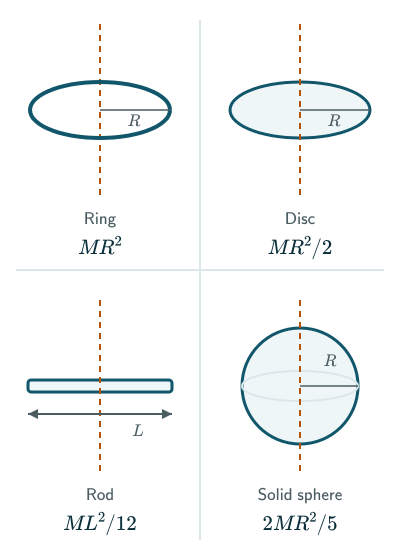
| Uniform body (mass M) | Axis | I |
|---|---|---|
| Thin ring, radius R | through centre, ⊥ to plane | MR |
| Thin ring, radius R | a diameter | MR/2 |
| Thin rod, length L | ⊥ to rod, at its middle | ML/12 |
| Disc, radius R | through centre, ⊥ to disc | MR/2 |
| Disc, radius R | a diameter | MR/4 |
| Thin-walled hollow cylinder, radius R | its axis | MR |
| Solid cylinder, radius R | its axis | MR/2 |
| Solid sphere, radius R | a diameter | 2MR/5 |
Two more results (beyond the NCERT text; neither is in its Table 6.1): a thin hollow sphere about a diameter has I = 2MR/3, and a thin rod about a perpendicular axis through one end has I = ML/3 (Q5); the parallel and perpendicular axes theorems give many more from the table.
Where two of these come from (beyond the NCERT text). For a uniform rod of length L, mass per unit length M/L, with the axis through its middle, an element of length dx at distance x has mass (M/L) dx:
For a uniform disc, split it into thin rings of radius r and width dr. Each ring has mass dm = (M/πR) × 2πr dr = (2Mr/R) dr, all at distance r from the axis:
An ideal thin-walled hollow cylinder has all its mass at R, like a ring, so its I is MR; a solid cylinder is a stack of discs, so its I is MR/2. The length of a cylinder does not enter.
Radius of gyration
Every moment of inertia in the table has the form I = Mk, where k is a length.
The radius of gyration of a body about an axis may be defined as the distance from the axis of a mass point whose mass is equal to the mass of the whole body and whose moment of inertia is equal to the moment of inertia of the body about the axis.
NCERT Physics Part I (Class 11), Section 6.9, page 115
Radius of gyration
For a rod about its middle, k = L/12, so k = L/√12; for a disc about a diameter, k = R/2; for a disc about its central axis, k = R/√2. The radius of gyration describes how the mass is spread about the axis, unchanged when all masses are scaled by the same factor while their relative distribution stays fixed. It is not the distance of the centre of mass from the axis.
Where the moment of inertia matters
- Flywheels. Engines that produce rotation carry a heavy disc with a large moment of inertia, the flywheel. It resists sudden changes of speed, smoothing out a jerky drive, as NCERT notes.
- Wheels and rotors. Light wheels with little mass at the rim speed up and slow down more easily, which is why racing cycles use light rims.
- Rotational kinetic energy. A spinning body stores ½Iω of kinetic energy; a flywheel can store energy this way and give it back.
- Spinning faster or slower. A skater or diver changes I by pulling in or stretching out the arms; why this changes the spin comes in the topic on angular momentum about a fixed axis.
Solved examples
Example 1: The same particles, two axes
Particles of 1 kg, 2 kg and 3 kg are fixed on a light rod at 0, 0.5 m and 1.0 m. Find the moment of inertia about an axis perpendicular to the rod through (a) the 1 kg particle and (b) the 2 kg particle.
(a) The distances are 0, 0.5 m and 1.0 m:
(b) The distances are 0.5 m, 0 and 0.5 m:
Answer: 3.5 kg m and 1.0 kg m. The same body has very different moments of inertia about different axes.
Example 2: A spinning cylinder
A solid cylinder of mass 20 kg and radius 0.25 m rotates about its axis at 100 rad s (data from NCERT Exercise 6.11, which also asks for the angular momentum, Iω = 62.5 kg m s). Find its moment of inertia, its kinetic energy of rotation and its radius of gyration.
The radius of gyration is k = R/√2 = 0.25/1.414, about 0.177 m.
Answer: 0.625 kg m, 3125 J (about 3.1 kJ), and about 0.177 m.
Example 3: Ring or disc?
A ring and a disc have the same mass and the same radius and spin at the same rate about their central axes. Compare their kinetic energies.
K is proportional to I. The ring has I = MR and the disc MR/2, so the ring has twice the kinetic energy.
Answer: ring : disc = 2 : 1. To reach the same rate of spin the ring needs twice the work, because all its mass is at the rim.
Common mistakes to avoid
Common mistake
Using MR for every round body
Only a thin ring about its central axis, or a thin-walled hollow cylinder about its axis, has MR. A disc or solid cylinder has MR/2 and a solid sphere 2MR/5. A hollow sphere has 2MR/3, not MR, and not the solid sphere’s 2MR/5.
Common mistake
Quoting a moment of inertia without its axis
I depends on the axis. A ring has MR about its central axis but MR/2 about a diameter.
Common mistake
Measuring r to the centre instead of to the axis
In I = Σmiri2, ri is the perpendicular distance from the axis.
Common mistake
Taking the radius of gyration as the distance of the centre of mass
For a disc about its central axis the centre of mass is on the axis, yet k = R/√2. The radius of gyration measures the spread of mass, not where its centre is.
Common mistake
Forgetting to convert ω to rad s
In K = ½Iω, ω must be in rad s; convert rpm with ω = 2πN/60, where N is in rpm.
Quick revision summary
- The moment of inertia I = Σmiri2 (in short, I = Σmr) measures rotational inertia about an axis, as mass measures inertia in translation.
- It depends on the mass, the shape and size, the spread of mass about the axis, and the position and orientation of the axis; not on ω.
- The kinetic energy of rotation is ½Iω; I is in kg m.
- Standard values: ring and disc about the central axis MR and MR/2, rod about its middle ML/12, solid sphere about a diameter 2MR/5 (and the rest of NCERT’s Table 6.1).
- The radius of gyration k is defined by I = Mk.
Formula sheet
- I = Σmr (system of particles)
- K = ½Iω (kinetic energy of rotation)
- I = Mk (radius of gyration)
- ring MR, disc MR/2 (central axis); rod ML/12 (middle); solid sphere 2MR/5 (diameter)
Questions students ask
What is the difference between inertia and moment of inertia?
Inertia, measured by mass, is a body’s resistance to a change in its linear motion, and it is the same whatever the direction of the push. Moment of inertia, I = Σmr, is its resistance to a change in rotation about a particular axis, so it depends on the mass, on how that mass is spread about the axis, and on the axis itself. Mass is in kg and is fixed for a body; I is in kg m and changes when the axis changes or the body changes shape. In the laws of rotation I takes the place of m: τ = Iα for F = ma, and ½Iω for ½mv.
What are the SI units and dimensional formulas of moment of inertia and radius of gyration?
The SI unit of moment of inertia is kg m and its dimensional formula is [M L], since it is a mass times the square of a distance. The radius of gyration is a length: its SI unit is the metre and its dimensional formula is [L]. Neither depends on how fast the body turns; both depend on the axis.
Is moment of inertia a scalar or a vector?
For rotation about a given axis, the moment of inertia is a scalar: a single non-negative number, I = Σmr, with no direction of its own, although its value depends on the axis chosen. It is not a vector: a body turning either way about the same axis has the same I. For rotations about axes in all directions through a point, the full description needs a 3 × 3 array of numbers, the inertia tensor, which is not needed for Class 11, JEE Main or NEET.
Why is it useful to define the radius of gyration?
The radius of gyration is useful because it describes, by a single length k = √(I/M), how a body’s mass is spread about an axis, whatever the total mass, so bodies of different masses and shapes can be compared directly. A thin ring about its central axis has k = R, a thin hollow sphere about a diameter k = √(2/3) R ≈ 0.82R and a solid sphere about a diameter k = √(2/5) R ≈ 0.63R. Since k = Σmr/M, k is the root-mean-square distance of the mass from the axis: the larger it is, the farther out the mass lies.
Are the moment of inertia and radius of gyration in the JEE Main and NEET syllabuses?
Yes, the moment of inertia and the radius of gyration are in Unit 5, Rotational Motion, of both the JEE Main 2027 and NEET (UG) 2026 syllabuses, which list the moment of inertia, the radius of gyration, values of moments of inertia for simple geometrical objects and the parallel and perpendicular axes theorems. NCERT Class 11 covers the first three in Section 6.9 and its Table 6.1; the two axes theorems have no section in the 2026–27 NCERT book.
Practice questions
Try each question first, then open the answer to check your working.
-
Q1. An oxygen molecule has a mass of 5.30 × 10 kg and a moment of inertia of 1.94 × 10 kg m about an axis through its centre perpendicular to the line joining the atoms. Take its root-mean-square translational speed as 500 m s, with mean rotational kinetic energy two thirds of mean translational kinetic energy. Find its root-mean-square angular speed. (Adapted from NCERT Exercise 6.17 to distinguish energy averages from arithmetic mean speeds.)
Show answerHide answer
Using v and ω for the RMS speeds, ½Iω = (2/3)(½mv), so ω = 2mv/(3I). With v = 2.5 × 10 m s, this is 2 × 5.30 × 10 × 2.5 × 10/(3 × 1.94 × 10), about 4.55 × 10 s. Thus the RMS angular speed is about 6.75 × 10 rad s. An arithmetic mean speed of 500 m s alone cannot be substituted for the RMS speed without additional information about the speed distribution.
-
Q2. Find the radius of gyration of (a) a disc about its central axis and (b) a ring about a diameter, each of radius R.
Show answerHide answer
(a) Mk = MR/2, so k = R/√2. (b) Mk = MR/2, so k = R/√2 as well.
-
Q3. A solid sphere and a thin-walled hollow cylinder have the same mass and radius; the sphere turns about a diameter and the cylinder about its own axis. Which has the larger moment of inertia, and by what factor?
Show answerHide answer
The hollow cylinder: MR against 2MR/5, a factor of 2.5. Its mass is all at distance R from its axis, while much of the sphere’s mass is near the axis.