Experiment: mass of an object with a metre scale
Beyond NCERT In the JEE Main and NEET syllabus; the Class 11 book has no section for it.
Quick answer
A metre scale balanced on a knife-edge at its own centre of gravity works as a lever. An unknown mass m at distance d on one side balances a known mass M at distance d on the other when m d = M d, so m = Md/d; g cancels, so the method compares masses directly. Distances are measured from the knife-edge, the scale must be horizontal at balance, and the masses should hang far from the knife-edge to reduce the error.
What is this experiment?
The principle behind it, in NCERT’s words
The above equation expresses the principle of moments for a lever.
NCERT Physics Part I (Class 11), Section 6.8.1, page 111
The aim is to find the mass of a small object using only a metre scale, a knife-edge and a known mass. The scale is used as a lever. When it balances on a knife-edge under its own centre of gravity, the moments of the two hanging weights about the knife-edge are equal, and since g is the same on both sides, the masses are in the inverse ratio of their distances from the knife-edge.
Both the NEET (UG) 2026 and the JEE Main 2027 syllabuses list this under Unit 20, Experimental Skills: “Metre Scale – the mass of a given object by the principle of moments”. The NCERT textbook gives the principle (Section 6.8.1; see equilibrium of a rigid body) but not the procedure, so this page describes the standard laboratory method.
Apparatus
- A metre scale, as uniform as possible, with clear centimetre and millimetre marks.
- A sharp knife-edge (a wedge) on a stand, to act as the fulcrum.
- A set of known masses, for example slotted masses on a hanger of known mass, or a weight box.
- The object of unknown mass, and fine thread to hang the masses with loops.
Theory: using the principle of moments
Balance the scale on the knife-edge at its centre of gravity G. The weight of the scale then acts at the fulcrum and has no moment about it, so it drops out.
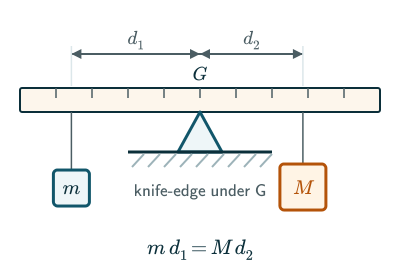
At balance the scale is at rest. As for a particle in equilibrium, the forces must balance: the knife-edge pushes up with the total weight. A body with size must also not turn, so the moments must balance too.
Hang the unknown mass m at a distance d1 on one side of G and a known mass M at a distance d2 on the other side, and move them until the scale balances horizontally. The anticlockwise and clockwise moments about the knife-edge are then equal: mg × d1 = Mg × d2. The g cancels, so
Mass by the principle of moments
Because g cancels, the experiment measures mass directly, by comparing it with a known mass; it would give the same answer on the Moon.
If the knife-edge is not at G. If the scale is supported at some other point, its own weight msg acts at G, a distance x from the knife-edge, and adds a moment msgx. Balancing at G removes this term, which is why the first step of the method is to find G. The same idea, run the other way, finds the mass of the scale itself (Q3).
Procedure
- Find the centre of gravity of the scale. Place the scale on the knife-edge and move it until it balances horizontally. Note the reading at the knife-edge: this is G. For a uniform scale it is close to the 50 cm mark, but use the measured value.
- Keep the knife-edge at G for the rest of the experiment.
- Hang the unknown mass by a thread loop at a convenient mark on one side, say 20 cm to 30 cm from G. Note the reading of the loop.
- Hang a known mass on the other side and slide its loop along the scale until the scale balances horizontally again. Note the reading.
- Work out the distances d1 and d2 from G, as differences of readings.
- Repeat with the unknown mass at two or three other positions (or with a different known mass), and calculate m each time.
- Take the mean of the values of m.
A record table looks like this. The readings below are made up to show the working; they are not measurements. Real trials give slightly different values of m, which is why step 7 takes the mean (here G is at 50.0 cm and M = 50 g):
| Trial | Marks of m, M (cm) | d1, d2 (cm) | m (g) |
|---|---|---|---|
| 1 | 25.0, 70.0 | 25.0, 20.0 | 40.0 |
| 2 | 20.0, 74.0 | 30.0, 24.0 | 40.0 |
| 3 | 30.0, 66.0 | 20.0, 16.0 | 40.0 |
Mean m = 40.0 g.
Precautions and sources of error
- The knife-edge must be sharp, and the scale must be horizontal at balance each time.
- Use fine thread and read each position at the thread, not at the edge of the loop.
- Include the hanger in the known total M. If the unknown object also uses a hanger, the calculation gives object plus hanger; subtract the hanger’s known mass to obtain the object’s mass.
- Keep the masses far from the fulcrum: a reading error of 1 mm matters less on 25 cm than on 5 cm.
- Avoid air currents (fans off), and read the scale straight on to avoid parallax.
- A real scale may not be uniform, so G need not be at 50 cm; that is why it is found first.
How big is the error? From m = Md2/d1, a first-order worst-case fractional uncertainty bound is the sum ΔM/M + Δd1/d1 + Δd2/d2. This is an approximate bound for small errors, not a standard-deviation combination rule. If each position is read to ±0.1 cm, each distance (a difference of two readings) is uncertain by up to ±0.2 cm. On about 20 cm that is 1% each, so even a perfect known mass gives m only to about 2%; Example 3 works this out in full.
A question from NCERT
NCERT Exercise 6.16 uses the same reasoning to find the mass of the scale itself:
A metre stick is balanced on a knife edge at its centre. When two coins, each of mass 5 g are put one on top of the other at the 12.0 cm mark, the stick is found to be balanced at 45.0 cm. What is the mass of the metre stick?
NCERT Physics Part I (Class 11), Chapter 6, Exercises, page 126
It is worked out as Q3 below.
Solved examples
Example 1: Finding the unknown mass
A metre scale balances on a knife-edge at the 50.0 cm mark. An object hung at the 20.0 cm mark is balanced by a 100 g mass at the 74.0 cm mark. Find the mass of the object.
The distances from the knife-edge are d1 = 50.0 − 20.0 = 30.0 cm and d2 = 74.0 − 50.0 = 24.0 cm. Then
Answer: 80.0 g. The object is lighter than the known mass, so it hangs farther from the knife-edge.
Example 2: When the knife-edge is not at the centre of gravity
A uniform metre scale of mass 60 g is supported at the 40.0 cm mark. Where must a 20 g mass hang to keep it horizontal?
The scale’s weight acts at its centre of gravity, the 50.0 cm mark, 10.0 cm on one side of the support. Its moment must be balanced by the 20 g mass on the other side, at a distance x: 60 × 10.0 = 20 × x, so x = 30.0 cm.
Answer: at the 40.0 − 30.0 = 10.0 cm mark. (The g cancels in every moment, so the masses can be used directly.)
Example 3: Estimating the error
In Example 1, each position is read to ±0.1 cm, and the 100 g mass is accurate to ±0.5 g. Estimate the uncertainty in the mass found.
Each distance is a difference of two readings, so its error is up to ±0.2 cm. Then
which is 0.0050 + 0.0067 + 0.0083 = 0.0200, that is 2.0%.
Answer: about ±1.6 g, so m = 80.0 ± 1.6 g.
Common mistakes to avoid
Common mistake
Measuring distances from the end of the scale
The distances in the principle of moments are from the knife-edge, not from the zero mark. Subtract the readings.
Common mistake
Forgetting the scale’s own weight
If the knife-edge is not at the centre of gravity, the scale’s weight has a moment too. Balance the scale at G first, or include its moment.
Common mistake
Leaving out the hanger
The known mass M includes the hanger if the slotted masses sit on one.
Common mistake
Reading the balance with the scale tilted
Keep the scale horizontal for the laboratory method. For an ideal straight zero-thickness lever with vertical loads, a common tilt factor would cancel from both moments; a real fulcrum offset and scale thickness can introduce extra moments when tilted.
Quick revision summary
- A metre scale balanced on a knife-edge is a lever; at balance, the moments about the knife-edge are equal.
- Balance the scale at its own centre of gravity first, so its weight has no moment.
- With the unknown mass m at d and a known mass M at d on the other side, m = Md/d; g cancels.
- Measure distances from the knife-edge, keep the scale horizontal, use fine thread, and repeat at several positions.
- For small bounded reading errors, add their fractional magnitudes for a first-order worst-case estimate.
Formula sheet
- m d = M d (balance about G)
- m = M d/d
- Δm/m ≈ ΔM/M + Δd/d + Δd/d (first-order worst-case bound)
Questions students ask
What type of lever is the metre scale in the principle of moments experiment?
The metre scale balanced on a knife-edge is a lever of the first class: the fulcrum, the knife-edge, lies between the two forces, the weight of the unknown mass on one side and the weight of the known mass on the other, as in a see-saw or a beam balance. At balance the moments about the knife-edge are equal, m × d1 = M × d2, so the smaller mass must hang on the longer arm.
How do you verify the principle of moments with a metre scale?
To verify the principle of moments, balance the metre scale on a knife-edge at its centre of gravity, hang known masses on both sides, slide them until the scale is horizontal again, and check that the clockwise and anticlockwise moments about the knife-edge are equal, within the reading errors. For example, 200 g hanging 15.0 cm on one side of the knife-edge balances 150 g at 20.0 cm on the other, since 200 × 15.0 = 150 × 20.0 = 3000 in g cm (the factor g is the same on both sides and cancels). With two masses on the same side, add their moments, m1d1 + m2d2, before comparing.
Why is a knife-edge used as the fulcrum in the metre scale experiment?
A knife-edge is used so that the scale rests on one sharp line, from which every distance can be measured. The upward push of the support then acts exactly along that line and has no moment about it. On a broad support the push can act anywhere under the scale, so the scale can rest level over a range of positions and the moment arms become uncertain.
Practice questions
Try each question first, then open the answer to check your working.
-
Q1. Why is the metre scale first balanced on the knife-edge without any masses?
Show answerHide answer
To find its centre of gravity G. With the knife-edge at G, the scale’s own weight passes through the fulcrum and has no moment, so only the two hanging masses appear in the balance equation.
-
Q2. A scale balances alone at the 50.0 cm mark. Keeping the knife-edge there, an object at the 15.0 cm mark balances a 50 g mass at the 85.0 cm mark. What is the object’s mass? What if the 50 g mass had to be at the 78.0 cm mark?
Show answerHide answer
In the first case both distances are 35.0 cm, so m = 50.0 g. In the second, d2 = 28.0 cm, so m = 50 × 28.0/35.0 = 40.0 g.
-
Q3. Solve NCERT Exercise 6.16: a metre stick balanced at its centre (50.0 cm) balances at 45.0 cm when two 5 g coins are placed at the 12.0 cm mark. Find the mass of the stick.
Show answerHide answer
With the knife-edge at 45.0 cm, the coins (10 g) are 33.0 cm to one side, and the stick’s weight acts at its centre of gravity, 50.0 cm, which is 5.0 cm to the other side. Moments: 10 × 33.0 = ms × 5.0, so ms = 66.0 g.