Motion of the centre of mass
NCERT Class 11 Physics Chapter 6 Section 6.3
Quick answer
In an inertial frame, the centre of mass of a fixed system of constant-mass particles moves as if the whole mass M were concentrated there and all the external forces acted on it: MA = Fext, where A is its acceleration. Internal forces cancel in pairs by Newton’s third law, so they cannot change its motion. With no external force its velocity stays constant, and the fragments of an exploding shell keep their centre of mass on the original parabola while all of them are in flight.
With your textbook
NCERT Physics Part I (Class 11), Chapter 6 “Systems of Particles and Rotational Motion”, Section 6.3 “Motion of centre of mass”, pages 99–100.
Open the official NCERT chapter (PDF, 4.2 MB, ncert.nic.in) (opens in a new tab)
Checked against the 2026-27 reprint on .
How does the centre of mass move?
The motion of the centre of mass in NCERT’s words
the centre of mass of a system of particles moves as if all the mass of the system was concentrated at the centre of mass and all the external forces were applied at that point.
NCERT Physics Part I (Class 11), Section 6.3, page 99
In plain words: however complicated the motion of the parts of a system, one special point, the centre of mass, moves in the simplest possible way. It moves like a single particle with the total mass M of the system, pushed by the total external force. A spinning, tumbling hammer thrown through the air has a messy motion, but its centre of mass follows a smooth parabola (ignoring air resistance), just as a thrown stone would.
On this page, as in NCERT, a vector is written in bold, v, and its magnitude in italics, v. Use an inertial frame and a fixed collection of particles, each of constant mass; then the total mass M = Σmi is constant.
Velocity and acceleration of the centre of mass
Start from the definition of the centre of mass of n particles, where R is the position vector of the centre of mass and ri that of the i-th particle:
Differentiate both sides with respect to time. The masses do not change, so each one comes out of its derivative, dri/dt is the velocity vi of the i-th particle, and dR/dt = V is the velocity of the centre of mass:
Velocity of the centre of mass
Differentiate once more; the derivative of each velocity is the acceleration of that particle, and dV/dt = A is the acceleration of the centre of mass:
Acceleration of the centre of mass
So the velocity of the centre of mass is the mass-weighted average of the velocities of the particles, and its acceleration is the mass-weighted average of their accelerations. For particles of equal mass these are plain averages.
The right-hand side of the velocity equation is the total momentum of the system, so P = MV; that link is taken up in the next topic of this chapter, the linear momentum of a system of particles.
External forces and the centre of mass
By Newton’s second law, miai is the net force Fi on the i-th particle, so
Each Fi is the sum of the external forces on that particle (from bodies outside the system) and the internal forces (from the other particles of the system). By Newton’s third law, the internal forces come in equal and opposite pairs: the force of particle 1 on particle 2 cancels the force of 2 on 1. So in the sum every internal force cancels, and only the external forces are left:
Motion of the centre of mass
Notice, to determine the motion of the centre of mass no knowledge of internal forces of the system of particles is required; for this purpose we need to know only the external forces.
NCERT Physics Part I (Class 11), Section 6.3, page 99
This is the justification, given here for the first time, of something done all through the earlier chapters: treating a car, a block or a ball as a single particle with all the forces acting at one point. That is exact for the centre of mass, whatever the body is doing. The system may be a rigid body that translates and rotates, or a collection of particles with all kinds of internal motion.
Three consequences follow at once:
- No external force, no change in the motion of the centre of mass. If Fext = 0, then A = 0 and V is constant. If the centre of mass starts at rest, it stays at rest, whatever the parts do.
- One direction at a time. MA = Fext holds for each component separately. If the external forces have no horizontal component (weight and the upward push of water or ice are vertical), the horizontal velocity of the centre of mass stays constant. Example 3 and Q1 use this.
- Internal forces cannot directly change the centre-of-mass velocity. Moving inside a freely rolling car can shift the car oppositely, just as a boat shifts when a person walks on it, while the combined centre of mass retains its motion if net external force is zero. A person standing on perfectly smooth ice cannot walk: walking needs an external force, the friction of the ground on the feet.
One caution: “all the external forces were applied at that point” is true for the motion of the centre of mass only. Where a force acts on the body does matter for its rotation, through torque, which comes later in this chapter.
An exploding projectile
A shell flying along a parabola explodes in mid-air. The forces of the explosion are internal, so they do not change the motion of the centre of mass. In the uniform-gravity approximation, neglecting air resistance, the total external force remains Mg before and after.
The centre of mass under the influence of the external force continues, therefore, along the same parabolic trajectory as it would have followed if there were no explosion.
NCERT Physics Part I (Class 11), Section 6.3, page 100
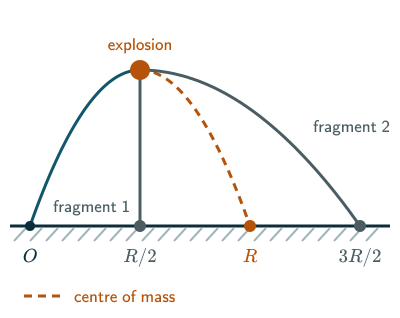
This gives a quick way to find where fragments land. It holds only while every fragment is still in flight: once one fragment hits the ground, the ground pushes on it, an extra external force, and the centre of mass leaves the parabola. In Example 2 both fragments land together, so the rule can be used right up to the landing.
Applications
- A person walking on a boat. With no horizontal external force (water resistance neglected), the centre of mass of person and boat stays where it is if initially at rest. As the person walks forward, the boat moves backward (Example 3).
- Two skaters pulling on a rope on smooth ice meet at their common centre of mass, which does not move (Q1).
- Recoil and explosions. A rifle and bullet, or a bomb and its pieces, move apart so that their centre of mass moves just as it would have without the explosion.
- Sports. A high jumper or a diver can change the shape of the body in the air but cannot change the path of the centre of mass after leaving the ground; with air resistance neglected, only gravity acts on it.
Solved examples
Example 1: Velocity of the centre of mass
A 1 kg particle moves at 2 m s along the +x axis and a 3 kg particle moves at 2 m s along the +y axis. Find the velocity of their centre of mass.
The total mass is 4 kg. Weight each velocity by its mass, component by component:
The speed is √(0.5 + 1.5) = √2.5, about 1.58 m s, and the direction makes tan(1.5/0.5), about 71.6°, with the +x axis.
Answer: about 1.58 m s at 71.6° to the +x axis, closer to the heavier particle’s direction.
Example 2: A shell that breaks in two
A shell fired on level ground would have a range of 120 m. At the highest point of its path it breaks into two equal pieces. One piece falls straight down from rest. Where does the other land? Ignore air resistance.
At the top, the shell’s velocity is horizontal. The break is so brief that gravity changes nothing during it, so momentum is conserved across it: the first piece is at rest just after, so the second moves horizontally at twice the shell’s speed. Neither has a vertical velocity, so both fall from the same height in the same time, and both are in flight until they land together. The centre of mass therefore lands where the shell would have, at 120 m.
The highest point is above the middle of the range, so the first piece lands at half the range, 60 m. With equal masses, the centre of mass is midway between the pieces:
so x = 180 m.
Answer: 180 m from the launch point.
Example 3: A man walking on a boat
A man of mass 60 kg stands at one end of a boat of mass 140 kg at rest on still water. He walks 4 m towards the other end, measured along the boat. How far does the boat move? Neglect the resistance of the water.
There is no horizontal external force, and the centre of mass starts at rest, so it stays put. Let the boat move by xb and the man by xm, both measured from the shore, with the man’s direction positive. Then
and the man’s displacement relative to the boat is 4 m:
Substituting xm = 4 + xb into the first equation gives 240 + 200xb = 0, so xb = −1.2 m and xm = 2.8 m.
Answer: the boat moves 1.2 m backward, and the man moves 2.8 m forward relative to the shore.
Common mistakes to avoid
Common mistake
Thinking internal forces can move the centre of mass
Explosions, muscles, springs and engines inside a system are internal. They can move the parts, but cannot directly change the velocity of the combined centre of mass. To change its motion, an external force is needed.
Common mistake
Using the parabola after a fragment has landed
The centre of mass of the fragments follows the original parabola only while all of them are in flight. If one lands first, the ground’s force is a new external force.
Common mistake
Using the man’s displacement relative to the boat as if it were relative to the shore
In Example 3 the 4 m is relative to the boat. The centre-of-mass equation needs displacements relative to the shore (an inertial frame), so link them with xm − xb = 4.
Common mistake
Averaging velocities without the masses
The velocity of the centre of mass is the mass-weighted average, not the plain average, unless the masses are equal.
Common mistake
Thinking the point of application of a force never matters
It does not matter for the motion of the centre of mass, but it does matter for the rotation of the body about the centre of mass.
Quick revision summary
- Differentiating MR = Σmiri gives MV = Σmivi and MA = Σmiai.
- Internal forces cancel in pairs by Newton’s third law, so MA = Fext: the centre of mass moves like a particle of mass M acted on by the total external force.
- Only external forces are needed to find the motion of the centre of mass.
- With no external force the velocity of the centre of mass is constant; if it starts at rest, it stays at rest.
- The fragments of an exploding projectile have their centre of mass on the original parabola, while all the fragments are in flight.
Formula sheet
- MV = Σmv (velocity of the centre of mass)
- MA = Σma (acceleration of the centre of mass)
- MA = Fext (motion of the centre of mass)
- Fext = 0 ⇒ V = constant
Questions students ask
How do you find the velocity of the centre of mass after a collision?
The velocity of the centre of mass is the same after a collision as before it, whether the collision is elastic or not, provided the external forces on the colliding bodies cancel or are negligible during the impact: the forces between the bodies are internal. So V = (m1u1 + m2u2)/(m1 + m2), using the velocities before the collision. For example, if a 4 kg ball moving at 3 m s hits a 2 kg ball at rest on a smooth floor, V = 12/6 = 2 m s before and after, whatever the balls do in the collision.
What is the acceleration of the centre of mass of the two blocks in an Atwood machine?
The centre of mass of the two blocks in an Atwood machine accelerates downward at A = [(m1 − m2)/(m1 + m2)]g (light string, light frictionless pulley). Taking m1 ≥ m2, each block accelerates at a = (m1 − m2)g/(m1 + m2), m1 down and m2 up, so their mass-weighted average is (m1 − m2)a/(m1 + m2). For 3 kg and 1 kg, a = g/2 and A = g/4; check: the weights, (4 kg)g, less the two string pulls 2T = (3 kg)g, leave (1 kg)g on 4 kg.
Is the motion of the centre of mass in the NEET syllabus?
Yes, the motion of the centre of mass is studied for NEET (UG) 2026 as part of Unit 5, Rotational Motion: the syllabus lists the centre of mass of a two-particle system and of a rigid body, and NCERT Class 11 teaches how the centre of mass moves in Section 6.3 of Chapter 6, Systems of Particles and Rotational Motion. JEE Main 2027 has the same wording in its Unit 5. The result to know is MA = Fext, with its uses for explosions, recoil and people walking on boats or planks.
Practice questions
Try each question first, then open the answer to check your working.
-
Q1. Two skaters of masses 40 kg and 60 kg stand 10 m apart on smooth ice and pull on a light rope between them. Where do they meet?
Show answerHide answer
The rope’s forces are internal, and the ice exerts no horizontal force, so the centre of mass stays at rest and they meet there. Measured from the 40 kg skater, it is at 60 × 10/100 = 6 m. They meet 6 m from the lighter skater’s starting point.
-
Q2. A child sits at one end of a long trolley that moves uniformly with speed V on a smooth horizontal floor. The child gets up and runs about on the trolley in any manner. What is the speed of the centre of mass of the trolley and child? (NCERT Exercise 6.3.)
Show answerHide answer
Still V. The forces between the child and the trolley are internal, and the smooth floor exerts no horizontal external force, so the velocity of the centre of mass does not change.
-
Q3. Two blocks of 1 kg and 2 kg are joined by a spring on a smooth floor. A horizontal force of 6 N acts on the 1 kg block only. Find the acceleration of the centre of mass.
Show answerHide answer
The spring force is internal. The only horizontal external force is 6 N, so A = 6/(1 + 2) = 2 m s in the direction of the force, whatever the spring is doing.