Parallel and perpendicular axes theorems
Beyond NCERT In the JEE Main and NEET syllabus; the Class 11 book has no section for it.
Quick answer
The perpendicular axes theorem says that for a flat body, Iz = Ix + Iy, where x and y lie in its plane, z is perpendicular to it and all three axes pass through one point. The parallel axes theorem says that for any body, I = Icm + Md2, where Icm is about a parallel axis through the centre of mass and d is the distance between the axes. Together they give, for example, a rod about an end ML2/3 and a disc about a diameter MR2/4.
What do the two theorems say?
The two theorems
- Perpendicular axes theorem. For a flat body (a lamina) lying in the xy-plane, the moment of inertia about the z-axis, perpendicular to the plane, equals the sum of its moments of inertia about the x- and y-axes, all three axes passing through the same point: Iz = Ix + Iy.
- Parallel axes theorem. For any body of mass M, the moment of inertia about an axis equals its moment of inertia about a parallel axis through its centre of mass plus Md, where d is the distance between the two axes: I = Icm + Md.
In plain words: once you know a body’s moment of inertia about one axis, these two theorems give it about many other axes without any new integration. The perpendicular axes theorem connects three axes through one point in the plane of a flat body; the parallel axes theorem shifts an axis sideways from the centre of mass.
Both theorems are listed in the JEE Main 2027 and NEET (UG) 2026 syllabuses (Unit 5; in the JEE Main wording, “parallel and perpendicular axes theorems and their applications”), but the 2026–27 NCERT textbook has no section on them. Its Table 6.1 gives moments of inertia about specific axes only; this page shows how to get the rest. The moment of inertia itself is I = Σmr, with r the perpendicular distance from the axis, and the kinetic energy of a body rotating with angular speed ω about a fixed axis is ½Iω.
Perpendicular axes theorem
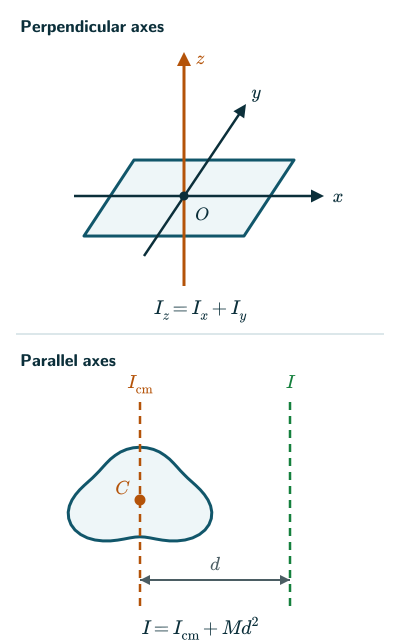
Take a flat body in the xy-plane. A particle of mass m at (x, y) is at distance √(x + y) from the z-axis, at distance |y| from the x-axis and at distance |x| from the y-axis. So
The first sum is Ix and the second is Iy:
Perpendicular axes theorem
The proof needs every particle to have z = 0, so the theorem holds only for a flat body, with the x- and y-axes in its plane and all three axes through one point. It does not apply to a sphere or a cylinder. The point need not be the centre: at a point on the rim of a ring, 2MR (perpendicular to the plane) = 3MR/2 (the tangent in the plane) + MR/2 (the diameter through that point).
Ring and disc about a diameter. A thin ring of radius R has Iz = MR about its central perpendicular axis. Any two perpendicular diameters are alike by symmetry, so Ix = Iy = MR/2. In the same way a disc, with Iz = MR/2, has MR/4 about a diameter. Both agree with NCERT’s Table 6.1.
Rectangular plate. For a uniform plate with sides a (along x) and b (along y), the axes through the centre parallel to the sides give Iy = Ma/12 and Ix = Mb/12 (cut the plate into thin strips parallel to x: each is a rod of length a turning about the y-axis through its middle, giving Iy = Ma/12; strips parallel to y give Ix = Mb/12), so about the perpendicular axis through the centre
Parallel axes theorem
Let both axes be parallel to z, the first through the centre of mass C. For each particle, let r′ be its position from C with the z-component left out, so its distance from the first axis is r′. Let d be the perpendicular vector from the first axis to the second. The particle is then |r′ − d| from the second axis, and |r′ − d| = r′ − 2d · r′ + d. Then
The first sum is Icm. The last term is Σm × d = Md, since d is the same for every particle. The middle sum is zero, because Σmr′ = 0 when positions are measured from the centre of mass. So
Parallel axes theorem
This holds for any body, flat or not, but one of the two axes must pass through the centre of mass. It also shows that, of all parallel axes, the one through the centre of mass gives the smallest moment of inertia.
Using the theorems for rods, rings and discs
Starting from NCERT’s Table 6.1, the two theorems give:
| Body (mass M) | Axis | I |
|---|---|---|
| Rod, length L | ⊥ to rod, through one end | ML/3 |
| Ring, radius R | tangent, in its plane | 3MR/2 |
| Ring, radius R | tangent, ⊥ to its plane | 2MR |
| Disc, radius R | tangent, in its plane | 5MR/4 |
| Disc, radius R | tangent, ⊥ to its plane | 3MR/2 |
| Solid sphere, radius R | tangent | 7MR/5 |
For example, a rod about one end: the end is L/2 from the centre, so I = ML/12 + M(L/2) = ML/3. A ring about a tangent in its plane: the tangent is parallel to a diameter and R from it, so I = MR/2 + MR = 3MR/2.
Solved examples
Example 1: A rod about different axes
A uniform rod of mass 0.6 kg and length 1.2 m. Find its moment of inertia about an axis perpendicular to it through (a) its centre, (b) one end and (c) a point 0.3 m from one end.
(a) Icm = ML/12 = 0.6 × 1.44/12 = 0.072 kg m.
(b) The end is 0.6 m from the centre: I = 0.072 + 0.6 × 0.6 = 0.072 + 0.216 = 0.288 kg m, which is ML/3.
(c) This point is 0.6 − 0.3 = 0.3 m from the centre: I = 0.072 + 0.6 × 0.3 = 0.072 + 0.054 = 0.126 kg m.
Answer: 0.072, 0.288 and 0.126 kg m. Notice that (b) is not (c) plus 0.6 × 0.3: the theorem works only from the axis through the centre of mass.
Example 2: A disc about a tangent
A uniform disc of mass 2 kg and radius 0.1 m. Find its moment of inertia about (a) a tangent in its plane and (b) a tangent perpendicular to its plane.
(a) About a diameter, I = MR/4 (perpendicular axes theorem). A tangent in the plane is parallel to a diameter and R away:
(b) The central perpendicular axis gives MR/2, and the tangent perpendicular to the plane is R away:
Answer: 0.025 kg m and 0.030 kg m, with MR = 0.02 kg m.
Example 3: A square plate about a diagonal
Find the moment of inertia of a uniform square plate of mass M and side a about one of its diagonals.
About the axis through the centre perpendicular to the plate, the rectangular-plate result with b = a gives Iz = M(a + a)/12 = Ma/6. The two diagonals are perpendicular axes in the plane through the centre, and by symmetry they have equal moments of inertia, so each is half of Iz.
Answer: Ma/12, the same as about a line through the centre parallel to a side. (For a square plate, every axis in its plane through its centre gives Ma/12.)
Common mistakes to avoid
Common mistake
Shifting between two axes that miss the centre of mass
I = Icm + Md needs one axis through the centre of mass. To go from an axis at distance d1 to one at d2, go through the centre: I2 = I1 − Md12 + Md22.
Common mistake
Using the perpendicular axes theorem for a solid body
It holds only for flat bodies. For a solid sphere, the three diameters each give 2MR/5, and 2MR/5 is not the sum of the other two.
Common mistake
Choosing axes that do not meet
In the perpendicular axes theorem the x-, y- and z-axes must all pass through the same point, with x and y in the plane of the body.
Common mistake
Expecting a smaller I away from the centre
The moment of inertia about the centre-of-mass axis is the least of all parallel axes; moving the axis away always adds Md.
Quick revision summary
- Perpendicular axes theorem: for a flat body, Iz = Ix + Iy, with x and y in the plane and all three axes through one point.
- Parallel axes theorem: for any body, I = Icm + Md, where one axis passes through the centre of mass and d is the distance between the parallel axes.
- The centre-of-mass axis gives the smallest moment of inertia of a family of parallel axes.
- Standard results: rod about an end ML/3; ring about a diameter MR/2; disc about a diameter MR/4; disc about a tangent in its plane 5MR/4; sphere about a tangent 7MR/5.
Formula sheet
- Iz = Ix + Iy (flat body)
- I = Icm + Md2 (any body)
- rod about an end: ML/3
- ring about a diameter: MR/2; disc about a diameter: MR/4
- disc about a tangent in its plane: 5MR/4
Questions students ask
What is the difference between the parallel and perpendicular axis theorems, and where does each apply?
The parallel axis theorem, I = Icm + Md, shifts an axis sideways: it applies to any body, flat or solid, but one of the two parallel axes must pass through the centre of mass. The perpendicular axis theorem, Iz = Ix + Iy, adds the moments of inertia about two axes instead: it applies only to a flat body (a lamina), with the x- and y-axes in its plane and all three axes through one point. Many standard results need both, one after the other.
Are the parallel and perpendicular axis theorems in the NCERT Class 11 book?
No, the 2026–27 NCERT Class 11 Physics Part I has no section on the parallel and perpendicular axes theorems; its Table 6.1 gives moments of inertia about particular axes only. Both theorems are still in Unit 5, Rotational Motion, of the JEE Main 2027 and NEET (UG) 2026 syllabuses, which list the parallel and perpendicular axes theorems and their applications, so they are needed for both exams.
What is the moment of inertia of a rectangular plate about an axis through a corner, perpendicular to the plate?
The moment of inertia of a uniform rectangular plate of mass M and sides a and b, about an axis through a corner perpendicular to the plate, is M(a + b)/3. About the parallel axis through the centre it is M(a + b)/12 (from the perpendicular axis theorem), and the corner is half a diagonal, √(a + b)/2, from the centre, so the parallel axis theorem adds M(a + b)/4. For a square plate of side a this gives 2Ma/3.
What is the moment of inertia of a thin hollow sphere about a tangent?
The moment of inertia of a thin hollow sphere of mass M and radius R about a tangent is 5MR/3. About a diameter it is 2MR/3, and a tangent is parallel to a diameter at distance R, so the parallel axis theorem gives 2MR/3 + MR = 5MR/3. For example, a hollow ball of mass 0.3 kg and radius 0.1 m has I = 5 × 0.3 × 0.1/3 = 0.005 kg m about a tangent.
Practice questions
Try each question first, then open the answer to check your working.
-
Q1. A thin ring of mass 0.5 kg and radius 0.2 m. Find its moment of inertia about (a) a diameter and (b) a tangent perpendicular to its plane.
Show answerHide answer
MR = 0.5 × 0.04 = 0.02 kg m. (a) About a diameter: MR/2 = 0.01 kg m. (b) About a tangent perpendicular to the plane: MR + MR = 2MR = 0.04 kg m.
-
Q2. A solid sphere of mass 5 kg and radius 0.1 m. Find its moment of inertia about a tangent.
Show answerHide answer
I = 2MR/5 + MR = 7MR/5 = 7 × 5 × 0.01/5 = 0.07 kg m.
-
Q3. The moment of inertia of a body about an axis through its centre of mass is 2 kg m, and its mass is 3 kg. Find its moment of inertia about a parallel axis 0.5 m from the centre of mass, and about another parallel axis 1 m from the centre of mass.
Show answerHide answer
I = 2 + 3 × 0.5 = 2.75 kg m, and I = 2 + 3 × 1 = 5 kg m. (If both axes are on the same side of C they are 0.5 m apart, but 2.75 + 3 × 0.5 = 3.5 kg m is wrong: always shift from the centre-of-mass axis.)