Linear momentum of a system of particles
NCERT Class 11 Physics Chapter 6 Section 6.4
Quick answer
The total linear momentum of a system is the vector sum of the momenta of its particles, and it equals the total mass times the velocity of the centre of mass: P = MV. For a fixed collection of constant-mass particles in an inertial frame, its rate of change equals the total external force, dP/dt = Fext, because internal forces cancel in pairs. When the external force is zero, the total momentum stays constant, component by component, and the centre of mass moves with constant velocity.
With your textbook
NCERT Physics Part I (Class 11), Chapter 6 “Systems of Particles and Rotational Motion”, Section 6.4 “Linear momentum of a system of particles”, pages 100–101.
Open the official NCERT chapter (PDF, 4.2 MB, ncert.nic.in) (opens in a new tab)
Checked against the 2026-27 reprint on .
What is the momentum of a system of particles?
Total momentum in NCERT’s words
Thus, the total momentum of a system of particles is equal to the product of the total mass of the system and the velocity of its centre of mass.
NCERT Physics Part I (Class 11), Section 6.4, page 100
In plain words: to find the momentum of a system, add the momenta of all its particles as vectors. The answer is the same as if the whole mass M were moving with the velocity V of the centre of mass. However the parts of the system move about, its total momentum is carried, in effect, by its centre of mass.
On this page, as in NCERT, a vector is written in bold, p, and its magnitude in italics, p. The classical derivation uses an inertial frame and a fixed collection of constant-mass particles. Nuclear-decay examples below use a nonrelativistic approximation to the products’ motion and approximate masses from their mass numbers.
Total momentum of a system
The momentum of a single particle of mass m moving with velocity v is p = mv. For n particles with masses m1, m2, … and velocities v1, v2, …, the total linear momentum is defined as the vector sum
that is, m1v1 + m2v2 + … + mnvn. The velocity of the centre of mass was found from MV = Σmivi, and the right-hand side is exactly this sum, so
Total momentum
Two things follow. First, a system can have zero total momentum while its parts move fast, as long as the momenta cancel: two equal balls flying apart in opposite directions at equal speeds have P = 0, and their centre of mass is at rest. Second, the velocity of the centre of mass is simply V = P/M.
Newton’s second law for a system
Differentiate P = MV with respect to time. The mass is constant, so dP/dt = MA, where A is the acceleration of the centre of mass. The previous topic, motion of the centre of mass, showed that MA equals the total external force, so
Second law for a system of particles
This is the statement of Newton’s second law of motion extended to a system of particles.
NCERT Physics Part I (Class 11), Section 6.4, page 100
It has the same form as Newton’s second law for one particle, F = dp/dt, with two differences: the momentum is the total momentum, and only the external forces count. The internal forces between the particles cancel in pairs by Newton’s third law, so they can shift momentum from one particle to another but cannot change the total.
Conservation of total momentum
If the sum of the external forces is zero, dP/dt = 0, and
Conservation of total linear momentum
Thus, when the total external force acting on a system of particles is zero, the total linear momentum of the system is constant.
NCERT Physics Part I (Class 11), Section 6.4, page 100
Because P = MV, this also means that the centre of mass moves with constant velocity, in a straight line, like a free particle, however complicated the paths of the individual particles.
The vector law is three separate laws, one for each component: Px, Py and Pz are each constant. This matters in practice. If the external force has no component along some direction, the momentum along that direction is conserved even though the total momentum is not. When a shell explodes in flight, gravity changes the vertical momentum of the pieces, but their horizontal momentum is conserved. And during a very short explosion, gravity hardly has time to act, so the whole momentum just before equals the whole momentum just after.
This is the same law as the conservation of momentum in the laws of motion; here it follows from dP/dt = Fext and is tied to the motion of the centre of mass.
The centre-of-mass frame
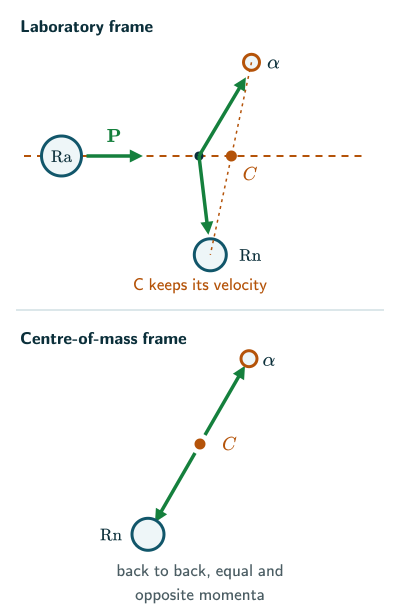
NCERT’s example is a radium nucleus that decays into a radon nucleus and an alpha particle (a helium nucleus). The forces of the decay are internal and the external forces are negligible, so the total momentum is the same before and after.
- In the laboratory frame, if the radium nucleus was moving, the radon nucleus and the alpha particle have velocities obtained by adding the centre-of-mass velocity to their opposite recoil velocities; they need not travel in different directions in the laboratory, and their centre of mass carries on along the radium nucleus’s original path, at approximately the same velocity in this classical mass-number model.
- In the centre-of-mass frame, the frame that moves with the centre of mass, the radium nucleus is at rest. The total momentum there is zero, so the two products fly apart back to back, with equal and opposite momenta.
Binary stars show the same idea. Two stars orbiting each other, with no external force, have a centre of mass that moves like a free particle; in our frame their paths look tangled. In the frame of the centre of mass, NCERT’s two stars, of equal mass, move in a circle about the centre of mass, always diametrically opposite each other.
separating the motion of different parts of a system into motion of the centre of mass and motion about the centre of mass is a very useful technique that helps in understanding the motion of the system.
NCERT Physics Part I (Class 11), Section 6.4, page 101
The same split works for energy. NCERT notes (in its Points to Ponder, page 124) that the kinetic energy of a system is the kinetic energy of motion about the centre of mass plus the kinetic energy of the centre of mass:
Kinetic energy of a system
Here K′ is the kinetic energy of motion relative to the centre of mass. So internal forces can change K′, as in an explosion that releases energy, without changing P.
Solved examples
Example 1: Total momentum and the velocity of the centre of mass
Three particles move in the xy-plane: 2 kg at 3 m s along +x, 1 kg at 4 m s along +y and 1 kg at 2 m s along −x. Find the total momentum of the system and the velocity of its centre of mass.
Add the momenta component by component:
The total momentum has magnitude 4√2, about 5.66 kg m s, at 45° to the +x axis. The total mass is 4 kg, so V = P/M has components 1 m s and 1 m s.
Answer: P is about 5.66 kg m s at 45° to +x; the centre of mass moves at √2, about 1.41 m s, in the same direction.
Example 2: A nucleus at rest decays
A radium-226 nucleus at rest decays into a radon-222 nucleus and an alpha particle (mass number 4). If the total kinetic energy released is 4.87 MeV, how is it shared?
The total momentum is zero, so the two products have equal and opposite momenta, of size p. Taking the masses in the ratio of the mass numbers, and with each kinetic energy equal to p/2m, the kinetic energies are in the inverse ratio of the masses:
So Kα/(Kα + KRn) = 222/(222 + 4): the alpha particle gets 222/226 of the total:
and the radon nucleus gets the remaining 4/226 of it, about 0.086 MeV.
Answer: about 4.78 MeV to the alpha particle and 0.086 MeV to the radon nucleus. The light particle carries almost all the energy, though the two momenta have equal size.
Example 3: An explosion in flight
A 5 kg bomb moving east at 10 m s explodes into two pieces. A 2 kg piece flies north at 15 m s. Find the velocity of the 3 kg piece, and of the centre of mass just after the explosion.
The explosion is internal and very short, so momentum is conserved. Take east as +x and north as +y. Before: Px = 5 × 10 = 50 and Py = 0, in kg m s. After, the 2 kg piece has 0 and 30. So the 3 kg piece has Px = 50 and Py = −30, and its velocity components are
Its speed is √((50/3) + 10), about 19.4 m s, at tan(10 ÷ 50/3) = tan 0.6, about 31.0°, south of east.
Answer: about 19.4 m s at 31.0° south of east. The centre of mass still moves east at 10 m s, as the total momentum is unchanged.
Common mistakes to avoid
Common mistake
Conserving momentum while an external force acts
Total momentum is constant only when the total external force is zero; it is very nearly the same just before and just after a very short event, such as an explosion, when the external force is finite (like gravity or friction). A large impulsive external force, from a floor or a fixed pivot, changes the momentum even in a very short time, and over a longer time gravity or friction does change it.
Common mistake
Conserving the whole vector when only some components are conserved
If the total external force always acts along one fixed direction, only the momentum at right angles to that direction is conserved: horizontal momentum for pieces falling under gravity, for example.
Common mistake
Thinking zero momentum means no motion
A system with P = 0 can have plenty of kinetic energy, like two pieces flying apart. Zero momentum means only that the centre of mass is at rest.
Common mistake
Expecting kinetic energy to be conserved too
With negligible external impulse, momentum is conserved in the explosions and decays discussed here, while released chemical or nuclear energy increases the products’ kinetic energy.
Common mistake
Sharing energy in the ratio of the masses
For a body at rest that splits in two, the momenta are equal in size (and opposite), so the kinetic energies are in the inverse ratio of the masses: the lighter piece gets more energy.
Quick revision summary
- The total momentum of a system is the vector sum of the momenta of its particles, and it equals the total mass times the velocity of the centre of mass: P = MV.
- Newton’s second law for a system: the rate of change of total momentum equals the total external force; internal forces cancel.
- With no external force, the total momentum is constant, each component separately, and the centre of mass moves with constant velocity.
- In the centre-of-mass frame the total momentum is zero; a body at rest that splits in two sends the pieces back to back with equal and opposite momenta.
- The kinetic energy of a system is the kinetic energy about the centre of mass plus ½MV.
Formula sheet
- P = Σmv = MV (total momentum)
- dP/dt = Fext (second law for a system)
- Fext = 0 ⇒ P = constant (Px, Py, Pz each)
- K = K′ + ½MV (kinetic energy of a system)
- K/K = m/m (two pieces from rest)
Questions students ask
How is the conservation of linear momentum derived for a system of particles?
For a system of particles, the conservation of linear momentum follows from Newton’s second and third laws together. The third law makes the internal forces cancel in pairs, so the second law for the whole system becomes dP/dt = Fext, and P is constant when Fext = 0, however many particles there are. The laws of motion chapter gives the two-body derivation; the system form extends it to any number of particles, rigid or not.
Is the momentum of each particle conserved when the total momentum of a system is conserved?
No, when the total momentum of a system is conserved, the momenta of its individual particles can still change: internal forces pass momentum from one particle to another without changing the sum. When two skaters at rest push each other apart, each gains momentum, but the two momenta are equal and opposite, so the total stays zero. In a collision on a smooth floor, one ball loses exactly the momentum that the other gains.
Is linear momentum conserved if the internal forces do not act along the line joining the particles?
Yes, the total linear momentum of a system is conserved whenever the total external force is zero, even if the internal forces do not act along the lines joining the particles. All it needs is Newton’s third law in its basic form: the two forces of each pair are equal and opposite, so they cancel in the sum. The line of action of the forces matters only for angular momentum, whose internal torques cancel when each pair also acts along the line joining the two particles (torque and angular momentum).
Practice questions
Try each question first, then open the answer to check your working.
-
Q1. Two particles of masses 2 kg and 3 kg move along the x-axis with velocities 6 m s and −4 m s. Find their total momentum and the velocity of their centre of mass.
Show answerHide answer
P = 2(6) + 3(−4) = 0. The total momentum is zero, so the centre of mass is at rest, although both particles are moving.
-
Q2. The total momentum of a system changes with time as P = (6t i + 3 j) kg m s, with t in seconds. Find the total external force on the system.
Show answerHide answer
Fext = dP/dt = 6 i N: a constant force of 6 N along +x. The y-component of momentum is constant, so there is no external force along y.
-
Q3. A shell at rest explodes into three pieces of equal mass. Two of them fly off at right angles to each other, each with speed v. Find the speed and direction of the third.
Show answerHide answer
The total momentum stays zero, so the third piece’s momentum is equal and opposite to the sum of the other two. Those two, of size mv each at right angles, add to √2 mv along the line midway between them. So the third piece moves at √2 v, about 1.41v, directly opposite that line, making 135° with each of the other two.