Torque and angular momentum
NCERT Class 11 Physics Chapter 6 Section 6.7
Quick answer
Torque is the turning effect of a force about a point, τ = r × F, of magnitude rF sin θ, where θ is the angle between r and F; this equals the force times the perpendicular distance from the point to its line of action. Angular momentum is the moment of momentum, l = r × p, of magnitude r⊥p, where r⊥ is the perpendicular distance from the point to the line of the momentum. About a fixed point in an inertial frame (or the system’s centre of mass), torque changes angular momentum, dL/dt = τext, so when the total external torque on a system is zero its angular momentum is conserved.
With your textbook
NCERT Physics Part I (Class 11), Chapter 6 “Systems of Particles and Rotational Motion”, Section 6.7 “Torque and angular momentum”, pages 105–109.
Open the official NCERT chapter (PDF, 4.2 MB, ncert.nic.in) (opens in a new tab)
Checked against the 2026-27 reprint on .
What are torque and angular momentum?
Torque in NCERT’s words
The rotational analogue of force in linear motion is moment of force. It is also referred to as torque or couple.
NCERT Physics Part I (Class 11), Section 6.7.1, page 105
In plain words: a force can turn a body as well as push it. How strongly it turns the body about a point depends not only on the size of the force but on where and in which direction it acts. That turning effect is the torque, or moment of force. In the same way, angular momentum is the rotational counterpart of linear momentum: the “moment of momentum” of a particle about a point. Torque changes angular momentum, just as force changes momentum.
(NCERT uses “couple” loosely here. In Section 6.8 it gives the strict meaning of a couple: a pair of equal and opposite forces with different lines of action.)
On this page, as in NCERT, a vector is written in bold, r or τ, and its magnitude in italics, r or τ. Both quantities are defined with the vector product.
Moment of force (torque)
Think of opening a door. A push on the hinge line does nothing. The same push at the outer edge, at right angles to the door, turns it most easily. A push along the door, towards the hinges, does nothing either.
For a force F acting on a particle at P, whose position vector from the origin O is r, the torque about O is
Torque
where θ is the angle between r and F. Grouping the factors two ways:
- τ = r⊥F, where r⊥ = r sin θ is the perpendicular distance from O to the line of action of F, often called the moment arm or lever arm;
- τ = rF⊥, where F⊥ = F sin θ is the component of the force perpendicular to r.
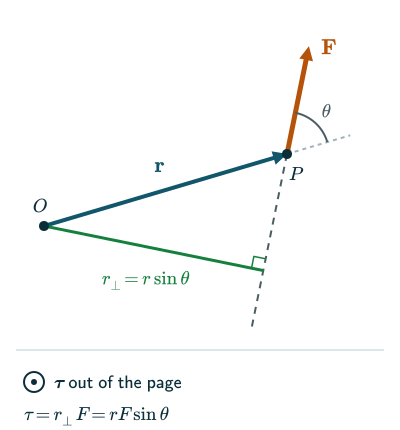
Thus, the moment of a force vanishes if either the magnitude of the force is zero, or if the line of action of the force passes through the origin.
NCERT Physics Part I (Class 11), Section 6.7.1, page 106
Direction. Torque is a vector, perpendicular to both r and F, given by the right-hand rule: curl the fingers from r to F, and the thumb points along τ. For forces in the plane of the page, τ points out of the page for an anticlockwise turning effect and into it for a clockwise one. Reversing F reverses τ; reversing both r and F leaves it unchanged.
Units. Torque has dimensions [M L T], the same as work, and its SI unit is the newton metre, N m. But it is a very different quantity: torque is a vector, work is a scalar, and torque is never written in joules.
About a point. A torque is always about some point; change the point and, in general, the torque changes, because r changes.
Angular momentum of a particle
It could also be referred to as moment of (linear) momentum.
NCERT Physics Part I (Class 11), Section 6.7.2, page 106
For a particle of mass m and linear momentum p = mv, at position r relative to the origin O, the angular momentum about O is
Angular momentum of a particle
Here r⊥ is the perpendicular distance from O to the line along which p points. So l is zero if the particle is at rest, if it is at the origin, or if it moves along a line through the origin. A particle does not have to move in a circle to have angular momentum: a particle moving in a straight line past O has angular momentum mvr⊥ about O (Example 3). Its SI unit is kg m s (the same as J s).
Torque changes angular momentum
Differentiate l = r × p with respect to time, using the product rule (keeping the order of each vector product):
The first term is v × mv, which is zero because a vector crossed with a parallel vector gives zero. In the second, dp/dt = F by Newton’s second law, and r × F is the torque. So
Torque and angular momentum
Thus, the time rate of change of the angular momentum of a particle is equal to the torque acting on it.
NCERT Physics Part I (Class 11), Section 6.7.2, page 107
This is the rotational analogue of F = dp/dt, Newton’s second law for a particle. Both l and τ must be taken about the same fixed point (in an inertial frame), because the proof used dr/dt = v.
Systems of particles and conservation of angular momentum
The total angular momentum of a system about a point is the vector sum L = Σli = Σri × pi. Adding the result above for every particle, dL/dt equals the sum of all the torques. The torques of the internal forces cancel, provided the forces between any two particles are not only equal and opposite (Newton’s third law) but also act along the line joining them: each action-reaction pair then has the same line of action and zero total torque. So only external torques remain, taken about a fixed point (or about the centre of mass):
Angular momentum of a system
This holds for any system of particles, rigid or not. It is the rotational analogue of dP/dt = Fext. (NCERT calls it the generalisation of “the single particle case of Eq. (6.23)”; the single-particle equation is in fact its Eq. (6.27), dl/dt = τ. Eq. (6.23) is the definition of torque.)
Thus, if the total external torque on a system of particles is zero, then the total angular momentum of the system is conserved, i.e. remains constant.
NCERT Physics Part I (Class 11), Section 6.7.2, page 108
Like linear momentum, this vector law is three laws, one for each component, Lx, Ly and Lz. If only one component of the external torque is zero, say τz, then Lz alone is conserved, even though L may change. Zero total external force and zero total external torque are separate conditions: a couple gives zero force but a non-zero torque.
A spinning wheel. NCERT describes an experiment with a bicycle rim hung by two strings tied to the ends of its axle. Spin the rim fast and let go of one string: instead of tipping over, the rim keeps turning in a vertical plane while that plane slowly swings round the string still held. The torque of gravity about the point where string A holds the axle is horizontal; it changes the direction of the large angular momentum rather than toppling the wheel. This turning of the axis is called precession.
Where torque and angular momentum matter
- Spanners and door handles. A longer spanner, or a handle far from the hinges, gives a larger moment arm, so a smaller force gives the same torque.
- Steering wheels and see-saws. Turning effects add and cancel through their moment arms, the idea behind the principle of moments in the next section of NCERT.
- Planets. In the ideal central-force model, neglecting other planets and treating the Sun as fixed, gravity points towards the Sun and its torque about the Sun is zero and the planet’s angular momentum about the Sun is constant. That is the reason behind Kepler’s second law, met in the chapter on gravitation.
Solved examples
Example 1: A spanner
A force of 50 N is applied to the end of a spanner, 0.25 m from the centre of a nut. Find the torque about the nut when the force is (a) at right angles to the spanner and (b) at 30° to the spanner.
(a) τ = rF sin 90° = 0.25 × 50 = 12.5 N m.
(b) τ = rF sin 30° = 12.5 × 0.5 = 6.25 N m.
Answer: 12.5 N m and 6.25 N m. Pushing at right angles to the spanner gives the largest torque.
Example 2: Torque from components
This is NCERT Example 6.5 (page 108). Find the torque about the origin of a force F = 7 + 3 − 5 acting on a particle at r = − + (forces in newtons, distances in metres).
Use the components of τ = r × F, with r = (1, −1, 1) and F = (7, 3, −5):
- x: ryFz − rzFy = (−1)(−5) − (1)(3) = 2;
- y: rzFx − rxFz = (1)(7) − (1)(−5) = 12;
- z: rxFy − ryFx = (1)(3) − (−1)(7) = 10.
Answer: τ = (2 + 12 + 10) N m.
Example 3: A particle moving in a straight line
A particle of mass 2 kg moves at a constant 3 m s along the line y = 4 m, in the +x direction. Find its angular momentum about the origin. Does it change? (NCERT Example 6.6 proves the general result.)
The line of the momentum is 4 m from the origin, so r⊥ = 4 m wherever the particle is, and
With r = x + 4 and p = 6, the z-component of r × p is x(0) − 4(6) = −24, so l = −24: into the page, a clockwise sense about the origin.
Answer: 24 kg m s, into the page, the same at every point of the path. No net force acts, so the total torque is zero, and the angular momentum is constant, as dl/dt = τ requires.
Common mistakes to avoid
Common mistake
Multiplying the force by the distance to the point of application
Use the perpendicular distance from the point to the line of action, r sin θ, or the perpendicular component of the force. Only when the force is at right angles to r is the torque simply rF.
Common mistake
Thinking a large force always gives a large torque
A force whose line of action passes through the point has zero torque about it, however large it is.
Common mistake
Quoting a torque or angular momentum without the point
Both depend on the point chosen as origin. In dl/dt = τ, take both about the same point.
Common mistake
Thinking only rotating bodies have angular momentum
A particle moving in a straight line has angular momentum mvr⊥ about any point off its line (Example 3).
Common mistake
Writing torque in joules or reversing the order
Torque is in N m, though N m and J have the same dimensions; and the order is r × F, not F × r, which would point the other way.
Quick revision summary
- Torque about a point is τ = r × F, of magnitude rF sin θ = r⊥F; it is zero if the line of action passes through the point.
- Torque is a vector, in N m, with the same dimensions as work but a different meaning.
- Angular momentum of a particle about a point is l = r × p, of magnitude r⊥p; a particle in straight-line motion has it about points off its path.
- dl/dt = τ for a particle; dL/dt = τext for a system, since internal torques cancel for internal forces along the lines joining the particles.
- If the total external torque is zero, the total angular momentum is conserved, each component separately.
Formula sheet
- τ = r × F (torque)
- τ = rF sin θ = r⊥F
- l = r × p (angular momentum)
- l = rp sin θ = r⊥p
- dl/dt = τ (particle)
- dL/dt = τext (system)
- τext = 0 ⇒ L = constant
Questions students ask
What is the difference between torque and force?
Force changes the linear motion of a body and torque changes its rotation: F = dp/dt, while the torque of that force about a point, τ = r × F, gives τ = dl/dt. Force is measured in newtons and points along the push or pull; non-zero torque is measured in N m and points in the direction of r × F, perpendicular to both vectors. It need not point along an existing rotation axis, as precession shows. A torque also depends on where the force acts, in which direction, and about which point it is taken, so the same force can give a large torque, a small one or none.
What is the difference between angular momentum and linear momentum?
Linear momentum, p = mv, measures a particle’s motion along its path; angular momentum, l = r × p, measures its turning motion about a chosen point, so it depends on that point while p does not. Their units differ, kg m s and kg m s, and different causes change them: a net force changes p, a net torque changes l. A particle moving straight towards a point has momentum but zero angular momentum about that point.
What are the SI unit and dimensional formula of angular momentum?
The SI unit of angular momentum is kg m s, which is the same as the joule second (J s), and its dimensional formula is [M L T]. It follows from l = r⊥p: a length, [L], times a momentum, [M L T]. The Planck constant h has the same dimensions, so in Bohr’s model of the atom, met in Class 11 Chemistry and again in Class 12 Physics, the electron’s angular momentum is a whole-number multiple of h/2π.
Practice questions
Try each question first, then open the answer to check your working.
-
Q1. A door 0.9 m wide is pushed at its outer edge with a force of 20 N at right angles to the door. Find the torque about the hinges. What force, at right angles, gives the same torque at 0.3 m from the hinges?
Show answerHide answer
τ = 0.9 × 20 = 18 N m. At 0.3 m the force must be 18/0.3 = 60 N, three times as large.
-
Q2. A force of 10 N acts at a point 2 m from O, and the angle between r and F is 150°. Find the magnitude of the torque about O.
Show answerHide answer
τ = rF sin 150° = 2 × 10 × 0.5 = 10 N m.
-
Q3. A particle moves in a circle of radius 0.5 m at a constant speed of 4 m s. Its mass is 0.2 kg. Find its angular momentum about the centre. What is the torque about the centre?
Show answerHide answer
The momentum is tangential, at right angles to the radius, so l = rmv = 0.5 × 0.2 × 4 = 0.4 kg m s. The force on it points to the centre, so its torque about the centre is zero, and l stays constant.