Mean free path
NCERT Class 11 Physics Chapter 12 Section 12.7
Quick answer
Mean free path is the average distance travelled between intermolecular collisions. For a dilute equilibrium gas of identical hard spheres, l = 1/(√2 nπd), where n is number density and d is collision diameter. At fixed n and d this ensemble mean is temperature-independent, while the collision rate grows with mean speed.
With your textbook
NCERT Physics Part II (Class 11), Chapter 12 “Kinetic Theory”, Section 12.7 “Mean free path”, pages 254–255.
Open the official NCERT chapter (PDF, 1.5 MB, ncert.nic.in) (opens in a new tab)
Checked against the 2026-27 reprint on .
What is the mean free path?
Mean free path
The mean free path l is the average distance a gas molecule travels between two successive collisions. For a dilute gas of identical hard spheres in classical equilibrium, with fixed collision diameter d and number density n, it is (NCERT Section 12.7, pages 254–255):
The average time between two collisions is τ = l/⟨v⟩, where ⟨v⟩ is the average speed of the molecules.
The mean free path l is the average distance covered by a molecule between two successive collisions
NCERT Physics Part II (Class 11), Chapter 12, Summary, page 256
In plain words: a gas molecule does not fly straight across the room. It keeps bumping into other molecules and changing direction, so its path is a zig-zag. The mean free path is the average length of one straight piece of that zig-zag. It is short when the gas is crowded (large n) or the molecules are big (large d).
Why gas molecules collide
Gas molecules move fast, at speeds of the order of the speed of sound. Yet gas leaking from a cylinder in a kitchen takes a long time to spread to the far corners of the room, (pages 254–255). Molecular diffusion is slowed by collisions; actual room transport also involves air currents, while visible smoke consists of suspended particles and is not simply a cloud of gas molecules.
This happens because molecules in a gas have a finite though small size, so they are bound to undergo collisions.
NCERT Physics Part II (Class 11), Section 12.7, page 255
Collisions generally deflect molecular paths. After many collisions it has wandered only a short distance from where it started, even though it has travelled a long way along its zig-zag path.
Deriving the mean free path
Treat the molecules as spheres of diameter d. Follow one molecule moving with the average speed ⟨v⟩, and for now imagine the others standing still.
- When does it hit another molecule? Two spheres of diameter d touch when their centres are a distance d apart. So our molecule hits any molecule whose centre comes within d of its own path.
- Volume swept. In a time Δt it moves a distance ⟨v⟩Δt. Any molecule whose centre lies inside a cylinder of radius d and length ⟨v⟩Δt is hit. The cylinder’s volume is πd⟨v⟩Δt.
- Number of collisions. With n molecules per unit volume, the cylinder holds nπd⟨v⟩Δt of them, so that is the number of collisions in Δt.
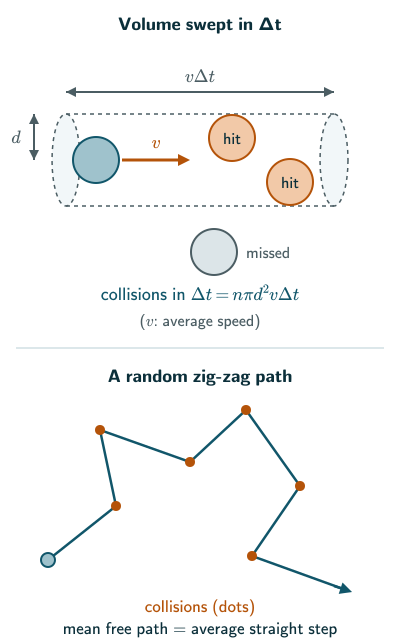
So the collision rate is nπd⟨v⟩, and the average time between collisions is (NCERT Eq. 12.38)
In that time the molecule travels ⟨v⟩τ, so the mean free path is (NCERT Eq. 12.39)
In this derivation, we imagined the other molecules to be at rest.
NCERT Physics Part II (Class 11), Section 12.7, page 255
The √2 correction. In fact all the molecules move, so the collision rate depends on the average speed of the molecules relative to each other, not on ⟨v⟩. NCERT replaces ⟨v⟩ by the average relative speed in the collision time (NCERT Eq. 12.38) and states the result of a more exact treatment:
Mean free path (NCERT Eq. 12.40)
For identical molecules with independent Maxwell–Boltzmann velocities, the √2 can be understood as follows (beyond NCERT): the relative velocity of two molecules is v1 − v2. Squaring and averaging, the cross term averages to zero because the two velocities point in unrelated directions, so the mean square relative speed is 2⟨v⟩. The typical relative speed is therefore √2 times the typical speed, and a full treatment with the spread of molecular speeds gives the same factor for average speeds. So the collision rate becomes √2 nπd⟨v⟩ and τ = 1/(√2 nπd⟨v⟩). Between collisions the molecule still moves at its own speed ⟨v⟩, so l = ⟨v⟩τ = 1/(√2 nπd). The relative speed goes into τ only.
NCERT’s estimate for air
NCERT estimates l and τ for air at STP, taking ⟨v⟩ = 485 m s and d = 2 × 10 m (page 255). The method is right, but the working has three slips:
- The number density is printed as (0.02 × 10)/(22.4 × 10). The numerator should be Avogadro’s number, 6.02 × 10. With it, n = 2.7 × 10 m, the value NCERT goes on to use.
- NCERT then gives τ = 6.1 × 10 s and l = 2.9 × 10 m ≈ 1500 d straight after presenting NCERT Eq. 12.40 as the more exact result, but these numbers come from NCERT Eqs. 12.38 and 12.39, which leave out √2. Using Eq. 12.40, l ≈ 2.1 × 10 m ≈ 1000 d and τ ≈ 4.3 × 10 s (Example 1).
- NCERT calls 485 m s the average speed, but it is the rms speed of air at 273 K, √(3RT/M0), with M0 the molar mass. The average speed is about 450 m s (beyond NCERT: √(8RT/(πM0))). This leaves l unchanged and makes τ about 4.7 × 10 s; the examples below keep NCERT’s 485 m s.
NCERT Example 12.9 makes the same √2 slip (Example 2). With the illustrative diameter chosen by NCERT, the model predicts a path about a thousand diameters long and billions of collisions per second. These are not universal measured air values: the result is sensitive to the effective collision diameter, and air is a mixture.
What the mean free path depends on
The formula l = 1/(√2 nπd) shows that the mean free path is:
- inversely proportional to the number density n: a denser gas means more molecules in the way;
- inversely proportional to d: doubling the diameter makes the target area four times larger and cuts l to a quarter;
- independent of temperature at fixed n and d for the whole equilibrium gas. This ensemble statement does not say that molecules selected for different individual speeds have identical collision statistics.
In a highly evacuated tube n is rather small and the mean free path can be as large as the length of the tube.
NCERT Physics Part II (Class 11), Section 12.7, page 255
For an ideal gas, PV = μRT (the ideal gas equation). With N = μNA molecules and kB = R/NA, this is PV = NkBT; dividing by V, P = nkBT, so n = P/(kBT). Substituting,
Keeping the collision diameter fixed, at a fixed temperature l ∝ 1/P, and at a fixed pressure l ∝ T. In a sealed rigid container n does not change, so heating the gas leaves l unchanged; it only shortens τ.
The time between collisions does depend on speed: τ = l/⟨v⟩ with ⟨v⟩ ∝ √T. In a sealed rigid container τ ∝ 1/√T; at fixed pressure τ ∝ √T. In a reversible adiabatic ideal-gas process with constant γ, TVγ−1 is constant, so τ ∝ V/√T ∝ V(γ+1)/2.
The mean free path also links the microscopic world to things we can measure. Kinetic theory relates bulk properties such as viscosity, heat conduction and diffusion to the size of the molecules, and that is how molecular sizes were first estimated (page 255).
Solved examples
Take Avogadro’s number NA = 6.02 × 10 mol and kB = 1.38 × 10 J K.
Example 1: Air at STP (NCERT’s estimate, with √2)
Using NCERT’s illustrative diameter d = 2 × 10 m and its quoted speed input 485 m s at STP (an approximate substitute for the mean speed, as discussed above), find the mean free path and the average time between collisions.
Number density: one mole occupies 22.4 × 10 m at STP, so n = 6.02 × 10/(22.4 × 10), about 2.7 × 10 m.
nπd = 2.7 × 10 × 3.1416 × (2 × 10), about 3.39 × 10 m.
l = 1/(√2 × 3.39 × 10), about 2.08 × 10 m. Then τ = l/⟨v⟩ = 2.08 × 10/485, about 4.3 × 10 s.
Answer: l ≈ 2.1 × 10 m, about 1000 molecular diameters, and τ ≈ 4.3 × 10 s. (NCERT’s 2.9 × 10 m and 6.1 × 10 s leave out √2; see above.)
Example 2: Water vapour at 373 K (NCERT Example 12.9)
Estimate the mean free path of a water molecule in water vapour at 373 K and atmospheric pressure, taking d the same as for air.
At a fixed pressure, n ∝ 1/T, so n = 2.7 × 10 × 273/373, about 2 × 10 m.
Here √2nπd = √2 × 2 × 10 × 3.1416 × 4 × 10 = 3.55 × 10 m, so l = 1/(3.55 × 10 m), about 2.8 × 10 m.
Answer: about 2.8 × 10 m. NCERT gives 4 × 10 m, which is the value without √2 (NCERT Eq. 12.39). NCERT compares its answer with the intermolecular distance in water vapour of about 40 Å (4 × 10 m) and finds it 100 times larger; with √2 the ratio is about 70. Either way, the mean free path is far larger than the spacing between molecules.
Example 3: How often does an air molecule collide?
Using Example 1, find the number of collisions an air molecule makes per second at STP.
Collision frequency = ⟨v⟩/l = 485/(2.08 × 10), about 2.3 × 10 per second. This is the same as 1/τ.
Answer: about 2.3 × 10 collisions every second.
Example 4: A highly evacuated tube
A tube is pumped down to 0.01 Pa at 300 K. Taking d = 2 × 10 m, find the mean free path.
n = P/(kBT) = 0.01/(1.38 × 10 × 300), about 2.42 × 10 m.
Here √2nπd = √2 × 2.42 × 10 × 3.1416 × 4 × 10 = 0.430 m, so l = 1/(0.430 m), about 2.33 m.
Answer: about 2.3 m, longer than most laboratory tubes. As NCERT says, in a highly evacuated tube the mean free path can be as long as the tube, so wall collisions can dominate. This intermolecular mean free path can exceed the tube size; the actual straight flight to a wall is then limited by the geometry.
Example 5: Scaling the mean free path
How does l change if (a) the pressure is halved at a fixed temperature, (b) the molecules have twice the diameter at the same n, (c) the temperature goes from 300 K to 600 K at a fixed pressure?
Use l ∝ 1/(nd) and n = P/(kBT).
(a) n halves, so l doubles. (b) d becomes four times larger, so l falls to a quarter. (c) n halves, so l doubles.
Answer: (a) ×2, (b) ×¼, (c) ×2.
Common mistakes to avoid
Common mistake
Using the radius for the collision cylinder
Two molecules collide when their centres are d apart, not d/2. The swept cylinder has radius d, so the target area is πd, not π(d/2). If a question gives the molecular radius r, put d = 2r: l = 1/(4√2 πrn).
Common mistake
Leaving out √2
l = 1/(nπd) treats the other molecules as still. For the equilibrium identical-hard-sphere model, use l = 1/(√2 nπd). NCERT’s own worked numbers on page 255 leave out √2, so check which formula a question wants.
Common mistake
Confusing the mean free path with the spacing between molecules
The average spacing is about n−1/3, roughly 3.3 × 10 m in air at STP. The mean free path is about 60 times longer, because a molecule usually passes many neighbours before it hits one.
Common mistake
Applying an ensemble formula to an individual speed class
The equilibrium mean l = 1/(√2 nπd) stays fixed when the whole gas is heated at fixed n and collision diameter d. It does not establish that an individual molecule’s path is independent of its speed relative to the surrounding gas.
Common mistake
Saying the mean free path always grows with temperature
l ∝ T only at a fixed pressure, because then n falls as the gas expands. In a sealed rigid container n is fixed, so l does not change when the gas is heated.
Quick revision summary
- The mean free path is the average distance a molecule travels between two successive collisions.
- A molecule of diameter d hits any molecule whose centre comes within d of its path, so it sweeps a cylinder of cross-section πd.
- With the other molecules at rest: τ = 1/(nπd⟨v⟩) and l = 1/(nπd). Allowing for their motion brings in √2: τ = 1/(√2 nπd⟨v⟩) and l = 1/(√2 nπd).
- At fixed hard-sphere diameter, the equilibrium mean obeys l ∝ 1/n and l ∝ 1/d, with no separate temperature dependence at fixed n. For an ideal gas, l = kBT/(√2 πdP).
- With NCERT’s illustrative hard-sphere diameter and speed input at STP, l ≈ 2 × 10 m (about 1000 d), τ ≈ 4 × 10 s, and a molecule collides about 2 × 10 times a second.
Formula sheet
- τ = 1/(nπd⟨v⟩) (other molecules at rest)
- l = ⟨v⟩τ = 1/(nπd) (other molecules at rest)
- l = 1/(√2 nπd) (all molecules moving)
- τ = 1/(√2 nπd⟨v⟩) (all molecules moving)
- l = kB T/(√2 πd2P) (ideal gas, n = P/(kB T))
- collisions per second = ⟨v⟩/l = 1/τ
Questions students ask
What is the collision frequency of a gas molecule?
The collision frequency of a gas molecule is the number of collisions it makes per second, z = ⟨v⟩/l = √2 nπd⟨v⟩, the reciprocal of the mean time between collisions τ; its SI unit is s. Unlike the mean free path, it depends on the speed: at a fixed number density it grows as √T, and at a fixed temperature it is proportional to the pressure, because n = P/(kBT). In chemistry, ‘collision frequency’ often means the total number of collisions per unit volume per second, ½nz for a single gas, so check which one a question wants.
What is the SI unit and dimensional formula of mean free path?
The mean free path is a length, so its SI unit is the metre (m) and its dimensional formula is [M L T]; this checks with l = 1/(√2 nπd), since n is in m and d in m, giving 1/(m × m) = m. Because it is so small at ordinary pressures, it is often quoted in nanometres or micrometres, or as a multiple of the molecular diameter d (the ratio l/d is a pure number).
What happens to the mean free path when a gas is compressed to half its volume?
Within the dilute hard-sphere model with unchanged collision diameter, compressing a fixed amount of gas to half its volume halves its mean free path: l = 1/(√2 nπd) depends only on the number density n = N/V and the molecular diameter d, and halving V doubles n. So an isothermal and an adiabatic compression to the same volume give the same l; as far as collisions go, they differ only in the time between them, τ = l/⟨v⟩, which is shorter after the adiabatic compression because the gas is hotter and its molecules faster.
How is the mean free path related to the viscosity of a gas?
Kinetic theory links the viscosity of a gas to its mean free path: molecules carry momentum across the flow over a distance of about l, which gives η ≈ (1/3)ρ⟨v⟩l, where ρ is the density (a result beyond NCERT). Since ρ = nm and l = 1/(√2 nπd), the product ρl does not depend on n, so dilute-gas viscosity is approximately pressure-independent in the continuum regime, where the mean free path is small compared with the flow geometry, and since ⟨v⟩ ∝ √T it rises with temperature, unlike a liquid’s viscosity, which falls. This approximation fails in strongly rarefied flow. Real collision cross-sections can also depend on temperature, so the hard-sphere √T scaling is not exact for every gas.
Practice questions
Try each question first, then open the answer to check your working.
-
Q1. Define the mean free path and write its formula, stating what each symbol means.
Show answerHide answer
The mean free path is the average distance a gas molecule travels between two successive collisions: l = 1/(√2 nπd), where n is the number of molecules per unit volume and d is the diameter of a molecule.
-
Q2. If the molecular diameter is doubled and the number density is halved, what happens to the mean free path?
Show answerHide answer
l ∝ 1/(nd). Doubling d multiplies d by 4; halving n multiplies l by 2. Overall l changes by 2/4 = ½: it halves.
-
Q3. Gas molecules move at hundreds of metres per second. Why, then, does a gas leaking in a kitchen take a long time to reach the far corners of the room?
Show answerHide answer
Each molecule collides with others after travelling only about 10 m, billions of times a second, with frequent deflections. Molecular diffusion therefore spreads gas much more slowly than individual molecular speeds suggest; room air currents can also carry gas across the room.