Viscosity
NCERT Class 11 Physics Chapter 9 Section 9.5
Quick answer
Viscosity is the internal friction of a fluid between layers that slide over one another; the coefficient of viscosity η is the shearing stress divided by the rate of strain, measured in Pa s. A rigid sphere of radius a moving at speed v through a Newtonian fluid, far from walls and at very low Reynolds number, feels drag F = 6πηav (Stokes’ law). A sphere falling through a fluid reaches a terminal velocity vt = 2a2(ρ − σ)g/(9η), where ρ and σ are the densities of the sphere and the fluid, so vt is proportional to the square of the radius.
With your textbook
NCERT Physics Part II (Class 11), Chapter 9 “Mechanical Properties of Fluids”, Section 9.5 “Viscosity”, pages 190–192.
Open the official NCERT chapter (PDF, 2.2 MB, ncert.nic.in) (opens in a new tab)
Checked against the 2026-27 reprint on .
What is viscosity?
This resistance to fluid motion is like an internal friction analogous to friction when a solid moves on a surface. It is called viscosity.
NCERT Physics Part II (Class 11), Section 9.5, page 190
Coefficient of viscosity
For a Newtonian fluid under the stated temperature and pressure, the coefficient of viscosity η (eta) is the ratio of the shearing stress to the rate of shear strain. For a layer of thickness l whose top moves at speed v relative to its bottom, with a force F on area A:
Its SI unit is the pascal second (Pa s, or N s m) and its dimensions are [MLT] (NCERT Section 9.5, page 191).
In plain words: real fluids resist being sheared. Pour honey and oil side by side and the honey flows far more sluggishly; it is more viscous. Viscosity is the fluid’s internal friction, the resistance between layers that slide past each other.
Layers in a viscous flow
Consider steady laminar flow of a Newtonian liquid between broad parallel plates, with no pressure gradient along them and negligible edge effects. Keep the lower plate fixed and slide the upper one at constant speed v. The fluid touching each plate moves with that plate, so the layer at the bottom is at rest and the layer at the top moves at v; in between, the speed rises evenly from 0 to v. Each layer is pulled forward by the faster layer above it and held back by the slower one below, like the pages of a book sliding when you push its top cover. This smooth, layered motion is laminar flow (see streamline and turbulent flow). A steady force is needed to keep the top plate moving, and replacing the oil with honey needs a larger force for the same speed (NCERT, pages 190–191).
For fully developed, steady laminar flow in a straight circular pipe with stationary walls, the speed is zero at the wall and greatest on the axis; it is uniform on each coaxial cylindrical surface.
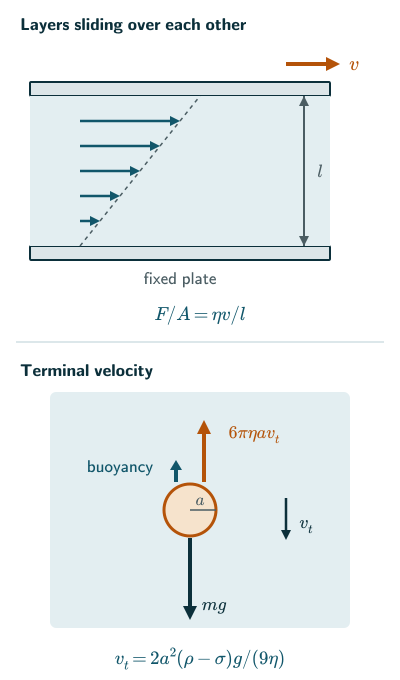
Why the definition uses the rate of strain. For a solid, stress depends on how far it has been sheared. In a flowing fluid the shear keeps growing with time: in a time Δt the top of the layer moves Δx = vΔt, and the shear strain Δx/l rises steadily. Experiment shows that the stress depends on the rate of strain, v/l, and η is the ratio of the two. If the speed does not rise evenly across the gap, v/l is replaced by the velocity gradient dv/dy at that layer: F = ηA dv/dy.
Values of viscosity
Some values from NCERT Table 9.2 (page 192), in mPa s (10 Pa s): water 1.0 at 20 °C and 0.3 at 100 °C; blood 2.7 at 37 °C; machine oil 113 at 16 °C and 34 at 38 °C; glycerine 830 at 20 °C; honey 200; air 0.017 at 0 °C and 0.019 at 40 °C. Thin liquids such as water and alcohol are less viscous than thick ones such as glycerine, blood and coal tar. NCERT’s glycerine value should not be treated as a precise value for pure glycerol at 20 °C: published measurements near that temperature are around 1.4–1.5 Pa s. Viscosity depends strongly on temperature and water content. Exercises here that specify 0.83 Pa s use that given value.
The viscosity of liquids decreases with temperature, while it increases in the case of gases.
NCERT Physics Part II (Class 11), Section 9.5, page 191
That is why engine oil thins out as the engine warms up. NCERT also describes blood as more viscous than water. Its constant-relative-viscosity statement on page 191 is a simplification: blood is non-Newtonian, so an apparent viscosity also depends on shear rate and composition.
A note on the unit. NCERT calls the SI unit of viscosity the poiseuille (Pl), and misspells it “poiseiulle” (page 191). The name poiseuille is not part of the official SI; the unit is simply the pascal second, 1 Pl = 1 Pa s. The CGS unit is the poise (P): 1 Pa s = 10 P, so water’s 1.0 mPa s is 1 centipoise. A value of η in poise is divided by 10 to give it in Pa s.
Stokes’ law
A body moving through a fluid drags along the layer in contact with it, the layers shear past one another, and the body feels a retarding force. A falling raindrop and a swinging pendulum bob are examples.
It is seen that the viscous force is proportional to the velocity of the object and is opposite to the direction of motion.
NCERT Physics Part II (Class 11), Section 9.5.1, page 192
For a sphere of radius a moving at speed v through a fluid of viscosity η, George Stokes (1819–1903) gave the drag force as
Stokes’ law
NCERT does not derive it. Beyond the NCERT text: Stokes’ law assumes a rigid sphere with no slip, a Newtonian fluid far from walls, and a very small sphere Reynolds number, Re = 2aσv/η ≪ 1, where σ is the fluid density. Smooth flow alone is not enough: fluid inertia can change the drag before turbulence begins.
Terminal velocity
Drop a small sphere into a fluid. At first it speeds up under gravity, but the viscous drag grows with its speed. When the drag plus the upthrust (buoyant force) balances the weight, the net force is zero and the sphere falls at a steady terminal velocity vt. With ρ the density of the sphere and σ that of the fluid, the weight is (4/3)πaρg and the upthrust (the weight of fluid displaced) is (4/3)πaσg, so
Dividing by 6πηa:
Terminal velocity
(NCERT Section 9.5.1, page 192, Eq. 9.18.) The terminal velocity grows as the square of the radius and is inversely proportional to the viscosity. Large raindrops fall much faster than tiny cloud droplets, which seem to float. (The a rule holds only in the Stokes regime; check Reynolds number rather than using a universal drop-size cutoff.) Measuring vt for a ball of known radius and density gives η; this is the falling-ball experiment. NCERT refers back to “Example 6.2”, its number in older editions; in the current Part I it is NCERT Example 5.2 (page 73), a raindrop whose resistive force is proportional to its speed, as in Stokes’ law (see the work-energy theorem).
At the terminal velocity the drag does work at a rate Fvt = 6πηavt2, which appears as heat in the fluid; since vt ∝ a, this rate is proportional to a.
If ρ < σ, the formula gives a negative vt. With downward positive, a lighter rigid sphere rises. A bubble also rises when buoyancy exceeds its weight, but a clean mobile bubble surface has a different drag from a rigid sphere, so the same numerical formula cannot automatically be used for it.
Solved examples
Take g = 9.8 m s.
Example 1: A block sliding on a liquid film
This is NCERT Example 9.8 (pages 191–192). A metal block of area 0.10 m is tied by a string over a light, frictionless pulley to a hanging 0.010 kg mass. A liquid film 0.30 mm thick lies between the block and the table. Released, the block moves at a steady 0.085 m s. Find the coefficient of viscosity of the liquid.
The steady speed means the viscous force equals the tension, which equals the weight of the hanging mass: F = 0.010 × 9.8 = 9.8 × 10 N.
Shear stress = F/A = 9.8 × 10/0.10 = 0.98 N m. Rate of strain = v/l = 0.085/(0.30 × 10), about 283 s.
η = 0.98/283, about 3.46 × 10 Pa s.
Answer: about 3.46 × 10 Pa s, a few times the viscosity of water.
Example 2: Viscosity from a falling ball
This is NCERT Example 9.9 (page 192). A copper ball of radius 2.0 mm falls through oil at 20 °C with a terminal velocity of 6.5 cm s. The densities of copper and oil are 8.9 × 10 and 1.5 × 10 kg m. Find the viscosity of the oil.
From vt = 2a(ρ − σ)g/(9η):
With a = 2.0 × 10 m, ρ − σ = 7.4 × 10 kg m and vt = 6.5 × 10 m s, η = 2 × (2.0 × 10) × 7.4 × 10 × 9.8/(9 × 6.5 × 10), about 0.99 Pa s.
Answer: about 9.9 × 10 kg m s (Pa s).
Example 3: A fog droplet
How fast does a water droplet of radius 0.020 mm fall through air? Take the viscosity of air as 1.8 × 10 Pa s (NCERT Table 9.2 gives 0.017 to 0.019 mPa s), and the densities of water and air as 1000 and 1.2 kg m.
vt = 2 × (2.0 × 10) × (1000 − 1.2) × 9.8/(9 × 1.8 × 10), about 0.048 m s.
Answer: about 4.8 cm s, which is why fog and cloud droplets seem to hang in the air. The sphere Reynolds number is about 0.13, so Stokes’ law gives a useful approximate estimate, with some finite-inertia correction. (The air’s buoyancy changes the answer by only about 0.1%.)
Example 4: When drops merge
Eight identical tiny droplets, each falling at a terminal velocity v, merge into one drop (assume Stokes’ law holds for the merged drop too). What is the terminal velocity of the big drop?
The volume becomes 8 times larger, so the radius doubles (81/3 = 2). Since vt ∝ a, the terminal velocity becomes 2 = 4 times larger.
Answer: 4v.
Common mistakes to avoid
Common mistake
Thinking viscosity always falls with temperature
For ordinary liquids it generally falls as temperature rises; for dilute gases it generally rises. These are trends over ordinary conditions, not universal rules for every complex fluid or phase change.
Common mistake
Using the diameter in Stokes’ law
In F = 6πηav and vt = 2a(ρ − σ)g/(9η), a is the radius.
Common mistake
Forgetting the buoyant force
The driving force at terminal velocity is the weight minus the upthrust, hence (ρ − σ). Ignoring σ is only safe when the fluid is much less dense than the body, as for drops in air.
Common mistake
Thinking terminal velocity is proportional to the radius
For the same densities and viscosity within the Stokes regime, terminal speed is proportional to the square of the radius. Doubling the radius gives four times the speed only if both sizes still satisfy that regime.
Quick revision summary
- Viscosity is a fluid’s internal friction between layers in relative motion.
- Coefficient of viscosity: η = (F/A)/(v/l); unit Pa s; dimensions [MLT].
- In fully developed laminar flow in a straight circular pipe, the speed is greatest on the axis and zero at a stationary wall.
- Viscosity of liquids falls with temperature; that of gases rises.
- Stokes’ law: F = 6πηav for a small sphere moving slowly.
- Terminal velocity vt = 2a(ρ − σ)g/(9η), proportional to a.
- In short: F = 6πηav, and vt ∝ a.
Formula sheet
- η = (F/A)/(v/l) = Fl/(vA) (unit Pa s)
- F = 6πηav (Stokes’ law)
- vt = 2a2(ρ − σ)g/(9η) (terminal velocity)
Questions students ask
Why does the viscosity of a liquid fall with temperature, while that of a gas rises?
The viscosity of a liquid falls on heating because it comes mainly from the attraction between molecules of neighbouring layers, and hotter, faster-moving molecules break away from their neighbours more easily, so the layers slide more freely. The viscosity of a gas rises on heating because its molecules are far apart and hardly attract one another: its viscosity comes from molecules carrying momentum from one layer to another, and hotter molecules move faster and cross between layers more often, as kinetic theory shows. That is why warm honey pours far more easily than cold honey, while hot air is slightly more viscous than cold air.
What is the difference between viscosity and friction?
Viscosity and friction both oppose relative motion and turn mechanical energy into heat, but viscosity acts between layers inside a fluid, while friction acts where the surfaces of two solids touch. Kinetic friction between solids hardly depends on the speed or on the area of contact, f = μkN (the laws of friction), whereas the viscous force grows with the velocity gradient and with the area, F = ηA dv/dy. A liquid such as water or oil also has nothing like limiting static friction: it starts to flow under any shearing force, however small.
What is the difference between viscosity and density?
Viscosity and density are different properties: density is the mass per unit volume, in kg m, while viscosity measures how strongly a fluid resists flowing, as the ratio of shearing stress to rate of strain, in Pa s. A denser fluid is not necessarily more viscous: machine oil floats on water because it is less dense, yet it is about a hundred times more viscous (NCERT gives 113 mPa s at 16 °C), and mercury, 13.6 times as dense as water, has a viscosity of only about 1.5 mPa s. In the terminal-velocity formula the two play different parts: the densities set the weight and the upthrust, and the viscosity sets the drag.
What is the difference between critical velocity and terminal velocity?
Terminal and critical velocities are different speeds: the terminal velocity is the constant speed a body reaches when falling through a fluid, once drag and upthrust balance its weight, while the critical velocity is the speed of a fluid above which its streamline flow turns turbulent. Terminal velocity belongs to the moving body, vt = 2a(ρ − σ)g/(9η) for a small sphere, while critical velocity belongs to the flow, about 2000η/(σd) for a fluid of density σ in a pipe of diameter d. A more viscous fluid lowers the terminal velocity but raises the critical velocity.
Why does terminal velocity increase with mass?
For bodies of the same size and shape, a heavier body has a larger terminal velocity because it must fall faster before the drag, which grows with speed, can balance its larger weight. For small spheres obeying Stokes’ law, vt = 2a(ρ − σ)g/(9η): at a fixed radius it rises with the density of the sphere, and for spheres of one material, whose mass grows as a, it grows as a, that is, as m2/3. A steel ball (7.8 × 10 kg m), for example, falls through glycerine (1.26 × 10 kg m) about 6.54/1.44 ≈ 4.5 times as fast as an aluminium ball (2.7 × 10 kg m) of the same radius.
Is Stokes’ law in the JEE Main and NEET syllabus?
Stokes’ law is in both the JEE Main 2027 and the NEET (UG) 2026 syllabus: Unit 7, Properties of Solids and Liquids, lists viscosity, Stokes’ law and terminal velocity for both exams, and Unit 20, Experimental Skills, lists the falling-ball experiment for finding a viscosity from a terminal velocity. NCERT states the law, F = 6πηav, without deriving it: the form F ∝ ηav follows from dimensional analysis, while the factor 6π needs a full calculation beyond the syllabus.
Practice questions
Try each question first, then open the answer to check your working.
-
Q1. Show that the dimensions of the coefficient of viscosity are [MLT].
Show answerHide answer
η = (F/A)/(v/l). F/A has dimensions [MLT] and v/l has [T], so η has [MLT]/[T] = [MLT].
-
Q2. Two identical tiny droplets falling at terminal velocity v merge (assume Stokes’ law still holds). What is the terminal velocity of the combined drop?
Show answerHide answer
The volume doubles, so the radius becomes 21/3 ≈ 1.26 times larger, and vt ∝ a becomes 22/3 ≈ 1.59 times larger: about 1.59v.
-
Q3. Find the viscous drag on a ball of radius 1.0 mm moving at 2.0 cm s through glycerine, of viscosity 0.83 Pa s.
Show answerHide answer
F = 6πηav = 6π × 0.83 × 1.0 × 10 × 2.0 × 10, about 3.1 × 10 N.