Bernoulli’s principle
NCERT Class 11 Physics Chapter 9 Section 9.4
Quick answer
Bernoulli’s principle states that, for the steady flow of an incompressible, non-viscous fluid, P + ½ρv + ρgh is the same at every point along a streamline, where P is the pressure, v the speed, h the height and ρ the density: it is energy conservation for a moving fluid. So at one height, faster flow means lower pressure. For a wide open tank with a small hole and negligible losses, it gives Torricelli’s law: v = √(2gh), where h is the hole’s depth below the surface.
With your textbook
NCERT Physics Part II (Class 11), Chapter 9 “Mechanical Properties of Fluids”, Section 9.4 “Bernoulli’s principle”, pages 187–190.
Open the official NCERT chapter (PDF, 2.2 MB, ncert.nic.in) (opens in a new tab)
Checked against the 2026-27 reprint on .
What is Bernoulli’s principle?
Bernoulli’s equation
For the steady flow of an incompressible, non-viscous fluid, along a streamline,
where P is the pressure, v the speed, h the height and ρ the density (NCERT Section 9.4, page 188, Eq. 9.13). Between two points 1 and 2:
In plain words: as a fluid flows along, the pressure, the kinetic energy per unit volume (½ρv) and the potential energy per unit volume (ρgh) add up to the same total. So where the fluid speeds up, at the same height, its pressure must drop; where it rises, its pressure or speed must fall. Bernoulli’s equation is energy conservation written for a moving fluid. Daniel Bernoulli, a Swiss physicist, developed it in 1738.
Deriving Bernoulli’s equation
Consider an incompressible fluid flowing steadily through a pipe whose cross-section and height change (see the figure). In a short time Δt, the fluid at section 1 (area A1, pressure P1, speed v1, height h1) moves forward by v1Δt, and the fluid at section 2 by v2Δt. By the equation of continuity the same volume ΔV = A1v1Δt = A2v2Δt passes both sections.
- The fluid behind pushes on section 1 and does work P1ΔV; the fluid ahead pushes back on section 2, doing work −P2ΔV. The work done by the pressure forces is (P1 − P2)ΔV.
- In effect, a mass ρΔV has moved from section 1 to section 2. Gravity does work −ρgΔV(h2 − h1) on it, and its kinetic energy changes by ½ρΔV(v22 − v12).
By the work-energy theorem, the total work equals the change in kinetic energy: (P1 − P2)ΔV − ρgΔV(h2 − h1) = ½ρΔV(v22 − v12). Dividing by ΔV:
which rearranges to Bernoulli’s equation (NCERT Section 9.4, page 188). (NCERT refers to the work-energy theorem of “Chapter 6”; in the current book it is in Chapter 5, Work, Energy and Power.)
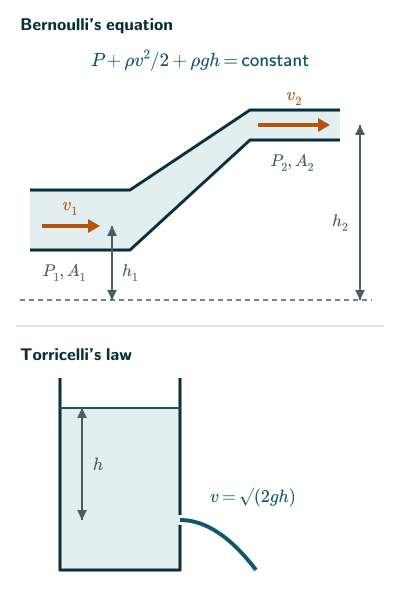
When it applies. The derivation assumes that no energy is lost to friction, so it holds strictly only for non-viscous fluids (see viscosity); it also assumes the fluid is incompressible and the flow steady. It does not hold for turbulent flow, where the velocity and pressure fluctuate all the time (NCERT, page 188). It is useful where viscous losses are small, with no pump or turbine adding or removing mechanical energy. Low viscosity or low gas speed alone does not guarantee this: losses can still matter greatly in a long narrow pipe.
A fluid at rest. With v = 0 everywhere, Bernoulli’s equation becomes P1 − P2 = ρg(h2 − h1), the familiar increase of pressure with depth.
Speed of efflux: Torricelli’s law
Torricelli discovered that the speed of efflux from an open tank is given by a formula identical to that of a freely falling body.
NCERT Physics Part II (Class 11), Section 9.4.1, page 188
A tank holds a liquid of density ρ; the air above it is at pressure P, and there is a small hole a depth h below the surface. If the tank is much wider than the hole, the liquid at the top is almost at rest. At the hole the pressure is atmospheric, Pa. Applying Bernoulli’s equation between the hole (taken as zero height, speed v) and the surface (height h, speed zero) gives Pa + ½ρv = P + ρgh, so the speed of the escaping liquid is
Speed of efflux
(NCERT Section 9.4.1, page 189, Eq. 9.14.) If the tank is open to the air, P = Pa and
Torricelli’s law
This is the speed a body gains by falling freely through h. If instead the pressure P in a closed tank is so large that 2gh can be ignored, the speed is set by the pressure; this illustrates pressure-driven efflux. NCERT mentions rocket propulsion here, but hot rocket exhaust is compressible and requires a different nozzle-flow treatment.
Dynamic lift
Dynamic lift is the force that acts on a body, such as airplane wing, a hydrofoil or a spinning ball, by virtue of its motion through a fluid.
NCERT Physics Part II (Class 11), Section 9.4.2, page 189
- A ball without spin in the ideal symmetric model. The streamlines are symmetrical above and below it, so the air speed, and hence the pressure, is the same on both sides: no sideways force.
- A spinning ball: the Magnus effect. A spinning ball drags air round with it. On one side the dragged air adds to the air rushing past, on the other it opposes it. The faster side has lower pressure, so the ball is pushed towards that side. This partly explains why a spinning cricket, tennis or golf ball swerves from its parabolic path.
- An aerofoil. A wing is shaped and tilted so that the streamlines crowd together above it more than below it. The air flows faster over the top, the pressure there is lower, and the pressure difference gives upward lift. In steady level flight, the total upward lift balances the plane’s weight. (Beyond the NCERT text: the wing also deflects air downwards, and the reaction to this push is another way of describing the same lift.)
Other applications (beyond the NCERT text). A strong wind over a roof lowers the pressure above it, and the still air inside can lift the roof off. A sprayer or atomiser blows air fast across the top of a tube dipping into a liquid; the low pressure there draws the liquid up. A venturi meter measures the flow speed in a pipe from the pressure drop at a narrow throat. For a horizontal pipe of area A1 (speed v1) with a throat of area A2, continuity gives v2 = (A1/A2)v1, and Bernoulli gives ΔP = P1 − P2 = ½ρv12[(A1/A2) − 1], so
Solved examples
Take g = 9.8 m s and the density of water as 1000 kg m. The pipe and tank examples use steady or slowly changing ideal flow, negligible losses, and wide tanks with small horizontal outlets; jet contraction and air resistance are neglected.
Example 1: Pressure in a narrowing pipe
Water flows at 2.0 m/s through a horizontal pipe where the pressure is 1.5 × 10 Pa. The pipe narrows to half the cross-section. Find the speed and the pressure in the narrow part.
By continuity, v2 = 2 × 2.0 = 4.0 m/s. The pipe is horizontal, so
since ½ × 1000 × (16 − 4) = 6000 Pa.
Answer: 4.0 m/s and 1.44 × 10 Pa: faster flow, lower pressure.
Example 2: Water from a hole in a tank
An open tank has a small hole of area 1.0 cm, 5.0 m below the water surface and 1.0 m above the ground. Find the speed of efflux, the flow rate, and how far from the tank the jet lands.
v = √(2gh) = √(2 × 9.8 × 5.0), about 9.9 m/s. Flow rate = Av = 1.0 × 10 × 9.9, about 9.9 × 10 m s, about 0.99 L/s.
The jet leaves horizontally and falls 1.0 m in a time √(2 × 1.0/9.8), about 0.45 s, so it lands 9.9 × 0.45, about 4.5 m away.
Answer: about 9.9 m/s; about 0.99 L/s (9.9 × 10 m s); about 4.5 m from the tank.
Example 3: Lift on an aircraft wing
This is NCERT Example 9.7 (page 190). A fully loaded Boeing aircraft has a mass of 3.3 × 10 kg and a total wing area of 500 m. In level flight at 960 km/h, estimate (a) the pressure difference between the lower and upper surfaces of the wings and (b) the fractional increase in the air speed over the upper surface. Take the density of air as 1.2 kg m.
(a) The lift balances the weight: ΔP × 500 = 3.3 × 10 × 9.8, so ΔP is about 6.5 × 10 N m.
(b) Let v2 be the air speed over the upper surface and v1 the speed under the lower surface. Ignoring the small height difference, ΔP = ½ρ(v22 − v12) = ρvav(v2 − v1), where vav = (v1 + v2)/2 = 960 km/h, about 267 m/s. So (v2 − v1)/vav = ΔP/(ρvav2) = 6.5 × 10/(1.2 × 267), about 0.08.
Answer: about 6.5 × 10 Pa; the speed difference divided by the assumed mean speed is about 0.076, rounded to 8%. Relative to the lower speed it is about 0.079, also 8% to this precision. NCERT’s estimate treats the pressure difference as an area average and the flight speed as the mean of the two surface speeds. At 267 m/s, air compressibility is significant, so this is a textbook estimate, not a reliable aircraft-design calculation.
Example 4: A pressurised tank
A closed tank holds water with air above it at a gauge pressure of 2.0 × 10 Pa. Water escapes through a small hole 1.0 m below the water surface. Find the speed of efflux.
v = √(2gh + 2(P − Pa)/ρ). Here 2gh = 2 × 9.8 × 1.0 = 19.6 and 2(P − Pa)/ρ = 2 × 2.0 × 10/1000 = 400, both in m s, so v = √(19.6 + 400), about 20.5 m/s.
Answer: about 20.5 m/s; here the air pressure, not the depth, does most of the work.
Example 5: A venturi meter (beyond NCERT)
Water flows through a horizontal pipe whose throat has a quarter of the pipe’s cross-section. The pressure in the throat is 1.5 × 10 Pa lower than in the pipe. Find the speed in the pipe and in the throat.
With A1/A2 = 4, (A1/A2) − 1 = 15, so v12 = 2 × 1.5 × 10/(1000 × 15) = 2 and v1 = √2, about 1.41 m/s. The throat speed is 4v1, about 5.66 m/s.
Answer: about 1.4 m/s in the pipe and 5.7 m/s in the throat.
Common mistakes to avoid
Common mistake
Thinking faster flow means higher pressure
At the same height, faster flow has lower pressure along a streamline with the same Bernoulli constant, when the ideal-flow assumptions hold. Do not compare unrelated flows using speed alone.
Common mistake
Using Bernoulli’s equation between different streamlines or in turbulent flow
The constant belongs to one streamline in steady, non-viscous, incompressible flow. It does not apply across a turbulent region or where much energy is lost to viscosity. Exception: if all the streamlines start in the same uniform, undisturbed flow (like the air reaching a wing), they share the same constant, so points on different streamlines can be compared.
Common mistake
Forgetting continuity
Most Bernoulli problems need two equations: continuity (A1v1 = A2v2) to find the speeds, then Bernoulli to find the pressures.
Common mistake
Taking h in Torricelli’s law from the bottom of the tank
In v = √(2gh), h is the depth of the hole below the liquid surface, not its height above the floor.
Quick revision summary
- Bernoulli’s equation: along a streamline, P + ½ρv + ρgh is constant, for steady, incompressible, non-viscous flow.
- It is the work-energy theorem applied to a moving fluid: pressure work changes the kinetic and potential energy.
- At the same height, faster flow means lower pressure.
- Torricelli’s law: liquid leaves a hole a depth h below an open surface at v = √(2gh); in a pressurised tank, v = √(2gh + 2(P − Pa)/ρ).
- Dynamic lift: the Magnus effect on a spinning ball and the lift on an aerofoil come from faster flow, and lower pressure, on one side.
- In short: P + ½ρv + ρgh = constant, and v = √(2gh) for efflux.
Formula sheet
- P + ½ρv + ρgh = constant (along a streamline)
- P − P = ½ρ(v − v) + ρg(h − h)
- v = √(2gh) (Torricelli’s law, open tank)
- v = √(2gh + 2(P − P)/ρ) (closed tank at pressure P)
- ΔP = ½ρ(v − v) (lift per unit wing area; v over the top)
Questions students ask
What are the assumptions of Bernoulli’s equation?
Bernoulli’s equation assumes the steady flow of an incompressible, non-viscous fluid, applied between two points on the same streamline, with no pump, fan or turbine adding or removing energy between them. Steady flow means the velocity at each point does not change with time, which rules out turbulence; non-viscous means no mechanical energy is lost to internal friction; incompressible means the density stays constant, which is true of liquids and nearly true of gases moving well below the speed of sound. Textbook problems often assume these conditions for water and air. Real pipes can have substantial frictional losses, and high-speed airflow can have appreciable density changes, so the assumptions must be checked.
Why is the pressure lower where a fluid flows faster, as in the narrow part of a pipe?
In a horizontal pipe, the pressure is lower where a fluid flows faster because a pressure difference is what speeds the fluid up: on entering a narrower section the fluid must go faster, by continuity, so by Newton’s second law the net force on it points forwards, and the pressure behind it must be higher than the pressure ahead. In energy terms, the work done by the pressure becomes the fluid’s extra kinetic energy, which is Bernoulli’s equation. So a narrow pipe does not squeeze a flowing liquid to a higher pressure, as P = F/A might suggest.
Is Bernoulli’s principle the real reason an aeroplane wing gets lift?
Bernoulli’s principle explains an aeroplane wing’s lift correctly but only in part: the air flows faster over the top of the wing, so the pressure there is lower than underneath, and this pressure difference acting over the wing area holds the plane up. It does not by itself explain why the air goes faster over the top; the popular reason, that air passing above and below must meet again at the trailing edge, is false, and in fact the air over the top arrives first. The same lift can be described with Newton’s laws: the tilted, curved wing turns the air downwards, and the air pushes the wing up; the two descriptions agree and are not rival theories.
What is the unit of each term in Bernoulli’s equation?
Every term in Bernoulli’s equation, P + ½ρv + ρgh, has the unit of pressure, the pascal, which is the same as the joule per cubic metre: the terms are the pressure energy, kinetic energy and potential energy per unit volume of fluid. Dividing by ρg gives the head form used in engineering, P/(ρg) + v/(2g) + h = constant, in which each term is a height in metres: the pressure head, the velocity head and the elevation head. For water, a gauge pressure of 1.0 × 10 Pa is a head of about 10.2 m, and a speed of 5.0 m s is a velocity head of about 1.3 m.
What are some everyday examples of Bernoulli’s principle?
Everyday examples of Bernoulli’s principle are effects in which faster-moving air or water has a lower pressure: blowing between two hanging sheets of paper pushes them together, and two boats moving side by side close together are pushed towards each other. A person standing near the edge of a platform as a fast train passes feels pushed towards it, and wind blowing across the top of a chimney lowers the pressure there and improves the draught. These examples also involve flow geometry, separation and entrainment; speed alone cannot predict the pressure everywhere. In a Bunsen burner the fast jet of gas entrains air through the side holes, and the carburettor of an older petrol engine uses a fast air stream through a narrow throat to draw in fuel.
Is Torricelli’s law in the NEET and JEE Main syllabus?
Torricelli’s law is not named in the NEET (UG) 2026 or the JEE Main 2027 syllabus, but it falls within both: they list “Bernoulli’s principle and its applications”, and NCERT Section 9.4.1 derives the speed of efflux, v = √(2gh), as one of those applications. It gives the speed of a liquid leaving a small hole a depth h below the open surface of a wide tank, the same speed a body gains by falling freely through h. Water 0.80 m below the surface, for example, comes out at √(2 × 9.8 × 0.80) ≈ 4.0 m s.
Practice questions
Try each question first, then open the answer to check your working.
-
Q1. Why can a strong wind blowing over a house lift its roof?
Show answerHide answer
The fast wind over the roof has a lower pressure than the still air inside the house. The pressure difference, acting over the large area of the roof, gives a large upward force.
-
Q2. Water stands 3.2 m above a small hole in the side of an open tank. With what speed does it come out? Take g = 9.8 m s.
Show answerHide answer
v = √(2gh) = √(2 × 9.8 × 3.2), about 7.9 m/s.
-
Q3. Air flows over the top of a wing at 70 m/s and under it at 60 m/s. Taking the density of air as 1.2 kg m, find the lift on a wing of area 16 m.
Show answerHide answer
ΔP = ½ × 1.2 × (70 − 60) = 780 Pa, so the lift is 780 × 16, about 1.25 × 10 N.