Surface tension
NCERT Class 11 Physics Chapter 9 Section 9.6
Quick answer
Surface tension S is the extra energy per unit area of a liquid surface, equal to the force per unit length acting in the surface; it makes a liquid take the least surface area it can. The pressure inside a drop of radius r exceeds that outside by 2S/r, and inside a soap bubble, which has two surfaces, by 4S/r. In a capillary tube of radius a, a liquid of density ρ rises to a height h = 2S cos θ/(ρga), where θ is the angle of contact.
With your textbook
NCERT Physics Part II (Class 11), Chapter 9 “Mechanical Properties of Fluids”, Section 9.6 “Surface tension”, pages 192–197.
Open the official NCERT chapter (PDF, 2.2 MB, ncert.nic.in) (opens in a new tab)
Checked against the 2026-27 reprint on .
What is surface tension?
As liquids have no definite shape but have a definite volume, they acquire a free surface when poured in a container. These surfaces possess some additional energy. This phenomenon is known as surface tension and it is concerned with only liquid as gases do not have free surfaces.
NCERT Physics Part II (Class 11), Section 9.6, page 193
Surface tension
The surface tension S of a liquid is the extra energy of its surface per unit area, which is also the force per unit length with which the surface pulls across any line drawn in it (at right angles to the line, in the plane of the surface) (NCERT Section 9.6.2, page 194):
Its SI unit is N m (the same as J m). More precisely, at fixed temperature and composition it is the reversible work needed per unit new interface area; this corresponds to surface free energy, rather than all the surface’s internal energy.
In plain words: the surface of a liquid behaves a little like a stretched skin. It tries to shrink to the smallest area it can. That is why small drops are round, why water climbs up a thin tube, why oil rises up a cotton wick, and why a paintbrush’s hairs stay apart when dry and even under water, but cling into a fine tip once the brush is lifted out (NCERT, pages 192–193).
Surface energy
A liquid holds together because its molecules attract one another. A molecule deep inside is pulled equally in all directions by the molecules around it, and this attraction gives it a negative potential energy. A molecule at the surface has neighbours only on the liquid side, so its potential energy is less negative, roughly half as much: it has extra energy compared with a molecule inside. Roughly, the energy needed to bring a molecule to the surface is half the energy needed to remove it from the liquid altogether, that is, half its share of the heat of evaporation (for water about 40 kJ per mole) (NCERT Section 9.6.1, page 193).
Thus, molecules on a liquid surface have some extra energy in comparison to molecules in the interior. A liquid, thus, tends to have the least surface area which external conditions permit.
NCERT Physics Part II (Class 11), Section 9.6.1, page 193
Making more surface therefore takes energy. The “surface” itself is not perfectly sharp: the density of molecules falls to zero over a distance of a few molecular sizes.
Surface energy and surface tension
Take a soap film stretched on a wire frame, with one side a bar of length l free to slide. Pull the bar out a small distance d with a force F. For a slow reversible pull at fixed temperature and composition, the work Fd increases the surface free energy. The film has two surfaces, front and back, so its area grows by 2dl. If the surface energy per unit area is S:
Surface tension from a film
It is equal to the surface energy per unit area of the liquid interface and is also equal to the force per unit length exerted by the fluid on the movable bar.
NCERT Physics Part II (Class 11), Section 9.6.2, page 194
So surface tension acts in the plane of the surface. Across any line drawn in the surface, the two sides pull on each other with a force S per unit length, at right angles to the line; at the edge of the surface (such as the movable bar) there is only the inward pull. NCERT’s text on page 194 points to “Figure 9.14 (a) and (b)” for this edge; the bar at the edge of a film is shown in its Fig. 9.15 (a) and (b).
Strictly, a surface energy belongs to the boundary between two materials (liquid and air, liquid and solid, and so on) and depends on both. Some values from NCERT Table 9.3 (page 194), in N m: water 0.0727 and ethanol 0.0227 at 20 °C, mercury 0.4355 at 20 °C, liquid oxygen 0.0132 at −183 °C. Like viscosity, the surface tension of a liquid usually falls as the temperature rises.
Measuring it. NCERT (page 195) describes hanging a flat glass plate from one arm of a balance, with its lower edge just above water. When the water is raised to touch the plate, surface tension pulls the plate down; the extra mass m needed to pull the plate clear of the water gives the surface tension, S = mg/(2l), where l is the length of the plate’s edge (Example 2).
Angle of contact
Near a solid, the surface of a liquid is usually curved.
The angle between tangent to the liquid surface at the point of contact and solid surface inside the liquid is termed as angle of contact.
NCERT Physics Part II (Class 11), Section 9.6.3, page 195
For an ideal smooth, chemically uniform solid at equilibrium, the contact-angle relation involves the three interfacial energies, liquid-air Sla, solid-air Ssa and solid-liquid Ssl, must balance along the solid surface:
Balance at the line of contact
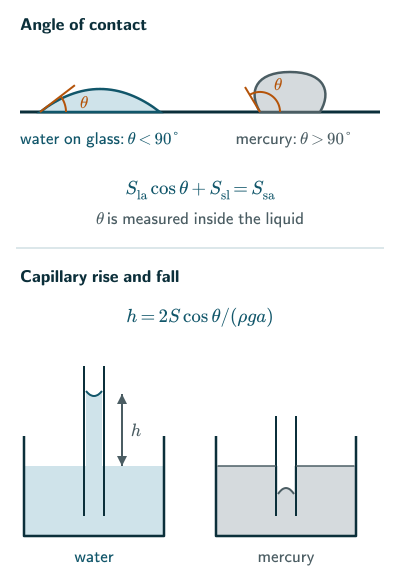
- Acute angle (θ < 90°): the liquid’s molecules are strongly attracted to the solid, so the liquid wets it and spreads. Water on clean glass is the standard example. Wetting of plastics depends on the polymer and its surface treatment; clean plastic is not automatically water-wetting.
- Obtuse angle (θ > 90°): the liquid’s molecules are attracted to one another far more strongly than to the solid’s molecules, so the liquid does not wet the solid and forms drops. Water on a lotus leaf, wax or an oily surface, and mercury on clean glass behave this way; mercury can wet or react with some metals.
From the balance above, cos θ = (Ssa − Ssl)/Sla. So the angle is obtuse when Ssl is greater than Ssa, and acute when it is smaller. NCERT (page 195) states the condition as Ssl > Sla for an obtuse angle and Ssl < Sla for an acute one; that comparison is not what its own Eq. (9.22) gives, which is Ssl against Ssa.
Soaps, detergents and dyeing substances are wetting agents.
NCERT Physics Part II (Class 11), Section 9.6.3, page 196
Wetting agents make the angle of contact small, so the liquid can soak into fabric; water-proofing agents do the opposite, making the angle of contact between water and fibres large (NCERT, page 196).
Drops and bubbles
One consequence of surface tension is that free liquid drops and bubbles are spherical if effects of gravity can be neglected.
NCERT Physics Part II (Class 11), Section 9.6.4, page 196
For a given volume, a sphere has the least surface area, and so the least surface energy.
Pressure inside a drop. Surface tension squeezes a drop, so the pressure inside, Pi, is greater than the pressure outside, Po. If a drop of radius r grows by Δr, its surface energy rises by Sla[4π(r + Δr) − 4πr] ≈ 8πrSlaΔr. In equilibrium this equals the work done by the pressure difference, (Pi − Po)4πrΔr, so
Excess pressure in a drop (or an air bubble in a liquid)
For the spherical interfaces considered here, the pressure is higher on the concave side. A general surface has two principal curvatures, so a saddle-shaped surface cannot be described by this one-radius rule. An air bubble inside a liquid has one surface, so the same 2S/r applies.
A soap bubble in air is a thin film with two surfaces, inside and outside, so its excess pressure is doubled:
Excess pressure in a soap bubble
That is why you have to blow a little harder to start a bubble, and why a smaller bubble has a higher pressure inside than a larger one.
Capillary rise
Dip a narrow glass tube (a capillary, from the Latin capillus, hair; NCERT, page 196, gives the word as “capilla”) of radius a into water. The angle of contact is acute, so the water surface in the tube is concave, and the pressure just under it is less than atmospheric, by 2S/R, where R = a/cos θ is the radius of the meniscus (NCERT Eq. 9.27), that is, by (2S/a) cos θ. Water is pushed up the tube until the weight of the column makes up the difference: points at the same level inside and outside the tube must, by Pascal’s law, be at the same pressure, so hρg = (2S/a)cos θ (NCERT Section 9.6.5, pages 196–197). The capillary rise is
Capillary rise
The narrower the tube, the higher the rise: a few centimetres for fine capillaries (Example 4). If the angle of contact is obtuse, as for mercury in glass, cos θ is negative, the surface is convex, and the liquid is pushed down in the tube. The capillary-rise experiment uses this formula to find S for water.
Detergents as wetting agents
Beyond the bare statement in NCERT, here is how detergents work. Water alone does not wash greasy dirt well: its surface tension is high and it does not wet grease. A detergent molecule has one end that is attracted to water and a long other end that is attracted to oil and grease. Added to water, detergent molecules gather at the surface and lower the surface tension, and they reduce the angle of contact with fabric, so the water spreads into the fibres. Their grease-loving ends then cling to oily dirt and break it into tiny droplets, each surrounded by detergent molecules with their water-loving ends outwards, so the dirt can be rinsed away.
Solved examples
Take g = 9.8 m s and, for water, S = 0.0727 N m (NCERT Table 9.3) and density 1000 kg m, unless stated otherwise.
Example 1: Pulling a soap film
A soap film is formed on a wire frame whose sliding side is 5.0 cm long. Taking the solution’s constant surface tension as S = 0.025 N m, what force holds the slider in place, and how much work is done in pulling it out 2.0 cm?
F = 2Sl = 2 × 0.025 × 0.050 = 2.5 × 10 N. Work = S × (increase in area of both surfaces) = 0.025 × 2 × 0.050 × 0.020 = 5.0 × 10 J.
Answer: 2.5 × 10 N; 5.0 × 10 J. Use the given soap-solution tension, not pure water’s value.
Example 2: The balance method
In the ideal thin-plate method, assume complete wetting, negligible plate thickness and negligible buoyancy at detachment. The plate’s lower edge is 10 cm long. What extra mass is needed to pull it clear of water?
S = mg/(2l), so m = 2Sl/g = 2 × 0.0727 × 0.10/9.8, about 1.48 × 10 kg.
Answer: about 1.5 g.
Example 3: Pressure in a drop and in a soap bubble
Find the excess pressure inside (a) a water drop of radius 1.0 mm and (b) a soap bubble of radius 2.0 cm, taking the surface tension of soap solution as 0.025 N m.
(a) 2S/r = 2 × 0.0727/(1.0 × 10), about 145 Pa.
(b) 4S/r = 4 × 0.025/0.020 = 5.0 Pa.
Answer: about 145 Pa; 5.0 Pa. Small drops have large excess pressures.
Example 4: Rise and fall in a capillary
(a) Find the rise of water in a clean glass tube of radius 0.05 cm (take θ ≈ 0). (b) How far is mercury pushed down in the same tube? For mercury take S = 0.4355 N m (NCERT Table 9.3), θ = 140° and density 13.6 × 10 kg m.
(a) h = 2S/(ρga) = 2 × 0.0727/
(b) h = 2 × 0.4355 × cos 140°/
Answer: water rises about 3.0 cm; mercury falls about 1.0 cm.
Example 5: Blowing a bubble under water
This is NCERT Example 9.10 (page 197). The lower end of a capillary tube of diameter 2.00 mm is 8.00 cm below the surface of water. What pressure is needed in the tube to blow a hemispherical bubble at its end? Take S = 7.30 × 10 N m, atmospheric pressure 1.01 × 10 Pa and g = 9.80 m s.
The bubble has one liquid surface, so its excess pressure is 2S/r, with r = 1.00 mm, the tube’s radius. Outside the bubble the pressure is atmospheric plus that of 8.00 cm of water:
Po = 1.01 × 10 + 0.08 × 1000 × 9.80 = 1.01784 × 10 Pa.
Excess pressure = 2 × 7.30 × 10/(1.00 × 10) = 146 Pa, so Pi = 1.01784 × 10 + 146, about 1.02 × 10 Pa.
Answer: about 1.02 × 10 Pa in the tube; the excess pressure in the bubble is 146 Pa.
Example 6: Energy to spray a drop
A water drop of radius 1.0 mm is broken into 1000 equal droplets. How much energy is needed?
Each droplet has radius 1.0/10001/3 = 0.10 mm. The surface area grows from 4πR to 1000 × 4πr, an increase of 4π(1000r − R). With r = 10 m and R = 10 m, 1000r − R = 9 × 10 m, so the increase is 4π × 9 × 10 m, about 1.13 × 10 m. The energy is S times this, 0.0727 × 1.13 × 10, about 8.2 × 10 J.
Answer: about 8.2 × 10 J. Breaking a liquid into a fine spray takes energy because it creates new surface.
Common mistakes to avoid
Common mistake
Forgetting that a film has two surfaces
A soap film or a soap bubble has two surfaces, so use S = F/(2l) for a film and 4S/r for a soap bubble. A drop, or an air bubble inside a liquid, has one surface: 2S/r. Thus the surface-creation work for a soap bubble is 8πrS, while a drop has surface energy 4πrS, taking the initial interface area as negligible. Total work supplied by a gas source can also include displacing the atmosphere; the surface term alone is not all of that work.
Common mistake
Using the diameter in 2S/r or in the capillary formula
r and a are radii. In NCERT Example 9.10, the 2.00 mm diameter gives r = 1.00 mm.
Common mistake
Thinking water would overflow from a short capillary
If the tube is shorter than the full rise, the water reaches the top and the meniscus simply flattens (its radius grows) until the pressures balance. There is no fountain.
Common mistake
Comparing the wrong pair of surface tensions
The angle of contact is obtuse when Ssl > Ssa, not Ssl > Sla; check with Sla cos θ = Ssa − Ssl.
Quick revision summary
- Surface tension S is the extra surface energy per unit area, equal to the force per unit length in the surface; unit N m. It usually falls as temperature rises.
- Surface molecules have extra energy, so a liquid takes the least surface area it can; free drops are spherical.
- For a film on a frame, S = F/(2l), because the film has two surfaces.
- Angle of contact: Sla cos θ + Ssl = Ssa; acute means the liquid wets the solid, obtuse means it does not.
- Excess pressure: 2S/r in a drop or an air bubble in a liquid; 4S/r in a soap bubble.
- Capillary rise h = 2S cos θ/(ρga); a liquid with an obtuse contact angle is pushed down.
- Detergents lower the surface tension and the angle of contact, and help lift greasy dirt.
- In short, with a the tube’s radius, ρ the liquid’s density and θ the angle of contact: h = 2S cos θ/(ρga).
Formula sheet
- S = F/(2l) (film with two surfaces); S = surface energy per unit area
- Sla cos θ + Ssl = Ssa (angle of contact)
- Pi − Po = 2S/r (drop; air bubble in a liquid)
- Pi − Po = 4S/r (soap bubble)
- h = 2S cos θ/(ρga) (capillary rise)
Questions students ask
What is the SI unit and dimensional formula of surface tension?
The SI unit of surface tension is the newton per metre, N m, which is the same as the joule per square metre, J m, and its dimensional formula is [MT]: a force, [MLT], divided by a length, [L]. In CGS units it is measured in dyne per centimetre, and 1 dyne cm = 10 N m, so water’s 0.0727 N m at 20 °C is 72.7 dyne cm. The two forms of the unit match the two meanings of surface tension: a force per unit length acting in the surface, and an energy per unit area of the surface.
What is the difference between surface tension and viscosity?
Surface tension is a property of a liquid’s free surface, the force per unit length (or energy per unit area) with which the surface pulls, while viscosity is the internal friction between layers of a fluid that move relative to one another. Surface tension acts even in a liquid at rest and is measured in N m; viscous shear stress appears when there is a velocity gradient and is measured in Pa s, and gases have viscosity but, having no free surface, no surface tension. The two are unrelated in size: glycerine is hundreds of times as viscous as water, yet its surface tension, about 0.063 N m at 20 °C, is a little lower than water’s 0.0727 N m.
How does temperature affect surface tension?
The surface tension of almost every liquid falls as its temperature rises, because its molecules move faster and spread farther apart, so their attraction weakens, and it becomes zero at the critical temperature, where the liquid and its vapour can no longer be told apart. For water it falls from about 0.0756 N m at 0 °C and 0.0727 N m at 20 °C to about 0.0589 N m at 100 °C. Dissolved substances change it too: soaps and detergents lower it a lot, while common salt raises it slightly.
What is the difference between surface tension and capillary action?
Surface tension is a property of a liquid, the pull of its surface, while capillary action is one of its effects: the rise or fall of a liquid in a narrow tube or in a porous material such as a cotton wick, blotting paper or soil. Whether the liquid rises or falls depends on the angle of contact, which reflects how strongly the liquid is attracted to the solid (adhesion) compared with its own molecules (cohesion): water wets clean glass and rises, while mercury does not wet it and is pushed down. Surface tension sets the size of the effect, h = 2S cos θ/(ρga) in a tube of radius a, so a narrower tube gives a larger rise.
Can capillary action alone lift water to the top of a tall tree?
No, capillary action alone cannot lift water to the top of a tall tree: even in a tube as fine as 0.020 mm in radius, water rises only about 2 × 0.0727/
How can some insects walk on water?
Some insects, such as pond skaters (water striders), can walk on water because surface tension supports them: each leg presses a small dent into the surface, and the surface, pulling along the edge of the dent, gives an upward force of up to S per unit length on each side of the leg, enough to carry the insect’s small weight. Their legs are covered with fine waxy hairs that water does not wet, so the legs do not break through the surface. Detergent can reduce that support by lowering surface tension and altering wetting; the outcome depends on concentration and the insect’s leg surfaces.
What happens to capillary rise in a lift that is accelerating, or in free fall?
Capillary rise depends on the effective gravity: in h = 2S cos θ/(ρga), g is replaced by g + a0 in a lift accelerating upwards at a0, and by g − a0 in one accelerating downwards. So the liquid rises less in a lift accelerating upwards and more in one accelerating downwards, and in free fall the hydrostatic formula has no finite equilibrium height. Wetting and capillary forces can move liquid along a tube, but the final distribution and whether it reaches an open end depend on available liquid, geometry, trapped gas and time; “infinite rise without overflowing” is not a general prediction. For example, water that rises 4.0 cm in a lift at rest rises about 4.0 × 9.8/(9.8 + 2.2) ≈ 3.3 cm in one accelerating upwards at 2.2 m s.
Practice questions
Try each question first, then open the answer to check your working.
-
Q1. Why are small free drops of a liquid spherical?
Show answerHide answer
Surface tension makes the surface take the least area, and so the least surface energy, for its volume. A sphere has the least area for a given volume. For small drops, gravity is too weak to flatten them noticeably.
-
Q2. How high does water rise in a clean glass capillary of radius 0.25 mm? Take S = 0.0727 N m, θ ≈ 0, density 1000 kg m and g = 9.8 m s.
Show answerHide answer
h = 2S/(ρga) = 2 × 0.0727/
(1000 × 9.8 × 2.5 × 10), about 5.9 × 10 m, or 5.9 cm. -
Q3. A soap bubble’s radius doubles. What happens to the excess pressure inside it?
Show answerHide answer
The excess pressure is 4S/r, so doubling r halves it.