Streamline and turbulent flow
NCERT Class 11 Physics Chapter 9 Section 9.3
Quick answer
Flow is steady, or streamline, when the velocity of the fluid at each point stays the same in time; a streamline is the path of a fluid particle in steady flow, and streamlines never cross. For an incompressible fluid the volume flow rate is the same all along a pipe, Av = Av (the equation of continuity), so the fluid moves faster where the pipe is narrower. Transition to turbulence depends on speed, viscosity, geometry and disturbances.
With your textbook
NCERT Physics Part II (Class 11), Chapter 9 “Mechanical Properties of Fluids”, Section 9.3 “Streamline flow”, pages 186–187.
Open the official NCERT chapter (PDF, 2.2 MB, ncert.nic.in) (opens in a new tab)
Checked against the 2026-27 reprint on .
What is streamline flow?
The flow of the fluid is said to be steady if at any given point, the velocity of each passing fluid particle remains constant in time.
NCERT Physics Part II (Class 11), Section 9.3, page 186
The path taken by a fluid particle under a steady flow is a streamline. It is defined as a curve whose tangent at any point is in the direction of the fluid velocity at that point.
NCERT Physics Part II (Class 11), Section 9.3, page 186
In plain words: in steady flow, every drop of water that passes a given point does exactly what the drop before it did there. The velocity may differ from point to point, but at each point it never changes. The paths the drops follow are the streamlines, and they form a fixed map of the flow. Turn a tap on slowly and the water comes out smooth and glassy; this is streamline flow.
Streamlines never cross
No two streamlines can cross, for if they do, an oncoming fluid particle can go either one way or the other and the flow would not be steady.
NCERT Physics Part II (Class 11), Section 9.3, page 187
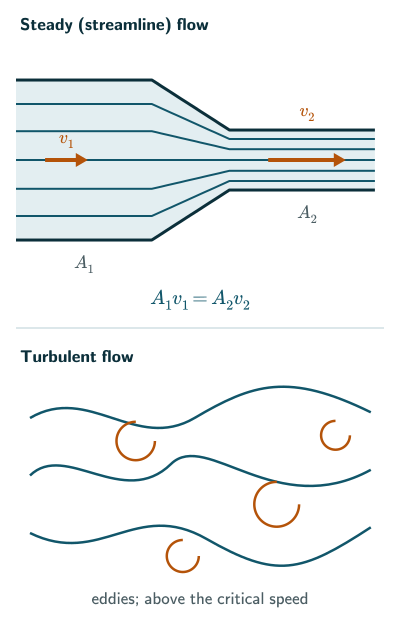
A bundle of neighbouring streamlines forms a tube of flow. In steady flow, fluid cannot cross the sides of this stream tube, so mass entering equals mass leaving. For incompressible flow, a narrower cross-section of the same stream tube means greater average speed; arbitrary spacing of lines in a sketch is not itself a speed measurement.
The equation of continuity
Take a tube of flow with cross-sections A1 and A2, where the fluid speeds are v1 and v2 and the densities ρ1 and ρ2. In a short time Δt the fluid at A1 moves forward v1Δt, so a volume A1v1Δt, of mass ρ1A1v1Δt, enters at one end and ρ2A2v2Δt leaves at the other. Here each speed is uniform over its section, or an appropriate section average; for uniform density at each section, steady flow gives equal mass rates (NCERT Section 9.3, page 187):
For a homogeneous incompressible fluid, such as water in this model, the density stays constant, and
Equation of continuity
that is, Av = constant.
This is the equation of continuity, a statement of conservation of mass for incompressible flow. The product Av is the volume flow rate (volume per second), in m s; it is the same all along the pipe. Where the pipe narrows, the fluid must speed up. For a specified flow rate, reducing the outlet area raises its speed. Covering a real hose also changes the flow rate because the supply pressure is finite, so it need not stay at its original value.
The fluid speeds up on entering a narrow section, so by Newton’s second law a net force must push it forward: in a horizontal pipe the pressure must be higher in the wide part than in the narrow part. This link between speed and pressure is Bernoulli’s principle, the next topic.
Turbulent flow and the critical speed
For a given fluid and flow geometry, increasing the speed can destabilise smooth flow. Near a critical speed (or critical velocity, as the JEE and NEET syllabuses call it), disturbances may grow into turbulent flow: small whirlpool-like regions (eddies) form (NCERT Section 9.3, page 187). White-water rapids, where a fast stream meets rocks, are an example; so is the thread of smoke from an incense stick (agarbatti) or a just-snuffed candle, which rises smoothly and then breaks into swirls a little higher up. Smooth flow in which neighbouring layers slide past each other in parallel is also called laminar flow.
The Reynolds number (beyond the NCERT text). Whether flow in a pipe is laminar or turbulent depends on the combination
where ρ, v and η are the fluid’s density, cross-sectional mean speed and viscosity (the next-but-one topic), and d is the pipe’s diameter. Re is a pure number. For a straight circular pipe, Re below about 2000–2300 usually indicates laminar flow, roughly 2300–4000 is transitional, and above about 4000 flow is usually turbulent. These are practical ranges, not universal sharp boundaries. So the critical speed is about 2000η/(ρd): it is lower in wide pipes and in fluids of low viscosity. Books differ on these limits; some Indian textbooks use laminar below about 1000 and turbulent above about 2000, and some use the radius instead of the diameter. Use the values a question gives. Av = constant still holds in turbulent flow if v is the average speed across the section, because it is just conservation of mass; flow in household taps and hoses is usually turbulent.
Solved examples
Example 1: A garden hose with a nozzle
Water flows at 1.0 m/s in a hose of inner diameter 2.0 cm, which ends in a nozzle of diameter 0.50 cm. Find the speed at the nozzle and the flow rate in litres per minute.
Areas go as the square of the diameter, so v2 = v1(d1/d2) = 1.0 × (2.0/0.50) = 16 m/s.
Flow rate = A1v1 = π(0.010) × 1.0, about 3.14 × 10 m s, that is, about 0.314 L per second or 18.8 L per minute.
Answer: 16 m/s; about 19 L/min.
Example 2: A river that narrows
A river 20 m wide and 2.0 m deep flows at 0.50 m/s. Further on it narrows to 10 m wide and 1.5 m deep. How fast does it flow there?
The flow rate is 20 × 2.0 × 0.50 = 20 m s in both places, so v = 20/(10 × 1.5), about 1.33 m/s.
Answer: about 1.3 m/s.
Example 3: From the aorta to the capillaries
Blood leaves the heart through the aorta, of radius 1.0 cm, at about 0.30 m/s. It ends up in capillaries of radius about 4 µm, where it moves at about 0.5 mm/s. Estimate the number of identical parallel capillaries needed to carry this flow. Treat blood as incompressible and use time-averaged speeds; this is a simplified circulation model, not an anatomical count.
The total flow rate is the same: N × π(4 × 10) × 5 × 10 = π(1.0 × 10) × 0.30. So (π cancels) N = (10 × 0.30)/
Answer: a few billion (about 4 × 10). Their total cross-section is 600 times the aorta’s, which is why blood moves so slowly in them.
Example 4: Why a falling stream narrows
Water leaves a tap of diameter 1.0 cm at 1.0 m/s. What is the diameter of the stream 20 cm below the tap? Take g = 9.8 m s.
Neglecting air resistance, surface-tension pressure and viscous losses, the jet is at atmospheric pressure and speeds up under gravity: from v = u + 2gh, v = √(1.0 + 2 × 9.8 × 0.20), about 2.22 m/s. By continuity, Av is constant, so the diameter goes as 1/√v: d = 1.0 × √(1.0/2.22), about 0.67 cm.
Answer: about 0.67 cm. The stream gets thinner as it speeds up.
Common mistakes to avoid
Common mistake
Using the diameter ratio instead of the area ratio
Av is constant, so the speed goes as 1/d. Halving the diameter makes the fluid four times faster, not twice.
Common mistake
Applying Av = constant to a compressible gas
The simple form needs constant density. Liquids, and gases moving well below the speed of sound (as in most textbook problems on air), can be treated as incompressible. When a gas’s density changes appreciably, use ρAv = constant.
Common mistake
Thinking steady flow means constant velocity everywhere
Steady flow means the velocity at each point does not change with time. Low speed alone is not a definition of steady flow. A particle can still speed up as it moves into a narrower part.
Common mistake
Thinking streamlines can cross
At a point with nonzero, well-defined velocity, two distinct streamlines cannot cross: the velocity has only one direction. This also applies to an instantaneous streamline map of unsteady flow; at a stagnation point the velocity is zero and its direction is undefined.
Quick revision summary
- Steady flow: at every point, the velocity of the passing fluid does not change with time.
- A streamline is the path of a fluid particle in steady flow; its tangent gives the velocity; streamlines never cross.
- Equation of continuity: ρAv is constant along a tube of flow; for an incompressible fluid A1v1 = A2v2, so the fluid is faster where the pipe is narrower.
- Av is the volume flow rate, in m s.
- Transition to turbulence depends on Reynolds number and disturbances; laminar flow is usual below Re ≈ 2000–2300 in a straight circular pipe.
- In short: A1v1 = A2v2.
Formula sheet
- ρAv = ρAv (conservation of mass)
- Av = Av, Av = constant (incompressible fluid)
- Volume flow rate = Av (m s)
- Re = ρvd/η (laminar below about 2000 in a pipe; beyond NCERT)
Questions students ask
What is the difference between streamline flow and turbulent flow?
In streamline flow the velocity of the fluid at each point stays constant in time, so the fluid particles follow smooth, fixed paths that never cross; in turbulent flow the velocity at each point keeps changing irregularly, eddies form and neighbouring layers mix. A fluid flows in streamlines at low speeds, below the critical velocity, and turns turbulent above it, and turbulent flow loses far more energy to internal friction. Blood flow can remain laminar while pulsating with each heartbeat, so laminar does not necessarily mean steady. Narrowing a vessel can promote disturbed flow, but a simple steady-pipe threshold is only an approximation for a pulsating artery.
What is critical velocity in fluid flow, and what is its formula?
In fluids, the critical velocity is the speed above which streamline flow turns turbulent; it is the JEE Main and NEET syllabus name for NCERT’s critical speed. For a liquid of viscosity η and density ρ in a pipe of diameter d, vc = Kη/(ρd), where K, the critical Reynolds number, is about 2000 (beyond NCERT; books differ), so vc is larger for viscous liquids and smaller in wide pipes. For water in a pipe 5.0 cm across it is only about 0.04 m s, far below the 1 to 2 m s usual in water pipes, so that flow is usually turbulent. In gravitation the name means a satellite’s orbital velocity instead.
What is the Reynolds number, and is it in the JEE Main syllabus?
The Reynolds number is the pure number Re = ρvd/η, which compares the inertia of a moving fluid with its viscous forces: flow in a straight circular pipe is usually laminar below about 2000–2300, transitional up to roughly 4000, and usually turbulent above that, depending on disturbances. It is not named in the JEE Main 2027 or the NEET (UG) 2026 syllabus, which list “streamline and turbulent flow” and “critical velocity” for this topic, and the current NCERT textbook does not use it. A question on critical velocity may still give the critical value of Re, so it is worth knowing how to use it.
Is streamline flow the same as laminar flow?
In Class 11, JEE and NEET problems, streamline flow and laminar flow mean the same thing: smooth flow without eddies, the opposite of turbulent flow. Strictly, streamline (steady) flow means that the velocity at each point does not change with time, while laminar flow means that the fluid moves in smooth layers that slide over one another without mixing. A flow that is steady in NCERT’s sense cannot be turbulent, but a laminar flow need not be steady: while a tap is being slowly opened, the smooth flow in the pipe is laminar, yet the velocity at each point is changing.
What is the difference between the equation of continuity and Bernoulli’s equation?
The equation of continuity expresses conservation of mass in a flowing fluid, while Bernoulli’s equation expresses conservation of energy. Continuity, A1v1 = A2v2 for an incompressible fluid, fixes how the speed changes with the area of the pipe; Bernoulli’s equation, P + ½ρv + ρgh = constant, then gives how the pressure changes with that speed and with height. Continuity holds even for viscous or turbulent flow if v is the average speed across the pipe, but Bernoulli’s equation needs the steady flow of a non-viscous fluid along a streamline.
Practice questions
Try each question first, then open the answer to check your working.
-
Q1. Water flows steadily through a pipe that narrows to half its diameter. How does the speed change?
Show answerHide answer
The area becomes a quarter, so the speed becomes 4 times as large.
-
Q2. Water flows at 0.60 L per second through a pipe of inner diameter 2.0 cm. What is its speed?
Show answerHide answer
v = Q/A = 0.60 × 10/(π × 0.010), about 1.9 m/s.
-
Q3. Why can two streamlines never cross in steady flow?
Show answerHide answer
At an ordinary point with nonzero velocity, a crossing would require two directions for the velocity at the same instant. The velocity field has only one value there. Stagnation points, where velocity is zero, require separate treatment.