Experiment: viscosity from terminal velocity
Beyond NCERT In the JEE Main and NEET syllabus; the Class 11 book has no section for it.
Quick answer
The viscosity of a thick liquid is found by timing small steel balls as they fall at their terminal velocity between two marks a distance d apart in a tall jar of the liquid, so that vt = d/t. Stokes’ law then gives η = 2a2(ρ − σ)g/(9vt), where a is the ball’s radius and ρ and σ are the densities of the ball and the liquid; a graph of vt against a2 gives η from its slope. The upper mark must be well below the surface, the balls small and dropped along the axis, and the temperature constant.
What is this experiment?
The principle behind it, in NCERT’s words
It is seen that the viscous force is proportional to the velocity of the object and is opposite to the direction of motion.
NCERT Physics Part II (Class 11), Section 9.5.1, page 192
The aim is to find the coefficient of viscosity η of a thick liquid such as glycerine or castor oil. Small steel balls are dropped into a tall jar of the liquid, their steady (terminal) velocity is measured, and η follows from the terminal-velocity formula, which comes from Stokes’ law. Here a is the radius of a ball, ρ its density and σ the density of the liquid.
The NEET (UG) 2026 syllabus lists this under Unit 20, Experimental Skills: “Co-efficient of Viscosity of a given viscous liquid by measuring terminal velocity of a given spherical body”; the JEE Main 2027 syllabus lists the same experiment. The NCERT textbook gives the theory (Section 9.5.1; see Stokes’ law) but not the method. The procedure is also described in NCERT’s Class XI Physics Laboratory Manual, Experiment 13.
Apparatus
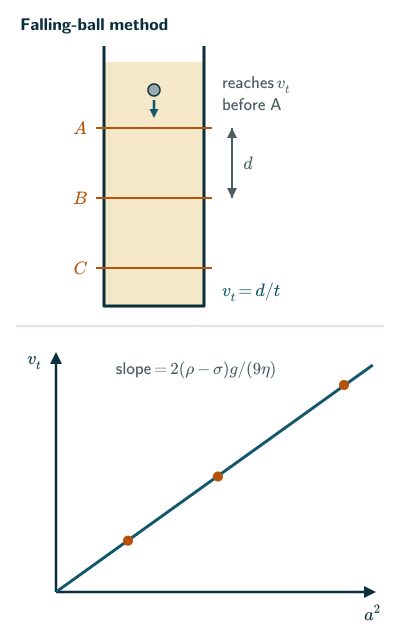
- A tall glass jar (about 1 m high), many times wider than the balls, filled with the liquid. Three marks A, B and C (rubber bands work well) are set equal distances d apart (for example 20 cm), A well below the surface and C well above the bottom.
- Small steel balls of a few different radii, of known density.
- A screw gauge to measure the diameters of the balls, a metre scale, a stopwatch, a thermometer and forceps to drop the balls.
- Densities of the steel and of the liquid (from a table or measured).
Theory
A ball falling through the liquid speeds up until the viscous drag 6πηav plus the upthrust balances its weight; its velocity-time graph rises and levels off at vt. From then on the net force is zero (as in any equilibrium):
Rearranging:
Viscosity from one ball
The terminal velocity is measured as the distance between two marks divided by the time taken, vt = d/t. The SI unit of η is Pa s (= N s m = kg m s), with dimensions [MLT]; 1 poise = 0.1 Pa s. Since vt ∝ a, a graph of vt against a for balls of different sizes is a straight line through the origin, and its slope gives η:
Viscosity from the graph
Why the upper mark is well below the surface, and why three marks. A ball needs some distance to reach its terminal velocity. The mark A must be low enough that the ball is already moving steadily when it passes A. Equal times over AB and BC, within timing uncertainty, support that it was; this check cannot resolve changes smaller than the measurement error.
Why the jar must be wide and the ball small. Stokes’ law assumes a small sphere moving slowly through a liquid that extends far in every direction. Near the walls or the bottom the drag is larger, and a large or fast ball no longer obeys Stokes’ law, so small balls dropped along the axis of a wide jar are used, and the lowest mark is kept well above the bottom. (A ball lighter than the liquid, ρ < σ, would instead rise to a terminal velocity.)
Procedure
- Note the temperature of the liquid; viscosity changes strongly with temperature.
- Measure the diameter of each ball with the screw gauge, in several directions, and take the mean. Halve it to get a.
- Wet a ball with the liquid (so that it does not carry air bubbles down) and drop it gently with forceps at the centre of the jar’s surface.
- Start the stopwatch as the ball passes A, note the time at B, and stop it at C. Compare the separate interval times t_AB and t_BC = t_AC − t_AB; they should agree within timing uncertainty. Disagreement can mean continued acceleration, bottom or wall effects, or timing error; adjust the marks and repeat. Call the time over AB t.
- Wait for the liquid to come to rest, then repeat with each ball a few times and take the mean time. Then vt = d/t.
- Plot vt against a, fit a straight line, inspect whether its intercept is consistent with zero, and find its slope. Use a fit through the origin only when the data and uncertainty support that model.
An illustrative observation table (the data of Example 1; d = 20.0 cm):
| a (mm) | t (s) | vt (cm s) |
|---|---|---|
| 1.00 | 11.7 | 1.71 |
| 1.50 | 5.2 | 3.85 |
| 2.00 | 2.9 | 6.90 |
Precautions. Drop each ball along the axis of the jar, well away from the walls, and keep the lowest mark well above the bottom. Make sure the ball carries no air bubbles. Keep the temperature constant and record it. Read the marks with the eye level with them, to avoid parallax: with rubber-band marks, the eye is level when the front and back of the band coincide. Use balls small enough to fall slowly.
Solved examples
Take g = 9.8 m s, the density of steel 7.8 × 10 kg m and that of glycerine 1.26 × 10 kg m.
Example 1: Viscosity of glycerine from three balls
In an idealised dataset, steel balls of radii 1.00, 1.50 and 2.00 mm take 11.7 s, 5.2 s and 2.9 s to fall 20.0 cm between marks in a glycerine sample at the recorded temperature. Estimate its viscosity using Stokes’ law, then assess the approximation.
The terminal velocities are 0.200/11.7, 0.200/5.2 and 0.200/2.9, that is 0.0171, 0.0385 and 0.0690 m s. Dividing each by a gives about 1.71 × 10, 1.71 × 10 and 1.72 × 10 m s: vt is indeed proportional to a. The best line through the origin has a slope of about 1.72 × 10 m s, and ρ − σ = 7.8 × 10 − 1.26 × 10 = 6.54 × 10 kg m, so
Answer: about 0.83 Pa s. The sphere Reynolds numbers are approximately 0.052, 0.18 and 0.42. The largest ball is not comfortably in the Re ≪ 1 limit, so the straight-looking graph alone does not validate an accurate Stokes measurement; use smaller balls for precision work. The given data illustrate NCERT’s 0.83 Pa s value, rather than establishing the viscosity of pure glycerol at 20 °C, which published measurements place around 1.4–1.5 Pa s.
Example 2: A first-order worst-case error estimate
For the 1.00 mm ball of Example 1, the radius is known to 0.01 mm (the fractional error in the radius equals that in the measured diameter), the time to 0.1 s and the distance to 1 mm. Taking the densities and g as exact, estimate the largest percentage error in η to first order.
From η = 2a(ρ − σ)gt/(9d), the fractional errors add, with the radius counted twice:
that is, 2 × 1% + 0.85% + 0.5%, about 3.4%.
Answer: about 3.4% as a first-order worst-case bound, more than half from the radius. This is not a statistical standard uncertainty, and it excludes errors from the Stokes model, walls and temperature.
Example 3: How quickly the ball reaches terminal velocity
Beyond the NCERT text: in a simplified model using instantaneous Stokes drag and neglecting added fluid inertia and flow-history effects, a ball approaches terminal velocity over a time of about τ = m/(6πηa). With m = (4/3)πaρ this is τ = 2aρ/(9η); the ball’s full mass sets its inertia, so ρ appears, not ρ − σ. Estimate τ for the 2.00 mm ball in glycerine, and how far it falls in about 5τ.
τ = 2 × (2.0 × 10) × 7.8 × 10/(9 × 0.83), about 8.4 × 10 s, so 5τ is about 0.042 s. Since the ball starts from rest, in that time it falls less than vt × 5τ = 0.069 m s × 0.042 s, about 3 mm (in fact about 2.3 mm).
Answer: the simplified model reaches 99.3% of terminal speed within a few millimetres. This estimate does not replace the equal-interval timing check, especially since the 2 mm ball is only approximately in the Stokes regime. (In a much less viscous liquid, such as water, a ball would need far longer, and Stokes’ law would not apply anyway.)
Common mistakes to avoid
Common mistake
Using the diameter in place of the radius
The formula needs the radius a. Using the diameter makes η four times too large.
Common mistake
Starting the timing too near the surface
The ball must already be at its terminal velocity at the first mark; otherwise vt comes out too small and η too large.
Common mistake
Forgetting the upthrust
The driving force is the weight minus the upthrust, which brings in (ρ − σ). Using ρ alone gives too large a value of η.
Common mistake
Ignoring the temperature
The viscosity of a liquid falls quickly as it warms, so a value of η means little without the temperature at which it was measured.
Quick revision summary
- A small ball falling through a viscous liquid reaches a terminal velocity when drag and upthrust balance its weight.
- vt = d/t from the time between two marks, the upper one well below the surface.
- η = 2a(ρ − σ)g/(9vt), or 2(ρ − σ)g/(9 × slope) from the straight-line graph of vt against a.
- Use small balls along the axis of a wide jar, no air bubbles, and a known, constant temperature.
- The radius, which enters squared, usually gives the largest error.
Formula sheet
- vt = 2a2(ρ − σ)g/(9η); vt = d/t
- η = 2a2(ρ − σ)g/(9vt)
- η = 2(ρ − σ)g/(9 × slope), slope of vt against a2
- Δη/η ≈ 2Δa/a + Δt/t + Δd/d (first-order worst-case; densities and g exact)
Questions students ask
What is a falling-ball viscometer, and what is its formula?
A falling-ball viscometer is an instrument that measures viscosity on the same principle as the falling-ball experiment: a ball falls through the liquid in a tube, and the time it takes to pass between two marks gives the viscosity. Because the tube is narrow, its walls slow the ball, so Stokes’ formula is not used directly; instead the instrument is calibrated with a liquid of known viscosity, and η = K(ρ − σ)t, where t is the time of fall, ρ and σ are the densities of the ball and the liquid, and K is the instrument’s constant. In the common Höppler type the tube is tilted slightly from the vertical, so that the ball rolls and slides down along its wall.
How is the viscosity of a thin liquid such as water measured?
The viscosity of a thin liquid such as water is usually found from how fast it flows through a narrow tube, not from a falling ball. Poiseuille’s method measures the volume flowing per second, Q = πpr/(8ηl), through a capillary of radius r and length l under a pressure difference p, and an Ostwald viscometer compares the times t1 and t2 for equal volumes of two liquids to drain through the same capillary, giving η1/η2 = ρ1t1/(ρ2t2). Rotational viscometers, used in industry, measure the torque needed to turn a cylinder in the liquid; all these methods are beyond the NCERT text.
How can you check that Stokes’ law holds in the falling-ball experiment?
Stokes’ law holds in the falling-ball experiment only while the flow round the ball is slow and smooth, which is checked with the ball’s Reynolds number, Re = 2aσvt/η, where σ is the density of the liquid: it should be well below 1 (a test beyond NCERT). A simpler check from the data is that vt/a comes out the same for every ball, so that the graph of vt against a is a straight line through the origin. A systematic deviation for larger balls can indicate fluid-inertia or wall effects, but measurement error, temperature variation and size errors should also be checked. A straight line supports the model; it does not prove all its assumptions.
Practice questions
Try each question first, then open the answer to check your working.
-
Q1. Why must the first timing mark be some distance below the surface of the liquid?
Show answerHide answer
The ball accelerates at first. Only after it has reached its terminal velocity does d/t give vt; the mark is placed low enough for this to have happened, and equal times over two equal distances, AB and BC, confirm it.
-
Q2. A steel ball of radius 1.25 mm takes 7.4 s to fall 20.0 cm through glycerine at its terminal velocity. Find the viscosity, using the densities given above and g = 9.8 m s.
Show answerHide answer
vt = 0.200/7.4, about 0.0270 m s. η = 2 × (1.25 × 10) × 6.54 × 10 × 9.8/(9 × 0.0270), about 0.82 Pa s.
-
Q3. If the radius is measured with an error of 1% and the time with an error of 2%, other errors being negligible, what is the largest percentage error in η?
Show answerHide answer
To first order, 2 × 1% + 2% = 4%, because the radius enters squared. The exact upper relative bound from these finite tolerances is (1.01) × 1.02 − 1 = 4.0502%.