Periodic and oscillatory motion
NCERT Class 11 Physics Chapter 13 Section 13.2
Quick answer
Periodic motion repeats exactly after a fixed interval; its period T is the smallest repeat time and its frequency is ν = 1/T. Oscillatory motion goes to and fro about a mean position: ideal undamped oscillations are periodic, while damped swings need not repeat exactly. Uniform circular motion is periodic but is not to-and-fro motion.
With your textbook
NCERT Physics Part II (Class 11), Chapter 13 “Oscillations”, Section 13.2 “Periodic and oscillatory motions”, pages 260–262.
Open the official NCERT chapter (PDF, 1.6 MB, ncert.nic.in) (opens in a new tab)
Checked against the 2026-27 reprint on .
What are periodic and oscillatory motions?
Periodic and oscillatory motion
- A periodic motion repeats itself at regular intervals of time, like a planet going round the Sun or the hands of a clock.
- An oscillatory motion is a to-and-fro motion about a mean position. In NCERT’s ideal undamped examples it is periodic, like a swing, a pendulum or a block on a spring.
- The period T is the smallest time after which the motion repeats. The frequency ν = 1/T is the number of repetitions per second, measured in hertz (Hz).
(NCERT Section 13.2, pages 260–262.)
Thus, a motion that repeats itself at regular intervals of time is called periodic motion.
NCERT Physics Part II (Class 11), Section 13.2, page 260
In plain words: if you can film a motion for one period and then just replay the clip over and over without anyone noticing, the motion is periodic. If, on top of that, the object keeps going back and forth through a middle position, it is also oscillatory.
Periodic motion
NCERT Fig. 13.1 (page 260) shows three height–time graphs that repeat: an insect that climbs a ramp and falls off, again and again; a child who climbs a step and comes down, again and again; and a ball bounced between your palm and the ground. In the last case each curved piece of the graph is part of a parabola, from the equations of motion with the acceleration g. (NCERT refers to section 2.6 for these equations, but in the current book they are in Section 2.4, Kinematic equations for uniformly accelerated motion.) None of these graphs looks like a sine wave, but each repeats after a fixed time T, so each is periodic.
Uniform circular motion and the orbital motion of the planets are periodic too. They are not to-and-fro, though, so they are not oscillatory.
Oscillatory motion
For the one-dimensional oscillators considered here, a stable equilibrium position has zero net force when the body is at rest there. Left there at rest, the body stays there. Near a stable equilibrium, a small displacement produces a restoring force towards that position, it overshoots, and it moves to and fro: it oscillates (page 260). A ball in a bowl is the simplest example: at rest at the bottom it stays put; nudged, it rolls back and forth.
Every oscillatory motion is periodic, but every periodic motion need not be oscillatory.
NCERT Physics Part II (Class 11), Section 13.2, page 260
NCERT’s statement uses ideal repeating oscillations. In the broader usage, a damped swing is oscillatory but not strictly periodic because its amplitude decreases. A zero-force equilibrium need not be stable; a restoring tendency is essential.
A few more points from the section (page 260):
- Oscillation or vibration? There is no real difference. Slow ones, such as a swaying branch, are usually called oscillations; fast ones, such as a guitar string, vibrations.
- Simple harmonic motion is the simplest oscillatory motion: the force is proportional to the displacement from the mean position and always points towards it. It is the subject of the rest of this chapter.
- Damping. Real oscillations die away because of friction and other losses, unless an external periodic push keeps them going. NCERT says that damped and forced oscillations are discussed later in the chapter, but the current edition of the chapter does not cover them; only a brief remark on damped motion remains in its Points to Ponder (page 273).
- Waves. A material medium behaves like a huge set of coupled oscillators; their collective oscillations travel as waves, the subject of the next chapter.
Period and frequency
The smallest interval of time after which the motion is repeated is called its period.
NCERT Physics Part II (Class 11), Section 13.2.1, page 260
The period T is measured in seconds, but other units are handier for very fast or very slow motions: a quartz crystal vibrates with a period of the order of microseconds, Mercury goes round the Sun in 88 days, and Halley’s comet returns about every 76 years (page 261).
The frequency ν is the number of repetitions per unit time (NCERT Eq. 13.1):
Frequency and period (NCERT Eqs. 13.1 and 13.2)
Its SI unit is the hertz: 1 Hz = 1 oscillation per second = 1 s.
The unit is named after Heinrich Rudolf Hertz (1857–1894), the discoverer of radio waves. A frequency need not be a whole number: 1.25 Hz is fine.
Displacement
In this chapter displacement has a wider meaning than a change in position. It is the change, with time, of whatever quantity is oscillating (NCERT Section 13.2.2, page 261):
- the signed position x of a block on a spring from its equilibrium position (NCERT Fig. 13.2(a));
- the angle θ of a pendulum from the vertical (NCERT Fig. 13.2(b));
- the voltage across a capacitor in an AC circuit;
- the pressure variation in a sound wave, or the electric and magnetic fields in a light wave.
A displacement can be positive or negative, and it is usually measured from the equilibrium position, though where you put the origin is a matter of convenience.
Periodic functions
For a periodic motion, the displacement is a periodic function of time. One of the simplest is (NCERT Eq. 13.3a)
Increasing ωt by 2π leaves the cosine unchanged, so the function repeats when t increases by 2π/ω. Its period is (NCERT Eq. 13.3b)
Here ω > 0 and A ≠ 0. The same holds for A sin ωt. A mixture of the two, A sin ωt + B cos ωt (NCERT Eq. 13.3c), is also periodic with the same period when A and B are not both zero. Putting A = D cos φ and B = D sin φ turns it into a single sine (NCERT Eq. 13.3d):
with
Squaring and adding A = D cos φ and B = D sin φ gives D; dividing them gives tan φ. Pick φ so that cos φ has the sign of A and sin φ the sign of B: NCERT’s φ = tan(B/A) is right only when A is positive. For −3 sin ωt + 4 cos ωt, tan φ = −4/3 but φ ≈ 126.9°, not −53.1°.
Fourier’s theorem. Sines and cosines matter so much because of a result proved by Jean Baptiste Joseph Fourier (1768–1830):
Any periodic function can be expressed as a superposition of sine and cosine functions of different time periods with suitable coefficients.
NCERT Physics Part II (Class 11), Section 13.2.2, page 262
For the piecewise smooth signals used in school physics, a Fourier series uses integer multiples of a fundamental frequency. At a jump, the series converges to the mean of the two one-sided limits; “any function” is a textbook shorthand requiring appropriate convergence conditions.
After combining equal-frequency terms and removing cancellations, to find the period of a nonconstant finite sum of sines and cosines, find the smallest time that is a whole number of periods of every term. If two periods have an irrational ratio, as in sin ωt + sin(√2 ωt), no such time exists and the sum is not periodic. NCERT’s Points to Ponder (page 273) says a sum of two SHMs is periodic only if one frequency is an integral multiple of the other. That is too strict: the sum is periodic whenever the ratio of the frequencies is a rational number, such as 3 : 2 in Practice Q5. A function that never repeats, such as e−ωt or log(ωt), is not periodic at all.
Solved examples
Example 1: Heartbeat (NCERT Example 13.1)
A human heart beats, on average, 75 times a minute. Find its frequency and period.
ν = 75/(60 s) = 1.25 s = 1.25 Hz. Then T = 1/ν = 1/1.25 = 0.8 s.
Answer: 1.25 Hz and 0.8 s (page 261).
Example 2: A watch crystal
The quartz crystal in a wristwatch vibrates 32 768 times a second. Find its period.
T = 1/ν = 1/32 768 s, about 3.05 × 10 s.
Answer: about 30.5 µs, which is why such periods are quoted in microseconds.
Example 3: Periodic or not? (NCERT Example 13.2)
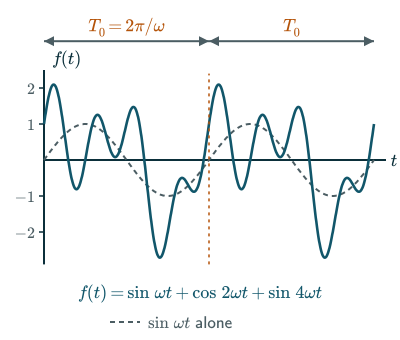
Which of these are periodic? Give the period where they are (ω is a positive constant). (i) sin ωt + cos ωt; (ii) sin ωt + cos 2ωt + sin 4ωt; (iii) e−ωt; (iv) log(ωt).
(i) sin ωt + cos ωt = √2 sin(ωt + π/4), a single sine, so it is periodic with period 2π/ω.
(ii) The terms have periods T0 = 2π/ω, T0/2 and T0/4. The smallest time that is a whole number of periods of all three terms is T0, so the period is 2π/ω.
(iii) e−ωt keeps decreasing towards zero and never repeats a value: not periodic.
(iv) log(ωt) keeps increasing and never repeats: not periodic. It is defined here for t > 0 and is non-periodic. NCERT rejects it as a bounded oscillation; unbounded growth alone does not prevent a function from modelling a displacement over a finite interval.
Answer: (i) and (ii) are periodic, each with period 2π/ω; (iii) and (iv) are not.
Example 4: Combining a sine and a cosine
Write 3 sin ωt + 4 cos ωt as a single sine function and give its largest value.
Here A = 3 and B = 4. D = √(3 + 4) = 5, and tan φ = 4/3 with A and B both positive, so φ ≈ 0.927 rad (53.1°).
Answer: 5 sin(ωt + 0.927), with the phase in radians (53.1°); its largest value is 5, not 3 + 4 = 7.
Example 5: The period of sinωt
Find the period of sinωt.
Use sinωt = (1 − cos 2ωt)/2. The only time-varying part is cos 2ωt, whose period is 2π/(2ω) = π/ω.
Answer: π/ω, half the period of sin ωt. Squaring flips the negative half-cycles up, so the shape repeats twice as often.
Common mistakes to avoid
Common mistake
Calling every periodic motion oscillatory
Uniform circular motion and a planet’s orbit are periodic but not oscillatory: there is no to-and-fro motion about a mean position.
Common mistake
Mixing up ν and ω
ν = 1/T counts repetitions per second (Hz). The angular frequency ω = 2π/T is in rad s and is 2π times larger.
Common mistake
Taking the period of sinωt as 2π/ω
sinωt = (1 − cos 2ωt)/2 repeats every π/ω (Example 5).
Common mistake
Adding the periods of the terms
For a nonconstant sum with distinct nonzero frequency components remaining after cancellation, the period is the smallest time that is a whole number of periods of every term, not the sum of the periods (Example 3). For other functions the true period can be shorter: sinωt + cosωt = ¾ + ¼ cos 4ωt repeats every π/(2ω), not π/ω.
Common mistake
Reading φ straight off tan(B/A)
When A is negative the calculator angle is off by 180°. For −3 sin ωt + 4 cos ωt, φ ≈ 126.9°, not −53.1°.
Common mistake
Adding the amplitudes of a sine and a cosine
A sin ωt + B cos ωt has amplitude √(A + B), not A + B (Example 4).
Quick revision summary
- Periodic motion repeats exactly at regular intervals. Ideal undamped to-and-fro oscillations are periodic; damped oscillations need not repeat exactly.
- The period T is the smallest repeat time; the frequency ν = 1/T, in hertz (1 Hz = 1 s).
- In this chapter, displacement means the change of any oscillating quantity: position, angle, voltage, pressure, field.
- A cos ωt and A sin ωt have period 2π/ω. A sin ωt + B cos ωt = D sin(ωt + φ) with D = √(A + B) and tan φ = B/A.
- Fourier: any periodic function is a sum of sines and cosines of suitable periods.
Formula sheet
- ν = 1/T; 1 Hz = 1 s
- T = 2π/ω for A cos ωt or A sin ωt
- A sin ωt + B cos ωt = D sin(ωt + φ)
- D = √(A + B), tan φ = B/A
Questions students ask
What is the difference between periodic motion and simple harmonic motion?
Simple harmonic motion is the special kind of periodic motion in which the displacement is a single sine or cosine function of time, x = A cos(ωt + φ), produced by a restoring force proportional to the displacement. Every SHM is periodic and oscillatory, but many periodic motions are not SHM: a planet’s orbit is periodic but not oscillatory, and a pendulum swinging through a large angle oscillates periodically but is not simple harmonic. So simple harmonic motion is a special case of oscillatory motion, which is periodic in the ideal undamped examples discussed here. Damped oscillatory motion is a broader, non-periodic case.
What is non-periodic motion, and what are some examples?
A non-periodic motion is one that does not repeat itself at regular intervals of time, so it has no period. A stone falling to the ground, a car moving through traffic, a ball rolling down a slope and a leaf blown by the wind are all non-periodic. A swing left to itself is only nearly periodic: each swing takes almost the same time, but the amplitude keeps shrinking, so strictly the motion never repeats exactly.
What are the SI unit and dimensional formula of frequency?
The SI unit of frequency is the hertz (Hz), one repetition per second, so 1 Hz = 1 s, and its dimensional formula is [M L T]. The period, being a time, is measured in seconds and has the dimensions [T]. The angular frequency ω = 2πν is quoted in rad s but also has the dimensions [T], because the radian is a ratio of two lengths and has no dimensions.
Is a ball bouncing on the floor in simple harmonic motion?
No, a ball bouncing on a floor is periodic (if every bounce is perfectly elastic and air resistance is negligible) but it is not in simple harmonic motion. Between bounces its acceleration is a constant g downwards, not proportional to its displacement from a mean position, so its height–time graph is a chain of parabolas, not a sine curve. Its period, 2√(2h/g) for a drop height h, also grows with the height: dropped from 0.80 m, the ball repeats about every 0.81 s (g = 9.8 m s), whereas the period of SHM does not depend on the amplitude.
Are damped and forced oscillations in the JEE Main 2027 and NEET (UG) 2026 syllabuses?
Damped oscillations, forced oscillations and resonance are not named as separate theory headings in Unit 10, Oscillations and Waves, of either the JEE Main 2027 or the NEET (UG) 2026 syllabus: its oscillations part runs from periodic motion and SHM through the oscillations of a spring and energy in SHM to the time period of the simple pendulum. The explicitly listed damping-related task is the Unit 20 experiment on the simple pendulum’s dissipation of energy, and resonance appears in the Unit 20 resonance tube experiment. The current NCERT chapter gives only brief damping remarks. Absence of a separate heading does not guarantee that an underlying concept cannot be needed in a listed experiment.
Practice questions
Try each question first, then open the answer to check your working.
-
Q1. Give one example of a motion that is periodic but not oscillatory, and one that is both.
Show answerHide answer
A planet going round the Sun (or any uniform circular motion) is periodic but not oscillatory. A swinging pendulum is periodic and oscillatory: it moves to and fro about its lowest point.
-
Q2. A pendulum makes 20 complete oscillations in 30 s. Find its period and frequency.
Show answerHide answer
T = 30/20 = 1.5 s, and ν = 1/T = 20/30, about 0.667 Hz.
-
Q3. Is e−ωt a periodic function? Explain.
Show answerHide answer
No. It decreases steadily towards zero as t increases and never takes the same value twice, so it never repeats.