Experiment: speed of sound with a resonance tube
Beyond NCERT In the JEE Main and NEET syllabus; the Class 11 book has no section for it.
Quick answer
In a resonance tube, a tuning fork drives an air column closed by water; measure successive resonance lengths l and l at the same frequency and temperature. If the same end correction applies to both, v = 2ν(l − l), while e = (l − 3l)/2 estimates that correction. Repeat readings with water rising and falling, and include uncertainty in locating the loudest position.
What is this experiment?
The principle behind it
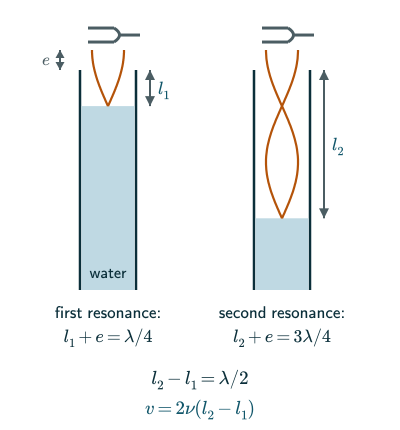
A tube of air closed at the bottom by water resonates loudly with a tuning fork when the air column fits an odd number of quarter-wavelengths of the sound. The first two resonating lengths, l1 and l2, differ by approximately half a wavelength, so the speed of sound is
where ν is the frequency of the fork. Provided it is the same at both resonances, using the difference cancels the end correction, the small distance by which the antinode lies above the open end.
A glass tube partially filled with water illustrates this system.
NCERT Physics Part II (Class 11), Section 14.6.1, page 292
The NCERT textbook supplies the closed-pipe theory (Section 14.6.1, page 292). The practical method is described directly in NCERT Laboratory Manual, Class 11 Physics, Experiment 16, pages 114–118. This page follows that method and adds illustrative calculations and uncertainty estimates. Check the official syllabus for your exam year for assessed practical coverage.
Apparatus
- A resonance tube: a vertical glass tube about 1 m long and a few centimetres across, fixed beside a metre scale.
- A water reservoir joined to the bottom of the tube by a rubber tube, so that the water level can be raised or lowered smoothly, with a clamp to hold it.
- Two or three tuning forks of known frequency (for example 480 Hz and 512 Hz), and a rubber pad to strike them on.
- A set square to read the water level against the scale, a thermometer for the room temperature, and vernier callipers for the inner diameter of the tube.
Theory
The air column is a pipe closed at one end: the water surface is a displacement node (a pressure antinode, where the pressure changes are largest) and the open end is an antinode, so the column resonates when its length is an odd number of quarter-wavelengths (NCERT Eq. 14.43, page 292).
If the external frequency is close to one of the natural frequencies, the system shows resonance.
NCERT Physics Part II (Class 11), Section 14.6.1, page 292
End correction (NCERT Laboratory Manual, Class 11, Experiment 16, pages 114 and 118; beyond the main textbook discussion). The antinode is not exactly at the rim but a little above it, by a distance e called the end correction; the manual takes e = 0.6r, where r is the radius of the tube, about 0.3 times the inner diameter. Beyond the NCERT text: the exact value depends on the geometry of the pipe; for an ideal unflanged cylindrical pipe theory gives about 0.61r (Levine and Schwinger, 1948, as given in Wikipedia, “End correction”). So, for the first two resonances,
Subtracting, l2 − l1 = λ/2, and e has dropped out:
Speed of sound from two resonances
The cancellation assumes a uniform tube, unchanged temperature and the same fork frequency and mouth geometry at both readings. The same two equations also give the end correction: e = (l2 − 3l1)/2.
Room temperature. The speed of sound in air rises with temperature as √T (in kelvin), so the result belongs to the room temperature at the time. To compare with a table value at 0 °C, use v0 = vt√(273.15/T), with T = t + 273.15 K, for the same gas composition and approximately constant γ. The school examples below use 273 K for 0 °C (Example 3).
Part 1: finding the resonance lengths
- Set the tube vertical with a spirit level, record the fork frequency and room temperature, and fill the tube almost to the top by raising the reservoir.
- Strike a tuning fork gently on the rubber pad and hold it just above the open end, about 1 cm above the rim, with the prongs horizontal and one above the other so their vibration is vertical, without touching the tube.
- Lower the water level slowly while listening. Near one level the sound suddenly becomes much louder: that is the first resonance.
- Move the water level up and down by small amounts around that point until the sound is loudest. Read the level from the top of the tube with the set square: this is l1.
- Repeat with water falling and rising, taking at least two readings in each direction as in the NCERT method. Record the spread as well as the mean.
Part 2: speed of sound from two resonances
- Lower the water to about three times l1, strike the fork again, and find the second resonance, usually fainter in this apparatus, in the same way, with the water both falling and rising: this is l2.
- Calculate v = 2ν(l2 − l1) and the end correction e = (l2 − 3l1)/2.
- Repeat with a second fork chosen so both resonances fit in the available tube length. Compare the two speeds before averaging; investigate a disagreement larger than the measurement uncertainty. Recheck room temperature.
A sample observation table (illustrative values, used in Example 1; fork 512 Hz, room temperature 28 °C):
| Resonance | Water falling (cm) | Water rising (cm) | Mean (cm) |
|---|---|---|---|
| First, l1 | 16.1 | 15.9 | 16.0 |
| Second, l2 | 50.2 | 49.8 | 50.0 |
Precautions. Keep the tube vertical. Strike the fork on the rubber pad, not on a hard surface, to reduce unwanted overtones, and hold it close to the mouth of the tube without touching it. Approach each resonance from both directions and take the mean, because the loudest point is easy to overshoot. Read the water level at eye level with the set square to avoid parallax. Keep the room quiet, and note the temperature, which affects the result.
Sources of error. Judging the exact point of loudest sound; reading the water level; the end correction if only one length is used (Example 4); and a fork frequency that is not exactly as marked. Using the difference removes a common end correction and a common additive length-zero offset, but not a scale-factor error or a changing end correction. Humidity can raise sound speed relative to dry-air tables; a nonuniform bore, drafts and temperature changes also affect the result. For worst-case small errors, Δv/v ≈ Δν/ν + (Δl1 + Δl2)/(l2 − l1). For independent standard uncertainties, combine the length uncertainties in quadrature instead.
Solved examples
Example 1: Speed of sound from the readings
With a 512 Hz fork, the mean resonance lengths are 16.0 cm and 50.0 cm. Find the speed of sound and the end correction.
l2 − l1 = 34.0 cm = λ/2, so λ = 0.680 m and v = 2 × 512 × 0.340, about 348 m s.
e = (l2 − 3l1)/2 = (50.0 − 48.0)/2 = 1.0 cm.
Answer: about 348 m s, with an end correction of about 1.0 cm (consistent with a tube about 3.3 cm across).
Example 2: Predicting the resonances
Where should the first two resonances appear with a 480 Hz fork, if v = 348 m s and e = 1.0 cm?
λ = 348/480, about 0.725 m. l1 = λ/4 − e = 18.1 − 1.0, about 17.1 cm; l2 = 3λ/4 − e = 54.4 − 1.0, about 53.4 cm.
Answer: about 17.1 cm and 53.4 cm. A lower frequency gives longer resonance lengths.
Example 3: Correcting to 0 °C
The speed measured at 28 °C is 348 m s. What would it be at 0 °C?
v0 = vt√(273/T) = 348 × √(273/301), about 331.4 m s.
Answer: about 331 m s, matching the value NCERT lists for air at 0 °C (Table 14.1, page 286; see the speed of sound).
Example 4: Why not use the first resonance alone?
Using only l1 = 16.0 cm with the 512 Hz fork, and ignoring the end correction, what speed would you get?
Taking l1 = λ/4: v = 4νl1 = 4 × 512 × 0.160, about 328 m s, about 6% too low. With e: 4 × 512 × (0.160 + 0.010), about 348 m s.
Answer: about 328 m s; the end correction matters, and the two-resonance method removes it.
Example 5: How precise is the result?
Assume each mean length in Example 1 has a total error bound of ±0.1 cm, and neglect fork-frequency error. Estimate a worst-case error bound in v.
The difference 34.0 cm carries up to ±0.2 cm, a fractional error of 0.2/34.0, about 0.6%. So Δv ≈ 0.006 × 348, about ±2 m s.
Answer: v ≈ 348 ± 2 m s as a worst-case bound under those assumptions. If 0.1 cm were an independent standard uncertainty for each length, quadrature would give about 1.45 m s instead. Scale resolution alone does not establish the total uncertainty, since judging the loudest position also contributes.
Common mistakes to avoid
Common mistake
Using v = 4νl without the end correction
The first resonance length is λ/4 − e, not λ/4, so this underestimates v (Example 4). Use 2ν(l2 − l1).
Common mistake
Looking for the second resonance at twice l
The second resonance is half a wavelength further down, at about 3l1 + 2e, not at 2l1.
Common mistake
Measuring from the wrong mark
Measure each length from the top rim of the tube to the water surface in the tube, not to the level in the reservoir.
Common mistake
Striking the fork on a hard surface
A hard knock excites overtones, which can give extra, misleading resonances. Strike it on a rubber pad.
Common mistake
Forgetting the temperature
The speed of sound depends on temperature, so a result without the room temperature cannot be compared properly.
Quick revision summary
- The water-closed tube is a closed pipe: node at the water, antinode just above the open end.
- Resonances at l1 + e = λ/4 and l2 + e = 3λ/4.
- v = 2ν(l2 − l1); the end correction e = (l2 − 3l1)/2 cancels in the difference.
- Approach each resonance from both sides and average; strike the fork on a rubber pad.
- Correct to 0 °C with v0 = vt√(273/T).
Formula sheet
- l + e = λ/4; l + e = 3λ/4
- v = 2ν(l − l)
- e = (l − 3l)/2
- v0 = vt √(273/T) (T in kelvin)
Questions students ask
What is resonance in a resonance tube, and why does the sound get louder?
Resonance in a resonance tube is the condition in which a natural frequency of the air column, closed at the bottom by the water, is close to the frequency of the tuning fork held over it; damping makes the resonance peak finite in width. The fork then drives the column in step with the waves reflected up and down inside it, so a standing wave of large amplitude builds up, with a node at the water surface and an antinode just above the open end, and the column radiates sound strongly. The louder sound draws on the fork’s own energy, which is passed to the air faster, so acoustic loading can make the fork decay faster; the observed decay also depends on how strongly fork and tube are coupled.
How can a resonance tube be used to find the frequency of an unknown tuning fork?
A resonance tube finds the frequency of an unknown tuning fork by comparison with a fork of known frequency at the same room temperature: since v = 2ν(l2 − l1) is the same for both, the frequencies are in the inverse ratio of the differences of their resonance lengths. For example, if a 320 Hz fork gives l2 − l1 = 54.2 cm and the unknown fork gives 41.0 cm, the unknown frequency is 320 × 54.2/41.0 ≈ 423 Hz. With a single fork, the speed of sound at the room temperature can be used instead: ν = v/[2(l2 − l1)].
How does room temperature affect the resonance lengths in a resonance tube?
On a warmer day the resonance lengths in a resonance tube are longer, because the speed of sound in air rises as √T (T in kelvin), so with the same fork the wavelength λ = v/ν, and with it the separation l2 − l1 = λ/2, grows in the same proportion. For example, from 15 °C to 35 °C the speed grows by a factor √(308/288) ≈ 1.034, so a separation of 33.0 cm becomes about 34.1 cm, an increase of about 3%.
Why is there an end correction at the open end of a resonance tube?
The end correction occurs because the air just outside the open end of a tube also takes part in its vibration: the pressure does not return exactly to atmospheric pressure at the rim but a little beyond it, so the displacement antinode forms slightly outside the tube. The NCERT Laboratory Manual takes this distance as 0.6 times the tube’s radius (Class 11, Experiment 16, page 114), so a wider tube has a larger end correction; the reason given here is a step beyond the NCERT text.
Is the second resonance the first overtone of the first?
No. The same tuning fork drives both observations at the same frequency, while the air-column length changes. The shorter column is near its fundamental mode; the longer column fits three quarter-wavelengths and is near its own third-harmonic mode. An overtone comparison instead keeps the pipe length fixed and changes frequency. NCERT Laboratory Manual Experiment 16 explicitly distinguishes these two situations.
Practice questions
Try each question first, then open the answer to check your working.
-
Q1. Why is the speed of sound calculated from the difference of the first two resonance lengths rather than from the first length alone?
Show answerHide answer
The first length is λ/4 − e and the second is 3λ/4 − e, with a common end correction e. In the difference l2 − l1 = λ/2 the end correction cancels, so e need not be known.
-
Q2. With a 480 Hz fork, resonances are found at 17.2 cm and 53.3 cm. Find the speed of sound.
Show answerHide answer
v = 2 × 480 × (0.533 − 0.172) = 960 × 0.361, about 347 m s.
-
Q3. What happens to the resonance lengths if a higher-frequency fork is used?
Show answerHide answer
The wavelength λ = v/ν is shorter, so both resonance lengths become shorter.