Reflection of waves and standing waves
NCERT Class 11 Physics Chapter 14 Section 14.6
Quick answer
Equal-amplitude harmonic waves of the same frequency travelling in opposite directions can form a standing wave, y = 2a sin kx cos ωt, with fixed nodes and zero cycle-averaged energy flux. Displacement reflects inverted at an ideal fixed end and upright at a free end; pressure reflection has the opposite sign. Ideal strings fixed at both ends and open pipes have all harmonics, while a pipe closed at one end has only odd harmonics.
With your textbook
NCERT Physics Part II (Class 11), Chapter 14 “Waves”, Section 14.6 “Reflection of waves”, pages 288–293.
Open the official NCERT chapter (PDF, 2.0 MB, ncert.nic.in) (opens in a new tab)
Checked against the 2026-27 reprint on .
What are reflection and standing waves?
Reflection and standing waves
- A displacement wave meeting an ideal rigid boundary is reflected with a phase change of π: the reflected pulse is inverted. At an ideal free boundary its displacement is reflected with no phase change (NCERT Section 14.6, pages 288–289).
- Two harmonic waves of equal amplitude and frequency travelling in opposite directions add up to a standing (stationary) wave (NCERT Eq. 14.37):
- Points that never move are nodes; points of largest amplitude are antinodes. Adjacent nodes, and adjacent antinodes, are λ/2 apart.
- For free vibrations satisfying ideal boundary conditions, only certain frequencies are allowed, the normal modes: a string fixed at both ends or a pipe open at both ends has νn = nv/2L; a pipe closed at one end has only the odd harmonics of v/4L (pages 289–293).
If the boundary is rigid, the pulse or wave gets reflected.
NCERT Physics Part II (Class 11), Section 14.6, page 288
In plain words: flick a rope tied to a wall and the hump comes back upside down. Keep shaking, and the waves going out and the waves coming back pile up into a pattern that stays in place, with still points and wildly swinging points. Only certain shaking rates fit the rope neatly, and those are the notes a guitar string or a flute can play.
Reflection at a boundary
At a boundary reflection and transmission depend on the wave impedances; a matched boundary can have no reflection, while an ideal fixed or free end reflects completely; an echo is reflection of sound. For plane waves at a stationary flat boundary between isotropic media, the reflected and transmitted directions obey the usual reflection and refraction laws when those waves exist (page 289).
Rigid boundary. A pulse on a string tied to a wall comes back with the same shape but inverted: a phase change of π (180°). The reason is the boundary condition: the end cannot move, so the incident and reflected displacements must cancel there at every instant, which needs a phase difference of π. Dynamically: the pulse pulls on the wall, and by Newton’s third law the wall pulls back the opposite way, launching an inverted pulse (NCERT Fig. 14.11, page 289).
Free boundary. If the end is free to move, such as a string tied to a ring that slides on a rod, the pulse comes back upright, with no phase change. The end then moves twice as far as the incident pulse alone. An open organ pipe approximately has this displacement reflection condition (page 289); acoustic pressure has the opposite reflection sign.
In equations (page 289). NCERT writes the reflected waves as a sin(kx − ωt + π) and a sin(kx − ωt) (NCERT Eqs. 14.35–14.36). Both have the form kx − ωt, so they would travel the same way as the incident wave. With Eq. 14.35 the sum y = 0 would then hold at every point, not just at the boundary: no wave at all. Take a rigid end at x = 0, the string lying along x < 0, and yi = a sin(kx − ωt). The reflected wave is yr = a sin(kx + ωt). At x = 0, yi = −a sin ωt and yr = a sin ωt: always opposite (phase change π), so the end stays still. At a free end, yr = −a sin(kx + ωt). At x = 0 this equals yi (no phase change), so the end swings with amplitude 2a.
Standing waves and normal modes
When a wave reflects back and forth between two boundaries, as on a string fixed at both ends or in a pipe, a steady pattern builds up. Using the principle of superposition, add a wave going along +x and an equal one going along −x (page 289):
using sin(A + B) + sin(A − B) = 2 sin A cos B; the result is NCERT Eq. 14.37. Now kx and ωt appear separately, not as kx − ωt, so the pattern does not move left or right: it is a standing or stationary wave (page 290).
- Each element oscillates with the same angular frequency ω, but with an amplitude 2a sin kx (strictly its size, |2a sin kx|) that depends on its position.
- Nodes, where sin kx = 0: x = nλ/2, n = 0, 1, 2, … (NCERT Eq. 14.38). They never move.
- Antinodes, where sin kx = ±1: x = (n + ½)λ/2 (NCERT Eq. 14.39). They have the largest amplitude, 2a.
Phases in a standing wave. NCERT says there is no phase difference between the oscillations of different elements and that the string vibrates as a whole in phase (page 290). That holds only within one loop. sin kx changes sign at each node, so elements in neighbouring loops move in opposite phase: when one loop is up, the next is down. All non-node elements pass through their mean position and reach their extremes together; their phase differences are 0 or π. A node is permanently at rest, so its oscillation phase is undefined.
The most significant feature of stationary waves is that the boundary conditions constrain the possible wavelengths or frequencies of vibration of the system.
NCERT Physics Part II (Class 11), Section 14.6.1, page 290
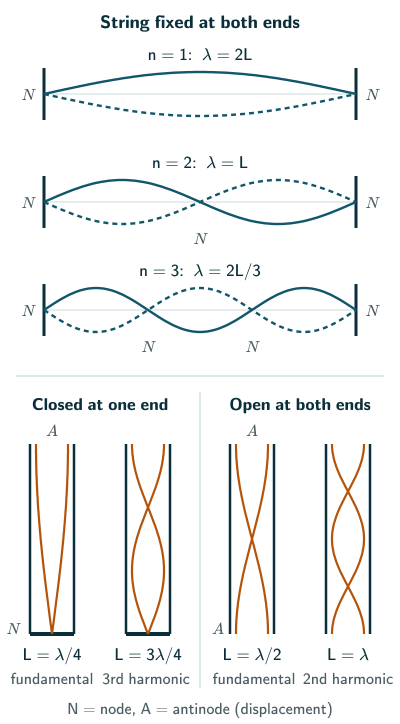
Standing waves on a string
A string of length L fixed at both ends must have nodes at x = 0 and x = L. So L must be a whole number of half-wavelengths (NCERT Eqs. 14.40–14.42):
Normal modes of a string fixed at both ends
with n = 1, 2, 3, …
Here v is the wave speed on the string, √(T/μ), set by the tension and the mass per unit length.
The lowest possible natural frequency of a system is called its fundamental mode or the first harmonic.
NCERT Physics Part II (Class 11), Section 14.6.1, page 291
- n = 1: the fundamental or first harmonic, ν1 = v/2L;
- n = 2: the second harmonic, 2ν1; n = 3: the third harmonic, 3ν1; and so on (NCERT Fig. 14.13).
A real string usually vibrates in a mixture of these modes. Where a sitar or violin string is plucked or bowed decides which modes are strongest, which is part of what gives each instrument its sound (page 291).
Standing waves in pipes
In an air column both displacement and pressure form standing-wave patterns. A closed end is a displacement node (where the pressure changes most); an open end is a displacement antinode (where the pressure changes least) (page 292). These are lossless long-wavelength pipe approximations: real open ends radiate sound and need an end correction.
Pipe closed at one end. A glass tube partly filled with water is an example: the water surface is a node and the open end an antinode. So L must be an odd number of quarter-wavelengths: L = (n + ½)λ/2 (NCERT Eqs. 14.43–14.44):
Normal modes of a pipe closed at one end
with n = 0, 1, 2, …
The fundamental is v/4L (n = 0), and only the odd harmonics 3v/4L, 5v/4L, … are present (NCERT Fig. 14.14). Note that NCERT counts these modes from n = 0, so its n is not the harmonic number: mode n is the (2n + 1)th harmonic.
Pipe open at both ends. Both ends are antinodes, so L is a whole number of half-wavelengths, and all harmonics are present: νn = nv/2L, n = 1, 2, 3, … (NCERT Fig. 14.15).
Harmonics and overtones. The modes above the fundamental are also called overtones: the first mode above the fundamental is the first overtone. For a string or an open pipe the pth overtone is the (p + 1)th harmonic, so the first overtone is 2ν1. For a closed pipe the pth overtone is the (2p + 1)th harmonic, so the first overtone is 3ν1. NCERT does not use the word overtone.
Resonance. Strings and air columns can also be driven by an outside vibration. When the driving frequency is close to one of the natural frequencies, the system responds strongly: resonance (page 292). This is how a resonance tube is used to measure the speed of sound (Example 6 below). (NCERT points to Chapter 13 for forced oscillations, but the current edition of that chapter does not cover them.) A drum skin such as a tabla has normal modes too, set by the condition that its clamped rim does not move; working them out is a two-dimensional problem (page 292).
Solved examples
Example 1: Open pipe or closed pipe? (NCERT Example 14.5)
A pipe 30.0 cm long is open at both ends. Which harmonic resonates with a 1.1 kHz source? Will it still resonate if one end is closed? Take v = 330 m s.
Open pipe: νn = nv/2L = n × 330/0.60 = 550n Hz. 1100 Hz = 2 × 550 Hz: the second harmonic.
Closed at one end: the fundamental is v/4L = 330/1.20 = 275 Hz, and only odd multiples are possible. 1100 Hz = 4 × 275 Hz would be the fourth harmonic, which a closed pipe cannot have. (NCERT’s answer cites Fig. 14.15 here; the closed-pipe modes are in NCERT Fig. 14.14.)
Answer: the second harmonic of the open pipe; no exact normal-mode resonance with this source once one end is closed, neglecting end corrections (pages 292–293).
Example 2: Harmonics of a string
A string 0.50 m long, fixed at both ends, carries waves at 200 m s. Find the first three natural frequencies and their wavelengths.
νn = nv/2L = n × 200/1.0 = 200n Hz; λn = 2L/n = 1.0/n m.
Answer: 200 Hz (1.0 m), 400 Hz (0.50 m), 600 Hz (about 0.33 m).
Example 3: From tension to pitch
A string 0.60 m long, with mass per unit length 2.0 × 10 kg m, is under a tension of 72 N. Find its fundamental frequency and second harmonic.
v = √(T/μ) = √(72/(2.0 × 10)) = √36 000, about 189.7 m s. ν1 = v/2L = 189.7/1.20, about 158 Hz; ν2 ≈ 316 Hz.
Answer: about 158 Hz and 316 Hz.
Example 4: Closed and open pipes of the same length
A pipe 25 cm long is used with v = 340 m s. Find its first three resonant frequencies (a) closed at one end, (b) open at both ends.
(a) v/4L = 340/1.0 = 340 Hz, then 3 × 340 = 1020 Hz and 5 × 340 = 1700 Hz.
(b) v/2L = 340/0.50 = 680 Hz, then 1360 Hz and 2040 Hz.
Answer: (a) 340, 1020, 1700 Hz; (b) 680, 1360, 2040 Hz. The open pipe’s fundamental is twice the closed pipe’s.
Example 5: Where are the nodes?
A standing wave on a string has wavelength 0.80 m, with a node at x = 0. Where are the nodes and antinodes?
Nodes at x = nλ/2 = 0, 0.40, 0.80 m, …; antinodes at (n + ½)λ/2 = 0.20, 0.60 m, …
Answer: nodes every 0.40 m starting at 0; antinodes midway, at 0.20 m, 0.60 m, …
Example 6: A resonance tube (beyond the NCERT text)
A 384 Hz tuning fork is held over a tube whose water level is lowered. Resonance is heard first with an air column of 21.5 cm and next at 66.5 cm. Find the speed of sound.
Successive resonances in a closed tube differ by half a wavelength: λ/2 = 66.5 − 21.5 = 45.0 cm, so λ = 90.0 cm. Then v = νλ = 384 × 0.900, about 346 m s.
The first resonance should be at λ/4 = 22.5 cm, but was found at 21.5 cm: the antinode sits a little above the open end. This end correction, about 1.0 cm here, cancels out when the difference of two lengths is used.
Answer: about 346 m s.
Common mistakes to avoid
Common mistake
Giving a closed pipe even harmonics
A pipe closed at one end has only odd harmonics: v/4L, 3v/4L, 5v/4L, … (Example 1).
Common mistake
Taking the node-to-node distance as λ
Adjacent nodes (or antinodes) are λ/2 apart; a node and the next antinode are λ/4 apart.
Common mistake
Thinking all points of a standing wave move in phase
Within one loop they do; points in neighbouring loops move in opposite phase.
Common mistake
Mixing up NCERT’s n with the harmonic number for a closed pipe
In ν = (n + ½)v/2L, n = 0 is the fundamental and n = 1 the third harmonic. The harmonic number is 2n + 1.
Common mistake
Swapping displacement and pressure nodes
A closed end is a displacement node but a pressure antinode; an open end is a displacement antinode but a pressure node. Reflection swaps too: at a closed end the displacement wave is inverted but the pressure wave is not; at an open end the pressure wave is inverted.
Common mistake
Calling a closed pipe’s first overtone its second harmonic
A closed pipe has no second harmonic; its first overtone is the third harmonic, 3v/4L.
Common mistake
Forgetting the phase change at a rigid end
A rigid end reflects a pulse upside down (phase change π); a free end reflects it the right way up.
Quick revision summary
- Displacement reflection: phase change π at an ideal rigid boundary; none at an ideal free boundary. Acoustic pressure has the opposite sign.
- Standing wave from two opposite waves: y = 2a sin kx cos ωt; amplitude depends on x, pattern does not travel.
- Nodes at x = nλ/2, antinodes at (n + ½)λ/2; neighbouring loops are in opposite phase.
- String fixed at both ends, or pipe open at both ends: νn = nv/2L, all harmonics.
- Pipe closed at one end: (2n + 1)v/4L, odd harmonics only.
- Ideal closed end: displacement node; ideal open end: displacement antinode. Real pipes need end corrections.
Formula sheet
- y = 2a sin kx cos ωt (standing wave)
- nodes: x = nλ/2; antinodes: x = (n + ½)λ/2
- νn = nv/2L (string fixed at both ends; pipe open at both ends)
- ν = (2n + 1)v/4L, n = 0, 1, 2, … (pipe closed at one end)
Questions students ask
What is the difference between a progressive wave and a stationary wave?
A progressive wave travels through the medium and carries energy along, while a stationary (standing) wave has a fixed nodal pattern and zero cycle-averaged energy flux. In a progressive wave in a uniform, lossless one-dimensional harmonic wave every particle oscillates with the same amplitude and the phase changes steadily from point to point, so no point is permanently at rest. In a stationary wave the amplitude, the size of 2a sin kx, varies from zero at the nodes, which are λ/2 apart, to 2a at the antinodes, and all non-node particles pass through their mean positions at the same instant; nodes remain at rest. Lossless spherical progressive waves can decrease in amplitude through geometric spreading.
What is the difference between an open and a closed organ pipe?
A closed organ pipe, closed at one end, has a displacement node at the closed end and an antinode at the open end, so its length holds an odd number of quarter-wavelengths and it gives only the odd harmonics of its fundamental v/4L. An open organ pipe has antinodes at both ends, so its length holds a whole number of half-wavelengths and it gives all the harmonics of its fundamental v/2L, which allows even as well as odd ideal modes. Actual tone also depends on how strongly each mode is excited. In practice the antinode lies a little beyond each open end, for a narrow unflanged opening in the long-wavelength limit, by an end correction e of about 0.3 times the diameter, so the effective lengths are L + e for a closed pipe and L + 2e for an open one.
Do stationary waves transfer energy?
An ideal stationary wave has local instantaneous energy exchange along each loop, but averaged over a cycle, no energy flows past any point, because the two equal waves that form it carry equal average energy in opposite directions. Within each loop the energy changes back and forth between kinetic energy, all of it at the instant the string passes straight through its mean position, and elastic potential energy, all of it at the extremes, while no mechanical energy flux crosses a displacement node of the ideal string wave. On a real string or air column, the energy lost to the air and the supports has to be made up by plucking, bowing, blowing or driving it.
What happens when a wave on a string reaches a junction with a heavier or a lighter string?
At a junction of two strings under the same tension, a wave is partly reflected and partly transmitted. Going from a lighter string to a heavier one (more mass per unit length, so a slower wave), the reflected wave is inverted, a phase change of π, as at a rigid end; going from a heavier string to a lighter one, it comes back upright, as at a free end. The transmitted wave is never inverted, and it keeps its frequency while its wavelength changes in proportion to the new wave speed (a step beyond the NCERT text).
How many nodes and antinodes does the nth harmonic of a string or an organ pipe have?
A string fixed at both ends vibrating in its nth harmonic has n loops, so n + 1 nodes (counting the two ends) and n antinodes, while a pipe open at both ends in its nth harmonic has n displacement nodes and n + 1 antinodes (counting the two open ends). A pipe closed at one end has only odd harmonics, and in its nth harmonic it has (n + 1)/2 nodes, including the closed end, and the same number of antinodes, including the open end. For example, the third harmonic of a closed pipe has two nodes and two antinodes, while the third harmonic of a string has four nodes and three antinodes.
Practice questions
Try each question first, then open the answer to check your working.
-
Q1. A pulse travels along a string to (a) a fixed end, (b) a free end. Describe the reflected pulse in each case.
Show answerHide answer
(a) It returns inverted: a phase change of π, because the fixed end cannot move. (b) It returns upright, with no phase change, and the free end moves twice as far as the incident pulse alone.
-
Q2. In a standing wave of wavelength 1.2 m, how far apart are adjacent nodes? A node and the nearest antinode?
Show answerHide answer
Adjacent nodes are λ/2 = 0.6 m apart; a node and the nearest antinode are λ/4 = 0.3 m apart.
-
Q3. Why can a pipe closed at one end not produce its second harmonic?
Show answerHide answer
The closed end must be a displacement node and the open end an antinode, so the pipe length must be an odd number of quarter-wavelengths. That allows only odd multiples of the fundamental v/4L.