Transverse and longitudinal waves
NCERT Class 11 Physics Chapter 14 Section 14.2
Quick answer
In a transverse wave, particles oscillate perpendicular to the direction of propagation; in a longitudinal wave they oscillate parallel to it. Ordinary plane sound waves in air are longitudinal because air has no static shear modulus, whereas solids can support both bulk types. Water surface waves combine horizontal and vertical motion, restored by gravity and surface tension.
With your textbook
NCERT Physics Part II (Class 11), Chapter 14 “Waves”, Section 14.2 “Transverse and longitudinal waves”, pages 280–281.
Open the official NCERT chapter (PDF, 2.0 MB, ncert.nic.in) (opens in a new tab)
Checked against the 2026-27 reprint on .
What are transverse and longitudinal waves?
Transverse and longitudinal waves
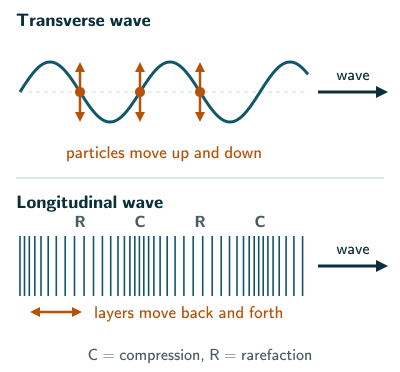
Mechanical waves are classified by the direction in which the particles of the medium oscillate (NCERT Section 14.2, pages 280–281):
- In a transverse wave the particles oscillate at right angles to the direction in which the wave travels, as in a wave on a stretched string.
- In a longitudinal wave the particles oscillate along the direction in which the wave travels, as in sound in air.
If the constituents of the medium oscillate perpendicular to the direction of wave propagation, we call the wave a transverse wave.
NCERT Physics Part II (Class 11), Section 14.2, page 280
In plain words: shake a rope up and down and the hump runs along it, while each bit of rope moves only up and down: that is transverse. Push and pull the end of a slinky along its length and a squashed region runs along it, while each coil moves only back and forth: that is longitudinal.
Transverse waves
A single up-and-down jerk at one end of a long stretched string sends a pulse along it (NCERT Fig. 14.2); a continuous sinusoidal up-and-down motion of the end sends a sinusoidal wave (NCERT Fig. 14.3). In both cases each element of the string moves up and down about its equilibrium position as the wave passes, at right angles to the string.
There are two ways to look at such a wave (page 280):
- fix an instant and look at the whole string: you see the shape of the wave in space, like a photograph;
- fix a point on the string and watch it: you see its oscillation in time.
Longitudinal waves
The most familiar longitudinal wave is sound. Picture a long pipe of air with a piston at one end (NCERT Fig. 14.4). One sudden push and pull of the piston sends a pulse of compressions (higher density; NCERT calls them condensations) and rarefactions (lower density) along the pipe; a continuous sinusoidal push and pull sends a sinusoidal wave. Each small volume of air oscillates back and forth along the length of the pipe, the direction in which the wave travels (pages 280–281).
Progressive waves. The examples above are travelling or progressive waves: they travel from one part of the medium to another, while the medium as a whole does not move (page 281). Both transverse and longitudinal waves can also form standing waves. Do not confuse a wave with a flow: a stream is water moving as a whole, while in a water wave it is the disturbance that moves, not the water as a whole; a wind is air moving as a whole, while a sound wave is a disturbance of pressure and density passing through the air (page 281). Beyond the NCERT text: a particle floating on water waves still drifts slowly in the direction the waves travel, the Stokes drift (Wikipedia, “Stokes drift”).
Which media carry which waves
In a mechanical transverse wave each element of the medium is pushed sideways relative to its neighbours: it undergoes a shearing strain. So mechanical transverse waves can travel through the body of a medium only if it resists shear, as solids do, and not as ordinary bulk shear waves in an ideal fluid. Viscosity can resist shear flow, but it supplies no static shear modulus. Every elastic medium, solid or fluid, resists compression, so longitudinal waves can travel through all of them (page 281). See shear modulus and bulk modulus.
- Steel carries both transverse and longitudinal waves.
- Air carries only longitudinal waves.
- In general, the two kinds travel at different speeds in the same medium (see the speed of a travelling wave).
Water waves are a special case. The rule above is about waves through the body of a fluid. A transverse wave needs some force that pulls a sideways-displaced element back: shear inside a solid, tension along a stretched string and, at a water surface, gravity or surface tension. Surface gravity and surface tension both contribute; the names below indicate which restoring effect dominates (page 281):
- capillary waves, short ripples, typically at centimetre and smaller wavelengths, dominated by surface tension;
- gravity waves, longer waves, including metre-scale ripples and ocean swell, dominated by gravity, which tends to restore a level surface.
In these waves the water particles move both up and down and back and forth, forming approximately circular orbits in deep water and flattened elliptical orbits in shallower water in linear theory. Deep-water motion decreases rapidly with depth; shallow-water waves move water throughout the depth. Surface waves therefore combine transverse and longitudinal displacement components.
Solved examples
Example 1: Classifying waves (NCERT Example 14.1)
State whether each wave is transverse, longitudinal or both: (a) a kink travelling along a long spring, made by moving one end sideways; (b) waves in a cylinder of liquid made by moving its piston back and forth; (c) waves made by a motorboat on water; (d) ultrasonic waves in air from a vibrating quartz crystal.
(a) NCERT classifies the real spring kink as having both transverse and longitudinal components. Its dominant motion is sideways; geometric stretching and coupling can also produce along-spring motion. In the ideal small-slope transverse-wave approximation, the longitudinal correction is neglected. State which model is being used. (b) The liquid is pushed and pulled along the cylinder: longitudinal. (c) Water waves: both. (d) Ultrasonic waves are sound waves in air, which can only be longitudinal.
Answer: (a) transverse and longitudinal; (b) longitudinal; (c) transverse and longitudinal; (d) longitudinal (page 281).
Example 2: Can sound in air be transverse?
Explain why sound cannot travel through air as a transverse wave.
A transverse wave travelling through the body of a medium needs one that resists being sheared, so that a sideways displacement of one layer pulls the next layer sideways. Air has no static shear modulus, so it has no elastic bulk restoring force for this sideways motion. It does resist compression; its viscosity resists shear flow but does not support the ordinary bulk shear wave considered here.
Answer: air can carry only longitudinal waves, so ordinary plane sound waves in air are longitudinal.
Example 3: How far away is the earthquake?
An earthquake sends out longitudinal P waves at 6.0 km/s and transverse S waves at 3.5 km/s. At a seismic station the S waves arrive 30 s after the P waves. How far away is the earthquake?
Assume both waves travel the same path at these steady speeds, and take d in km. The S waves take d/3.5 s and the P waves d/6.0 s, so d/3.5 − d/6.0 = 30. Since 1/3.5 − 1/6.0 = 2.5/21, d = 30 × 21/2.5 = 252 km.
Answer: 252 km (the P waves take 42 s, the S waves 72 s). This uses the fact that the two kinds of wave travel at different speeds in the same medium.
Example 4: What moves, and what does not?
A cork floats on the sea as waves pass, and a leaf blows past in the wind. In each case, is the medium moving as a whole?
The sea wave is a travelling disturbance: in linear theory the cork moves up and down and back and forth locally. Actual waves can add a slow Stokes drift, and background currents can also transport it. The wind is air moving as a whole: the leaf is carried along.
Answer: the leading-order wave motion is local oscillation; wind is bulk flow. Real seas can contain both wave motion and net transport.
Example 5: Ripples and swell
A ripple on a pond is 1 cm long from crest to crest; an ocean swell is 100 m from crest to crest. What restores the water surface in each case?
A wavelength of a centimetre or so is in the range of capillary waves; 100 m is in the range of gravity waves.
Answer: surface tension dominates for the 1 cm ripple; gravity dominates for the 100 m swell. Both restoring effects exist, and their relative importance changes continuously with wavelength.
Common mistakes to avoid
Common mistake
Calling sound in air transverse
Air has no static shear modulus, so ordinary plane sound waves in air are longitudinal. In solids, both kinds of wave are possible.
Common mistake
Calling water waves purely transverse
Water particles move both up and down and back and forth. Water waves combine transverse and longitudinal motion.
Common mistake
Applying ‘no transverse waves in fluids’ to the water surface
The rule is about waves through the body of a fluid, which has no static shear modulus. Surface waves are restored by gravity or surface tension instead.
Common mistake
Applying the shear rule to light
The rule is for mechanical waves. Light is a transverse electromagnetic wave and needs no medium: it crosses a vacuum and passes through air and water.
Common mistake
Mixing up a wave with a flow
A wave moves a disturbance and its energy; a stream or a wind moves the medium itself.
Common mistake
Assuming both kinds travel at the same speed
In the same medium, transverse and longitudinal waves generally have different speeds, which is how seismologists find how far away an earthquake is (Example 3).
Quick revision summary
- Transverse: particles oscillate at right angles to the direction of travel (string). Longitudinal: particles oscillate along it (sound in air).
- Longitudinal waves form compressions and rarefactions.
- Mechanical transverse waves through the body of a medium need one that resists shear (solids); on a string tension, and at a water surface gravity or surface tension, does the restoring instead. Longitudinal waves travel in any elastic medium.
- Steel carries both kinds; air only longitudinal; the two kinds generally travel at different speeds.
- Water surface waves combine both: capillary waves (surface tension) and gravity waves (gravity).
- Travelling (progressive) waves move a disturbance, not the medium as a whole.
Formula sheet
- distance = speed × time (for a wave travelling at constant speed)
- arrival gap: Δt = d/vS − d/vP (two waves of speeds vP and vS)
- distance from the gap: d = Δt × vP vS/(vP − vS)
Questions students ask
What is the difference between transverse and longitudinal waves?
Transverse and longitudinal waves differ in the direction in which the particles of the medium oscillate: at right angles to the direction of travel in a transverse wave, and along it in a longitudinal wave. So a transverse wave forms crests and troughs, while a longitudinal wave forms compressions and rarefactions, regions of higher and lower pressure and density. A mechanical transverse wave needs a force that resists sideways displacement, such as shear in a solid or tension in a string, so it cannot travel through the body of a liquid or gas, while longitudinal waves travel through solids, liquids and gases alike. A pure transverse plane wave has a choice of sideways oscillation direction; a pure longitudinal plane wave has only the propagation axis.
What are some examples of transverse and longitudinal waves?
Examples of transverse waves are waves on a stretched string, such as a sitar or guitar string, a rope shaken up and down at one end, the S waves of an earthquake and, among electromagnetic waves, light and radio waves. Examples of longitudinal waves are sound in air or water, ultrasound used in medical scans, the P waves of an earthquake and a push-and-pull pulse along a slinky. Water surface waves combine both kinds, and sound in a solid can travel in either form.
How are transverse and longitudinal waves alike?
Transverse and longitudinal waves are alike in most of their behaviour: both carry energy from place to place while each particle only oscillates about its own mean position, and both are described by the same progressive wave equation, with v = νλ. Both can be reflected and refracted, superpose, form standing waves and give beats. They differ in the direction of the particles’ oscillation, which decides which media can carry them and whether they can be polarised.
Why can’t longitudinal waves be polarised?
In the school-level meaning of transverse polarisation, a pure longitudinal plane wave cannot be polarised because their particles oscillate only along the direction of travel, so there is no choice of direction to select. Polarisation picks out one direction of oscillation in the plane at right angles to the direction of travel, which only a transverse wave has; this is how light was shown to be a transverse wave (a Class 12 idea). In a solid, the transverse (shear) waves can be polarised, though the longitudinal ones still cannot.
Why are longitudinal waves called pressure waves?
Longitudinal waves in a fluid, such as sound, are called pressure waves because they travel as a pattern of pressure changes: each compression is a region of slightly raised pressure and density, and each rarefaction a region of slightly lowered pressure, with a compression and the next rarefaction half a wavelength apart. A microphone or the eardrum responds to these pressure changes rather than to the tiny displacements of the air. In a sinusoidal plane progressive sound wave the magnitude of the pressure change is greatest where the displacement of the air is zero (a step beyond the NCERT text). For a 500 Hz sound in air at 340 m s, λ = 0.68 m, so a compression and the next rarefaction are 0.34 m apart.
Why do S waves not travel through the Earth’s outer core?
S waves (secondary waves) from an earthquake do not travel through the Earth’s outer core because they are transverse, and the outer core is a liquid iron-rich alloy with no static shear modulus. So stations more than about 104° of arc from the earthquake’s epicentre record no direct S waves, while the longitudinal P waves do cross the core, slowed and bent. The absence of transmitted shear waves, together with the behaviour of P waves, supports a liquid outer core; see the USGS explanation.
Practice questions
Try each question first, then open the answer to check your working.
-
Q1. Define a transverse wave and a longitudinal wave, and give one example of each.
Show answerHide answer
In a transverse wave the particles oscillate at right angles to the direction of travel, for example a wave on a stretched string. In a longitudinal wave they oscillate along the direction of travel, for example sound in air.
-
Q2. Why can transverse waves travel through steel but not through water?
Show answerHide answer
Transverse waves shear the medium. Steel resists shear, so it can pass the sideways motion on; water, a fluid, has no static shear modulus, so it cannot carry transverse waves through its body.
-
Q3. What are compressions and rarefactions?
Show answerHide answer
In a longitudinal wave the particles crowd together in some regions, compressions of higher density and pressure, and spread apart in others, rarefactions of lower density and pressure.