Speed of a travelling wave
NCERT Class 11 Physics Chapter 14 Section 14.4
Quick answer
A sinusoidal wave has phase speed v = λν = ω/k; in a nondispersive medium the speed is independent of frequency. For a uniform flexible string with small slopes, v = √(T/μ); for ordinary sound in a fluid, v = √(B/ρ), using the adiabatic bulk modulus. An ideal gas gives v = √(γP/ρ), about 331 m s for air at 0 °C.
With your textbook
NCERT Physics Part II (Class 11), Chapter 14 “Waves”, Section 14.4 “The speed of a travelling wave”, pages 284–287.
Open the official NCERT chapter (PDF, 2.0 MB, ncert.nic.in) (opens in a new tab)
Checked against the 2026-27 reprint on .
How fast does a wave travel?
Speed of a travelling wave
A sinusoidal wave advances one wavelength per period, so its phase speed is (NCERT Eqs. 14.11–14.12, Section 14.4, pages 284–287)
Equivalently, v is the wavelength divided by the period. For the following linear, nondispersive models, speed is measured relative to the medium and determined by its properties:
- transverse wave on a stretched string: v = √(T/μ), with T the tension and μ the mass per unit length;
- longitudinal wave (sound) in a fluid: v = √(B/ρ), with B the adiabatic bulk modulus and ρ the density; for a long-wavelength extensional wave in a thin solid bar, v = √(Y/ρ);
- sound in an ideal gas (Laplace): v = √(γP/ρ), about 331 m s in air at STP.
It should be noted that the speed of a mechanical wave is determined by the inertial (linear mass density for strings, mass density in general) and elastic properties (Young’s modulus for linear media/ shear modulus, bulk modulus) of the medium.
NCERT Physics Part II (Class 11), Section 14.4, page 284
In plain words: a stiffer medium snaps back faster and a heavier medium responds more sluggishly, so waves run fast in stiff, light media and slowly in soft, heavy ones. In the nondispersive model a sinusoidal driver sets the frequency, the medium fixes the speed, and the wavelength adjusts. In a dispersive medium the phase speed also varies with frequency.
Speed from the wave equation
For the progressive wave y = a sin(kx − ωt + φ), follow a point of fixed phase, such as a crest (NCERT Fig. 14.8). Its phase stays constant (NCERT Eq. 14.10):
In a short time Δt the point moves Δx, with kΔx − ωΔt = 0. So the speed is (NCERT Eq. 14.11)
With ω = 2πν = 2π/T, where T is the period, and k = 2π/λ, this is v = λν = λ/T (NCERT Eq. 14.12): in the time one element completes one oscillation, the pattern moves on one wavelength. For a single sinusoid this is the crest or phase speed (page 284). In a dispersive medium a packet of different frequencies need not keep its shape, and its group or energy speed can differ from ω/k.
Who decides what? For driven waves in a fixed nondispersive medium, the medium fixes the speed and the source fixes the frequency. Free vibrations instead have frequencies selected by the system and its boundary conditions. Then the wavelength follows (NCERT Eq. 14.15):
A medium that can carry both transverse and longitudinal waves, such as a solid, carries them at different speeds (page 285).
Transverse wave on a stretched string
Assume a uniform, taut, perfectly flexible string, small slopes, approximately constant tension and negligible bending stiffness. Then the restoring force comes from the tension T, and the inertia is the mass per unit length μ = m/L. The exact derivation uses Newton’s laws and is beyond the NCERT book, which uses dimensional analysis instead (NCERT Section 14.4.1, page 285):
- μ has dimensions [ML] and T, a force, [MLT];
- T/μ then has dimensions [MLT]/[ML] = [LT], the square of a speed;
- so v = C√(T/μ) (NCERT Eq. 14.13), where dimensional analysis cannot fix the number C.
(In the display of this step NCERT prints the denominator as [ML]; it should be [ML], as the text just above it says.) Newton’s laws in this ideal model give C = 1 (NCERT Eq. 14.14):
Speed of a transverse wave on a string
Within this model the speed depends only on the string and its tension, not on frequency (page 285). Real string stiffness and large amplitude can invalidate that approximation.
Longitudinal waves: the speed of sound
For a small-amplitude longitudinal wave in a fluid, the elastic property that matters is the bulk modulus B = −ΔP/(ΔV/V) (NCERT Eq. 14.16), which has the units of pressure, Pa. For ordinary sound use the local adiabatic derivative B = −V(∂P/∂V) at constant entropy; the finite-change expression is its small-change approximation. The inertia is the equilibrium density ρ. B/ρ has dimensions [MLT]/[ML] = [LT], again a speed squared. (NCERT’s display of this step, Eq. 14.17, prints the numerator as [MLT]; the dimensions of B are [MLT].) The exact derivation gives (NCERT Eqs. 14.18–14.19):
Speed of a longitudinal wave
For an extensional wave whose wavelength is much longer than the bar’s diameter, the lateral surfaces are free to move, so only a lengthwise stress acts and Young’s modulus takes the place of B: v = √(Y/ρ) (NCERT Eq. 14.20). (NCERT’s reason, that the bar’s lateral expansion is negligible, has it the wrong way round: if the sides could not move, the relevant modulus would be larger than Y.) In a bulk isotropic solid, the longitudinal plane-wave speed instead involves B + 4G/3, with G the shear modulus. Specify the wave type and geometry before choosing a modulus; the distinction is derived in this continuum-mechanics treatment of stress waves.
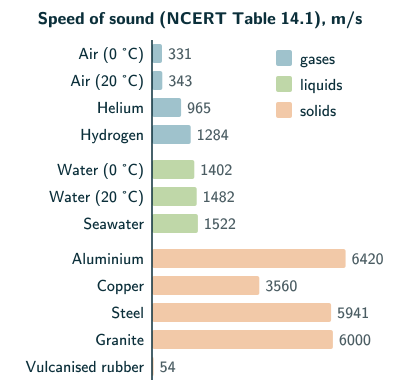
Why many solids and liquids carry sound faster than gases. They are denser than gases, which on its own would slow sound down. But they are far harder to compress, so their bulk modulus is larger by a much bigger factor, and the relevant elastic-modulus-to-density ratio often comes out larger (page 286). For solids use the modulus appropriate to the mode and geometry; the ordering is not universal.
Sound in a gas: Newton and Laplace
Newton’s formula. For an ideal gas, PV = NkBT (NCERT Eq. 14.21; see the ideal gas). Newton assumed the compressions happen at constant temperature. Then VΔP + PΔV = 0, so −ΔP/(ΔV/V) = P: the isothermal bulk modulus is B = P, and (NCERT Eq. 14.22)
For air at STP this gives about 280 m s (Example 2), about 15% below the measured 331 m s (page 287).
Laplace’s correction. In the ordinary small-amplitude acoustic regime, heat diffusion between compressed and rarefied regions is negligible during a cycle, and dissipation is small, so the local compression is approximately reversible and adiabatic, not isothermal. For a reversible adiabatic change of an ideal gas with approximately constant heat capacities, PVγ = constant, with γ = Cp/Cv. Then γPVγ−1ΔV + VγΔP = 0; dividing by Vγ, −ΔP/(ΔV/V) = γP. So the adiabatic bulk modulus is B = γP, and (NCERT Eq. 14.24)
Speed of sound in an ideal gas (Laplace)
For air, γ = 7/5, and this gives about 331 m s (NCERT quotes 331.3 m s), in agreement with experiment (page 287).
Temperature, not pressure (a step beyond the NCERT text). For an ideal gas P/ρ = RT/M, where R = 8.314 J mol K is the gas constant, T the absolute temperature (in kelvin) and M the molar mass, so v = √(γRT/M). For fixed composition and approximately constant γ, at a fixed temperature, raising the pressure raises the density in the same proportion, and the speed does not change. Raising the temperature does raise it: v ∝ √T (Example 4). Moist air is slightly less dense than dry air at the same pressure and temperature, so sound is slightly faster in humid air.
Solved examples
Example 1: A steel wire (NCERT Example 14.3)
A steel wire 0.72 m long has a mass of 5.0 × 10 kg and is under a tension of 60 N. Find the speed of transverse waves on it.
μ = 5.0 × 10/0.72, about 6.94 × 10 kg m (NCERT rounds to 6.9 × 10). Then v = √(T/μ) = √(60/(6.94 × 10)), about 93 m s.
Answer: about 93 m s (page 285).
Example 2: Sound in air, Newton and Laplace (NCERT Example 14.4)
Estimate the speed of sound in air at NCERT’s STP convention: 0 °C and approximately 1 atmosphere. The mass of 1 mole of air is 29.0 × 10 kg.
One mole occupies 22.4 × 10 m at STP, so ρ = (29.0 × 10)/(22.4 × 10), about 1.29 kg m. With P = 1.01 × 10 Pa, as NCERT uses:
Newton: v = √(P/ρ) = √(1.01 × 10/1.29), about 280 m s.
Laplace: v = √(γP/ρ) = √1.4 × 280, about 331 m s.
Answer: Newton’s formula gives about 280 m s (where NCERT Example 14.4 stops), about 15% too low; Laplace’s correction, from the text after the example, gives about 331 m s, matching the measured value (pages 286–287).
Example 3: Sound in water
The bulk modulus of water is about 2.2 × 10 Pa and its density 1000 kg m. Estimate the speed of sound in water.
v = √(B/ρ) = √(2.2 × 10/1000) = √(2.2 × 10), about 1483 m s.
Answer: about 1480 m s, close to the 1482 m s listed for water at 20 °C in NCERT Table 14.1.
Example 4: A warmer day
The speed of sound in air is 331 m s at 0 °C. Find it at 20 °C.
v ∝ √T, with T in kelvin: v = 331 × √(293/273), about 343 m s.
Answer: about 343 m s, as NCERT Table 14.1 lists for air at 20 °C.
Example 5: A guitar string
A string of mass per unit length 4.0 × 10 kg m is under a tension of 100 N. Find the wave speed, and the wavelength of a 440 Hz wave on it. What tension would double the speed?
v = √(100/(4.0 × 10)) = √25 000, about 158 m s. λ = v/ν = 158/440, about 0.36 m.
v ∝ √T, so doubling v needs four times the tension: 400 N.
Answer: about 158 m s, about 0.36 m, and 400 N.
Common mistakes to avoid
Common mistake
Thinking a higher frequency travels faster
In a fixed nondispersive medium the speed is independent of frequency. A higher frequency then has a shorter wavelength, λ = v/ν.
Common mistake
Confusing the wave speed with the speed of the particles
The wave speed v = ω/k is how fast the pattern moves, fixed by the medium. Each particle only oscillates about its place; its velocity keeps changing, has maximum speed aω, and depends on the amplitude. For a sinusoidal transverse string wave the ratio of maximum particle speed to wave speed is ak; the small-slope condition ak ≪ 1 makes this ratio small.
Common mistake
Forgetting that μ = ρA for a wire
If a problem gives a wire’s density ρ and cross-section A (or diameter), use μ = ρA, so v = √(T/(ρA)) = √(stress/ρ).
Common mistake
Using the total mass instead of μ
In v = √(T/μ), μ is the mass per unit length, m/L, not the mass of the string.
Common mistake
Using Newton’s formula for sound in a gas
Sound compressions are adiabatic, so use v = √(γP/ρ). The isothermal √(P/ρ) is about 15% too low for air.
Common mistake
Expecting the speed of sound to change with pressure
For an ideal gas of fixed composition and γ at fixed temperature, P/ρ stays the same as the pressure changes, so the speed does not. It does increase with temperature, as √T.
Common mistake
Thinking denser always means slower
Solids are denser than gases, yet sound travels much faster in them, because their elastic moduli are larger by a much bigger factor.
Quick revision summary
- Wave speed: v = ω/k = λν = λ/T (T the period); the medium sets v, the source sets ν, and λ = v/ν.
- Speed depends on an elastic property (restoring force) and an inertial property (mass density) of the medium.
- String: v = √(T/μ), independent of frequency and wavelength.
- Longitudinal waves: v = √(B/ρ) in a fluid, √(Y/ρ) in a solid bar.
- Gas: Newton’s isothermal √(P/ρ) ≈ 280 m s for air is too low; Laplace’s adiabatic √(γP/ρ) ≈ 331 m s is right.
- Many solids carry sound faster than liquids and gases, but material, mode and geometry matter.
Formula sheet
- v = λν = ω/k
- v = √(T/μ) (string)
- v = √(B/ρ) (fluid); v = √(Y/ρ) (solid bar)
- v = √(γP/ρ) (ideal gas, Laplace)
Questions students ask
What factors affect the speed of sound in air?
For ordinary small-amplitude sound, the ideal-gas approximation gives a speed that depends mainly on temperature, rising as √T (T in kelvin), and slightly on its humidity, because moist air is less dense than dry air at the same pressure and temperature. At a fixed temperature it does not depend on the pressure, nor on the frequency or loudness of an ordinary sound. For uniform wind along the propagation direction, ground-frame velocity is the sound velocity relative to air plus the wind velocity; downwind travel is faster and upwind travel slower. In other gases, v = √(γRT/M) shows that the speed also depends on γ and the molar mass M.
Why does the speed of sound increase with temperature?
The speed of sound in a gas increases with temperature because the molecules move faster and so pass the compressions and rarefactions on more quickly: in v = √(γP/ρ), heating the gas at constant pressure lowers its density, so that v = √(γRT/M) grows as the square root of the absolute temperature. Near room temperature this is about 0.6 m s for each 1 °C rise; for example, sound that travels at 331 m s in air at 0 °C travels at about 354 m s at 40 °C.
Which is faster, sound or light?
Light is far faster than sound: about 3.00 × 10 m s in air, against about 343 m s for sound in air at 20 °C, roughly 870 000 times faster, which is why a lightning flash is seen before its thunder is heard. Even in granite or steel, where sound travels at about 6000 m s, it is some 50 000 times slower than light in vacuum. Light, an electromagnetic wave, also crosses a vacuum, where sound cannot travel at all.
How does the speed of sound depend on the molar mass of a gas?
At the same temperature, the speed of sound in an ideal gas is inversely proportional to the square root of its molar mass, v = √(γRT/M) ∝ 1/√M, for gases with the same γ. Treating hydrogen and oxygen as classical diatomic gases with approximately γ = 7/5 in this temperature range, and oxygen’s molar mass (32 g mol) is 16 times hydrogen’s (2 g mol), so sound travels √16 = 4 times faster in hydrogen. At 0 °C, √(1.4 × 8.314 × 273/0.032) ≈ 315 m s in oxygen gives about 1260 m s in hydrogen, close to the 1284 m s listed in NCERT Table 14.1.
What is the speed of a transverse wave on a rope hanging under its own weight?
On a uniform rope hanging freely under its own weight, the local transverse characteristic speed at height y above the lower end is v = √(gy), because the tension there supports the rope below it, T = μgy, and v = √(T/μ), so the mass per unit length cancels. The wave therefore speeds up as it climbs, and integrating dt = dy/√(gy) gives the ideal characteristic travel-time estimate t = 2√(L/g) over length L. Tension varies with position, so a finite pulse need not retain its shape, and the zero-tension free end requires care; this is not a uniform-string solution (a step beyond the NCERT text). For a 4.9 m rope, t = 2√(4.9/9.8) ≈ 1.41 s, whatever the rope’s mass.
What is the ratio of the speed of sound to the rms speed of gas molecules?
The speed of sound in an ideal gas is √(γ/3) times the rms speed of its molecules, because v = √(γRT/M) while the rms speed is √(3RT/M). For a classical three-dimensional ideal gas with equilibrium heat capacities, γ ≤ 5/3, so the acoustic speed in this model is less than the rms molecular speed: for air, with γ = 7/5, the ratio is √(1.4/3) ≈ 0.68, so at 0 °C, where sound travels at 331 m s, the rms speed of the molecules is about 485 m s. This is a relation between two characteristic speeds in that model; the rms speed is not a maximum molecular speed or a general speed limit for collective waves.
Practice questions
Try each question first, then open the answer to check your working.
-
Q1. What two properties of a medium decide the speed of a mechanical wave in it? Give them for a stretched string.
Show answerHide answer
An elastic property, which supplies the restoring force, and an inertial property, the mass density. For a string they are the tension T and the mass per unit length μ: v = √(T/μ).
-
Q2. A string with μ = 0.02 kg m is under a tension of 50 N. Find the wave speed and the wavelength of a 25 Hz wave on it.
Show answerHide answer
v = √(50/0.02) = √2500 = 50 m s, and λ = 50/25 = 2 m.
-
Q3. What was wrong with Newton’s formula for the speed of sound in air, and how did Laplace correct it?
Show answerHide answer
Newton assumed the compressions and rarefactions were isothermal, giving B = P and about 280 m s. Laplace pointed out that they are too fast for heat to flow, so they are adiabatic: B = γP, giving v = √(γP/ρ), about 331 m s for air, which matches experiment.