Wave motion
NCERT Class 11 Physics Chapter 14 Section 14.1
Quick answer
A travelling wave is a propagating disturbance that can carry energy and information; in the small-amplitude mechanical-wave model, the medium oscillates locally rather than travelling with the pattern. Mechanical waves need a material medium, while electromagnetic waves can cross a vacuum at c = 299 792 458 m s. Real water waves can also cause a smaller net drift of water.
With your textbook
NCERT Physics Part II (Class 11), Chapter 14 “Waves”, Section 14.1 “Introduction”, pages 278–280.
Open the official NCERT chapter (PDF, 2.0 MB, ncert.nic.in) (opens in a new tab)
Checked against the 2026-27 reprint on .
What is a wave?
Wave
A travelling wave is a propagating disturbance that can carry energy and information. In the small-amplitude mechanical-wave model, the medium oscillates locally rather than travelling with the pattern (NCERT Section 14.1, pages 278–280). NCERT introduces three important kinds:
- mechanical waves, such as waves on a string, water waves, sound and seismic waves, which need a material medium;
- electromagnetic waves, such as light, radio waves and X-rays, which can also travel through a vacuum;
- matter waves, associated with electrons, protons, atoms and molecules.
These patterns, which move without the actual physical transfer or flow of matter as a whole, are called waves.
NCERT Physics Part II (Class 11), Section 14.1, page 278
In plain words: when a wave passes, in the ideal mechanical-wave model, each bit of the medium wobbles about its own place, and it is the wobble, the pattern, that moves on. A stadium “Mexican wave” is a good picture: the wave races round the stands, but every spectator stays in their seat. The analogy shows only the moving pattern: in a real wave, energy is also passed on from each bit of the medium to the next.
Energy travels through an oscillating medium
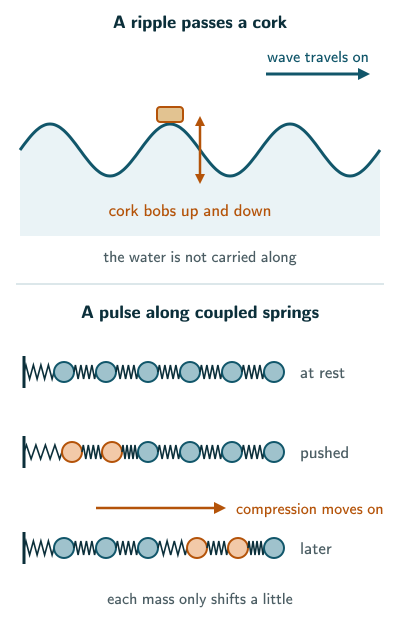
Drop a pebble into a still pond and circles spread outward from the point of disturbance. The cork example on page 278 illustrates that the disturbance travels much farther than an individual water particle. The cork bobs as the ripple passes; actual surface-wave motion also has a horizontal component. In the first-order small-wave model the particles follow nearly closed orbits. Real waves can produce a smaller net drift (Stokes drift), and currents can carry the cork along: “energy, not matter” describes the leading-order oscillation, not an exact prohibition on fluid transport.
The same is true of sound: when we speak, ordinary sound travels outward through local pressure and density oscillations; it does not require a bulk air current from speaker to listener (page 278). Waves carry energy, and the pattern of the disturbance carries information: speech is the production of sound waves and hearing is their detection, and most of our communication depends on sending signals as waves, often turning sound into an electric signal and then into an electromagnetic wave sent along an optical cable or via a satellite (pages 278–279).
Kinds of waves
Not all waves require a medium for their propagation.
NCERT Physics Part II (Class 11), Section 14.1, page 279
Mechanical waves need a material medium and cannot travel through a vacuum. They involve oscillations of the particles of the medium, and their behaviour depends on its elastic properties. This chapter deals with them; they can be transverse or longitudinal.
Electromagnetic waves, studied in Class 12, do not need a medium: light from stars hundreds of light years away reaches us across interstellar space, which is practically a vacuum. In a vacuum all electromagnetic waves travel at the same speed (NCERT Eq. 14.1):
Speed of electromagnetic waves in a vacuum
Matter waves arise in the quantum description of nature: a wavefunction describes the quantum state, rather than a mechanical displacement of an underlying material medium. They are more abstract, but they are already used in technology: electron microscopes use the matter waves of electrons (page 279).
How a medium carries a wave
Waves in elastic media are closely tied to the oscillations of masses on springs (page 279):
- Coupled springs. Pull the spring at one end of a chain of springs and release it: the disturbance travels to the other end, though each spring only oscillates a little about its equilibrium length (NCERT Fig. 14.1). The bogies of a stationary train behave similarly: a push from the engine is transmitted from bogie to bogie through the spring couplings before the entire train responds. This illustrates transmission of a disturbance; an unrestrained train can also acquire overall motion.
- Sound in air. A sound wave compresses or expands small regions of air. A change in density, δρ, causes a change in pressure, δp. A spatial pressure difference across an air element supplies the net force; for small disturbances pressure changes are proportional to density changes, as in a linear spring model; here the change in density plays the part of the spring’s extension or compression. A compressed region pushes air into its neighbour, compressing it, and is itself left rarefied; air rushes into a rarefied region from around it. So compressions and rarefactions pass from region to region.
- Solids. In a crystal, atoms sit in a regular lattice, each held in place by forces from its neighbours. Displace one atom a little and restoring forces act, just as in a spring, so a solid behaves like masses joined by springs (page 280).
NCERT highlights seventeenth-century studies of waves, with Christiaan Huygens (1629–1695), Robert Hooke and Isaac Newton among the pioneers (page 279).
Solved examples
Take c = 3.00 × 10 m s where three figures are enough.
Example 1: Light from a distant star
Light from a star 100 light years away reaches the Earth. How long did it travel, and how far?
A light year is the distance light travels in a year: 299 792 458 m s × (365.25 × 24 × 3600 s), about 9.46 × 10 m. (NCERT Part I, Chapter 1, page 5, gives 9.47 × 10 m because it rounds c up to 3.00 × 10 m s.)
Answer: it travelled for 100 years, a distance of about 9.46 × 10 m, almost all of it through near-vacuum. No mechanical wave could make that journey.
Example 2: A radio signal to the Moon
A radio signal is sent to a spacecraft at the Moon, about 3.84 × 10 m away (the Earth–Moon distance NCERT uses in Example 7.6, Part I, page 138). How long does it take to arrive, and how long before a reply can arrive back?
Radio waves are electromagnetic, so they travel at c: t = 3.84 × 10/(3.00 × 10), about 1.28 s.
Answer: about 1.28 s one way, and at least 2.56 s for a reply.
Example 3: Lightning and thunder
Thunder is heard 3.0 s after a lightning flash. How far away was the strike? Take the speed of sound in air as 343 m s, the value NCERT uses for dry air at 20 °C (Exercise 14.3, page 297; see the speed of sound).
The flash reaches you almost at once: light covers 1 km in about 3 µs. So the 3.0 s delay is the travel time of the sound: 3.0 × 343, about 1030 m.
Answer: about 1 km away.
Example 4: Sunlight is old news
The Sun is about 1.5 × 10 m away. How long has the sunlight travelled since leaving the Sun’s visible surface?
t = 1.5 × 10/(3.0 × 10) = 500 s, about 8.3 minutes.
Answer: about 8.3 minutes in transit from the visible surface to Earth. This does not measure the earlier transport of energy inside the Sun.
Example 5: Medium or no medium?
Which of these need a material medium: (a) the sound of a bell, (b) radio signals from a space probe, (c) seismic waves from an earthquake, (d) X-rays?
Sound and seismic waves are mechanical waves; radio waves and X-rays are electromagnetic.
Answer: (a) and (c) need a medium; (b) and (d) do not. A bell ringing inside a jar grows fainter and fainter as the air is pumped out.
Common mistakes to avoid
Common mistake
Thinking the medium travels with the wave
In the small-amplitude model each particle oscillates locally while the wave pattern travels. A cork also has horizontal orbital motion, and real water waves can produce slow drift.
Common mistake
Saying every wave needs a medium
Mechanical waves do; electromagnetic waves do not. Light crosses the near-vacuum of space.
Common mistake
Calling light a mechanical wave
Light, radio waves and X-rays are electromagnetic waves. All of them travel at the same speed c in a vacuum.
Common mistake
Thinking sound is moving air
Wind is air moving from one place to another; an ordinary sound wave is a small oscillatory disturbance superposed on the air’s background state (NCERT Points to ponder, page 297).
Common mistake
Thinking elasticity alone is enough
A mechanical wave needs a medium with both elasticity, to supply restoring forces, and inertia (mass); its speed depends on both (NCERT Points to ponder, page 297).
Common mistake
Forgetting that waves carry energy
A travelling wave can carry energy and information without requiring bulk transport of the medium, which is how sound reaches your ear and signals reach your phone.
Quick revision summary
- A travelling wave can carry energy and information; local oscillation differs from bulk flow. Real fluid waves may also cause small net drift.
- Mechanical waves (string, water, sound, seismic) need a material medium; small-amplitude motion is described as oscillation about the background state.
- Electromagnetic waves (light, radio, X-rays) need no medium and travel at c = 299 792 458 m s in a vacuum.
- Matter waves belong to particles such as electrons; electron microscopes use them.
- A medium carries a wave because its parts are coupled by restoring forces, like masses joined by springs.
Formula sheet
- c = 299 792 458 m s (all electromagnetic waves, in a vacuum)
- distance = speed × time (for a wave travelling at constant speed)
- 1 light year = c × 1 year ≈ 9.46 × 10 m
Questions students ask
What is the difference between mechanical and electromagnetic waves?
Mechanical and electromagnetic waves differ in what oscillates: a mechanical wave is an oscillation of the particles of a material medium, so it cannot cross a vacuum, while an electromagnetic wave is an oscillation of electric and magnetic fields, which needs no medium. The speed of a mechanical wave is set by the elasticity and density of its medium, as for sound at about 343 m s in air at 20 °C, while all electromagnetic waves travel at the same speed c ≈ 3.00 × 10 m s in a vacuum. Mechanical waves can be transverse or longitudinal, while electromagnetic waves in free space are transverse.
What are the characteristics of wave motion?
For a small-amplitude travelling mechanical wave, the disturbance propagates while the medium oscillates locally. In a fixed nondispersive medium, a sinusoidal driver sets the frequency and the medium sets the speed. Frequency is preserved across a stationary, linear interface; a moving boundary can change it. Waves can be reflected and refracted, and in a linear system, where two waves meet their displacements add, by the principle of superposition, before each travels on unchanged.
Why is wave motion called doubly periodic?
Wave motion is called doubly periodic because a periodic wave, such as a sinusoidal one, repeats itself both in space and in time. At a fixed instant the pattern repeats every wavelength λ along the direction of travel, and at a fixed place each particle repeats its motion every period T; in the progressive wave equation y = a sin(kx − ωt), these are the changes of x by 2π/k and of t by 2π/ω. The two periods are linked by the wave speed, v = λ/T, while a single pulse is not periodic in either sense.
What are the main formulas of wave motion in Class 11?
The main formulas of Class 11 wave motion are the wave speed v = νλ = ω/k, the progressive wave y = a sin(kx − ωt + φ) with k = 2π/λ and ω = 2πν, and the wave speeds √(T/μ) on a string and √(γP/ρ) in a gas. For standing waves, a string fixed at both ends or an open pipe has nv/2L (n = 1, 2, 3, …), and a pipe closed at one end has (2n + 1)v/4L (n = 0, 1, 2, …); two close frequencies give beats at |ν − ν|.
Which topics does this Waves unit cover?
This unit covers wave motion, longitudinal and transverse waves, wave speed, the progressive-wave equation, superposition, reflection, standing waves in strings and organ pipes, harmonics and beats. The resonance tube experiment adds a practical measurement of sound speed. Use the official syllabus for your exam year to check assessed coverage; omission of a named effect here is not a guarantee about every possible application question.
Practice questions
Try each question first, then open the answer to check your working.
-
Q1. A cork floats on a pond as ripples pass. Describe its motion and explain what it shows about waves.
Show answerHide answer
The cork bobs and also moves horizontally as the wave passes. In the first-order model it oscillates locally while the disturbance and energy travel outward; real waves may add a smaller net drift.
-
Q2. A ship’s horn is heard 1.7 km away. Taking the speed of sound in air as 343 m s, how long after it sounds is it heard?
Show answerHide answer
t = 1700/343, about 4.96 s, roughly 5 s.
-
Q3. Why can astronauts on the Moon not talk to each other directly through the airless space between them, though they can talk by radio?
Show answerHide answer
Sound is a mechanical wave and needs a medium; the Moon’s extremely tenuous exosphere cannot carry ordinary speech between them. Radio waves are electromagnetic and travel through a vacuum.