Principle of superposition of waves
NCERT Class 11 Physics Chapter 14 Section 14.5
Quick answer
In a linear wave system, overlapping scalar displacements add as y = y + y, and each wave continues according to the same linear equation. Equal-amplitude harmonic waves with the same frequency, wavelength and propagation direction have resultant amplitude A = |2a cos(φ/2)|. They reinforce in phase and cancel at an odd multiple of π in phase difference.
With your textbook
NCERT Physics Part II (Class 11), Chapter 14 “Waves”, Section 14.5 “The principle of superposition of waves”, pages 287–288.
Open the official NCERT chapter (PDF, 2.0 MB, ncert.nic.in) (opens in a new tab)
Checked against the 2026-27 reprint on .
What is the principle of superposition?
Principle of superposition of waves
In a linear wave system, when two or more waves overlap, the displacement at every point and every instant is the algebraic sum of the displacements the waves would cause separately (NCERT Eq. 14.25, Section 14.5, pages 287–288):
Each wave travels on as if the others were not there.
When the pulses overlap, the resultant displacement is the algebraic sum of the displacement due to each pulse.
NCERT Physics Part II (Class 11), Section 14.5, page 287
In plain words: small-amplitude waves in the linear model do not bump into each other like balls. Where they overlap, their displacements simply add up, with signs, and afterwards each one carries on exactly as before.
Two pulses crossing
Send two small pulses towards each other along an ideal uniform string. While they overlap the string has a shape different from either pulse; once they have passed, each pulse continues with its own shape (page 287).
NCERT Fig. 14.9 shows the dramatic case of two pulses of equal and opposite shape. At the instant they exactly overlap, their displacements cancel at every point and the string is momentarily straight. A moment later both pulses reappear and move apart unchanged.
Where has the wave gone at that instant? (A step beyond the NCERT text.) The string is straight, so there is no displacement, but it is still moving: the energy is all kinetic energy of the string at that moment, which is why the pulses can re-emerge.
For any number of waves the same rule applies (NCERT Eq. 14.26): the total displacement is the sum of all the separate wave functions. (NCERT writes each wave as f(x − vt), all moving the same way; the principle holds just as well for waves moving in opposite directions, like the pulses of Fig. 14.9. Two equal harmonic waves moving in opposite directions superpose to give a standing wave.)
The principle of superposition is basic to the phenomenon of interference.
NCERT Physics Part II (Class 11), Section 14.5, page 288
Two harmonic waves with a phase difference
Take two harmonic waves on a string with the same ω and k (so the same wavelength and speed), the same amplitude a, both moving along +x, differing only in phase by φ (NCERT Eqs. 14.27–14.28):
Their sum (NCERT Eq. 14.29) follows from sin A + sin B = 2 sin[(A + B)/2] × cos[(A − B)/2]. Put A = kx − ωt + φ and B = kx − ωt: then (A + B)/2 = kx − ωt + φ/2 and (A − B)/2 = φ/2, so (NCERT Eqs. 14.30–14.31)
This is again a harmonic wave travelling along +x with the same frequency and wavelength. Its phase is φ/2 when cos(φ/2) is positive, and shifted by π when that factor is negative; when the resultant is zero its phase is undefined. Its amplitude depends on the phase difference (NCERT Eq. 14.32):
Amplitude of the resultant wave
Amplitude is nonnegative. The signed coefficient 2a cos(φ/2) in the wave equation may be negative; that sign is absorbed into a phase shift of π.
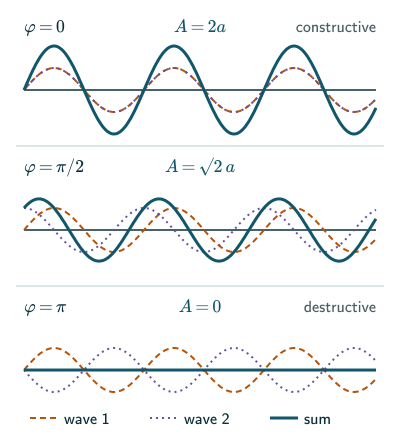
Constructive and destructive interference
- In phase, φ = 0 (and, beyond the NCERT text, any multiple of 2π): y = 2a sin(kx − ωt) (NCERT Eq. 14.33). The amplitudes add to 2a, the largest possible. This is constructive interference.
- Completely out of phase, φ = π (or 3π, 5π, …): y = 0 everywhere at all times (NCERT Eq. 14.34). The amplitudes subtract to zero. This is destructive interference.
- In between, the amplitude lies between 0 and 2a: for example √2 a at φ = π/2.
If the amplitudes are unequal, a1 and a2 (beyond the NCERT text):
so A ranges from a1 + a2 (in phase) down to |a1 − a2| (out of phase). Cancellation is complete only for equal amplitudes.
These cases are on page 288. Interference of scalar sound pressure and of the same-polarisation components of light follows this linear rule; general vector disturbances add vectorially. In terms of a path difference Δx between two waves from sources in phase (beyond the NCERT text), φ = 2πΔx/λ: a path difference of a whole number of wavelengths gives constructive interference, and an odd number of half-wavelengths gives destructive interference.
Solved examples
Example 1: A resultant amplitude
Two waves of amplitude 3 mm, the same frequency and wavelength, travel the same way with a phase difference of π/3. Find the amplitude of the resultant.
A = 2a cos(φ/2) = 2 × 3 × cos(π/6) = 6 × 0.866, about 5.2 mm.
Answer: about 5.2 mm.
Example 2: When does the sum equal one wave?
For what phase difference does the resultant of two equal waves of amplitude a have amplitude a?
2a cos(φ/2) = a gives cos(φ/2) = ½, so φ/2 = π/3 and φ = 2π/3.
Answer: the smaller phase separation is 2π/3 (120°). The complete solutions are φ = ±2π/3 modulo 2π, because amplitude uses the absolute value.
Example 3: Two pulses meeting
A pulse 2 cm high and a pulse 1 cm high travel towards each other on a string. What is the displacement at the point where their crests coincide if they are (a) on the same side of the string, (b) on opposite sides?
Displacements add algebraically. (a) 2 + 1 = 3 cm. (b) 2 + (−1) = 1 cm.
Answer: (a) 3 cm; (b) 1 cm, on the side of the larger pulse. After they pass, each pulse continues unchanged.
Example 4: Waves a quarter-cycle apart
Find the resultant of y1 = 4 sin(kx − ωt) and y2 = 4 sin(kx − ωt + π/2), in mm.
A = 2 × 4 × cos(π/4) = 8 × 0.707, about 5.66 mm, and the phase is φ/2 = π/4.
Answer: y = 5.66 sin(kx − ωt + π/4) mm.
Example 5: Amplitude and intensity
Two equal waves travelling the same way meet first with a phase difference of π/2, then in phase. How many times the energy carried by one wave does the resultant carry? (For the same frequency and medium, the energy of a wave goes as the square of its amplitude: a step beyond the NCERT text.)
At φ = π/2, A = √2 a, so A = 2a: twice one wave. In phase, A = 2a, so A = 4a: four times one wave.
Answer: 2 times and 4 times. Displacements add; energies do not simply add. In phase the resultant carries more than the two waves separately (4 times instead of 2); completely out of phase it carries none. For co-propagating waves this changes the work needed to maintain the specified source amplitudes; one cannot assume the combined source power remains the sum of two isolated-source powers. In spatial interference patterns energy can also be redistributed, but conservation must include the sources and the full energy flux.
Common mistakes to avoid
Common mistake
Adding amplitudes without the phase
Two waves of amplitude a give 2a only when in phase. In general its amplitude is |2a cos(φ/2)|.
Common mistake
Forgetting the half
The amplitude is |2a cos(φ/2)|, not |2a cos φ|. At φ = π/2, for example, it is √2 a, not zero.
Common mistake
Reading the phase difference from mixed forms
Write both waves in the same form first. a cos(kx − ωt) = a sin(kx − ωt + π/2), a phase difference of π/2 from a sin(kx − ωt); a sin(ωt − kx) = a sin(kx − ωt + π), completely out of phase with it.
Common mistake
Thinking cancelled waves are destroyed
Two opposite pulses cancel only while they overlap. Afterwards both continue unchanged, because each travels as if the other were not there.
Common mistake
Thinking energy disappears at cancellation
When equal, opposite-shaped pulses travelling in opposite directions cancel everywhere on an ideal string, it is straight but moving: energy is kinetic at that instant. This differs from two opposite co-propagating waves that cancel both displacement and velocity; their source-energy balance must be included.
Common mistake
Adding something other than displacements
Superposition adds the displacements at each point and instant. It is the displacement, with its sign, that adds, not the wave speeds or their energies. A sum of opposite travelling waves can be stationary, so the resultant need not itself be one travelling wave.
Quick revision summary
- Superposition in a linear system: where waves overlap, y = y1 + y2 at every point and instant; each wave moves on as if alone.
- Equal and opposite pulses cancel momentarily, then separate unchanged.
- Two equal harmonic waves moving the same way with phase difference φ: y = 2a cos(φ/2) × sin(kx − ωt + φ/2).
- Resultant amplitude A = |2a cos(φ/2)|: 2a in phase (constructive), 0 for φ = π (destructive).
- Superposition is the basis of interference.
Formula sheet
- y = y + y (at every x and t)
- y = 2a cos(φ/2) sin(kx − ωt + φ/2)
- A = |2a cos(φ/2)|
- φ = 0: A = 2a (constructive); φ = π: A = 0 (destructive)
Questions students ask
What is the difference between superposition and interference of waves?
Superposition is the general rule for overlapping waves, that their displacements add at every point and instant, while interference is one result of it: the steady pattern of reinforcement and cancellation when waves of the same frequency, with a constant phase difference, overlap. Applied to two equal waves travelling in opposite directions, the same rule gives a standing wave; applied to waves of slightly different frequencies, it gives beats, a rise and fall of loudness in time. So every interference pattern comes from superposition, but not every superposition gives a steady pattern.
What are the conditions for sustained interference of waves?
Sustained (steady) interference needs coherent sources: waves of the same frequency whose phase difference stays constant in time, so that the places of reinforcement and cancellation stay fixed. For a clear pattern the two amplitudes should also be equal or nearly equal, so that the minima are close to zero, and transverse waves should have a shared polarisation component; identical polarisations give full contrast for equal amplitudes. Two loudspeakers driven by the same oscillator are coherent; two independent sources, such as two light bulbs, are not, because their phases change randomly.
How do you find the maximum and minimum intensity when two waves interfere?
For two coherent, same-polarisation waves with a common propagation direction and amplitudes a1 and a2 interfere, the resultant amplitude follows A = a12 + a22 + 2a1a2 cos φ, and the intensity goes as A (for the same frequency and medium). So the intensity is greatest where the waves are in phase, Imax ∝ (a1 + a2), and least where they are completely out of phase, Imin ∝ (a1 − a2). For example, amplitudes in the ratio 3 : 2 give Imax/Imin = (3 + 2)/(3 − 2) = 25.
Does the principle of superposition always hold?
No, the principle of superposition holds only for linear waves, whose governing equations and boundary conditions are linear. For a stretched string the net force is related to curvature, not simply to local displacement; the small-slope approximation makes the wave equation linear. Waves on strings, ordinary sound and ripples on water obey it very closely, and so does light in a vacuum. Very large disturbances, such as the shock wave from an explosion or waves breaking on a beach, do not simply add, because the medium no longer responds in proportion to the disturbance (a step beyond the NCERT text).
Practice questions
Try each question first, then open the answer to check your working.
-
Q1. State the principle of superposition of waves.
Show answerHide answer
When two or more waves overlap, the resultant displacement at any point and instant is the algebraic sum of the displacements due to each wave separately; each wave travels as if the others were absent.
-
Q2. Two waves of amplitude 4.0 mm, the same frequency and wavelength, travel the same way and differ in phase by π/4. Find the resultant amplitude.
Show answerHide answer
A = 2 × 4.0 × cos(π/8) = 8.0 × 0.924, about 7.4 mm.
-
Q3. What is the difference between constructive and destructive interference?
Show answerHide answer
In constructive interference the waves are in phase and their amplitudes add, giving the largest resultant (2a for equal waves). In destructive interference they are completely out of phase and their amplitudes subtract, giving zero for equal waves.