Displacement relation for a progressive wave
NCERT Class 11 Physics Chapter 14 Section 14.3
Quick answer
For positive k and ω, a sinusoidal wave travelling along +x has y(x, t) = a sin(kx − ωt + φ), with amplitude a and phase constant φ. Here k = 2π/λ and ω = 2π/T; fixed x labels a material element at its equilibrium position. Replacing kx − ωt by kx + ωt reverses the direction of travel.
With your textbook
NCERT Physics Part II (Class 11), Chapter 14 “Waves”, Section 14.3 “Displacement relation in a progressive wave”, pages 281–284.
Open the official NCERT chapter (PDF, 2.0 MB, ncert.nic.in) (opens in a new tab)
Checked against the 2026-27 reprint on .
What is the equation of a progressive wave?
Displacement relation for a progressive wave
A sinusoidal wave travelling in the positive x direction is described by NCERT Eq. 14.2 (Section 14.3, page 281), with a > 0, k > 0, ω > 0 and y = y(x, t):
- y(x, t): displacement at time t of the material element labelled by equilibrium coordinate x;
- a: amplitude, the largest displacement magnitude;
- k: angular wave number, k = 2π/λ, where λ is the wavelength;
- ω: angular frequency, ω = 2π/T = 2πν;
- kx − ωt + φ: the phase; φ, its value at x = 0 and t = 0, is the initial phase angle.
A wave travelling in the negative x direction has kx + ωt in place of kx − ωt (NCERT Eq. 14.4).
The minimum distance between two points having the same phase is called the wavelength of the wave, usually denoted by λ.
NCERT Physics Part II (Class 11), Section 14.3.2, page 283
In plain words: one formula holds the whole wave. Freeze time and it draws the wave’s shape along the string; stand at one place and it tells you how that bit of string bobs up and down; and the minus sign between kx and ωt says which way the pattern is sliding.
Why the equation describes a travelling wave
Look at NCERT Eq. 14.2 in three ways (pages 281–282):
- Fix the time, t = t0. The argument is kx + constant, so the shape of the string at that instant is a sine curve in x.
- Fix the place, x = x0. The argument is constant − ωt, so the element there moves sinusoidally in time: every element performs simple harmonic motion.
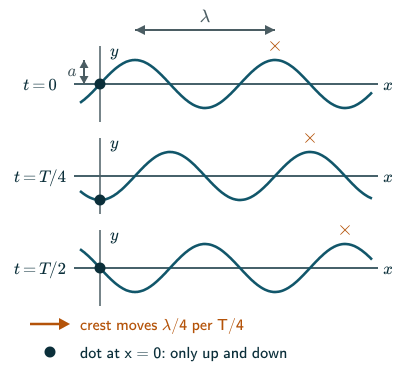
- Follow a point of fixed phase, such as a crest. To keep kx − ωt + φ constant as t increases, x must increase. So the whole pattern moves in the +x direction.
The phase constant. φ is also called the phase constant. Including it is the same as using a combination of sine and cosine (NCERT Eq. 14.3), here with θ = kx − ωt:
with a = √(A + B) and tan φ = B/A. (NCERT writes φ = tan(B/A); that holds as written only when A is positive. In general choose φ so that cos φ has the sign of A and sin φ the sign of B.) By choosing the origin of x and t suitably, φ for one wave can be made zero (page 282). This does not remove the physically meaningful relative phase between two waves.
Amplitude and phase
Since the sine runs from −1 to +1, y runs from −a to +a. The amplitude a is taken as positive: it is the largest magnitude of displacement of the elements from their equilibrium positions, while y itself can be positive or negative (NCERT Section 14.3.1, page 282).
The argument kx − ωt + φ is the phase of the wave: given the amplitude, it fixes the displacement at any place and time. Its value at x = 0 and t = 0 is φ, the initial phase angle. (NCERT’s table of symbols, Fig. 14.5 on page 282, labels the whole expression kx − ωt + φ as the initial phase angle. The text on the same page gets it right: the whole expression is the phase, and only φ is the initial phase angle.)
Phase difference between two points. At one instant, two points a distance Δx apart differ in phase by kΔx = 2πΔx/λ. At one place, the signed change from t to t + Δt is −ωΔt for this +x wave. Its magnitude is ω|Δt| = 2π|Δt|/T (Example 3).
Wavelength and angular wave number
At t = 0, with φ = 0, the displacement is y(x, 0) = a sin kx (NCERT Eq. 14.5). The sine repeats when kx grows by 2π, so the shape repeats every 2π/k. That distance between consecutive crests (or troughs) is the wavelength (NCERT Eq. 14.6):
Wavelength and angular wave number
k is the angular wave number or propagation constant. Its SI unit is the radian per metre, often written simply as m (page 283). Think of it as 2π times the number of waves that fit into one metre.
Careful: two points with the same displacement need not be a wavelength apart. Two points just either side of a crest have equal y but move in opposite directions. Only points in the same phase (same displacement and same direction of motion) are a whole number of wavelengths apart; points λ/2 apart are always in opposite phase. (NCERT’s derivation on page 283 speaks of points with the same displacement; it is points with the same phase that define λ.)
Period, angular frequency and frequency
Now watch one element, say at x = 0, with φ = 0: y(0, t) = a sin(−ωt) = −a sin ωt (NCERT page 283; plotted in NCERT Fig. 14.7). The period T is the time for that element to complete one full oscillation. The sine repeats when ωt grows by 2π, so ωT = 2π (NCERT Eqs. 14.7–14.8):
Angular frequency, period and frequency
ω is the angular frequency of the wave, in rad s, like an angular velocity; ν is the frequency, in hertz (page 283).
Longitudinal waves
Everything above was worked out for a transverse wave on a string, but it applies equally to a longitudinal wave. There the displacement s of an element is along the direction of travel (NCERT Eq. 14.9):
where s = s(x, t) and a is now the displacement amplitude along x; k, ω and φ mean the same as before (page 283). Here x labels equilibrium position: the actual longitudinal position of that element is x + s(x,t).
Solved examples
Example 1: Reading a wave equation (NCERT Example 14.2)
A wave on a string is y(x, t) = 0.005 sin(80.0x − 3.0t), in SI units. Find (a) the amplitude, (b) the wavelength, (c) the period and frequency, and the displacement at x = 30.0 cm and t = 20 s.
Comparing with y = a sin(kx − ωt): a = 0.005 m, k = 80.0 rad m, ω = 3.0 rad s.
(a) a = 5 mm. (b) λ = 2π/80.0, about 0.0785 m = 7.85 cm. (c) T = 2π/3.0, about 2.09 s, and ν = 1/T, about 0.48 Hz.
Displacement: with x = 30.0 cm = 0.300 m, the phase is 80.0 × 0.300 − 3.0 × 20 = −36 rad. Adding 12π (six whole turns, which leaves the sine unchanged) gives about 1.699 rad, that is about 97.4°. So y = (0.005 m) × sin(97.4°), about 4.96 mm.
Answer: 5 mm; 7.85 cm; 2.09 s and 0.48 Hz; about 5 mm (page 284).
Example 2: Wavelength, period and direction
A wave is y = 0.02 sin(4πx − 200πt), in SI units. Find its amplitude, wavelength, period, frequency and direction of travel.
a = 0.02 m. k = 4π rad m, so λ = 2π/4π = 0.5 m. ω = 200π rad s, so T = 2π/200π = 0.01 s and ν = 100 Hz.
The phase has kx − ωt, so the wave travels along +x.
Answer: 2 cm, 0.5 m, 0.01 s, 100 Hz, along +x.
Example 3: Phase differences
For the wave of Example 2, find the phase difference between (a) two points 12.5 cm apart at the same instant, (b) the same point at two instants 2.5 ms apart.
(a) Δφ = 2πΔx/λ = 2π × 0.125/0.5 = π/2.
(b) From the earlier to the later instant, Δφ = −2πΔt/T = −2π × 0.0025/0.01 = −π/2.
Answer: the magnitude is π/2 in both cases. The signed changes are +π/2 towards increasing x and −π/2 towards increasing t for this wave.
Example 4: A wave going the other way
A wave is y = 3 sin(2x + 5t), with y in cm and x in m, t in s. Describe it.
The phase has kx + ωt, so the wave travels along −x (NCERT Eq. 14.4). a = 3 cm; k = 2 rad m, so λ = 2π/2 = π ≈ 3.14 m; ω = 5 rad s, so T = 2π/5 ≈ 1.26 s and ν ≈ 0.796 Hz.
Answer: amplitude 3 cm, wavelength about 3.14 m, period about 1.26 s, travelling in the −x direction.
Example 5: Sine plus cosine
A wave is y = 3 sin(kx − ωt) + 4 cos(kx − ωt), in mm. Write it in the form a sin(kx − ωt + φ).
Here A = 3 and B = 4, both positive. a = √(3 + 4) = 5 mm and tan φ = 4/3, so φ ≈ 0.927 rad (53.1°).
Answer: y = 5 sin(kx − ωt + 0.927) mm: amplitude 5 mm, not 3 + 4 = 7 mm.
Common mistakes to avoid
Common mistake
Reading the direction from the wrong sign
Compare the signs of the x term and the t term. Opposite signs (kx − ωt or ωt − kx): the wave travels along +x. The same sign (kx + ωt): along −x. A minus sign in front of the whole function, or a cosine in place of the sine, does not change the direction.
Common mistake
Confusing the motion of an element with the motion of the wave
Each element only performs SHM about its own mean position, with amplitude a and angular frequency ω. Its velocity keeps changing: its speed is greatest, aω, as the element passes y = 0, and zero at a crest or trough. The speed at which the pattern travels is a different, constant quantity; NCERT takes it up in Section 14.4, the speed of a travelling wave.
Common mistake
Taking k as 1/λ
The angular wave number is k = 2π/λ, not 1/λ. Likewise ω = 2πν, not ν.
Common mistake
Confusing the phase with the initial phase angle
The phase is the whole argument kx − ωt + φ, which changes with x and t; the initial phase angle is only φ.
Common mistake
Using degrees inside the sine
kx and ωt are in radians. Convert to degrees only at the end, as in Example 1, or keep the calculator in radian mode.
Common mistake
Adding amplitudes of a sine and a cosine
A sin θ + B cos θ has amplitude √(A + B), not A + B (Example 5).
Quick revision summary
- A sinusoidal wave along +x: y(x, t) = a sin(kx − ωt + φ); along −x: kx + ωt.
- Fixed t: the shape is a sine curve. Fixed x: the element performs SHM. Fixed phase: the pattern moves along +x.
- Amplitude a > 0; phase kx − ωt + φ; initial phase angle φ.
- k = 2π/λ (rad m); ω = 2π/T = 2πν (rad s); ν = 1/T.
- Points Δx apart differ in phase by 2πΔx/λ.
- The same equation, with s for y, describes a longitudinal wave.
Formula sheet
- y(x, t) = a sin(kx − ωt + φ) (wave along +x)
- y(x, t) = a sin(kx + ωt + φ) (wave along −x)
- k = 2π/λ
- ω = 2π/T = 2πν
- Δφ = 2πΔx/λ (points Δx apart)
Questions students ask
What are the characteristics of a progressive wave?
A harmonic progressive wave has these characteristics: in a uniform, lossless one-dimensional medium, every particle performs SHM about its mean position with the same amplitude and frequency, with a phase delay along the direction of travel, so the phase changes by 2π over every wavelength and no point stays permanently at rest. The whole pattern of crests and troughs, or of compressions and rarefactions, moves forward at the constant speed v = ω/k = νλ, carrying energy along the medium in this nondispersive model. The phase speed ω/k need not equal the energy or group speed in a dispersive medium. A spherical wave can decrease in amplitude through geometric spreading even without dissipation.
What is the difference between wave number and angular wave number?
The wave number is the number of wavelengths in a unit length, 1/λ, while the angular wave number is 2π times that, k = 2π/λ, the phase change per unit length in radians, just as ω = 2πν is 2π times the frequency. Wave equations such as y = a sin(kx − ωt) use k, in rad m, and many books call k itself the wave number, so check which one a question means; 1/λ is used mostly in spectroscopy, often in cm. For example, a wave of wavelength 0.25 m has 1/λ = 4 m and k = 8π ≈ 25.1 rad m.
How is the particle velocity related to the wave speed in a progressive wave?
In a wave travelling along +x, the particle velocity equals minus the wave speed times the slope of the wave at that point: ∂y/∂t = −v ∂y/∂x (a step beyond the NCERT text). For y = a sin(kx − ωt), ∂y/∂t = −aω cos(kx − ωt) and ∂y/∂x = ak cos(kx − ωt), with v = ω/k; for a wave along −x the minus sign drops out. The largest particle speed, aω, is ak = 2πa/λ times the wave speed: for an amplitude of 4 mm and a wavelength of 0.8 m, it is 2π × 0.004/0.8 ≈ 0.031 times the wave speed.
Can any function of x and t represent a travelling wave?
No, a function of x and t represents a wave travelling without change of shape only if x and t appear in the combination x − vt (a wave along +x) or x + vt (along −x), as in y = f(x − vt); the sine form a sin(kx − ωt) is the special case with v = ω/k. For example, y = 4/[1 + (2x − 3t)], with x in metres and t in seconds, is a pulse moving along +x at 3/2 = 1.5 m s (the coefficients carry the units needed to make the squared argument dimensionless). A translating mathematical profile must also satisfy the governing wave equation and boundary conditions to be a physical solution. By contrast, y = a sin kx cos ωt is a standing wave, not a travelling one, and y = sin(x − t) does not keep a fixed shape at all.
How do you write the equation of a progressive wave from its amplitude, frequency and speed?
To write the equation of a progressive wave, find ω = 2πν and k = ω/v = 2π/λ, then put them into y = a sin(kx − ωt + φ), using kx + ωt for a wave moving along −x. For example, a wave of amplitude 2 mm and frequency 200 Hz travelling along −x at 40 m s has ω = 400π rad s and k = 400π/40 = 10π rad m (λ = 0.2 m). If the element at x = 0 is at its mean position and moving in the +y direction at t = 0, then φ = 0 and the wave is y = 0.002 sin(10πx + 400πt) in SI units.
Practice questions
Try each question first, then open the answer to check your working.
-
Q1. In y = a sin(kx − ωt + φ), what do a, k, ω and φ stand for?
Show answerHide answer
a is the amplitude, k the angular wave number (2π/λ), ω the angular frequency (2π/T) and φ the initial phase angle, the phase at x = 0 and t = 0.
-
Q2. A wave has wavelength 2 m and frequency 50 Hz. Find k and ω.
Show answerHide answer
k = 2π/2 = π, about 3.14 rad m; ω = 2π × 50 = 100π, about 314 rad s.
-
Q3. How can you tell from its equation whether a wave travels along +x or −x?
Show answerHide answer
If the phase contains kx − ωt, a point of fixed phase moves to larger x as t grows, so the wave travels along +x. If it contains kx + ωt, it travels along −x.