Beats
NCERT Class 11 Physics Chapter 14 Section 14.7
Quick answer
Two nearby audible tones of comparable amplitudes can produce beats: a regular rise and fall of loudness as their relative phase changes. The beat frequency is νbeat = |ν1 − ν2|, while the perceived pitch is approximately near their average. A known small frequency change can identify which tone is higher, provided it does not cross the reference.
With your textbook
NCERT Physics Part II (Class 11), Chapter 14 “Waves”, Section 14.7 “Beats”, pages 293–294.
Open the official NCERT chapter (PDF, 2.0 MB, ncert.nic.in) (opens in a new tab)
Checked against the 2026-27 reprint on .
What are beats?
Beats
When two stable sound waves of close but unequal frequencies ν1 and ν2 are heard together, the sound has a frequency close to their average, but its loudness rises and falls regularly. These periodic swells of loudness are beats, and the number of beats per second is the difference of the frequencies, higher minus lower (NCERT Eq. 14.48, Section 14.7, pages 293–294):
We hear audibly distinct waxing and waning of the intensity of the sound, with a frequency equal to the difference in the two close frequencies.
NCERT Physics Part II (Class 11), Section 14.7, page 293
In plain words: two notes that are almost, but not quite, the same keep drifting in and out of step. When they are in step they reinforce each other and the sound is loud; half a beat later they are out of step and nearly cancel, so the sound is soft. The slower the drift, the closer the two notes are, and a beat rate tending to zero indicates matching frequencies, provided both notes remain audible and their comparable harmonics are being compared.
Why beats happen
Take two sound waves of equal amplitude and nearly equal angular frequencies ω1 > ω2, observed at one place, x = 0 (NCERT Eq. 14.45):
(The symbol s is used because sound is a longitudinal displacement.) By the principle of superposition, and using the sum-to-product formula cos A + cos B = 2 cos[(A − B)/2] cos[(A + B)/2] (NCERT Eqs. 14.46–14.47):
with ωb = (ω1 − ω2)/2 and ωa = (ω1 + ω2)/2, half the difference and half the sum of the two angular frequencies. When the two frequencies are close, ωa is much larger than ωb, so this reads as (page 293):
- a fast oscillation at the average angular frequency ωa, which approximates the perceived pitch for close, comparable, audible tones;
- with a signed amplitude factor 2a cos(ωbt); its nonnegative envelope is |2a cos(ωbt)|.
The sound is loudest when cos ωbt = +1 or −1, since time-averaged acoustic intensity depends on squared amplitude, not its sign (perceived loudness is not itself proportional to intensity) (intensity ∝ (2a cos ωbt) = 2a(1 + cos 2ωbt)). That happens twice in each cycle of cos ωbt, so the loudness rises and falls with angular frequency 2ωb = ω1 − ω2. Dividing by 2π gives νbeat = ν1 − ν2 (NCERT Eq. 14.48, page 294).
Beats are heard when the two frequencies are close (NCERT page 293). Beyond the NCERT text: as they move apart the beats become too fast to follow and the sound turns rough; beating and roughness are heard while the two frequencies are too close for the ear to resolve, closer than its critical bandwidth (Wikipedia, “Critical band”), and further apart the ear hears two separate notes (reasoned). There is no sharp cut-off, and the superposition identity itself holds at any separation (reasoned).
Using beats to tune instruments
Musicians tune two instruments, or two strings, by playing them together and adjusting one until the beats slow down and finally stop: the frequencies are then equal (page 293).
The beat frequency tells you how far apart the two frequencies are, but not which is higher. To decide, change one of them slightly in a known direction and watch the beats (Examples 2 and 3):
- Tightening a string raises its frequency; loosening it lowers it. The frequency of a string goes as √T, through the wave speed √(T/μ) (NCERT Eqs. 14.14 and 14.42).
- Loading a tuning fork with a little wax adds mass to its prongs and lowers its frequency (beyond the NCERT text).
For a sufficiently small change that does not cross the reference frequency, raising the lower frequency slows the beats, while raising the higher one speeds them up.
If the beat rate stays the same after the change, the frequency has crossed to the other side: a fork at 515 Hz giving 3 beats with a 512 Hz fork still gives 3 beats if wax lowers it to 509 Hz. Removing a little material near the free tips generally raises the frequency; removing material elsewhere can also change stiffness, so “filing raises frequency” is not a location-independent rule (beyond the NCERT text).
NCERT’s box on the musical pillars of the Nellaiappar temple in Tamil Nadu is a reminder that any vibrating object has its own frequencies: there, gentle taps on stone pillars give the notes of Indian classical music, and the vibrations depend on the elasticity, density and shape of the stone (page 294). (The box’s word beats for the taal of some pillars means musical rhythm, not the beats on this page.)
Solved examples
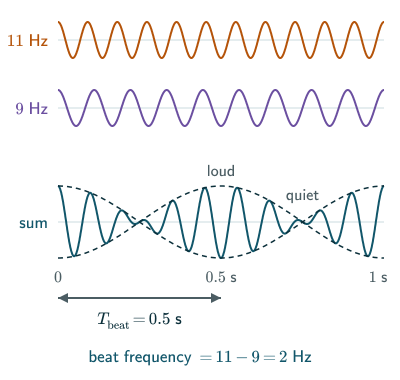
Example 1: Two close frequencies (NCERT Fig. 14.16)
Waves of 11 Hz and 9 Hz are superposed as in the illustrative graph. Find the carrier and envelope repetition frequencies; would 10 Hz be an ordinary audible musical pitch?
The carrier factor has frequency (11 + 9)/2 = 10 Hz. The envelope magnitude repeats at 11 − 9 = 2 Hz, every 0.5 s. The constituent frequencies and this carrier are below the usual audible pitch range; the drawing illustrates the mathematics.
Answer: carrier 10 Hz, envelope repetition 2 Hz; do not interpret this graph as an audible 10 Hz note. For an audible example, 401 Hz and 399 Hz give a carrier near 400 Hz and the same 2 Hz beating.
Example 2: Tuning a sitar (NCERT Example 14.6)
Two sitar strings A and B, both meant to play ‘Dha’, give 5 beats per second. Tightening B slightly lowers the beat frequency to 3 Hz. If A is at 427 Hz, what was the original frequency of B?
Tightening B raises its frequency. If B had been above A, raising it further would have increased the beats. Instead they decreased, so B was below A: νA − νB = 5 Hz, and νB = 427 − 5 = 422 Hz.
Answer: 422 Hz (page 294).
Example 3: An unknown fork
A fork of unknown frequency gives 4 beats per second with a 256 Hz fork. When the unknown fork is loaded with a little wax, without crossing the reference frequency, the beats become 6 per second. Find its original frequency.
The unknown is 256 ± 4 Hz: 260 or 252 Hz. Wax lowers its frequency. From 260 Hz, lowering would bring it closer to 256 Hz and reduce the beats; from 252 Hz, lowering moves it further away and increases them, as observed.
Answer: 252 Hz under the no-crossing condition. Without it, 260 Hz lowered past 256 Hz to 250 Hz would also give 6 beats per second, so a final beat rate alone would not uniquely decide.
Example 4: Hearing a mistuned note
Notes of 440 Hz and 443 Hz are played together. Find the beat frequency, the time between loudness maxima and the pitch heard.
νbeat = 443 − 440 = 3 Hz, so the loudness peaks every 1/3 s, about 0.33 s. The pitch heard is the average, 441.5 Hz.
Answer: 3 beats per second, about 0.33 s apart, at a pitch of about 441.5 Hz.
Example 5: How much to loosen a string
A guitar string sounds at 330 Hz and gives 1 beat per second with a 329 Hz fork, being the higher of the two. By what fraction must its tension be reduced to remove the beats?
The frequency of the string goes as √T, so T must change in the ratio (329/330) ≈ 0.9939: a reduction of about 0.61%. (For a small change, ΔT/T ≈ 2Δν/ν = 2 × 1/330, the same 0.61%.)
Answer: reduce the tension by about 0.6%.
Common mistakes to avoid
Common mistake
Halving the beat frequency
The amplitude factor is cos ωbt with ωb = (ω1 − ω2)/2, but the loudness peaks twice in each of its cycles. The beat frequency is ν1 − ν2, not half of it.
Common mistake
Thinking the pitch heard is the difference
For nearby audible tones of comparable amplitudes, the perceived pitch is approximately near the average frequency, (ν1 + ν2)/2. The difference is only the rate at which its loudness swells and fades.
Common mistake
Deciding which frequency is higher from the beats alone
5 beats per second means the frequencies differ by 5 Hz either way. You need a further test, such as tightening a string or loading a fork, to decide (Examples 2 and 3).
Common mistake
Thinking wax raises a fork’s frequency
Wax adds mass to the prongs and lowers the frequency; tightening a string raises its frequency.
Common mistake
Expecting beats from any two notes
Slow loudness beats are heard only for nearby frequencies; further apart the sound turns rough and then two separate notes are heard (beyond the NCERT text; Wikipedia, “Critical band”), though the superposition still applies (reasoned).
Quick revision summary
- Beats: periodic rise and fall of loudness when two close frequencies sound together.
- s = [2a cos ωbt] cos ωat, with ωb = (ω1 − ω2)/2 and ωa = (ω1 + ω2)/2.
- Nearby comparable audible tones: perceived pitch approximately near the average. Beat frequency: |ν − ν|.
- Instruments are tuned by removing the beats; a known small change (tension, wax) shows which frequency is higher.
Formula sheet
- s = [2a cos ωb t] cos ωa t
- ωb = (ω1 − ω2)/2; ωa = (ω1 + ω2)/2
- νbeat = |ν1 − ν2|
- string: ν ∝ √T (tighter string, higher frequency)
Questions students ask
What is the maximum beat frequency the human ear can detect?
There is no single universal maximum. The transition from slow beats to roughness and separate tones depends on frequency, level and the listener. A school rule such as “about 10 beats per second” is a rough guide, not a hard physiological boundary; UNSW Physclips provides examples across this transition.
What is the difference between beats and interference?
Beats are interference in time, while ordinary interference is interference in space: beats come from two waves of slightly different frequencies, whose phase difference keeps changing, so at any one place the loudness rises and falls ν1 − ν2 times a second. A steady spatial interference pattern needs waves of the same frequency with a constant phase difference, which give a steady pattern of loud and quiet places that does not change with time. Both follow from the principle of superposition.
What are the applications of beats?
Beats are used mainly to compare and match frequencies: musicians tune an instrument until its beats with a reference note stop, and the frequency of an unknown tuning fork is found from the beats it makes with a fork of known frequency. Because the beat frequency measures a small frequency difference, beats can reveal small shifts in a resonator. Radio receivers use the related technique of heterodyning: a nonlinear mixer or multiplier produces sum and difference frequency components. Simply adding two ideal sinusoids produces a beating envelope, not a new spectral line at their difference.
Are beats heard if the two sounds have unequal amplitudes?
Yes, two sounds of close frequencies give beats even when their amplitudes are unequal, but the loudness then never falls to zero: the amplitude of the combined sound swings between a1 + a2 and |a1 − a2|, the same limits as for the interference of unequal waves. So beats are most distinct when the two amplitudes are nearly equal, and a faint sound against a loud one gives only a slight flutter in loudness.
Practice questions
Try each question first, then open the answer to check your working.
-
Q1. What are beats, and what is the beat frequency of two sounds of frequencies ν1 and ν2?
Show answerHide answer
Beats are the regular rise and fall in loudness heard when two sounds of slightly different frequencies are superposed. The number of beats per second is |ν1 − ν2|, the higher frequency minus the lower.
-
Q2. Forks of 512 Hz and 515 Hz are sounded together. How many beats are heard in 5 s?
Show answerHide answer
The beat frequency is 3 Hz, so 3 × 5 = 15 beats in 5 s.
-
Q3. Why do musicians listen for beats when tuning two instruments together?
Show answerHide answer
Beats show that the two frequencies differ, and their rate shows by how much. Adjusting one instrument until the beats disappear makes the two frequencies equal.