Electric charge: positive, negative and charging
NCERT Class 12 Physics Chapter 1 Sections 1.1–1.2
Quick answer
Electric charge is the property that makes rubbed bodies attract or repel. There are two kinds, positive and negative: like charges repel and unlike charges attract, and by convention a glass rod rubbed with silk is positive and a plastic rod rubbed with fur is negative. Rubbing creates no charge; it only transfers loosely bound electrons, so the body that loses electrons becomes positive and the one that gains them negative.
With your textbook
NCERT Physics Part I (Class 12), Chapter 1 “Electric Charges and Fields”, Sections 1.1–1.2 “Introduction” and “Electric Charge”, pages 1–3.
Open the official NCERT chapter (PDF, 4.0 MB, ncert.nic.in) (opens in a new tab)
Checked against the 2026-27 reprint on .
What is electric charge?
Electric charge
Rubbed amber, glass or plastic attracts light objects because rubbing gives it an electric charge. Charge comes in two kinds, positive and negative: like charges repel and unlike charges attract (NCERT Section 1.2, page 2). This chapter and the next study charges at rest:
Electrostatics deals with the study of forces, fields and potentials arising from static charges.
NCERT Physics Part I (Class 12), Section 1.1, page 1
In plain words: everyday matter is packed with charges, but the positive and negative ones balance. Rubbing two materials together moves a tiny fraction of the electrons from one to the other, and the balance tips: one object ends up with extra electrons (negative), the other is short of them (positive). The crackle of a woollen sweater pulled off on a dry day is that imbalance discharging.
NCERT’s everyday examples are the spark or crackle when synthetic clothes or a sweater come off in dry weather, lightning in a thunderstorm, and the shock felt on touching a car door or the iron bar of a bus after sliding along a seat. NCERT traces the sparks and shocks to charges, built up by rubbing insulating surfaces, discharging through our body; lightning is another electric discharge, on the scale of the sky (NCERT page 1).
Positive and negative charges
The credit for finding that amber rubbed with wool or silk attracts light objects goes to Thales of Miletus, Greece, around 600 BC. The word electricity comes from the Greek elektron, meaning amber (NCERT pages 1–2).
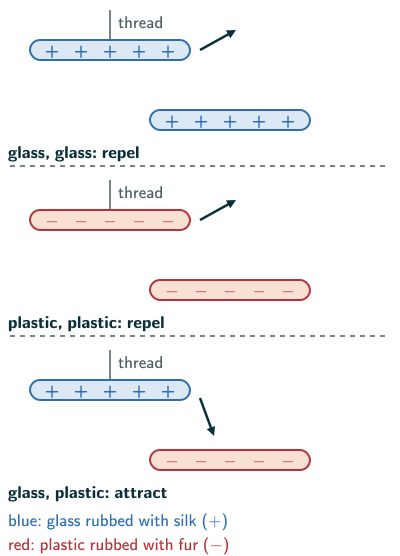
NCERT’s experiments with rubbed rods (page 2):
- Two glass rods rubbed with wool or silk repel each other; the two pieces of wool or silk also repel each other; but a glass rod and its wool attract.
- Two plastic rods rubbed with cat’s fur repel each other, but each attracts the fur.
- A rubbed plastic rod attracts a rubbed glass rod, and repels the silk or wool used on the glass. The glass rod repels the fur.
So there are only two kinds of charge, and (i) like charges repel, (ii) unlike charges attract. The property that tells the two kinds apart is the polarity of charge (page 2). NCERT’s sentence here says “two kinds of an entry” where it means an entity.
- The names positive and negative come from Benjamin Franklin. By convention, the charge on a glass rod or cat’s fur is positive and that on a plastic rod or silk is negative (page 2).
- A body with a charge is electrified or charged; with no net charge it is electrically neutral (page 2).
- If a rubbed glass rod is touched to the silk it was rubbed with, the two stop attracting each other and no longer attract light objects: unlike charges neutralise each other’s effect (page 2).
Charging by rubbing
Why does rubbing charge a body? NCERT’s answer (page 3):
- All matter is made of atoms and molecules. Normally a material is electrically neutral: it does contain charges, but they are exactly balanced.
- To electrify a neutral body, one kind of charge must be added or removed. A charged body is one with an excess or deficit of charge.
- In solids, some electrons are less tightly bound in the atom, and these are the charges that move from one body to the other. A body losing electrons becomes positive; a body gaining electrons becomes negative.
- When a glass rod is rubbed with silk, some electrons pass from the rod to the silk: the rod becomes positive and the silk negative.
- No new charge is created by rubbing, and the electrons transferred are a very small fraction of all the electrons in the body.
NCERT also notes how far electric forces reach: the forces holding molecules and atoms together in a solid, the adhesive force of glue and the forces of surface tension are all basically electrical, arising from forces between charged particles (page 3).
The gold-leaf electroscope
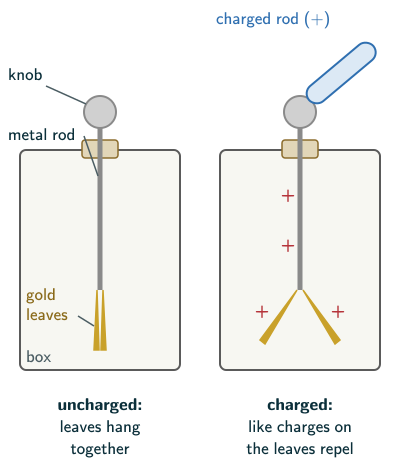
A simple apparatus to detect charge is the gold-leaf electroscope (NCERT page 3):
- A vertical metal rod is housed in a box, with two thin gold leaves attached to its bottom end.
- When a charged object touches the metal knob at the top, charge flows down the rod onto the leaves, and the leaves diverge: both carry the same kind of charge, so they repel.
- The degree of divergence indicates the amount of charge qualitatively for the same electroscope under the same surroundings; it is not a direct calibrated reading in coulombs.
Solved examples
Example 1: Which way did the electrons go?
A glass rod rubbed with silk becomes positively charged. Which object lost electrons, and what is the charge on the silk?
Answer: the glass rod lost electrons to the silk, so the rod is positive and the silk is negative, with charges equal in size: no charge is created, it only moves (NCERT page 3).
Example 2: Predict the force
A plastic rod rubbed with cat’s fur is brought near (a) another plastic rod rubbed with fur, (b) a glass rod rubbed with silk, (c) the fur used on the first rod. Does it attract or repel each one?
Answer: the plastic rod is negative. (a) Plastic is negative: like charges, so it repels. (b) Glass is positive: unlike charges, so it attracts. (c) The fur is positive: it attracts (NCERT page 2).
Example 3: Counting electrons
When a glass rod is rubbed with silk, 5.0 × 10¹⁰ electrons pass from the rod to the silk. Find the charge on each. Take the charge of an electron as −1.6 × 10⁻¹⁹ C.
Answer: each electron carries −e, where e = 1.6 × 10⁻¹⁹ C. The rod has lost n = 5.0 × 10¹⁰ of them, so it is left with a positive charge
The silk has gained them: −8.0 nC. The total is zero, as before rubbing (NCERT pages 3 and 5–6).
Example 4: Reading the electroscope
A charged rod touches the knob of an uncharged gold-leaf electroscope, and the leaves open. A second rod with more charge of the same kind then touches the knob, and the leaves open wider. Explain both observations.
Answer: charge flows from the rod down the metal rod to the leaves. Both leaves carry the same kind of charge, so they repel and diverge. More charge on the leaves gives a stronger repulsion and a wider divergence, which is why the divergence shows the amount of charge (NCERT page 3).
Common mistakes to avoid
Common mistake
Thinking rubbing creates charge
Rubbing only transfers electrons from one body to the other; no new charge is created (NCERT page 3).
Common mistake
Saying a positive body has gained protons
In charging by rubbing, the moving charges are electrons. A body becomes positive by losing electrons, not by gaining protons (NCERT page 3).
Common mistake
Calling a neutral body chargeless inside
A neutral body still contains a huge number of charges; its positive and negative charges are exactly balanced (NCERT page 3).
Common mistake
Taking attraction as proof that a body is charged
A charged rod also attracts neutral bits of paper: it pulls the paper’s opposite charges slightly nearer and pushes its like charges slightly away, and the nearer charges win. NCERT explains this later, in Section 1.11 (pages 27–28). In this electrostatic test, repulsion by a known charged body is evidence that the tested body is charged with the same sign.
Common mistake
Reading the sign of a charge from the electroscope
The leaves diverge for either kind of charge, because both leaves always get the same kind. The divergence shows only the amount of charge, not its sign (NCERT page 3).
Common mistake
Thinking charging never changes mass
Electrons have mass, so a body that gains electrons gets very slightly heavier and one that loses them very slightly lighter. Beyond the NCERT text, with the electron mass 9.11 × 10⁻³¹ kg (US National Institute of Standards and Technology, CODATA values), the silk in Example 3 gains about 4.6 × 10⁻²⁰ kg, far too little to weigh.
Quick revision summary
- Electrostatics studies the forces, fields and potentials of charges at rest.
- There are two kinds of charge: like charges repel, unlike charges attract. The property that tells them apart is polarity.
- By Franklin’s convention, a glass rod rubbed with silk is positive (the silk negative), and a plastic rod rubbed with fur is negative (the fur positive).
- Rubbing transfers loosely bound electrons; the loser is positive, the gainer negative, and no charge is created.
- In a gold-leaf electroscope, charge reaching the leaves makes them repel; the divergence shows the amount of charge.
Formula sheet
- like charges repel; unlike charges attract
- glass rubbed with silk: glass +, silk −
- plastic rubbed with fur: plastic −, fur +
- rubbing transfers electrons; total charge unchanged
- charge on n electrons: q = −ne
Questions students ask
What are the SI unit and dimensional formula of electric charge?
The SI unit of electric charge is the coulomb (C), and its dimensional formula is [A T]: charge is not a base quantity but current × time (see dimensional formulae). NCERT defines 1 C as the charge that flows through a wire in 1 s when the current is 1 A, so 1 C = 1 A s (NCERT pages 5 and 41). One coulomb is a very large charge, about 6 × 10 times the charge of an electron, so electrostatics mostly works in microcoulombs, 1 µC = 10 C (see quantisation of charge).
What is the difference between electric charge and electric current?
Electric charge is a property a body carries in a definite amount, measured in coulombs, while electric current is the rate at which charge flows past a point, measured in amperes: a steady current I carries a charge q = It in a time t. So a current of 1 A carries 1 C every second, which is how NCERT defines the coulomb (NCERT page 5). NCERT Chapter 1 studies charges at rest; charges in motion, as currents, are the subject of NCERT Chapter 3, Current Electricity.
Why is gold used in a gold-leaf electroscope?
Gold is used in a gold-leaf electroscope because, beyond the NCERT text, it is the most malleable of all metals, so it can be beaten into leaf only about 0.1 µm thick, and it is chemically inert, so it does not tarnish or corrode (US Geological Survey, Mineral Commodity Profiles: Gold, Open-File Report 02-303, 2005). Leaves that thin and light are spread visibly apart by the weak repulsion between them once both carry the same kind of charge, and gold, a metal and so a conductor, lets the charge flow down the rod onto them (NCERT page 3).
Is the gold-leaf electroscope in the JEE Main and NEET syllabus?
The gold-leaf electroscope is not named in the JEE Main syllabus or the NEET (UG) 2026 syllabus: Unit 11, Electrostatics, of the JEE Main syllabus begins with “Electric charges: conservation of charge” and goes on to Coulomb’s law and the electric field, and the NEET (UG) 2026 Unit 11 begins the same way. It is in NCERT Class 12 Physics Part I, Section 1.2 (page 3), so it belongs to the NCERT course, and the idea it shows, that like charges repel, is part of the “Electric charges” topic that both syllabuses list.
Practice questions
Try each question first, then open the answer to check your working.
-
Q1. Who named the two kinds of charge positive and negative?
Show answerHide answer
Benjamin Franklin (NCERT page 2).
-
Q2. A comb run through dry hair attracts bits of paper. How did the comb get its charge, and is any charge created?
Show answerHide answer
It is charged by electrons moving between the comb and the hair, so one gains electrons and the other loses them; no charge is created (NCERT page 3).
-
Q3. What does the degree of divergence of the leaves of a gold-leaf electroscope indicate?
Show answerHide answer
The amount of charge on the electroscope qualitatively, with the same instrument and surroundings (NCERT page 3).