Dipole in a uniform external field
NCERT Class 12 Physics Chapter 1 Section 1.11
Quick answer
The torque on a dipole in a uniform electric field is τ = p × E, of size pE sin θ: the forces qE and −qE on its two charges cancel, so the net force is zero, but they act at different points and form a couple. The torque turns the dipole to line up with the field and is zero when p is along E. In a non-uniform field there can also be a net force: towards the stronger field when p is along E.
With your textbook
NCERT Physics Part I (Class 12), Chapter 1 “Electric Charges and Fields”, Section 1.11 “Dipole in a Uniform External Field”, pages 27–28.
Open the official NCERT chapter (PDF, 4.0 MB, ncert.nic.in) (opens in a new tab)
Checked against the 2026-27 reprint on .
What happens to a dipole in a uniform field?
Dipole in a uniform external field
A permanent dipole, one whose moment p exists whatever the field, placed in a uniform field E feels no net force but a torque (NCERT Section 1.11, page 27):
NCERT states its effect:
This torque will tend to align the dipole with the field E.
NCERT Physics Part I (Class 12), Section 1.11, page 27
In plain words: in a uniform field the push on +q and the pull on −q are equal and opposite, so its centre of mass has no acceleration from the electric field: it stays at rest if initially at rest, or continues with constant velocity. But the two forces act at different points, like two hands turning a steering wheel, so the dipole swings round towards the field direction; with nothing to damp it, it swings past and oscillates about it.
Torque on a dipole
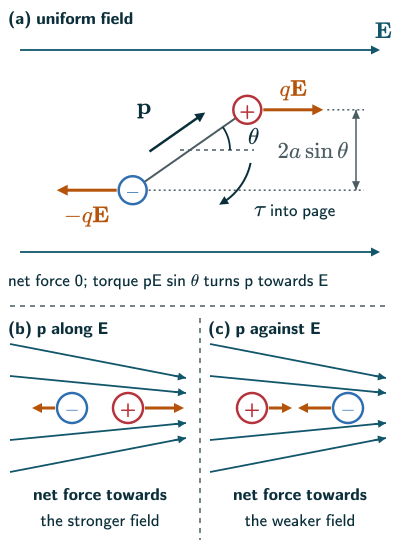
- The field pushes +q with a force qE and −q with −qE. Because E is uniform, these cancel: the net force is zero (NCERT page 27).
- The two forces act at points 2a apart, so they form a couple (see couple). With zero net force, the torque of a couple is the same about any origin (page 27).
- Its size is each force times the arm of the couple, the perpendicular distance between the two antiparallel forces, 2a sin θ, where θ is the angle between p and E (page 27):
Torque on a dipole (NCERT Eq. 1.22)
- Direction: τ is perpendicular to the plane of p and E, by the right-hand rule for p × E. In NCERT’s Figure 1.19 the couple turns p anticlockwise and τ points out of the paper (page 27). In the figure below, p is at θ anticlockwise from E, so the couple turns it clockwise and τ points into the page.
- Effect: the torque turns p towards E. When p is along E (θ = 0) the torque is zero (page 27). It is also zero at θ = 180°, with p against E, and greatest, pE, at θ = 90° (from sin θ).
- Stable and unstable: at θ = 0, a small twist brings a torque that turns the dipole back, so this alignment is stable; at θ = 180°, a small twist brings a torque that turns it further away, so that alignment is unstable (reasoned from τ = p × E).
For exams, NCERT’s next chapter gives the work an external torque must do to turn the dipole slowly from θ0 to θ1, W = pE(cos θ0 − cos θ1). Because that torque just cancels the field’s torque, the field does −W. Taking U = 0 at θ = 90°, the energy at angle θ is U = −pE cos θ = −p·E (NCERT Chapter 2, Section 2.8.3, Eqs. (2.31)–(2.32), page 60). U is least, −pE, at θ = 0 (stable) and greatest, +pE, at θ = 180° (unstable).
The torque here is the same quantity as in rotational motion: see torque.
Net force on a dipole in a non-uniform field
- If the field is not uniform, the net force is evidently non-zero, and in addition there will, in general, be a torque (NCERT page 27); give that in an exam. The forces on the two charges no longer cancel because the field differs at their positions. Strictly, if the field happens to be the same at both charges, the forces still cancel, so a net force is the general case rather than a certainty (reasoned).
- For a small dipole in NCERT’s simple examples, where the field direction is the same at both ends and its strength changes along the dipole, p is parallel or antiparallel to E: the torque is zero and the net force is nonzero (page 27):
- p parallel to E: net force in the direction of increasing field;
- p antiparallel to E: net force in the direction of decreasing field.
- In general, the force depends on the orientation of p with respect to E (page 27).
The comb and the paper. A comb run through dry hair attracts bits of paper, although the paper is not charged. The charged comb polarises the paper: it induces a net dipole moment in the direction of its field. The comb’s field is not uniform, and a dipole in a non-uniform field feels a net force, so the paper moves towards the comb (NCERT pages 27–28).
Solved examples
Example 1: Torque on a dipole (NCERT Exercise 1.10)
A dipole of moment 4 × 10⁻⁹ C m is at 30° to a uniform field of 5 × 10⁴ N C−1. Find the torque on it.
Answer:
(NCERT Eq. (1.22), page 27.)
Example 2: Greatest torque
Charges ±2 µC, 3 cm apart, sit in a uniform field of 2 × 10⁵ N C−1. Find the dipole moment, the greatest torque, and the net force.
Answer: p = q × 2a = (2 × 10⁻⁶)(0.03) = 6 × 10⁻⁸ C m. The torque is greatest at θ = 90°: τmax = pE = (6 × 10⁻⁸)(2 × 10⁵) = 1.2 × 10⁻² N m. The net force is zero, since the field is uniform (NCERT page 27).
Example 3: Work to turn a dipole
How much work does it take to turn the dipole of Example 2 slowly from θ = 0 to θ = 180°?
Answer: with NCERT’s W = pE(cos θ0 − cos θ1) (Chapter 2, Eq. (2.31), page 60):
Example 4: Which way does it move?
A small dipole lies in the field of a positive point charge, with p pointing away from the charge. Which way is the net force on the dipole?
Answer: the field of a positive charge points away from it and grows towards the charge. Here p is parallel to E, and a dipole parallel to the field is pushed towards the stronger field: towards the charge (NCERT page 27). The nearer end of the dipole is −q, which is attracted more strongly than +q is repelled.
Common mistakes to avoid
Common mistake
Expecting a net force in a uniform field
In a uniform field the forces qE and −qE cancel; the dipole feels only a torque (NCERT page 27).
Common mistake
Using cos θ for the torque
The arm of the couple is 2a sin θ, so τ = pE sin θ: zero when p is along E, greatest at 90° (NCERT page 27).
Common mistake
Thinking an uncharged body cannot be attracted
A neutral body can be polarised; in a non-uniform field the induced dipole feels a net force, as the paper does near a charged comb (NCERT pages 27–28).
Quick revision summary
- Permanent dipole in a uniform field: net force zero; torque τ = p × E, of size pE sin θ.
- The torque turns p towards E; it is zero at θ = 0 (stable) and θ = 180° (unstable), greatest at 90°.
- Non-uniform field: in general a net force as well as a torque; p along E is pushed towards the stronger field, p against E towards the weaker field.
- A charged comb polarises paper and, its field being non-uniform, attracts it.
- From NCERT Chapter 2: U = −pE cos θ (zero at θ = 90°); an external torque turning the dipole slowly from θ to θ does work pE(cos θ − cos θ).
Formula sheet
- τ = p × E
- τ = pE sin θ
- uniform field: net force = 0
- U = −pE cos θ (U = 0 at θ = 90°)
- external work θ → θ: pE(cos θ − cos θ)
Questions students ask
Which chapter and syllabus unit cover the torque on a dipole in a uniform electric field?
The torque on a dipole in a uniform electric field is in Chapter 1, Electric Charges and Fields, of NCERT Class 12 Physics Part I, Section 1.11, Dipole in a Uniform External Field (pages 27–28), right after the electric dipole in Section 1.10. The JEE Main syllabus lists it in Unit 11, Electrostatics, as “torque on a dipole in a uniform electric field”, and the NEET (UG) 2026 syllabus lists the same words in its Unit 11. The energy of a dipole in a field comes later, in NCERT Chapter 2.
What is the formula for the force on a dipole in a non-uniform electric field?
For a small dipole lined up with a field whose size changes along it, the net force is F = p dE/dx in the point-dipole approximation, with p the signed dipole component along a fixed x-axis and E the signed field component along it (beyond the NCERT text, reasoned from the forces qE on its two charges, which sit in fields of different strength; NCERT page 27 gives the direction only). It points towards the stronger field when p is along E and towards the weaker field when p is against E. Near a point charge Q, where E = kQ/r, a dipole lined up with the field at distance r feels a force of size 2k|Q|p/r, so the force between a charge and a dipole falls as 1/r.
Does an electric dipole feel a torque in a uniform magnetic field?
No, an electric dipole at rest in a magnetic field feels no torque and no force: the magnetic force on a charge, q(v × B), is zero when the charge is not moving, and NCERT notes that only a moving charge feels it (NCERT Chapter 4, Section 4.2, pages 109–110). The magnetic counterpart of τ = p × E is τ = m × B, the torque on a magnetic dipole such as a compass needle or a current loop (NCERT Chapter 5, Eq. (5.2), page 139; Table 5.1, page 141). Beyond the NCERT text, a dipole moving across the field can feel a torque, since its two charges then feel opposite magnetic forces at different points (reasoned from NCERT Eq. (4.3), page 109).
Does an induced dipole feel a torque in a uniform electric field?
An induced dipole feels no torque in a uniform field when its moment is induced along the field, as NCERT assumes for linear isotropic dielectrics (NCERT Chapter 2, page 66) and says of the paper near a charged comb (NCERT page 28): then θ = 0 and τ = pE sin θ = 0. NCERT’s torque result is for a permanent dipole, one whose p exists whatever the field (NCERT page 27), which can sit at any angle to E and be turned towards it. Beyond the NCERT text, a body that polarises more easily along one direction, such as a thin strip, can get a moment tilted away from E, so it can feel a torque that turns that direction along the field (reasoned from τ = p × E).
Practice questions
Try each question first, then open the answer to check your working.
-
Q1. At what angle between p and E is the torque on a dipole greatest?
Show answerHide answer
At 90°, where sin θ = 1 and τ = pE (NCERT page 27).
-
Q2. A dipole of moment 1 × 10⁻⁸ C m is perpendicular to a field of 3 × 10³ N C−1. Find the torque.
Show answerHide answer
τ = pE = (1 × 10⁻⁸)(3 × 10³) = 3 × 10⁻⁵ N m (NCERT Eq. (1.22), page 27).
-
Q3. What is the net force on a dipole in a uniform field?
Show answerHide answer
Zero: the forces on +q and −q are equal and opposite (NCERT page 27).