Electric flux
NCERT Class 12 Physics Chapter 1 Section 1.9
Quick answer
Electric flux through a small area element is Δϕ = E ΔS cos θ, where θ is the angle between the field and the area vector, which points along the normal to the area. It is proportional to the number of field lines crossing the area, is greatest when the area faces the field squarely and zero when the field runs along it, and is measured in N C m. On a closed surface the area vectors point outwards, so lines leaving give positive flux and lines entering give negative flux.
With your textbook
NCERT Physics Part I (Class 12), Chapter 1 “Electric Charges and Fields”, Section 1.9 “Electric Flux”, pages 21–23.
Open the official NCERT chapter (PDF, 4.0 MB, ncert.nic.in) (opens in a new tab)
Checked against the 2026-27 reprint on .
What is electric flux?
Electric flux
Electric flux through a small area measures how much electric field passes through it: it is proportional to the number of field lines crossing the area. NCERT defines it for an area element ΔS (NCERT Eq. (1.11), page 22):
Here θ is the angle between E and the area vector ΔS, which points along the normal to the area (page 22).
In plain words: hold a small frame in a steady breeze. Face it square to the wind and the most air passes through; tilt it and less gets through; turn it edge-on and none does. Electric flux is the same idea for field lines, with one difference: nothing actually flows.
Flux of a flow, and of a field
- Liquid flow. A liquid moving with speed v straight through a small flat surface dS carries a volume v dS through it each second: the flux of the liquid. If the surface’s normal makes an angle θ with v, only the projected area dS cos θ counts, and the flux is v·n̂ dS (NCERT page 21).
- Electric flux is defined the same way, but there is no flow of any physically observable quantity, unlike a liquid (page 21).
- Counting lines. The number of field lines crossing a small area ΔS placed normal to E is proportional to EΔS. Tilt the area by θ: its projection normal to E is ΔS cos θ, so the number crossing is proportional to EΔS cos θ. At θ = 90° the lines run along the area and none cross it (NCERT page 22, Figure 1.15).
- NCERT adds that the number of lines is not equal to EΔS: how many lines are drawn is a choice. What matters is the relative number crossing different areas (page 22, footnote).
Area vector
- Why a vector? The water flowing through a ring held in a stream depends on how you hold it: most flows when the ring faces the flow squarely. So an area element has a direction as well as a size (NCERT page 22).
- Its direction is along the normal to the plane:
Thus the direction of a planar area vector is along its normal.
NCERT Physics Part I (Class 12), Section 1.9, page 22
- Curved surfaces are divided into many very small elements, each treated as flat with its own area vector (page 22).
- Which normal? A normal can point two ways, so a convention is needed. For an open surface either normal may be chosen, and reversing that choice reverses the sign of the flux. For a closed surface, the area vector of every element points along the outward normal (page 22):
Area vector on a closed surface
Here ΔS is the size of the element and n̂ is the unit vector along the outward normal at that point (page 22).
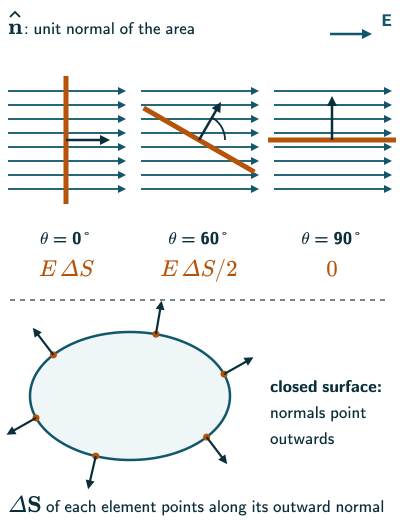
Flux through an area element
Electric flux (NCERT Eq. 1.11)
- θ is the angle between E and ΔS. For a closed surface it is the angle between E and the outward normal (NCERT page 22).
- Two ways to read EΔS cos θ: E times the projection of the area normal to E, ΔS cos θ; or the component of E along the normal, E⊥, times ΔS (pages 22–23).
- Unit: N C−1 m2 (page 23); NCERT Chapter 2 gives field in V m−1 (NCERT Example 2.6, page 61), so this is also V m.
- Sign: cos θ is positive for θ < 90° and negative for θ > 90°. On a closed surface, then, field lines coming out give positive flux and lines going in give negative flux (reasoned from NCERT’s Eq. (1.11) with the outward-normal convention).
- Total flux through a surface: divide it into small elements, find the flux through each and add (NCERT Eq. (1.12), page 23). The sum is approximate because E is taken as constant over each element; it becomes exact in the limit ΔS → 0, when the sum is written as an integral (page 23). For a closed surface, Gauss’s law gives this total flux from the charge enclosed (NCERT Section 1.13).
Total flux through a surface (NCERT Eq. 1.12)
The flux is a dot product of two vectors, so it is a scalar: see the scalar product.
Solved examples
Example 1: Flux through a square (NCERT Exercise 1.14)
A uniform field E = 3 × 10³ î N/C. (a) What is the flux through a square of side 10 cm whose plane is parallel to the yz plane? (b) What is the flux through the same square if its normal makes 60° with the x-axis?
Answer: the area is ΔS = (0.10 m)2 = 0.01 m2.
(a) Choose the +x normal for the open square. It is along E, so θ = 0; the opposite choice would give negative flux:
(b) Now θ = 60° and cos 60° = 0.5, so ϕ = 30 × 0.5 = 15 N m2 C−1 (NCERT Eq. (1.11), page 22).
Example 2: A cube in a uniform field (NCERT Exercise 1.15)
What is the net flux of the uniform field of Example 1 through a cube of side 20 cm whose faces are parallel to the coordinate planes?
Answer: zero. Each face has area 0.04 m2. On the face whose outward normal is along +x, ϕ = EA = (3 × 10³)(0.04) = +120 N m2 C−1. On the opposite face the outward normal is along −x, so θ = 180° and ϕ = −120 N m2 C−1. The other four faces have normals perpendicular to E (θ = 90°), so no flux. Total: +120 − 120 + 0 = 0: every line that enters the cube also leaves it (NCERT pages 22–23).
Example 3: A tilted plate
A flat plate of area 0.05 m2 lies in a uniform field of 2.0 × 10³ N C−1, with its normal at 30° to the field. Find the flux through it.
Answer:
(NCERT Eq. (1.11), page 22.)
Example 4: Edge-on and face-on
A square of side 0.2 m is placed in a uniform field of 500 N C−1. Find the flux when (a) the field is perpendicular to the square’s plane, (b) the field lies along the plane.
Answer: (a) choosing the normal along E, θ = 0: ϕ = 500 × 0.04 = 20 N m2 C−1. (b) The normal is perpendicular to E, θ = 90°: ϕ = 0, since the lines run along the square and none cross it (NCERT page 22).
Common mistakes to avoid
Common mistake
Measuring θ from the surface instead of the normal
In Δϕ = E ΔS cos θ, θ is the angle between E and the area vector, which is along the normal. A field lying in the plane of the area has θ = 90° and gives zero flux (NCERT page 22).
Common mistake
Ignoring the sign on a closed surface
With outward normals, lines going in give negative flux and lines coming out give positive flux; in a uniform field every line that enters a closed surface also leaves it, so the two cancel (as for the cube in Example 2).
Common mistake
Saying flux equals the number of field lines
Flux is proportional to the number of lines crossing an area; the number itself depends on how many lines are drawn (NCERT page 22).
Quick revision summary
- Electric flux through an area element: Δϕ = E · ΔS = E ΔS cos θ, proportional to the number of field lines crossing it.
- θ is the angle between E and the area vector ΔS; for a closed surface ΔS = ΔS n̂ points along the outward normal.
- An area is a vector because its orientation matters; its direction is along its normal.
- Unit of flux: N C m. Flux is a scalar; it can be positive, negative or zero.
- Total flux through a surface: ϕ ≈ Σ E · ΔS, exact as an integral.
Formula sheet
- Δϕ = E · ΔS = E ΔS cos θ
- ΔS = ΔS n̂ (outward normal on a closed surface)
- ϕ ≈ Σ E · ΔS
- θ = 0: Δϕ = E ΔS; θ = 90°: Δϕ = 0
- unit: N C m
Questions students ask
Is electric flux a scalar or a vector?
Electric flux is a scalar: it is the dot product E·ΔS of the field and the area vector, so it has a size and a sign but no direction in space (NCERT page 22). Its sign only records which way the field lines cross compared with the chosen normal: on a closed surface, positive where they leave, negative where they enter and zero where they run along the surface. The two vectors that go into it both have directions, but their product EΔS cos θ is a single number, just as the work F·d is (see scalar product).
What are the SI unit and dimensional formula of electric flux?
The SI unit of electric flux is N C m, which is the same as the volt metre, V m, and its dimensional formula is [M L T A] (NCERT pages 23 and 40). Both follow from Δϕ = EΔS cos θ: the field, in N C or V m with dimensions [M L T A], times an area, in m with dimensions [L] (see dimensional formulae). The cosine is a pure number and adds nothing to the unit.
Is electric flux measured in webers, like magnetic flux?
No, the weber is the unit of magnetic flux, not of electric flux: magnetic flux through an area in a uniform magnetic field is ΦB = B·A = BA cos θ, measured in webers, 1 Wb = 1 T m, while electric flux is measured in N C m (NCERT Chapter 6, Section 6.3, pages 156–157; NCERT page 23). NCERT defines magnetic flux in the same way as electric flux, a field dotted with the area vector, and both are scalars, but they belong to different fields. Their dimensions differ too: [M L T A] for magnetic flux (NCERT Chapter 6, page 174) and [M L T A] for electric flux (NCERT page 40).
What is the difference between electric field and electric flux?
Electric field is a vector defined at a point, the force per unit positive charge there, measured in N C, while electric flux is a scalar that belongs to a whole surface and measures how much field passes through it, in N C m (NCERT pages 14 and 22–23). For a flat area A held face-on in a uniform field, ϕ = EA, so the field equals the flux per unit area normal to it: a field of 2.5 × 10 N C through 0.03 m gives a flux of 75 N C m. So a strong field can send little flux through a small or tilted surface, and a weak field a large flux through a big one.
What is electric flux density, and is it the same as electric flux?
Electric flux density is not the same as electric flux: beyond the NCERT text, the SI gives that name to the electric displacement D, measured in coulombs per square metre, C m, like a surface charge density (NIST Special Publication 330, The International System of Units, 2019, Table 6). Electric flux is measured in N C m (NCERT page 23), and D is not used in NCERT’s Class 12 electrostatics chapters. On this page’s definition, the flux per unit area through a small area held normal to the field is the field strength E (NCERT page 22), much as NCERT calls B the magnetic flux density (NCERT Chapter 5, page 151), so check which quantity a book means by ‘flux density’.
Practice questions
Try each question first, then open the answer to check your working.
-
Q1. A uniform field of 400 N C crosses an area of 0.5 m at right angles. Choose the area normal along the field. What is the flux?
Show answerHide answer
ϕ = EΔS = 400 × 0.5 = 200 N m2 C−1 (NCERT Eq. (1.11), page 22).
-
Q2. For a small area in a uniform field, at what angle between E and the area vector is the flux zero?
Show answerHide answer
At 90°, when the field lines run along the area (NCERT page 22).
-
Q3. Which way does the area vector of an element of a closed surface point?
Show answerHide answer
Along the outward normal at that point (NCERT page 22).