Gauss’s law
NCERT Class 12 Physics Chapter 1 Section 1.13
Quick answer
Gauss’s law says that the electric flux through any closed surface equals the total charge it encloses divided by ε: ϕ = q/ε. It holds for a surface of any shape or size; charges outside change the field on the surface but add nothing to the net flux, so zero net flux means zero net charge inside. The chosen closed surface is the Gaussian surface; it must not pass through a point charge, and choosing it to match the symmetry makes fields easy to find.
With your textbook
NCERT Physics Part I (Class 12), Chapter 1 “Electric Charges and Fields”, Section 1.13 “Gauss’s Law”, pages 29–32.
Open the official NCERT chapter (PDF, 4.0 MB, ncert.nic.in) (opens in a new tab)
Checked against the 2026-27 reprint on .
What is Gauss’s law?
Gauss’s law
The total electric flux through any closed surface equals the total charge enclosed by it divided by ε0 (NCERT Eq. (1.31), page 30):
NCERT reaches it from the flux of a single point charge through a sphere around it (page 30), and stresses how general it is:
Gauss’s law is true for any closed surface, no matter what its shape or size.
NCERT Physics Part I (Class 12), Section 1.13, page 30
In plain words: draw any closed bag around some charges and count the field lines leaving it, minus those entering. That net count depends only on the charge inside the bag, not on the bag’s shape or size, nor on any charges outside it.
Flux of a point charge through a sphere
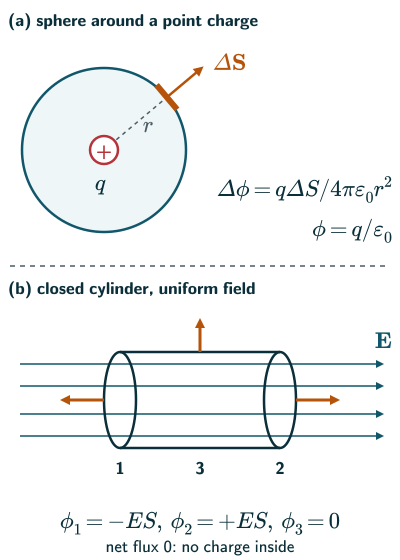
Take a point charge q at the centre of a sphere of radius r, and divide the sphere into small area elements (NCERT pages 29–30):
- On each element the field is q/(4πε0r2) along r̂, and the normal to a sphere is along the radius, so ΔS is along r̂ too. The flux through one element is (NCERT Eqs. (1.28)–(1.29)):
- Every element is the same distance r from the charge, so adding them just adds up ΔS to the whole area, 4πr2 (NCERT Eq. (1.30)):
The radius has cancelled: the field falls as 1/r2 while the area grows as r2, the same reason the number of field lines crossing any sphere around a charge is constant.
Statement of Gauss’s law
Gauss’s law (NCERT Eq. 1.31)
Here ϕ is the electric flux through a closed surface S and q is the total charge enclosed by S (NCERT page 30). NCERT states it without proof. Its main points (pages 30–31):
- Sign of the flux. On a closed surface each ΔS points along the outward normal (NCERT Section 1.9, page 22), so lines leaving count as positive flux and lines entering as negative. A positive ϕ means a net positive charge inside; a negative ϕ means a net negative charge.
- No charge inside, no net flux. In a uniform field, a closed cylinder with its axis along E has ϕ1 = −ES on the face whose outward normal is against E, ϕ2 = +ES on the other, and ϕ3 = 0 on the curved side: total zero. Conversely, zero net flux means the total charge enclosed is zero (page 30).
The law implies that the total electric flux through a closed surface is zero if no charge is enclosed by the surface.
NCERT Physics Part I (Class 12), Section 1.13, page 30
- q is the sum of all charges enclosed, wherever they sit inside the surface (page 30).
- The field on the surface is due to all charges, inside and outside; but the flux depends only on the charge inside (page 30). A charge outside sends as many field lines into the surface as it takes out, so it adds nothing to the flux.
- Gauss’s law rests on the inverse-square dependence in Coulomb’s law; any violation of it would show a departure from the inverse-square law (page 31).
Gaussian surface
- The closed surface chosen for applying Gauss’s law is the Gaussian surface. Any closed surface may be chosen (NCERT page 31).
- It must not pass through a discrete charge: the field of a point charge is not well defined at the charge itself and grows without bound near it. It may pass through a continuous charge distribution (page 31).
- Gauss’s law makes the field much easier to find when the system has some symmetry, through a suitable choice of Gaussian surface: a sphere for a point charge or a charged shell, a cylinder for a long wire or a plane sheet (page 31; NCERT works these out in Section 1.14, pages 33–37: see applications of Gauss’s law).
Solved examples
Example 1: Flux and charge in a non-uniform field (NCERT Example 1.10)
The field is Ex = αx1/2, Ey = Ez = 0, with α = 800 N C−1 m−1/2. A cube of edge a = 0.1 m has its left face at x = a and its right face at x = 2a. Find (a) the flux through the cube, (b) the charge inside.
Answer: (a) the field is along x, so only the two faces normal to x carry flux; on the other four, E lies along the face. On the left face the outward normal is against E, so ϕL = −ELa2 with EL = αa1/2. On the right face ϕR = +ERa2 with ER = α(2a)1/2. So
(b) By Gauss’s law, q = ε0ϕ = 1.05 × 8.854 × 10−12 C ≈ 9.3 × 10⁻¹² C (NCERT pages 31–32).
Two NCERT slips here. NCERT prints q = 9.27 × 10⁻¹² C (page 32), but 1.05 × 8.854 × 10−12 is 9.30 × 10⁻¹² C (9.28 × 10⁻¹² C with the unrounded flux, 1.048 N m2 C−1). And its solution says the flux is zero on the faces “perpendicular to x direction”; it means the four faces parallel to the x direction, whose normals are perpendicular to x (page 31).
Example 2: A cylinder in a reversing field (NCERT Example 1.11)
E = 200 î N/C for x > 0 and −200 î N/C for x < 0. A cylinder of length 20 cm and radius 5 cm has its centre at the origin and its axis along x. Find (a) the outward flux through each flat face, (b) through the side, (c) in total, (d) the charge inside.
Answer: (a) On the right face (x = +10 cm) the field and the outward normal both point along +x. On the left face (x = −10 cm) both point along −x. So each face gives
(b) On the side E is perpendicular to ΔS: zero. (c) Total: 1.57 + 1.57 + 0 = 3.14 N m2 C−1. (d) q = ε0ϕ = 3.14 × 8.854 × 10−12 = 2.78 × 10⁻¹¹ C (NCERT page 32).
Example 3: Flux through one face of a cube (NCERT Exercise 1.17)
A point charge +10 µC is 5 cm directly above the centre of a square of side 10 cm. What is the size of the flux through the square?
Answer: think of the square as one face of a cube of edge 10 cm with the charge at its centre (NCERT’s hint). By Gauss’s law the cube’s total flux is q/ε0, and by symmetry each of its six faces carries the same share:
Example 4: Charge at the centre of a cube (NCERT Exercise 1.18)
A point charge of 2.0 µC is at the centre of a cubic Gaussian surface of edge 9.0 cm. What is the net flux through the surface?
Answer: the size of the cube does not matter:
(NCERT Eq. (1.31), page 30.)
Common mistakes to avoid
Common mistake
Counting charges outside the surface
Only the enclosed charge sets the flux. Charges outside change the field on the surface, but every line they send in also comes out (NCERT page 30).
Common mistake
Reading zero flux as zero field
Zero net flux means zero net charge inside; the field on the surface need not be zero, as for the cylinder in a uniform field (NCERT page 30).
Common mistake
Letting the Gaussian surface pass through a point charge
The field is not defined at a point charge, so a Gaussian surface must avoid discrete charges; it may cut through a continuous distribution (NCERT page 31).
Quick revision summary
- Gauss’s law: the flux through any closed surface is ϕ = q/ε, where q is the total charge enclosed.
- For a point charge at the centre of a sphere: Δϕ = qΔS/(4πεr) on each element, and the total q/ε does not depend on r.
- The law holds for any closed surface, whatever its shape or size; the field is due to all charges, but the flux only to those inside.
- Gaussian surface: the closed surface chosen; it must not pass through a discrete charge; choose it to match the symmetry.
- Gauss’s law follows from the inverse-square law; zero net flux means zero net enclosed charge.
Formula sheet
- ϕ = q/ε (closed surface, q enclosed)
- point charge at sphere centre: Δϕ = qΔS/(4πεr)
- no charge inside: ϕ = 0
- charge at a cube’s centre: each face q/(6ε)
- q = εϕ
Questions students ask
What is the difference between Coulomb’s law and Gauss’s law?
Coulomb’s law gives the force between two point charges, F = k|q1q2|/r (NCERT pages 6–7), while Gauss’s law relates the electric flux through any closed surface to the charge it encloses, ϕ = q/ε0 (NCERT page 30). For charges at rest, Gauss’s law follows from Coulomb’s law and rests on its inverse-square form (NCERT pages 31 and 36), and for a sphere round one point charge it gives Coulomb’s law back. Gauss’s law also holds when fields change with time: NCERT lists it as the first of Maxwell’s equations (NCERT Chapter 8, page 205).
Why does Gauss’s law hold for a closed surface of any shape, not only a sphere?
Gauss’s law holds for a closed surface of any shape because a point charge’s flux through a small patch depends only on the solid angle the patch subtends at the charge, not on its distance or tilt: the field falls as 1/r, while the projected area ΔS cos θ filling a given solid angle grows as r (beyond the NCERT text, reasoned from NCERT pages 20 and 22). A closed surface round the charge fills the whole solid angle, 4π, so its flux is q/ε0, as for a sphere; for a charge outside, every cone that meets the surface goes in and out, so the flux cancels. NCERT states the law without proof (page 30) but notes that it rests on the inverse-square law (page 31).
If Gauss’s law holds for every closed surface, why is it used only for symmetric charge distributions?
Gauss’s law holds for every closed surface, but it gives only one number, the total flux, so it can be solved for the field only when symmetry fixes the field’s direction and makes its normal component constant on useful parts of the Gaussian surface and zero on the others, letting those flux contributions be written as E × area (NCERT page 31). Without symmetry the field changes from point to point on any surface you choose, and it also depends on charges outside, so the single equation ϕ = q/ε0 cannot give E at each point. The law is still true for a charged cube or a finite rod, but their fields have to be found the long way, by adding the fields of small elements with Coulomb’s law and superposition (NCERT pages 29 and 33).
What is Gauss’s law in magnetism, and how does it differ from Gauss’s law in electrostatics?
Gauss’s law for magnetism says that the net magnetic flux through any closed surface is zero, whereas in electrostatics the net electric flux equals the enclosed charge divided by ε0 (NCERT Class 12 Physics Part I, Chapter 5, Section 5.3, pages 142–143). The difference comes from the sources: isolated magnetic poles, or monopoles, are not known to exist, and the simplest magnetic element is a dipole or a current loop, so every magnetic field line that enters a closed surface also leaves it (page 143). If monopoles existed, NCERT adds, that flux would equal μ0 times the magnetic charge enclosed (NCERT Example 5.4, pages 144–145).
Is Gauss’s law the same as Gauss’s theorem?
Yes, in Class 12 electrostatics Gauss’s law and Gauss’s theorem are two names for the same result, that the electric flux through any closed surface equals the enclosed charge divided by ε0; NCERT calls it Gauss’s law (NCERT page 30), while many students and books say Gauss’s theorem. Beyond the NCERT text, mathematics also has a Gauss’s theorem, also called the divergence theorem, which turns an integral over a closed surface into an integral over the volume inside it (NIST Digital Library of Mathematical Functions, §1.6(v)). So in a Class 12, JEE or NEET question, ‘Gauss’s theorem’ means ϕ = q/ε0.
Practice questions
Try each question first, then open the answer to check your working.
-
Q1. A closed surface encloses charges of +3 µC, −5 µC and +1 µC. What is the net flux through it?
Show answerHide answer
q = −1 µC, so ϕ = q/ε0 = (−1 × 10⁻⁶)/(8.854 × 10−12) ≈ −1.1 × 10⁵ N m2 C−1: more lines enter than leave (NCERT Eq. (1.31), page 30).
-
Q2. A point charge sits at the centre of a sphere. If the radius is doubled, what happens to the flux?
Show answerHide answer
Nothing: the flux is q/ε0 whatever the radius (NCERT Eq. (1.30), page 30).
-
Q3. Why may a Gaussian surface not pass through a point charge?
Show answerHide answer
Because the field of a discrete charge is not well defined at the charge; it grows without bound as you approach it (NCERT page 31).