Electric field
NCERT Class 12 Physics Chapter 1 Section 1.7
Quick answer
The electric field at a point is the force that a unit positive test charge would feel there, E = F/q, measured in N C. A point charge produces E = (1/4πε) Q/r, pointing radially outwards for positive Q and inwards for negative Q, and a charge q placed in the field feels F = qE. The field of several charges is the vector sum of their separate fields.
With your textbook
NCERT Physics Part I (Class 12), Chapter 1 “Electric Charges and Fields”, Section 1.7 “Electric Field”, pages 14–19.
Open the official NCERT chapter (PDF, 4.0 MB, ncert.nic.in) (opens in a new tab)
Checked against the 2026-27 reprint on .
What is an electric field?
Electric field
If a charge Q pushes on a charge q placed at a point P, what is at P when q is taken away? NCERT’s answer is the field:
According to this, we say that the charge Q produces an electric field everywhere in the surrounding. When another charge q is brought at some point P, the field there acts on it and produces a force.
NCERT Physics Part I (Class 12), Section 1.7, page 14
The electric field at a point is the force that a unit positive charge would feel if placed there (pages 14–15):
In plain words: a charge changes the space around it, even where nothing else is. Bring a small test charge anywhere into that space, and the field at that spot tells you the force on it per coulomb. Double the test charge and the force doubles, but the field stays the same.
Field of a point charge
A point charge Q at the origin produces, at the point with position vector r, the field (NCERT Eq. (1.6), page 14):
Field of a point charge (NCERT Eq. 1.6)
Here r̂ = r/r is the unit vector from the charge to the point. A charge q placed at r then feels the force (NCERT Eqs. (1.7) and (1.8), page 14):
Force on a charge in a field (NCERT Eq. 1.8)
- Unit: NCERT’s Eq. (1.8) makes the SI unit of electric field N/C (N C−1). NCERT notes an alternative unit, V/m, which comes in the next chapter (page 14).
- Source and test charge: Q, which produces the field, is the source charge; q, which tests its effect, is the test charge. A test charge pushes back on Q and could move it, so q is made negligibly small: the force then becomes tiny, but the ratio F/q stays finite (NCERT Eq. (1.9), page 15):
- Independent of q: F is proportional to q, so E = F/q does not depend on q. It does depend on position: the field is defined away from the ideal point charges and generally varies from point to point (page 15).
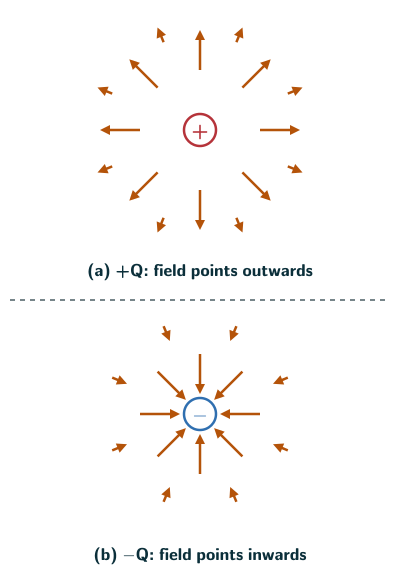
- Direction: for a positive source charge the field points radially outwards; for a negative one it points radially inwards (page 15). A positive test charge is pushed along E; a negative one is pushed the opposite way.
- Which field acts on q: in F = qE, E is the field of the other charges at the place where q sits. In this electrostatic point-charge model we exclude the charge’s own field from its force (NCERT page 14: the field E “at the location of q”).
- Spherical symmetry: the field’s magnitude depends only on the distance r, so it is the same at every point of a sphere centred on the charge (page 15).
Electric field due to a system of charges
For charges q1, q2, …, qn, the field at a point P is the force on a unit test charge at P, with the charges left in place. Coulomb’s law gives each charge’s field and superposition adds them (NCERT Section 1.7.1, pages 15–16):
Field of a system of charges (NCERT Eq. 1.10)
Here k = 1/4πε0, riP is the distance from qi to P, and r̂iP is the unit vector from qi to P. E is a vector that varies from point to point, fixed by the positions of the source charges (page 16). For charge spread out continuously, the sum becomes a sum over small elements: see continuous charge distributions.
Physical significance of electric field
If Coulomb’s law and superposition already give the force on any charge, why bring in the field? NCERT’s answer (Section 1.7.2, pages 16–17):
- In electrostatics, the field is convenient but not really necessary. It is an elegant way of describing the electrical environment of a system of charges: at each point it tells you the force on a unit positive test charge, without disturbing the system. It belongs to the source charges and is independent of the test charge. Since force is a vector, the electric field is a vector field (page 16).
- Beyond electrostatics, the field becomes essential. No signal travels faster than light, c, so when a charge q1 accelerates, the effect on a distant q2 comes after a delay. In the field picture, the accelerated q1 produces electromagnetic waves that travel at speed c, reach q2 and push it. The field accounts for the delay (pages 16–17).
- So fields are regarded as physical entities, not mere mathematical constructs: they evolve by their own laws and carry energy. The concept of field was first introduced by Faraday (page 17).
Solved examples
Example 1: Falling in an electric field (NCERT Example 1.7)
An electron falls 1.5 cm from rest in a uniform upward field of 2.0 × 10⁴ N C−1. The field is then reversed and a proton falls the same distance. Find each time of fall, ignoring gravity, and contrast this with free fall.
Answer: each particle feels a downward force eE, so its acceleration is a = eE/m. From rest, h = ½at2 (equations of motion), so
With e = 1.6 × 10⁻¹⁹ C, h = 1.5 × 10⁻² m, me = 9.11 × 10⁻³¹ kg and mp = 1.67 × 10⁻²⁷ kg:
The heavier proton takes longer. Under gravity alone the time of fall does not depend on mass; here it does, because the force is the same but the masses differ. Ignoring gravity is fair: the proton’s acceleration is eE/mp = 1.9 × 10¹² m s−2, against g = 9.8 m s−2, and the electron’s is larger still (NCERT pages 17–18).
Example 2: Field of two opposite charges (NCERT Example 1.8)
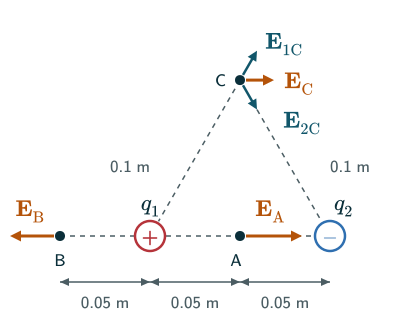
Charges q1 = +10−8 C and q2 = −10−8 C are 0.1 m apart. Find the field at A (the midpoint), at B (on the line, 0.05 m from q1 on the side away from q2) and at C (0.1 m from each charge).
Answer: with E = k|q|/r2 and k|q| = (9 × 10⁹)(10−8) = 90 N m2 C−1:
- At A (0.05 m from each): q1’s field points away from q1, to the right, with 90/(0.05)2 = 3.6 × 10⁴ N C−1. q2’s field points towards q2, also to the right, with the same size. So EA = 7.2 × 10⁴ N C−1, to the right.
- At B (0.05 m from q1, 0.15 m from q2): 3.6 × 10⁴ N C−1 to the left from q1, and 90/(0.15)2 = 4 × 10³ N C−1 to the right from q2. So EB = 3.2 × 10⁴ N C−1, to the left.
- At C (0.1 m from each): each field is 90/(0.1)2 = 9 × 10³ N C−1, one pointing away from q1, the other towards q2, each at 60° to the line of the charges. Their vertical parts cancel, so EC = 2 × 9 × 103 × cos 60° = 9 × 10³ N C−1, to the right (NCERT pages 18–19).
Example 3: Field and force near a point charge
Find the field 20 cm from a +4 µC charge, and the force on a −2 µC charge placed there.
Answer: kQ = (9 × 10⁹)(4 × 10⁻⁶) = 3.6 × 10⁴ N m2 C−1 and r2 = (0.20 m)2 = 0.04 m2, so
pointing away from the +4 µC charge. Then the force magnitude is F = |q|E = (2 × 10⁻⁶)(9 × 10⁵) = 1.8 N. The test charge is negative, so the force points opposite to E: towards the +4 µC charge (NCERT Eqs. (1.6) and (1.8), page 14).
Example 4: Holding a charged drop still
A drop of mass 1.0 × 10⁻¹⁵ kg carries a charge of −3e. What field holds it at rest against gravity? Take g = 9.8 m s−2.
Answer: the electric force must balance the weight, |q|E = mg, so
Here mg = 9.8 × 10⁻¹⁵ N and |q| = 3 × 1.6 × 10−19 = 4.8 × 10⁻¹⁹ C, so
The force must point up. The drop is negative, so the field must point down (NCERT Eq. (1.8), page 14).
Common mistakes to avoid
Common mistake
Thinking the field depends on the test charge
E = F/q: doubling q doubles F, so E is unchanged. The field belongs to the source charges (NCERT page 15).
Common mistake
Getting the field direction wrong for negative charges
The field of a negative charge points radially inwards, towards it. And a negative charge placed in a field is pushed opposite to E (NCERT page 15).
Common mistake
Adding field magnitudes without directions
Fields add as vectors. At B in NCERT Example 1.8 the two fields point opposite ways, so their sizes subtract (NCERT page 19).
Common mistake
Looking for zero field between unlike charges
Between +q and −q both fields point towards −q and add, as at A in NCERT Example 1.8. For unlike charges, zero field can occur only outside the pair, beyond the smaller charge, and for equal and opposite charges there is no such point at a finite distance. For like charges it lies between them, nearer the smaller (reasoned from NCERT Example 1.8, pages 18–19).
Common mistake
Expecting all charges to fall alike
In a uniform field, a = qE/m depends on the mass: the proton takes more than 40 times as long as the electron to fall the same distance, since t ∝ √m and √(mp/me) ≈ 43 (NCERT pages 17–18).
Quick revision summary
- Electric field at a point: the force on a unit positive test charge there, E = F/q, with q made so small that it does not disturb the source charges.
- Point charge: E = (1/4πε) Q/r, radially outwards for positive Q and inwards for negative Q; same size everywhere on a sphere centred on the charge.
- A charge q in a field feels F = qE. Unit of E: N C (also V m, from the next chapter).
- Several charges: E = E + E + … + E, by superposition.
- In electrostatics the field is a convenience; for time-varying fields it is essential, since effects travel at the speed of light, and fields carry energy. Faraday introduced the idea.
Formula sheet
- E = F/q (q → 0)
- E = (1/4πε) Q/r, along r̂
- F = qE
- E = E + E + … + E
- unit: N C = V m
Questions students ask
Is electric field intensity the same as electric field, and is it a vector?
Yes, electric field intensity, electric field strength and electric field all name the same quantity, E = F/q: the force per unit positive test charge at a point, measured in N C. It is a vector, pointing the way a positive charge placed there would be pushed, and the fields of several charges add as vectors, by the parallelogram law (NCERT pages 14–16).
What are the SI unit and dimensional formula of electric field?
The SI unit of electric field is the newton per coulomb, N C, which is the same as the volt per metre, V m, and its dimensional formula is [M L T A] (NCERT pages 14 and 40). The dimensions follow from E = F/q: force is [M L T] and charge is [A T], so dividing gives [M L T A] (see dimensional formulae).
Is a test charge always positive?
A test charge need not be positive, but a small positive one is the usual choice: the field is defined as the force per unit positive charge, so a positive test charge is pushed along E and shows the field’s direction directly (NCERT pages 14–15). A negative test charge measures the same field, because in E = F/q, with the sign of q included, both F and q change sign; only the force on it points against the field.
What is the difference between electric field and electric force?
The electric field at a point belongs to the source charges: it is the force per unit positive charge there, in N C, whereas the electric force is the push or pull on a particular charge placed at that point, in newtons. The two are linked by F = qE: the field is there whether or not a charge is placed at the point, while the force depends on the size and sign of the charge that feels it (NCERT pages 14–16). For example, in a field of 5.0 × 10 N C a 4.0 µC charge feels 2.0 × 10 N, and an electron feels 8.0 × 10 N, opposite to the field.
Is the electric field of a point charge uniform, and how does it vary with distance?
No, the electric field of a point charge is not uniform: its size falls as 1/r, E = k|Q|/r, and its direction is radial, so it changes from point to point (NCERT pages 14–15). A graph of E against r is a steeply falling curve that approaches zero far away, while a graph of E against 1/r is a straight line through the origin with slope k|Q|; the field is not defined at the point charge itself (NCERT page 41). A uniform field, the same in size and direction throughout a region, is found on either side of an infinite uniformly charged plane sheet; a large finite sheet approximates it near its middle at distances small compared with its size (see field of a sheet).
Practice questions
Try each question first, then open the answer to check your working.
-
Q1. A charge of 3 µC feels a force of 6 × 10 N at a point. What is the field there?
Show answerHide answer
E = F/q = (6 × 10⁻³)/(3 × 10−6) = 2 × 10³ N C−1 (NCERT Eq. (1.8), page 14).
-
Q2. By what factor does the field of a point charge change when the distance is halved?
Show answerHide answer
It becomes 4 times as strong, because E ∝ 1/r (NCERT Eq. (1.6), page 14).
-
Q3. Why is a test charge made negligibly small when defining the field?
Show answerHide answer
So that its own force does not move the source charge; F/q stays finite as q → 0 (NCERT page 15).