Applications of Gauss’s law
NCERT Class 12 Physics Chapter 1 Section 1.14
Quick answer
The applications of Gauss’s law in Class 12 are the fields of three symmetric charge distributions, each found in a few lines with a Gaussian surface matched to the symmetry. An infinite uniformly charged straight wire gives E = λ/(2πεr), an infinite plane sheet gives E = σ/(2ε) at any distance, and a uniformly charged thin spherical shell gives E = q/(4πεr) outside, as if its charge were at the centre, and E = 0 inside.
With your textbook
NCERT Physics Part I (Class 12), Chapter 1 “Electric Charges and Fields”, Section 1.14 “Applications of Gauss’s Law”, pages 33–37.
Open the official NCERT chapter (PDF, 4.0 MB, ncert.nic.in) (opens in a new tab)
Checked against the 2026-27 reprint on .
How is Gauss’s law used to find fields?
Applications of Gauss’s law
Adding up the fields of all the small pieces of a charge distribution is usually too hard to do in general. NCERT points to the way round it:
For some symmetric charge configurations, however, it is possible to obtain the electric field in a simple way using the Gauss’s law.
NCERT Physics Part I (Class 12), Section 1.14, page 33
The method: use the symmetry to find the direction of E and where its size is the same, choose a Gaussian surface on which E is either constant and normal to the surface or parallel to it, and solve ϕ = q/ε0 for E.
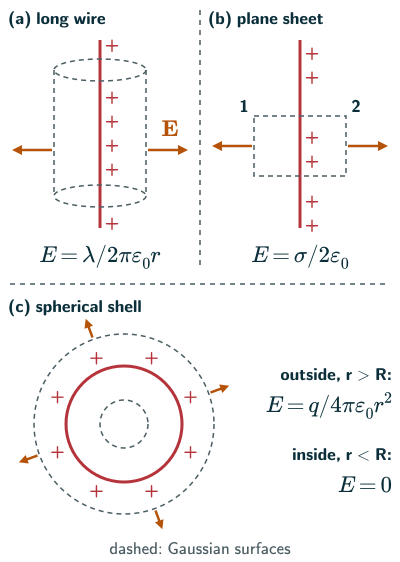
In plain words: symmetry tells you the shape of the answer before you calculate. Around a long wire the field must point straight out and depend only on the distance; so wrap the wire in a cylinder, where the field is the same all over the curved side, and Gauss’s law gives the field in one line.
Field due to an infinitely long straight uniformly charged wire
Take a thin, infinitely long straight wire with uniform linear charge density λ (NCERT Section 1.14.1, pages 33–34):
- Symmetry: turning the radius from the wire to a point P around the wire gives equivalent points, so E has the same size at all of them. A pair of line elements above and below P give a field whose parts along the wire cancel, so the field is radial: outward if λ > 0, inward if λ < 0. And for an infinite wire it cannot depend on where P is along the wire (page 33).
- Gaussian surface: a cylinder of radius r and length l around the wire. The flux through its flat ends is zero, since E is radial; on the curved part E is normal and constant, so the flux is E × 2πrl. The charge enclosed is λl (pages 33–34).
Field of a long straight charged wire (NCERT Eq. 1.32)
- In vector form E = (λ/2πε0r)n̂, with n̂ the radial unit vector in the plane normal to the wire; here E is an algebraic number, negative when E points inward (page 34).
- Only the enclosed charge λl enters the calculation, but E is due to the charge on the whole wire. The wire being infinitely long is crucial; for a long real wire the result holds near its central part, away from the ends (page 34).
Field due to a uniformly charged infinite plane sheet
Take an infinite plane sheet with uniform surface charge density σ, with the x-axis normal to it (NCERT Section 1.14.2, pages 34–35):
- Symmetry: the field cannot depend on y and z, and it must point along x, away from a positive sheet on both sides (page 34).
- Gaussian surface: a box (or a cylinder) of cross-section A through the sheet. Only its two faces parallel to the sheet carry flux; their outward normals point along −x and +x, and the field points the same ways, so the two fluxes add to 2EA. The charge enclosed is σA (pages 34–35).
Field of an infinite plane sheet (NCERT Eq. 1.33)
- E points away from the sheet if σ is positive and towards it if σ is negative (page 35).
- The field does not depend on the distance from the sheet. For a large but finite sheet, the result is an approximation near the middle, at distances small compared with the sheet’s dimensions (page 35).
Field due to a uniformly charged thin spherical shell
Take a thin spherical shell of radius R with uniform surface charge density σ, so its total charge is q = 4πR2σ. By spherical symmetry the field at any point depends only on the distance r from the centre and is radial (NCERT Section 1.14.3, page 35). For the Gaussian surface, take a sphere of radius r about the centre O: the flux through it is E × 4πr2.
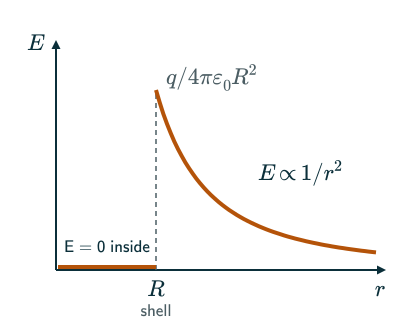
- Outside the shell (r > R): the sphere encloses the whole charge, so E × 4πr2 = q/ε0 (NCERT Eq. (1.34), page 35). This is exactly the field of a point charge q at the centre: outside, the shell acts as if all its charge were at its centre.
- Inside the shell (r < R): the sphere encloses no charge, so E = 0 (NCERT Eq. (1.35), page 36). The field of a uniformly charged thin shell is zero at every point inside it.
Field of a charged thin spherical shell (NCERT Eqs. 1.34–1.35)
- The zero field inside follows from Gauss’s law, which follows from Coulomb’s law; checking it by experiment confirms the 1/r2 dependence in Coulomb’s law (page 36).
- NCERT asks you to compare a uniform mass shell in gravitation (page 36, footnote): see the gravity of a spherical shell.
Solved examples
Example 1: An early model of the atom (NCERT Example 1.12)
A point nucleus of charge Ze is surrounded by negative charge of uniform density up to a radius R; the atom is neutral. Find the field at a distance r from the nucleus.
Answer: the negative charge is −Ze spread through a sphere of radius R, so its density is ρ = −3Ze/(4πR3). Use a spherical Gaussian surface of radius r centred on the nucleus (NCERT pages 36–37).
(i) 0 < r < R: the enclosed charge is the nucleus plus the negative charge inside radius r:
and E × 4πr2 = q/ε0 gives
directed radially outward.
(ii) r > R: the atom is neutral, so the enclosed charge is zero and E = 0. At r = R both cases give E = 0. The field is undefined at r = 0 because the nucleus is modelled as a point charge.
Example 2: Charge on a long wire (NCERT Exercise 1.22)
An infinite line charge produces a field of 9 × 10⁴ N/C at a distance of 2 cm. Find its linear charge density.
Answer: from E = λ/(2πε0r):
This is the magnitude |λ|. Its sign is positive for an outward field and negative for an inward field; the question gives no direction. Using 2πε0 = 5.56 × 10⁻¹¹ C2 N−1 m−2, r = 0.02 m and E = 9 × 10⁴ N/C (NCERT Eq. (1.32), page 34).
Example 3: A charged sphere from its field (NCERT Exercise 1.20)
A conducting sphere of radius 10 cm has an unknown charge. The field 20 cm from its centre is 1.5 × 10³ N/C and points radially inward. What is the net charge on the sphere?
Answer: a conductor’s excess charge sits on its surface (NCERT Chapter 2, Section 2.9, page 62), and on an isolated sphere it spreads evenly, so the sphere is a charged thin shell. Outside, its field is that of a point charge at the centre (NCERT Eq. (1.34), page 35), E = k|q|/r2. So |q| = Er2/k = (1.5 × 103 × 0.04)/
Example 4: Two charged plates (NCERT Exercise 1.23)
Two large, thin metal plates are parallel and close together. Their inner faces carry surface charge densities of opposite signs and magnitude 17.0 × 10⁻²² C/m2. Find E (a) outside the first plate, (b) outside the second plate, (c) between the plates.
Answer: treat each charged face as a large sheet, giving σ/2ε0 away from the positive face and towards the negative one, and add the fields (superposition). Outside the plates the two fields are equal and opposite: (a) and (b) E = 0. Between them they point the same way, from the positive plate to the negative:
(NCERT Eq. (1.33), page 35. NCERT uses the same superposition for the parallel plate capacitor: Chapter 2, Section 2.12, Eqs. (2.39)–(2.41), pages 68–69.)
Common mistakes to avoid
Common mistake
Using the sheet result near the edge of a small plate
E = σ/2ε is for an infinite sheet; for a finite sheet it holds only in the middle, away from the edges (NCERT page 35).
Common mistake
Thinking the field inside a charged shell is the field of its charge at the centre
Outside, a thin shell acts like a point charge at its centre; inside, its field is zero (NCERT pages 35–36).
Common mistake
Using σ/2ε just outside a conductor
E = σ/2ε is for a thin sheet, whose flux leaves through both sides. Inside a conductor E = 0, so all the flux leaves through one side and the field just outside is E = σ/ε (NCERT Chapter 2, Section 2.9, Eq. (2.35), page 63). This is why the field between the plates in NCERT Exercise 1.23 is σ/ε.
Common mistake
Thinking only the enclosed charge makes the field
Only the enclosed charge enters Gauss’s law, but the field itself is due to all the charge; symmetry is what lets the enclosed charge give the answer (NCERT page 34).
Quick revision summary
- Gauss’s law finds fields easily for symmetric charge distributions, with a Gaussian surface matched to the symmetry.
- Long straight wire: E = λ/(2πεr), radial; Gaussian surface a coaxial cylinder.
- Infinite plane sheet: E = σ/(2ε), normal to the sheet and the same at every distance; Gaussian surface a box or cylinder through it.
- Thin spherical shell: E = q/(4πεr) outside, as if the charge were at the centre; E = 0 inside.
- The zero field inside a shell, checked by experiment, confirms the inverse-square law.
Formula sheet
- wire: E = λ/(2πεr)
- sheet: E = σ/(2ε)
- shell, r > R: E = q/(4πεr)
- shell, r < R: E = 0
- atom model, 0 < r < R: E = (Ze/4πε)(1/r − r/R)
Questions students ask
Why is the electric field inside a uniformly charged spherical shell zero?
The electric field inside a uniformly charged thin spherical shell is zero because a Gaussian sphere inside encloses no charge, and symmetry makes any field there radial and equal all over that sphere, so zero flux means E = 0 (NCERT pages 35–36). Zero enclosed charge alone is not enough: inside an unevenly charged insulating shell, or a uniform one with a charge outside it, the field is not zero. Beyond the NCERT text, by Coulomb’s law: a thin double cone through any inside point cuts two patches whose charges grow as the square of their distance while their fields fall as 1/r, so the two cancel, and the experiment checking this zero tests the inverse-square law (NCERT page 36).
Why does the field of an infinite plane sheet not depend on the distance from it?
The field of an infinite charged plane sheet does not depend on distance because its field lines are parallel straight lines that leave the sheet at right angles: they never spread out, so their density, and the field E = σ/2ε0, stay the same at every distance (NCERT pages 35 and 38). Compare the spreading in the other two cases: a point charge’s lines spread over spheres of area 4πr, so E ∝ 1/r, and a long wire’s lines spread over cylinders of area 2πrl, so E ∝ 1/r (NCERT pages 30 and 33–34). For a real sheet this holds only at distances small compared with its size, near its middle (NCERT page 35).
What is the electric field exactly at the surface of a charged spherical shell?
The electric field at the surface of a uniformly charged thin spherical shell jumps there, because the field of a surface charge is discontinuous across the surface (NCERT page 41): just inside it is zero, and just outside it is q/4πε0R, which with q = 4πRσ equals σ/ε0 (NCERT pages 35–36). NCERT’s summary counts the surface with the outside, writing E = q/4πε0r for r ≥ R (NCERT page 40), so “field at the surface” in that NCERT convention means the just-outside value q/(4πεR). For an ideal zero-thickness charge layer there is no single continuous value at the layer; specify which side is intended. The jump, σ/ε0, is the same as across an infinite sheet, whose field changes from σ/2ε0 one way to σ/2ε0 the other.
How many applications of Gauss’s law are in Class 12, and which are in the JEE and NEET syllabus?
NCERT Class 12 Physics Part I works out three applications of Gauss’s law in Section 1.14: the field of an infinitely long, uniformly charged straight wire, of a uniformly charged infinite plane sheet and of a uniformly charged thin spherical shell (pages 33–36), followed by NCERT Example 1.12, an early model of the atom (pages 36–37). The JEE Main syllabus and the NEET (UG) 2026 syllabus both name exactly these three in Unit 11, Electrostatics: “Gauss’s law and its applications to find field due to infinitely long uniformly charged straight wire, uniformly charged infinite plane sheet and uniformly charged thin spherical shell” (JEE Main wording).
Practice questions
Try each question first, then open the answer to check your working.
-
Q1. How does the field of a long charged wire change when the distance from it is doubled?
Show answerHide answer
It halves, since E ∝ 1/r (NCERT Eq. (1.32), page 34).
-
Q2. A large sheet has σ = 8.854 × 10⁻⁹ C/m2. Find the field near it.
Show answerHide answer
E ≈ σ/2ε0 = (8.854 × 10⁻⁹)/
(2 × 8.854 × 10−12) = 500 N/C near the middle, at distances much smaller than the sheet’s dimensions (NCERT Eq. (1.33), page 35). -
Q3. What is the field at the centre of a uniformly charged thin spherical shell?
Show answerHide answer
Zero: the field is zero everywhere inside the shell (NCERT Eq. (1.35), page 36).