Electric field lines
NCERT Class 12 Physics Chapter 1 Section 1.8
Quick answer
An electric field line is a curve whose tangent at every point gives the direction of the net electric field there, and the relative density of the lines shows the field’s strength. Field lines start on positive charges and end on negative charges (or at infinity), are continuous in a charge-free region, never cross each other, and form no closed loops. For a point charge, ΔΩ = ΔS/r shows that their density, like E, falls as 1/r.
With your textbook
NCERT Physics Part I (Class 12), Chapter 1 “Electric Charges and Fields”, Section 1.8 “Electric Field Lines”, pages 19–21.
Open the official NCERT chapter (PDF, 4.0 MB, ncert.nic.in) (opens in a new tab)
Checked against the 2026-27 reprint on .
What are electric field lines?
Electric field lines
Electric field lines are thus a way of pictorially mapping the electric field around a configuration of charges.
NCERT Physics Part I (Class 12), Section 1.8, page 20
A field line is a curve drawn so that its tangent at every point is along the net field at that point, with an arrow to show which of the two directions along the tangent the field takes (NCERT pages 20–21).
In plain words: start at any point, take a tiny step in the direction of the field there, then another step in the direction of the field at the new point, and so on; the curve you trace is a field line. It is not, in general, the path a released charge follows (see Common mistakes). Where the lines bunch together the field is strong; where they spread out it is weak.
Drawing field lines
- From arrows to lines. Around a point charge, draw arrows along the field with lengths proportional to its strength: they shrink as 1/r2 and point radially outwards. Each arrow shows the force on a unit positive charge at its tail. Joining arrows that point in one direction gives a field line (NCERT page 19).
- Strength from density. Once the arrows become lines, the strength is no longer in an arrow’s length but in the density of lines: close together where the field is strong, far apart where it is weak (page 19).
- The number is a choice. Another person may draw more lines; any number can be drawn. Only the relative density in different regions matters (pages 19–20).
- Space curves. Field lines live in three dimensions, even when a figure shows them in one plane (page 21).
- Faraday’s idea. Faraday invented the picture to visualise fields without mathematics and called them lines of force. NCERT prefers field lines, since “lines of force” is somewhat misleading, especially for magnetic fields (page 20).
Density of lines and field strength
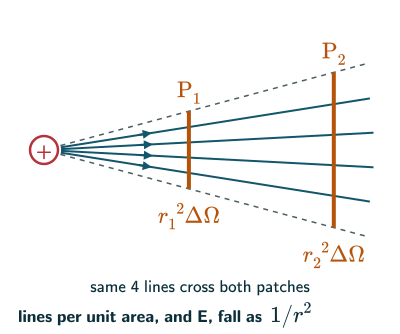
In three dimensions, the density of lines means the number of lines per unit area, counted on an area held perpendicular to them (NCERT page 20). For a point charge, NCERT shows that this density falls as 1/r2, just as the field does:
- A small area ΔS held perpendicular to the lines at a distance r subtends a solid angle, NCERT’s generalisation of angle to three dimensions (page 20), measured in steradians:
Solid angle of a small area
- Within one solid angle the number of radial lines, n, is fixed. At distance r1 they cross an area r12ΔΩ; at r2 the same n lines cross r22ΔΩ. So the lines per unit area are n/(r12ΔΩ) and n/(r22ΔΩ): a 1/r2 dependence (page 20).
- Put the other way: the field falls as 1/r2 while a sphere around the charge grows as r2, so the number of lines crossing any sphere around the charge is the same, however far away it is (page 20).
- Lines and charge. That number is density × area ∝ (q/r2) × r2 ∝ q. So in a picture drawn to scale, the number of lines leaving a positive charge, or ending on a negative one, is proportional to the size of the charge: 2q has twice as many lines as q (reasoned from page 20; this is the idea behind Gauss’s law, NCERT Section 1.13).
Field lines start on positive and end on negative charges
The first general property of field lines (NCERT page 21):
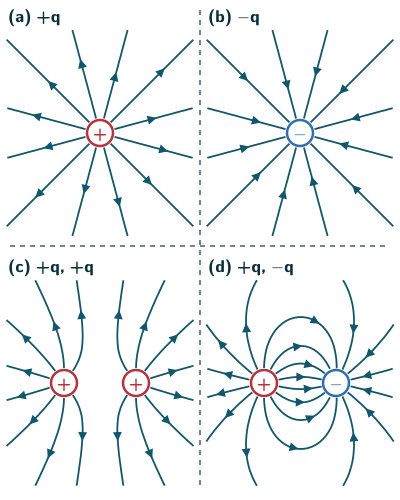
- Field lines start from positive charges and end at negative charges. With a single charge, they may start or end at infinity.
- The lines of a single positive charge point radially outwards; those of a single negative charge point radially inwards.
- Around two equal positive charges, the lines bend away from the gap between them: a picture of their repulsion. Around equal and opposite charges (a dipole), lines run from +q to −q: a picture of their attraction (page 21).
- In a region with no charge, field lines can be taken to be continuous curves without any breaks (page 21).
- Where the field is the same everywhere, the lines are uniformly spaced parallel straight lines (NCERT Summary, page 38).
Field lines never cross
Two field lines can never cross each other.
NCERT Physics Part I (Class 12), Section 1.8, page 21
The reason: if two lines crossed, the field at the crossing point would have two directions, one along each tangent. But the net field at a point has a single direction, so this is impossible (page 21).
The argument needs a field that is not zero. At a null point, where E = 0 (such as the midpoint of the two equal charges in NCERT Figure 1.14(c)), the field has no direction. Limiting branches may approach the null from different directions, but they do not define a single field line passing through it with two tangents (reasoned).
One more property: electrostatic field lines do not form closed loops. This follows from the conservative nature of the electrostatic field, which NCERT takes up in Chapter 2 (page 21).
Solved examples
Example 1: No breaks, no crossings (NCERT Exercise 1.7)
(a) An electrostatic field line is a continuous curve: it cannot have sudden breaks. Why not? (b) Explain why two field lines never cross each other at any point.
Answer: (a) The field of the charges exists at every point in space and changes smoothly from point to point in a region without charges (NCERT pages 15 and 21). A break would mean a gap where the field had no direction, yet a test charge placed in the gap would still feel a force there. So the line continues. Away from field zeros, lines begin and end on charges or at infinity; at a null the tangent construction is undefined and branches may approach it. (b) At a crossing point the field would point along two different tangents at once. The net field at a point has only one direction, so field lines cannot cross (NCERT page 21).
Example 2: Density at two distances
Around a point charge, a small area held perpendicular to the lines at 10 cm is crossed by 36 lines. How many lines cross an area of the same size at 30 cm, and how do the fields compare?
Answer: in one solid angle the same lines spread over an area that grows as r2. Tripling r spreads them over 9 times the area, so the same-sized area at 30 cm is crossed by 36/9 = 4 lines. The field at 30 cm is 1/9 of the field at 10 cm, matching E ∝ 1/r2 (NCERT page 20).
Example 3: Reading a field-line picture
In the field-line picture of a dipole (+q and −q), (a) which way is the field at the midpoint between the charges? (b) Which way is a small electron placed there pushed? (c) Is the field stronger near the charges or far from them?
Answer: (a) Lines run from +q to −q, so at the midpoint the field points from +q towards −q. (b) The electron is negative, so it is pushed against the field, towards +q. (c) The lines crowd near the charges and spread out far away, so the field is stronger near the charges (NCERT pages 19–21).
Example 4: Which pictures are possible?
Which of these could be electrostatic field lines: (a) lines leaving a positive charge and ending on a negative one, (b) a closed circle with no charge on it, (c) two lines crossing at a point, (d) parallel, equally spaced straight lines?
Answer: (a) yes; (b) no, electrostatic field lines do not form closed loops; (c) no, field lines never cross; (d) yes: this is a uniform field (NCERT pages 21 and 38).
Common mistakes to avoid
Common mistake
Reading the number of lines as an exact quantity
Any number of lines can be drawn; only their relative density matters (NCERT pages 19–20).
Common mistake
Drawing crossing lines where two fields meet
Fields from several charges add to one net field with one direction, so even where two charges’ fields meet, the lines do not cross (NCERT page 21).
Common mistake
Drawing closed loops of electrostatic field lines
Electrostatic field lines start and end on charges or at infinity; they do not close on themselves (NCERT page 21).
Common mistake
Taking a field line as the path of a charge
The field line gives the direction of the force at each point, not the path. Released from rest at a nonzero field, a positive charge initially accelerates along the line and a negative charge against it, but once it is moving its path can leave a curved line (reasoned from F = qE, NCERT page 14).
Quick revision summary
- An electric field line is a curve whose tangent at each point gives the direction of the net field there; an arrow shows the sense.
- The relative density of lines (number per unit area, perpendicular to the lines) shows the relative strength of the field; the number drawn is a matter of choice.
- For a point charge, ΔΩ = ΔS/r: the same lines cross areas that grow as r, so their density, like E, falls as 1/r.
- Lines start on positive charges and end on negative charges (or at infinity); they are continuous in a charge-free region.
- Two field lines never cross, and electrostatic field lines form no closed loops; a uniform field has parallel, equally spaced lines.
Formula sheet
- ΔΩ = ΔS/r
- lines per unit area ∝ E
- point charge: lines per unit area ∝ 1/r
- start on +q, end on −q (or at infinity)
- never cross; no closed loops
Questions students ask
Why do electrostatic field lines not form closed loops?
Electrostatic field lines cannot form closed loops because the electrostatic field is conservative, as NCERT notes on page 21: the work it does on a charge moved from one point to another does not depend on the path, so its work round any closed path is zero (NCERT Chapter 2, pages 45–46). If a field line closed on itself, the field would push a positive charge carried once round it forwards all the way, doing positive work round a closed path, which is impossible. So the lines must start on positive charges and end on negative charges or at infinity; the rule is for fields of charges at rest.
What is the difference between electric field lines and magnetic field lines?
Electrostatic field lines start on positive charges and end on negative charges, or at infinity, and never form closed loops, while the magnetic field lines of a magnet or a solenoid form continuous closed loops (NCERT Chapter 5, page 137). The difference comes from the sources: isolated positive and negative charges exist, but fundamental magnetic monopoles have not been established experimentally. In the standard no-monopole description, magnetic field lines have nowhere to begin or end (NCERT page 151). Both kinds of line give the field’s direction by their tangent, crowd where the field is strong and never cross (pages 19–21 and 138), but, unlike electric field lines, magnetic ones do not show the direction of the force on a moving charge (page 137).
Are electric field lines real?
Electric field lines are not real objects but a picture: Faraday invented them as an intuitive, non-mathematical way of visualising the field, and NCERT calls them a way of mapping the field around a configuration of charges (NCERT page 20). The field they map is real, though: NCERT regards electric and magnetic fields as physical entities that carry energy, not mere mathematical constructs (page 17).
What is the difference between electric field and electric field lines?
The electric field is a vector quantity with a definite size and direction at every point in space, the force per unit positive test charge there, in N C, while electric field lines are curves drawn to picture it (NCERT pages 14–16 and 20). A field line shows the field’s direction by its tangent and, through how closely it crowds its neighbours, the field’s relative strength, but it does not give the field’s value at a point (NCERT pages 20–21).
Practice questions
Try each question first, then open the answer to check your working.
-
Q1. What does the tangent to a field line at a point give?
Show answerHide answer
The direction of the net electric field at that point (NCERT pages 20–21).
-
Q2. Around a point charge, the lines per unit area at distance r are N. What are they at 2r?
Show answerHide answer
N/4, because the same lines cross an area 4 times as large (NCERT page 20).
-
Q3. Who invented the picture of field lines, and what did he call them?
Show answerHide answer
Faraday, who called them lines of force (NCERT page 20).