Electrostatic potential energy
NCERT Class 12 Physics Chapter 2 Section 2.1
Quick answer
Electrostatic potential energy is the energy a charge stores because of its position in an electric field. The potential energy difference between two points is the work an external force does in moving the charge between them without accelerating it, ΔU = UP − UR = WRP, and it does not depend on the path because the Coulomb force is conservative. With the zero taken at infinity, the potential energy at a point is the work done in bringing the charge there from infinity.
With your textbook
NCERT Physics Part I (Class 12), Chapter 2 “Electrostatic Potential and Capacitance”, Section 2.1 “Introduction”, pages 45–47.
Open the official NCERT chapter (PDF, 3.9 MB, ncert.nic.in) (opens in a new tab)
Checked against the 2026-27 reprint on .
What is electrostatic potential energy?
Electrostatic potential energy
Pushing a charge against an electric force takes work, and that work is stored, just as lifting a stone stores gravitational potential energy. With the potential energy taken as zero at infinity, NCERT defines it:
Potential energy of charge q at a point (in the presence of field due to any charge configuration) is the work done by the external force (equal and opposite to the electric force) in bringing the charge q from infinity to that point.
NCERT Physics Part I (Class 12), Section 2.1, page 47
In plain words: bring a positive charge towards another positive charge and you must keep pushing, because they repel. Let go, and the charge flies back out, turning the stored energy into motion. The energy stored on the way in is its electrostatic potential energy.
The electrostatic force is conservative
- Class 11 met potential energy for spring and gravitational forces: the work done against them is stored, and kinetic plus potential energy is conserved when only conservative forces do work. Such forces are conservative (NCERT page 45; see conservative forces).
- The Coulomb force between stationary charges is also conservative. That is no surprise: like gravity it goes as 1/r2, with charges in place of masses (page 45).
- The work done by an electrostatic field in moving a charge between two points depends only on the two points, not on the path between them. This is the defining property of a conservative force; without it, potential energy would have no meaning. It can be proved from Coulomb’s law; NCERT omits the proof (page 46).
Potential energy difference as work done
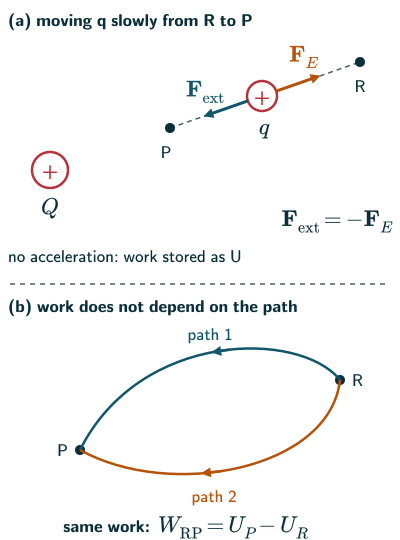
Take a charge Q fixed at the origin and bring a test charge q from a point R to a point P, against the repulsion when both are positive (NCERT Figure 2.1, pages 45–46):
- q is small enough not to disturb Q (or Q is held fixed).
- The external force just balances the electric force, Fext = −FE, so q moves without acceleration, at an infinitesimally slow constant speed.
- Then the work done by the external force is the negative of the work done by the electric force, and it is all stored as potential energy. If the external force is removed at P, the electric force pushes q away, turning the stored energy into kinetic energy so that their sum stays constant (page 46).
The work done by the external force from R to P, WRP, is the integral of Fext·dr from R to P, which equals minus the integral of FE·dr (NCERT Eq. (2.1), page 46). The second form of NCERT’s Eq. (2.1) is printed with Fext in place of FE, which would make the work zero; it should read FE, since Fext = −FE. This work is the rise in potential energy (NCERT Eq. (2.2), page 46):
Potential energy difference (NCERT Eq. 2.2)
- The electric field does work −WRP on the charge, since it pushes against the motion (page 46).
- So the potential energy difference between two points is the work an external force must do to move the charge, without accelerating it, from one to the other. This holds for the field of any charge arrangement (page 46).
Zero of potential energy at infinity
- NCERT’s Eq. (2.2) fixes only differences: adding the same constant α to the potential energy at every point leaves every difference unchanged, (UP + α) − (UR + α) = UP − UR. Only differences are physically significant (NCERT page 47).
- So we are free to choose where U = 0. For a localised charge distribution, the convenient choice is zero at infinity; this requires finite work from infinity (see the FAQ below). Taking R at infinity then gives (NCERT Eq. (2.3), page 47):
Potential energy with zero at infinity (NCERT Eq. 2.3)
- Since P is any point, this defines the potential energy of q anywhere: the work done by the external force in bringing q from infinity to that point (page 47).
Solved examples
Example 1: External work and field work
An external force moves a 2 µC charge slowly from R to P, doing 3.0 × 10⁻⁵ J of work. Find UP − UR, and the work done by the electric field.
Answer: by NCERT Eq. (2.2), UP − UR = WRP = +3.0 × 10⁻⁵ J. The field does the negative of this, −3.0 × 10⁻⁵ J, because the external force just balances it (NCERT page 46).
Example 2: Two paths, one answer
Taking a charge from R to P along a straight line needs 5.0 mJ of external work. How much is needed along a winding path between the same points? And around a closed loop from P back to P?
Answer: 5.0 mJ along any path, because the work depends only on the end points. Around a closed loop the start and end coincide, so the total work is zero (NCERT page 46).
Example 3: Moving the zero
With the zero at infinity, a charge has UP = 4.0 J at P and UR = 1.0 J at R. What are they if the zero is chosen at R instead? How much work is needed from R to P in each case?
Answer: moving the zero subtracts 1.0 J everywhere: UP = 3.0 J and UR = 0. The work from R to P is 3.0 J both times, because only the difference matters (NCERT page 47).
Example 4: Stored energy becomes motion
A charge repelled by a fixed charge has potential energy 6.0 × 10⁻⁴ J at P (zero at infinity) and is released from rest there. Only the electric force acts. What kinetic energy does it have very far away?
Answer: kinetic plus potential energy stays constant (NCERT page 46). At P it is 0 + 6.0 × 10⁻⁴ J; far away U = 0, so the kinetic energy is 6.0 × 10⁻⁴ J.
Common mistakes to avoid
Common mistake
Mixing up external work and field work
Moving a charge slowly from R to P, the external force does W; the field does −W. The potential energy rises by W (NCERT page 46).
Common mistake
Treating a value of potential energy as absolute
Only differences of potential energy are physically significant; its value at a point depends on where the zero is chosen (NCERT page 47).
Common mistake
Forgetting the no-acceleration condition
If the charge also speeds up, the external work is ΔU + ΔK, not ΔU (from the work–energy theorem; NCERT’s definition assumes no acceleration, page 46).
Common mistake
Thinking a longer path needs more work
For the electrostatic force the work depends only on the end points, not on the path (NCERT page 46).
Quick revision summary
- The Coulomb force between stationary charges is conservative: the work it does depends only on the end points.
- Potential energy difference: ΔU = UP − UR = WRP, the work done by an external force moving the charge without acceleration; the field does −WRP.
- Only differences matter; adding a constant everywhere changes nothing.
- With the zero at infinity, UP = W∞P: the work done in bringing the charge from infinity to P.
- Released, the charge turns potential energy into kinetic energy, their sum staying constant.
Formula sheet
- ΔU = UP − UR = WRP
- work by the field = −WRP
- UP = W∞P (U = 0 at infinity)
- (UP + α) − (UR + α) = UP − UR
- work round a closed path = 0
Questions students ask
How can you prove that the electrostatic force is conservative?
The electrostatic force can be proved conservative from Coulomb’s law, the proof NCERT omits on page 46: the force of a fixed point charge acts along the line joining the two charges and depends only on the distance between them (NCERT Chapter 1, page 7). So on any path only the steps along the radius take work, as in NCERT Example 2.1 (page 49; see the worked example), and those steps add up to an amount fixed by the starting and final distances alone. By superposition the same holds for the field of any set of charges at rest.
Can the zero of potential energy always be put at infinity?
The zero of potential energy can be put at infinity only when the work of bringing a charge in from infinity is finite, which NCERT’s ‘convenient choice’ takes for granted (NCERT page 47). Beyond the NCERT text, reasoned from the fields of NCERT Chapter 1: charges in a finite region have a field that falls off at least as fast as 1/r, so that work is finite, but an infinitely long charged wire has a field falling only as 1/r (NCERT Chapter 1, page 34), and the work from infinity would be infinite. For such a wire the zero is put at some finite distance instead, which is allowed because only differences of potential energy matter.
What is the difference between electrostatic potential energy and electric potential?
Electrostatic potential energy, U, is the energy of a particular charge at a point, in joules, and it is proportional to that charge, while the electric potential, V, is the potential energy per unit charge, in volts, a property of the point that does not depend on the charge placed there: U = qV (NCERT pages 47 and 59). At a point where V = 80 V, a charge of 1.5 µC has U = 1.2 × 10 J and a charge of −1.5 µC has U = −1.2 × 10 J, both measured from a zero at infinity. Potential itself is worked out on the page on electrostatic potential.
Does electrostatic potential energy belong to a charge or to the system of charges?
Electrostatic potential energy belongs to a system of charges, not to one charge alone: the work done in bringing a charge near a fixed charge is stored as the energy of the pair, which NCERT calls the potential energy of the system (NCERT pages 55–56). NCERT’s ‘potential energy of charge q’ in Section 2.1 (page 47) is shorthand for a charge moved among sources held fixed, so that the whole change in the system’s energy is put down to that charge. NCERT also pictures the energy as stored in the electric field itself (see energy density).
Practice questions
Try each question first, then open the answer to check your working.
-
Q1. Why must the external force equal −FE when we define potential energy?
Show answerHide answer
So that the charge moves without acceleration: then no kinetic energy is gained, and all the external work is stored as potential energy (NCERT page 46).
-
Q2. Where is the electrostatic potential energy usually taken to be zero?
Show answerHide answer
At infinity (NCERT page 47).
-
Q3. The electric field does −2 J of work as a charge moves from A to B. What is U_B − U_A?
Show answerHide answer
+2 J: the potential energy rises by the negative of the work done by the field (NCERT page 46).