Potential due to a point charge
NCERT Class 12 Physics Chapter 2 Section 2.3
Quick answer
The potential at a distance r from a point charge Q is V = Q/(4πεr), with the potential taken as zero at infinity; it comes from adding up the work done against the Coulomb force along a radial path from infinity. The formula holds for either sign of Q, so a negative charge gives a negative potential. The potential falls as 1/r, more slowly than the field, which falls as 1/r.
With your textbook
NCERT Physics Part I (Class 12), Chapter 2 “Electrostatic Potential and Capacitance”, Section 2.3 “Potential due to a Point Charge”, pages 48–49.
Open the official NCERT chapter (PDF, 3.9 MB, ncert.nic.in) (opens in a new tab)
Checked against the 2026-27 reprint on .
What is the potential of a point charge?
Potential due to a point charge
The potential at a distance r > 0 from a point charge Q, taken as zero at infinity, is (NCERT Eq. (2.8), page 48):
Writing k = 1/4πε0 ≈ 9 × 10⁹ N m2 C−2, the value NCERT uses in Example 2.1 (page 49), this is V = kQ/r.
It holds whatever the sign of the charge. For a negative charge, NCERT notes:
For Q < 0, V < 0, i.e., work done (by the external force) per unit positive test charge in bringing it from infinity to the point is negative.
NCERT Physics Part I (Class 12), Section 2.3, page 49
In plain words: near a positive charge the potential is high, like the top of a hill, and it falls away as you move off, but only as 1/r, more gently than the field. Near a negative charge it is a valley: the potential is negative and rises towards zero far away.
Deriving V = Q/4πεr
Bring a unit positive test charge from infinity to the point P, a distance r from a positive charge Q at the origin. The work does not depend on the path, so take the straight radial path (NCERT Section 2.3, page 48):
- At an intermediate point P′, a distance r′ from Q, the force on the unit charge is Q/(4πε0r′2) outward, by Coulomb’s law (NCERT Eq. (2.5)).
- The work done against it in a small step Δr′ is (NCERT Eq. (2.6)):
The minus sign is there because moving inwards, Δr′ < 0, needs positive work.
- Adding the steps from r′ = ∞ to r′ = r, that is, integrating (NCERT Eq. (2.7)):
The integral of 1/r′2 is −1/r′, and 1/r′ → 0 at infinity:
By definition this work is the potential at P (NCERT Eq. (2.8), page 48).
Sign of the potential
- For Q < 0, V < 0: the external force does negative work per unit positive charge in bringing it from infinity, because the field itself pulls the charge in. Equivalently, the electrostatic force does positive work, since force and displacement point the same way (NCERT page 49).
- V → 0 as r → ∞, consistent with choosing the potential at infinity to be zero (page 49).
- Potential is a scalar (it is work per unit charge, and work is a scalar): it has a sign but no direction.
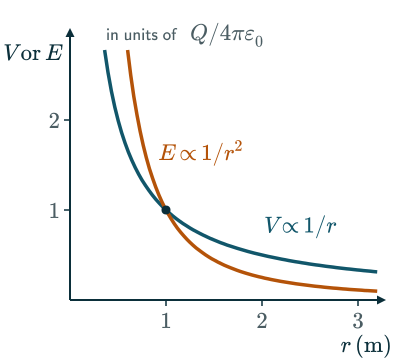
Potential falls as 1/r, the field as 1/r
Potential and field of a point charge
Here Er is the signed outward radial component; the field magnitude is |Q|/(4πε0r).
- The potential falls off as 1/r, the field as 1/r2 (NCERT Figure 2.4, page 49). Doubling the distance halves V but quarters E.
- Dividing one by the other: for a single point charge, |V| = |E|r. This is not a general rule (reasoned from the two formulas above).
Solved examples
Example 1: Potential and work (NCERT Example 2.1)
(a) Find the potential at a point P 9 cm from a charge of 4 × 10⁻⁷ C. (b) Hence find the work done in bringing a charge of 2 × 10⁻⁹ C from infinity to P. Does it depend on the path?
Answer: (a) kQ = 9 × 109 × 4 × 10−7 = 3.6 × 10³ V m, so
(b) W = qV = 2 × 10−9 × 4 × 104 = 8 × 10⁻⁵ J. No, the work does not depend on the path: any small step can be split into a part along r and a part perpendicular to it, and the perpendicular part needs no work (NCERT page 49).
Example 2: A negative charge
Find the potential 30 cm from a charge of −2.0 µC.
Answer: kQ = 9 × 10⁹ × (−2.0 × 10⁻⁶) = −1.8 × 10⁴ V m, so
Negative, as it must be for a negative charge (NCERT page 49).
Example 3: From V and E to r and Q
At a point near a point charge, the potential is 600 V and the field is 200 N/C. How far is the point from the charge, and what is the charge?
Answer: V = kQ/r and E = kQ/r2, so r = V/E = 600/200 = 3.0 m. Then Q = Vr/k = (600 × 3.0)/(9 × 109) = 2.0 × 10⁻⁷ C (NCERT Eqs. (2.8) and (1.6)).
Example 4: Moving closer to a charge
A 1.0 µC charge is moved slowly from 20 cm to 10 cm from a fixed 5.0 µC charge. How much work is needed?
Answer: the potential rises from kQ/0.20 to kQ/0.10. With kQ = 9 × 109 × 5.0 × 10−6 = 4.5 × 10⁴ V m, 1/0.10 − 1/0.20 = 5 m−1, so the rise is 4.5 × 104 × 5 = 2.25 × 10⁵ V. So W = qΔV = 1.0 × 10−6 × 2.25 × 105 ≈ 0.23 J (NCERT Eqs. (2.4) and (2.8)).
Common mistakes to avoid
Common mistake
Using 1/r for the potential
The potential of a point charge falls as 1/r; it is the field that falls as 1/r (NCERT page 49).
Common mistake
Dropping the sign of a negative charge
Put Q in with its sign: a negative charge gives a negative potential (NCERT page 49).
Common mistake
Adding potentials as vectors
Potential is a scalar; potentials from several charges add as signed numbers, not as arrows.
Quick revision summary
- Potential of a point charge: V = Q/(4πεr), zero at infinity.
- Derived by adding the work against the Coulomb force along a radial path from infinity to r.
- True for either sign of Q: negative charges give negative potentials.
- V falls as 1/r, E as 1/r; for a single point charge, |V| = |E|r.
- Work to bring q from infinity: W = qV, independent of the path.
Formula sheet
- V = Q/(4πεr)
- Er = Q/(4πεr) (signed radial component)
- |V| = |E|r (one point charge, zero at infinity)
- W = qV (from infinity)
- W = −∫ Q dr′/(4πεr′), from ∞ to r
Questions students ask
What is the difference between electric potential and electric field?
Electric potential is a scalar, the work per unit positive charge in bringing a charge from infinity to a point, in volts, while the electric field is a vector, the force per unit positive charge at the point, in N C (NCERT Chapter 1, pages 14–15, and pages 47–48). The field depends on how fast the potential changes, not on its value, and points the way V falls fastest (NCERT page 55; see field and potential), so either can be zero where the other is not (see examples).
What is the potential at the position of a point charge itself?
The potential of a point charge at its own position is not defined: V = Q/4πε0r has unbounded magnitude as r → 0 (positive for Q > 0, negative for Q < 0), and NCERT notes that the potential of a charge at its own location is infinite (NCERT Points to Ponder 5, page 78). Real charged bodies have a size, so their potential stays finite: an isolated metal ball in vacuum, with no external field, of radius 1.5 cm carrying 5.0 nC has its charge on its surface (NCERT page 62) and sits at Q/4πε0R = 3.0 × 10 V, from the formula for a charged shell.
Which NCERT chapter covers potential due to a point charge, and is it in the JEE and NEET syllabus?
Potential due to a point charge is in NCERT Class 12 Physics Part I, Chapter 2, Electrostatic Potential and Capacitance, Section 2.3 (pages 48–49), which derives V = Q/4πε0r and works NCERT Example 2.1. It is in both syllabuses: the JEE Main syllabus lists “Electric potential and its calculation for a point charge, electric dipole and system of charges” in Unit 11, Electrostatics, and the NEET (UG) 2026 syllabus has the same words in its Unit 11. The same line covers the potential of a dipole and of a system of charges.
Practice questions
Try each question first, then open the answer to check your working.
-
Q1. By what factor does the potential of a point charge change when the distance is tripled?
Show answerHide answer
It falls to one third, since V ∝ 1/r (NCERT Eq. (2.8), page 48).
-
Q2. What is the potential 10 cm from a 1 nC charge?
Show answerHide answer
V = 9 × 109 × 10−9/0.10 = 90 V (NCERT Eq. (2.8), page 48).
-
Q3. Is the potential near a negative charge positive or negative?
Show answerHide answer
Negative (NCERT page 49).