Effect of a dielectric on capacitance
NCERT Class 12 Physics Chapter 2 Section 2.13
Quick answer
A homogeneous linear dielectric filling the electric-field region raises capacitance to C = KC; for parallel plates C = εKA/d. K = ε/ε is the relative permittivity, greater than 1 for ordinary static dielectrics. With Q fixed, field and voltage fall by K; with a battery fixing V, Q rises by K and the field remains V/d.
With your textbook
NCERT Physics Part I (Class 12), Chapter 2 “Electrostatic Potential and Capacitance”, Section 2.13 “Effect of Dielectric on Capacitance”, pages 69–71.
Open the official NCERT chapter (PDF, 3.9 MB, ncert.nic.in) (opens in a new tab)
Checked against the 2026-27 reprint on .
What does a dielectric do to a capacitor?
Effect of a dielectric on capacitance
Fill the gap between a capacitor’s plates with a dielectric, an insulator such as mica or paper, and the capacitance goes up by a factor K, the dielectric constant of the material: C = KC0 (NCERT Eqs. (2.51) and (2.54), page 70). NCERT states what K means:
Thus, the dielectric constant of a substance is the factor (>1) by which the capacitance increases from its vacuum value, when the dielectric is inserted fully between the plates of a capacitor.
NCERT Physics Part I (Class 12), Section 2.13, page 70
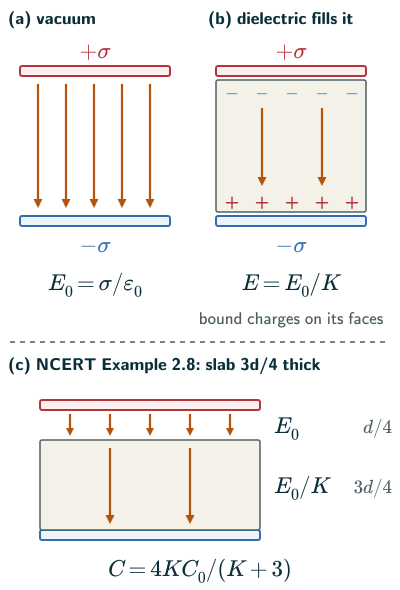
In plain words: the dielectric is polarised by the field between the plates. Its bound charges sit right next to the plates, with the opposite sign, and partly cancel the field of the free plate charges, without removing those free charges. The field and the voltage between the plates both drop, so the same charge now needs a smaller voltage. A smaller V for the same Q means a bigger C = Q/V.
Capacitance with a dielectric between the plates
Use a homogeneous, linear isotropic dielectric in electrostatics, with fringing neglected. The comparison of fields uses the same free plate charge; it does not describe insertion while a battery fixes the voltage.
Take a parallel plate capacitor with plates of area A, a distance d apart, carrying ±Q, so the charge density is ±σ with σ = Q/A (NCERT pages 69–70).
- Vacuum: E0 = σ/ε0, V0 = E0d and C0 = Q/V0 = ε0A/d (NCERT Eq. (2.46), page 70).
- Dielectric filling the gap: it is polarised and, as NCERT explains in Section 2.10, acts like two sheets with bound charge densities σp and −σp on its faces next to the plates. The field in the dielectric is then that of a net density ±(σ − σp) on the plates (NCERT Eq. (2.47), page 70):
- The potential difference is V = Ed (NCERT Eq. (2.48)). For a linear dielectric σp is proportional to E0, that is to σ, so (σ − σp) is proportional to σ too. NCERT writes the constant of proportionality as 1/K (NCERT Eq. (2.49), page 70):
- K is a constant of the dielectric, and K > 1 since σp is positive. Then V = σd/(ε0K) = Qd/(Aε0K) (NCERT Eq. (2.50)), and the capacitance is (NCERT Eq. (2.51), page 70):
Capacitor filled with a dielectric (NCERT Eq. 2.51)
Dielectric constant
- The product ε0K is the permittivity of the medium, ε = ε0K. For vacuum K = 1 and ε = ε0, the permittivity of vacuum (NCERT Eq. (2.52), page 70).
- The dimensionless ratio K = ε/ε0 is the dielectric constant of the substance, and for the ordinary static dielectrics considered here it is greater than 1 (NCERT Eq. (2.53), page 70).
- Comparing NCERT Eqs. (2.46) and (2.51) gives K = C/C0 (NCERT Eq. (2.54), page 70). This holds for any capacitor geometry when the same uniform dielectric fills its entire electric-field region, not only a parallel plate one, and can be taken as the general definition of the dielectric constant (page 71).
Dielectric constant (NCERT Eqs. 2.53–2.54)
- Link to the susceptibility (reasoned from NCERT Section 2.10, pages 66–67, and Eqs. (2.37) and (2.49)): a slab of face area A and thickness L has dipole moment PAL, since P is the dipole moment per unit volume. Its face charges ±σpA, a distance L apart, give the dipole moment σpAL, so σp = P = ε0χeE. With ε0E = σ − σp, this gives σp = χe(σ − σp), so σ = (1 + χe)(σ − σp) and K = 1 + χe.
A slab that fills only part of the gap
NCERT Example 2.8 puts in a slab of thickness 3d/4 (page 71). The same reasoning works for any thickness t < d (reasoned from NCERT Example 2.8):
- With the charge fixed, the field is E0 in the air gaps, of total thickness d − t, and E0/K inside the slab.
- So V = E0(d − t) + E0t/K, and C = Q/V = ε0A/(d − t + t/K).
- With t = d this gives KC0; with t = 3d/4 it gives NCERT’s 4KC0/(K + 3). Where the slab sits in the gap does not matter.
- If the dielectric fills the whole gap over only part of the plate area, the two parts act as capacitors in parallel. Over half the area, C = (K + 1)C0/2 (reasoned from NCERT Eqs. (2.51) and (2.64)). A slab that fills part of the thickness, as above, acts like capacitors in series.
Battery connected or disconnected
What changes when a dielectric fills the gap depends on what is held fixed (reasoned from NCERT Eqs. (2.38) and (2.51)):
- Battery disconnected first (Q fixed): C becomes KC0, so V = Q/C falls to V0/K, and the field falls to E0/K.
- Battery still connected (V fixed): C becomes KC0, so the charge rises to KQ0, drawn from the battery. The field V/d stays E0.
Solved examples
Example 1: A slab three-quarters as thick as the gap (NCERT Example 2.8)
A slab of dielectric constant K, with the same area as the plates, has thickness 3d/4, where d is the separation of the plates. How does the capacitance change when it is put between the plates?
Answer: let E0 = V0/d with no dielectric. With the slab in, the field is E0 in the gap of d/4 and E0/K in the slab, so
That is, V = V0(K + 3)/4K. For this calculation keep the free charge Q0 unchanged, so C = Q0/V = 4K/(K + 3) × C0, larger than C0 since K > 1 (NCERT page 71).
Example 2: Half the gap, filled (NCERT Exercise 2.5)
A parallel plate capacitor with air between the plates has a capacitance of 8 pF. What is its capacitance if the plate separation is halved and the gap is filled with a substance of dielectric constant 6?
Answer: halving d doubles C to 16 pF; filling with K = 6 multiplies it by 6. So C = 6 × 16 = 96 pF (NCERT Eq. (2.51), page 70).
Example 3: Mica in, with and without the supply (NCERT Exercise 2.9)
The capacitor of NCERT Exercise 2.8 (plates 6 × 10⁻³ m2, 3 mm apart, charged to 100 V) gets a 3 mm mica sheet of dielectric constant 6 between its plates. What happens (a) if the supply stays connected, (b) if it was disconnected first?
Answer: without the mica, C0 ≈ 17.7 pF and Q0 ≈ 1.77 × 10⁻⁹ C. The mica fills the gap, so C = 6 × 17.7 ≈ 106 pF in both cases.
(a) V stays 100 V, so Q = CV ≈ 106 × 10−12 × 100 ≈ 1.06 × 10⁻⁸ C, six times as much; the field stays 100/0.003 ≈ 3.3 × 10⁴ V/m.
(b) Q stays 1.77 × 10⁻⁹ C, so V = Q/C = 100/6 ≈ 16.7 V; the field falls six times as well (NCERT Eqs. (2.38) and (2.51), pages 67 and 70).
Example 4: Finding K from two capacitances
A capacitor reads 20 pF in air and 90 pF when its gap is completely filled with an oil. Find the oil’s dielectric constant and permittivity.
Answer: K = C/C0 = 90/20 = 4.5 (NCERT Eq. (2.54), page 70). ε = ε0K = 8.854 × 10−12 × 4.5 ≈ 4.0 × 10⁻¹¹ C2 N−1 m−2 (NCERT Eq. (2.52)).
Common mistakes to avoid
Common mistake
Thinking the field stays E after the battery is removed
With the charge fixed, a dielectric filling the gap cuts the field and the voltage to 1/K of their values; only with the battery connected does V stay fixed.
Common mistake
Using C = KεA/d for a partly filled gap
That needs the whole gap filled. A slab of thickness t gives C = εA/(d − t + t/K) (reasoned from NCERT Example 2.8, page 71).
Common mistake
Writing ε = ε/K
The permittivity of a medium is larger than that of vacuum: ε = εK, with K > 1 (NCERT Eqs. (2.52)–(2.53), page 70).
Quick revision summary
- A dielectric filling a capacitor is polarised; its bound charges ±σp reduce the net density to σ − σp = σ/K.
- So the field and V drop for the same Q, and C = εKA/d, equivalently C = KC.
- K = ε/ε = C/C is the dielectric constant, greater than 1 for ordinary static dielectrics; ε = εK, and C/C = K requires complete filling of the electric-field region.
- With Q fixed, V and the field fall to 1/K (E = E/K); with the battery connected, V stays and Q rises K times.
- A slab of thickness t: C = εA/(d − t + t/K); for t = 3d/4 this is 4KC/(K + 3).
Formula sheet
- C = εKA/d = KC
- ε = εK
- K = ε/ε = C/C (> 1)
- Q fixed: V → V/K, E → E/K
- slab of thickness t: C = εA/(d − t + t/K)
Questions students ask
Is the dielectric constant the same as relative permittivity?
Yes, the dielectric constant is the relative permittivity: K = ε/ε0 is the permittivity of the medium relative to that of vacuum, which is where the second name comes from (NCERT Eq. (2.53), page 70). It is a pure number with no unit, being a ratio of two permittivities, or equally of two capacitances, C/C0 (NCERT page 70; the table on page 78 lists it as dimensionless). For vacuum K = 1; beyond the NCERT text, dry air at 20 °C and 1 atm has K ≈ 1.0005 (US National Bureau of Standards, Circular 537, 1953), which is why air between the plates is treated as vacuum.
Why is the dielectric constant of a metal taken as infinite?
The dielectric constant of a metal is taken as infinite because a metal cancels an applied field completely: a dielectric cuts the field from E0 to E0/K, and only K → ∞ gives the zero field found inside a conductor (reasoned from NCERT Eq. (2.49), page 70, and page 62). In the same way, the induced charge on a metal’s face equals the free charge on the plate next to it, while a dielectric’s bound charge is only σp = σ(1 − 1/K). This is a limit, not a measured value: a metal is not a dielectric, since its charges are free, not bound (NCERT page 65).
Is a dielectric slab pulled into a charged capacitor?
Yes, a dielectric slab partly inside a charged capacitor is pulled further in, battery connected or not, because the fringing field at the plate edges acts on its bound charges (beyond the NCERT text, reasoned from NCERT Sections 2.13 and 2.15). With the battery removed, Q is fixed and U = Q/2C falls as C rises, the energy lost becoming work done on the slab; with the battery connected, U = ½CV rises, but the battery supplies twice that rise and the other half does work on the slab. For a slab as thick as the gap d, between plates of width b, the force is F = ε0(K − 1)bV/2d, with V the potential difference at that moment.
How is the dielectric constant related to the refractive index?
For a transparent, approximately non-magnetic isotropic material the refractive index is the square root of the dielectric constant, n = √K, if both are taken at the same frequency (beyond the NCERT text, Maxwell’s relation, as stated in US National Bureau of Standards Circular 537; it follows from NCERT Chapter 8, Eq. (8.11), page 207, v = 1/√(με)). The static K fits for the non-polar gases of Circular 537, not for water, whose K ≈ 78.5 at 25 °C (NBS Circular 514) goes with n = 1.33 (NCERT Class 12 Physics Part II, Table 9.1, page 230), so n ≈ 1.77. Its polar molecules cannot turn fast enough to follow the field of light, which reverses about 10 times a second.
Practice questions
Try each question first, then open the answer to check your working.
-
Q1. A 5.0 pF air capacitor has its gap filled with glass of dielectric constant 7.0. What is its new capacitance?
Show answerHide answer
C = KC0 = 7.0 × 5.0 = 35 pF (NCERT Eq. (2.54), page 70).
-
Q2. Why is K greater than 1 for the ordinary static dielectrics in this model?
Show answerHide answer
The bound charges on the dielectric’s faces are opposite to those on the plates next to them, so σ − σp = σ/K is less than σ, which needs K > 1 (NCERT Eq. (2.49), page 70).
-
Q3. A charged capacitor is disconnected from its battery, and a dielectric of K = 3 is slid in to fill the gap. What happens to the charge and to the potential difference?
Show answerHide answer
The charge stays the same; the capacitance triples, so the potential difference falls to one third (NCERT Eqs. (2.38) and (2.54)).