Electrostatic potential
NCERT Class 12 Physics Chapter 2 Section 2.2
Quick answer
Electrostatic potential is potential energy per unit test charge, relative to a chosen zero. With no kinetic-energy change, external work from R to P is Wext = q(VP − VR), and U = qV for a charge in the fixed source field. Potential is measured in volts, 1 V = 1 J/C; infinity is a valid zero only when the work from infinity is finite.
With your textbook
NCERT Physics Part I (Class 12), Chapter 2 “Electrostatic Potential and Capacitance”, Section 2.2 “Electrostatic Potential”, pages 47–48.
Open the official NCERT chapter (PDF, 3.9 MB, ncert.nic.in) (opens in a new tab)
Checked against the 2026-27 reprint on .
What is electrostatic potential?
Electrostatic potential
Electrostatic potential is potential energy per unit charge: a number attached to each point of a field that does not depend on which test charge you use. NCERT defines it, with the potential taken as zero at infinity:
In other words, the electrostatic potential (V) at any point in a region with electrostatic field is the work done in bringing a unit positive charge (without acceleration) from infinity to that point.
NCERT Physics Part I (Class 12), Section 2.2, page 48
In plain words: potential energy depends on both the field and the charge you put in it. Divide by the charge and you are left with something that belongs to the field alone, like the height of a hill rather than the energy of a particular stone on it. Gravity has the same idea: gravitational potential is potential energy per unit mass.
Potential as work done per unit charge
Throughout, the source charges remain fixed and external work is evaluated quasistatically, with no change in kinetic energy. Infinity can serve as zero only when the work from infinity is finite; otherwise choose a finite reference point.
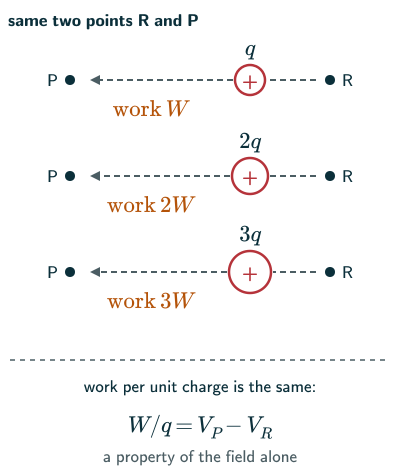
- The work done in bringing a test charge q to a point is proportional to q, because the force on it is qE (NCERT page 47; see force in a field).
- So it is convenient to divide the work by q. The result, the work done per unit test charge, is characteristic of the field of the charge configuration and independent of q. This is the electrostatic potential V (page 47).
- From the potential energy difference (NCERT Eq. (2.4), page 47):
Potential difference (NCERT Eq. 2.4)
that is, the work done by an external force in bringing a unit positive charge from R to P.
- With the potential zero at infinity, the potential at a point is the work done by an external force in bringing a unit positive charge from infinity to that point, without acceleration (pages 47–48).
- The same care as for potential energy applies: strictly, take an infinitesimal test charge δq, find the work δW in bringing it from infinity, and form the ratio δW/δq; the external force must be equal and opposite to the electrostatic force at every point of the path (page 48).
Potential difference
- As with potential energy, only the potential difference is physically significant; the value of V at a point depends on where the zero is chosen (NCERT page 47).
- Multiplying NCERT’s Eq. (2.4) by q: moving a charge q from R to P needs external work q(VP − VR), and its potential energy changes by the same amount. With V = 0 at infinity, a charge q at a point of potential V has potential energy qV (NCERT Section 2.8.1, Eq. (2.27), page 59).
- Unit: by NCERT Eq. (2.4), potential is energy per unit charge, so its SI unit is the joule per coulomb. This is the volt (V), the unit NCERT uses on page 59: 1 V = 1 J C−1. NCERT Section 2.8.1 then defines an energy unit: an electron accelerated through 1 V gains e × 1 V = 1.6 × 10⁻¹⁹ J, called 1 electron volt (1 eV) (page 59; see potential energy of a single charge).
- The electric force on a positive charge points towards lower potential; on a negative charge it points towards higher potential (reasoned from U = qV). A charge released from rest initially moves that way; an existing velocity can carry it against the force.
Work and potential energy from potential
Solved examples
Example 1: From work to potential difference
Moving a charge of 2.0 µC slowly from R to P takes 6.0 × 10⁻⁵ J of external work. Find VP − VR.
Answer: by NCERT Eq. (2.4), VP − VR = W/q = (6.0 × 10⁻⁵)/(2.0 × 10−6) = 30 V (page 47).
Example 2: Bringing charges from infinity
The potential at P is 100 V, with V = 0 at infinity. How much quasistatic external work does it take to bring (a) +3.0 µC, (b) −3.0 µC from infinity to P?
Answer: W = qV. (a) 3.0 × 10−6 × 100 = 3.0 × 10⁻⁴ J. (b) −3.0 × 10⁻⁴ J: on the way in the field does +3.0 × 10⁻⁴ J of work on the negative charge, so the external force, holding it back, does the negative of that (NCERT pages 47–48).
Example 3: Work between two points
Points A and B are at potentials of 20 V and −10 V. Find the external work to move 5.0 µC slowly from A to B, and the work done by the field.
Answer: W = q(VB − VA) = 5.0 × 10⁻⁶ × (−30) = −1.5 × 10⁻⁴ J. The field does +1.5 × 10⁻⁴ J: the positive charge moves to lower potential of its own accord (NCERT Eq. (2.4), page 47).
Example 4: An electron through 50 V
An electron moves from a point at 0 V to a point at +50 V. Find the change in its potential energy, in joules and in eV.
Answer: ΔU = qΔV = (−1.6 × 10⁻¹⁹)(50) = −8.0 × 10⁻¹⁸ J, that is −50 eV. The electron loses potential energy; if no other force acts, it gains 50 eV of kinetic energy (NCERT pages 47 and 59).
If it starts from rest, its kinetic energy is K = 8.0 × 10⁻¹⁸ J. With m = 9.11 × 10⁻³¹ kg (NCERT Example 1.7, page 17):
For motion under the electric force alone, ΔK = −qΔV. Through the same accelerating potential drop, an α-particle gains twice the kinetic energy of a proton because its positive charge is twice as large.
Common mistakes to avoid
Common mistake
Confusing potential with potential energy
Potential V is work per unit charge and does not depend on the test charge; potential energy U = qV does (NCERT page 47).
Common mistake
Getting the sign wrong for negative charges
U = qV: for a negative charge, a high potential means a low potential energy, so the electric force on electrons points towards higher potential; their velocity need not point that way.
Common mistake
Treating the potential at a point as absolute
Only potential differences are physically significant; values depend on where V = 0 is chosen (NCERT page 47).
Quick revision summary
- Electrostatic potential: the work done per unit positive charge, without acceleration, in bringing it from infinity to the point (V = 0 at infinity).
- VP − VR = (UP − UR)/q, independent of the test charge.
- Only potential differences are physically significant.
- Wext = q(VP − VR), and the field does the negative of this; U = qV; unit of potential: volt, 1 V = 1 J/C; 1 eV = 1.6 × 10 J.
- The electric force points towards lower potential for positive charges and higher potential for negative charges; motion also depends on initial velocity.
Formula sheet
- VP − VR = (UP − UR)/q
- Wext = q(VP − VR)
- U = qV
- 1 V = 1 J C
- 1 eV = 1.6 × 10 J
Questions students ask
Is electric potential the same as electrostatic potential?
Yes, in Class 12 electrostatics electric potential and electrostatic potential are two names for the same quantity, V: the work done per unit positive charge, without acceleration, in bringing a charge from infinity to a point (NCERT page 48). NCERT’s word ‘electrostatic’ marks that the field comes from charges at rest, whose Coulomb forces are conservative, so that the work, and with it the potential, does not depend on the path (NCERT pages 45–46). In circuits the same quantity appears as the potential difference between two points, often called the voltage (NCERT Chapter 3, page 104).
What is the difference between electric potential and potential difference?
Electric potential is a value at a single point, the work per unit positive charge in bringing a charge there from infinity, where V = 0, while potential difference compares two points: VP − VR is the work per unit positive charge in moving a charge from R to P (NCERT pages 47–48). So the potential of a point is its potential difference from the chosen zero: points at 12 V and 5 V differ by 7 V, and they still differ by 7 V if the zero is moved, though both values change.
Is electric potential a scalar or a vector, and what are its SI unit and dimensional formula?
Electric potential is a scalar: it is work per unit charge, and work, the scalar product of force and displacement, has a size and a sign but no direction. Its SI unit is the volt, 1 V = 1 J C, and its dimensional formula is [M L T A], energy [M L T] divided by charge [A T] (NCERT pages 59 and 78; see dimensional formulae). Because they are scalars, the potentials of several charges add as signed numbers (see superposition of potentials).
What is the difference between a volt and an electron volt?
The volt is the unit of electric potential and potential difference, 1 V = 1 J C, while the electron volt is a unit of energy: the energy an electron gains when it is accelerated through a potential difference of 1 V, 1 eV = 1.6 × 10 J (NCERT page 59). So 1 J is about 6.2 × 10 eV, and a particle of charge 2e accelerated through 150 V gains 300 eV, whatever its mass. Beyond the NCERT text, 1 eV is exactly 1.602 176 634 × 10 J, because the 2019 revision of the SI fixed the elementary charge exactly (NIST, CODATA recommended values: electron volt–joule relationship).
Why is electric potential defined with a unit positive charge?
Electric potential is defined with a unit positive charge so that it is the work per coulomb, a property of the point rather than of any test charge, and so that its sign follows the field’s convention, which also uses a unit positive charge (NCERT Chapter 1, pages 14–15): the potential is positive near positive charges, and a positive charge released from rest initially accelerates towards lower potential (reasoned from U = qV). ‘Unit’ does not mean that a whole coulomb is carried in: NCERT takes a tiny test charge δq, finds the work δW in bringing it from infinity and uses the ratio δW/δq (NCERT page 48). A negative test charge gives the same potential, since the work and the charge both change sign.
Practice questions
Try each question first, then open the answer to check your working.
-
Q1. How much external work is needed to move a 4 µC charge slowly to a point 25 V higher in potential?
Show answerHide answer
W = qΔV = 4 × 10−6 × 25 = 1.0 × 10⁻⁴ J (NCERT Eq. (2.4), page 47).
-
Q2. Why is the potential independent of the test charge used to measure it?
Show answerHide answer
Because the work done is proportional to the test charge, so the work per unit charge is not (NCERT page 47).
-
Q3. How many joules are there in 1 MeV?
Show answerHide answer
1 MeV = 106 eV = 1.6 × 10⁻¹³ J (NCERT page 59).