Potential due to a system of charges
NCERT Class 12 Physics Chapter 2 Section 2.5
Quick answer
The potential at a point due to several charges is the algebraic sum of the potentials of each, V = (1/4πε) Σ q/rP, each charge taken with its sign. For a uniformly charged thin shell the potential is q/(4πεr) outside and q/(4πεR) everywhere inside, where the field is zero. Two unlike charges of different sizes give zero potential at two points on the line through them.
With your textbook
NCERT Physics Part I (Class 12), Chapter 2 “Electrostatic Potential and Capacitance”, Section 2.5 “Potential due to a System of Charges”, pages 51–53.
Open the official NCERT chapter (PDF, 3.9 MB, ncert.nic.in) (opens in a new tab)
Checked against the 2026-27 reprint on .
How do you find the potential of several charges?
Potential due to a system of charges
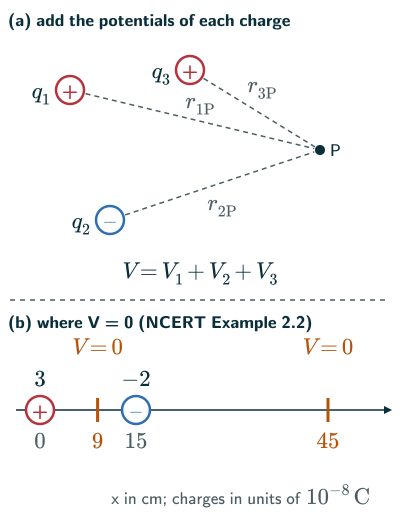
The potential at a point due to several charges is the sum of the potentials due to each charge, taken with their signs (NCERT Eq. (2.17), page 51). NCERT states it:
By the superposition principle, the potential V at P due to the total charge configuration is the algebraic sum of the potentials due to the individual charges
NCERT Physics Part I (Class 12), Section 2.5, page 51
In plain words: work out each charge’s potential at the point as if it were alone, and add the numbers, plus for positive charges and minus for negative ones. No arrows, no angles: potential is a scalar, which is what makes it easier to add up than the field.
Superposition of potentials
For charges q1, q2, …, qn at distances r1P, r2P, …, rnP from P (NCERT Eqs. (2.17)–(2.18), pages 51–52):
Potential of a system of charges (NCERT Eq. 2.18)
- Each term is the potential of a point charge, qi/(4πε0riP), with qi in with its sign (page 51). It is the same superposition principle as for forces, but with numbers instead of vectors.
- Continuous charge: divide the distribution, of charge density ρ, into small volume elements Δv carrying ρΔv, find the potential of each and add (strictly, integrate) (page 52).
Potential of a uniformly charged spherical shell
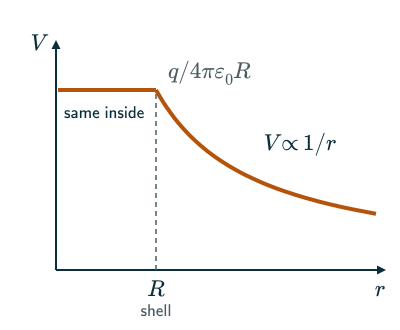
For a uniformly charged thin spherical shell of radius R carrying total charge q (NCERT Eq. (2.19), page 52):
- Outside (r ≥ R): the field is as if the whole charge were at the centre (see the field of a charged shell), so the potential is too (as with the gravity of a mass shell).
- Inside: the field is zero, so no work is done in moving a charge inside, and the potential is constant, equal to its value at the surface.
Potential of a charged thin shell (NCERT Eq. 2.19)
Note the contrast with the field: inside the shell the field is zero but the potential is not; it is the same everywhere inside (page 52).
Solved examples
Example 1: Where is the potential zero? (NCERT Example 2.2)
Charges of 3 × 10⁻⁸ C and −2 × 10⁻⁸ C are 15 cm apart. At what points on the line joining them is the potential zero?
Answer: put the positive charge at O and the negative charge at A, 15 cm along the x-axis, and let P be at x cm. For x < 0 the potentials cannot cancel (NCERT page 52): there P is nearer the larger charge, so its potential always wins. Between O and A:
so 45 − 3x = 2x and x = 9 cm. Beyond A:
so 3x − 45 = 2x and x = 45 cm. The potential is zero 9 cm and 45 cm from the positive charge, on the side of the negative charge; this uses V = 0 at infinity (NCERT pages 52–53).
Example 2: Signs near point charges (NCERT Example 2.3)
P is nearer than Q to a positive point charge; A is nearer than B to a negative point charge (NCERT Figure 2.8). Give the signs of (a) VP − VQ and VB − VA; (b) the potential energy of a small negative charge at Q minus at P, and at A minus at B; (c) the work done by the field moving a small positive charge from Q to P; (d) the work done by an external agency moving a small negative charge from B to A; (e) if only the electric force acts, does the kinetic energy of a small negative charge rise or fall as it moves from B to A?
Answer: (a) V ∝ 1/r, so VP > VQ: positive. VB is less negative than VA: positive. (b) A negative charge is pulled towards the positive charge, from higher to lower potential energy, so UQ − UP is positive; likewise, a negative charge is repelled by the negative charge, so moving out from A to B lowers its potential energy: UA − UB is positive. (c) An external agency must push the positive charge in against the field, so the field’s work is negative. (d) The external agency pushes the negative charge in against the repulsion: positive. (e) It decreases: the repulsion slows the charge (NCERT page 53).
Example 3: Centre of a hexagon (NCERT Exercise 2.2)
A regular hexagon of side 10 cm has a charge of 5 µC at each vertex. Find the potential at its centre.
Answer: in a regular hexagon each vertex is one side length, 0.10 m, from the centre. Each charge gives 9 × 109 × 5 × 10−6/0.10 = 4.5 × 10⁵ V, and the six add as numbers: V = 6 × 4.5 × 105 = 2.7 × 10⁶ V (NCERT Eq. (2.18), page 52).
Example 4: Zero potential, two charges (NCERT Exercise 2.1)
Charges of 5 × 10⁻⁸ C and −3 × 10⁻⁸ C are 16 cm apart. Where on the line joining them is the potential zero?
Answer: as in Example 1, with x in cm from the positive charge. Between them, 5/x = 3/(16 − x) gives 80 − 5x = 3x, so x = 10 cm. Beyond the negative charge, 5/x = 3/(x − 16) gives 5x − 80 = 3x, so x = 40 cm.
Common mistakes to avoid
Common mistake
Adding potentials as vectors
Potentials add algebraically, with signs; directions play no part (NCERT page 51).
Common mistake
Mixing up zero field and zero potential
Inside a charged shell the field is zero but the potential is q/(4πεR), the same as at the surface (NCERT page 52). The reverse also fails: midway between +q and −q the potential is zero but the field is not; it points towards −q (reasoned from NCERT Eq. (2.18)).
Common mistake
Missing the second zero-potential point
For unlike charges of different sizes there is a point of zero potential outside the pair as well as between them; both are nearer the smaller charge (NCERT Example 2.2, page 53).
Quick revision summary
- Potential obeys superposition: V = V + V + … + V, an algebraic sum with signs.
- V = (1/4πε) Σ q/rP; for continuous charge, sum (integrate) over small elements ρΔv.
- Thin charged shell: V = q/(4πεr) outside, and V = q/(4πεR), constant, everywhere inside.
- Inside a shell the field is zero but the potential is not.
- Two unlike charges of different sizes give zero potential at two points on their line, one between them and one outside, both nearer the smaller charge.
Formula sheet
- V = V + V + … + V
- V = (1/4πε) Σ q/rP
- shell, r ≥ R: V = q/(4πεr)
- shell, r ≤ R: V = q/(4πεR)
- zero potential: q/r + q/r = 0
Questions students ask
Does the potential of a charged shell jump at its surface, as the field does?
No, the potential of a uniformly charged thin shell does not jump at its surface: it is continuous, q/4πε0R just inside, at and just outside the surface, even though the field jumps there from zero inside to σ/ε0 just outside (NCERT Points to Ponder 3, page 78; see field of a shell). What changes suddenly is the slope of the graph of V against r, flat inside and falling as 1/r outside, because the field is the rate at which the potential falls with distance (NCERT page 55). A jump in potential across a surface would need an infinite field there.
What is the potential inside a uniformly charged solid sphere?
The potential inside a solid insulating sphere with charge Q spread evenly through its volume, its material taken to have permittivity ε0, is not constant: beyond the NCERT text, it is V = kQ(3R − r)/(2R), with k = 1/4πε0, changing from kQ/R at the surface to 3kQ/(2R) at the centre (rising for Q > 0, falling for Q < 0) (reasoned from the field inside, kQr/R, which Gauss’s law gives as in NCERT Example 1.12, pages 36–37). A charged metal sphere behaves like a shell instead: its charge sits on its surface, so the potential is kQ/R everywhere inside (see charge on the surface).
For two unlike charges, are the points of zero potential also points of zero field?
No, for two unlike charges the zero-potential points and the zero-field point differ: for +4 nC and −1 nC 30 cm apart, the potential is zero 24 cm and 40 cm from the +4 nC charge, on the side of the −1 nC charge, but the field is zero only 60 cm from the +4 nC charge, 30 cm beyond the −1 nC one (reasoned from NCERT Eq. (2.18), page 52, and Coulomb’s law). With x and y the distances in cm from the two charges, the potentials cancel where 4/x = 1/y, the fields only where 4/x = 1/y outside the pair, where they point opposite ways. Like charges are the other way round: their fields cancel between them, but their potentials, of one sign, are zero nowhere at a finite distance.
Practice questions
Try each question first, then open the answer to check your working.
-
Q1. Equal charges q sit at the four corners of a square of side a. What is the potential at the centre?
Show answerHide answer
Each corner is a/√2 from the centre, so V = 4kq/(a/√2) = 4√2 kq/a (NCERT Eq. (2.18), page 52).
-
Q2. A uniformly charged thin spherical shell of radius 0.10 m carries 2 nC. Find the potential at its centre and 0.20 m from it. Take k = 9 × 10⁹ N m2 C−2.
Show answerHide answer
Centre: V = kq/R = 18/0.10 = 180 V. At 0.20 m: V = 18/0.20 = 90 V (NCERT Eq. (2.19), page 52).
-
Q3. Charges +q and −q are a distance d apart. Where on the line joining them, at a finite distance, is the potential zero?
Show answerHide answer
Only at the midpoint: elsewhere one charge is nearer than the other and its potential wins (reasoned as in NCERT Example 2.2, page 52).