The parallel plate capacitor
NCERT Class 12 Physics Chapter 2 Section 2.12
Quick answer
A parallel plate capacitor has two large plates of area A separated by a small vacuum gap d, carrying Q and −Q. Neglecting fringing, the fields cancel outside and add inside to E = Q/(εA), so V = Ed. Its capacitance is C = εA/d when d is much smaller than each lateral plate dimension.
With your textbook
NCERT Physics Part I (Class 12), Chapter 2 “Electrostatic Potential and Capacitance”, Section 2.12 “The Parallel Plate Capacitor”, pages 68–69.
Open the official NCERT chapter (PDF, 3.9 MB, ncert.nic.in) (opens in a new tab)
Checked against the 2026-27 reprint on .
What is a parallel plate capacitor?
The parallel plate capacitor
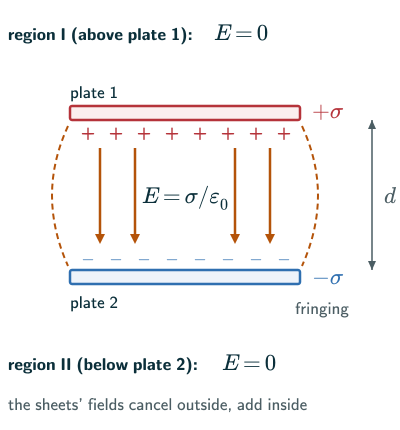
Two large, flat, parallel metal plates, each of area A, a small distance d apart, with charges Q and −Q. With vacuum between them, the field between the plates is σ/ε0 and the capacitance is C = ε0A/d (NCERT Eqs. (2.41) and (2.43), pages 68–69). Away from the edges the field is the same everywhere between the plates:
Thus, the electric field is localised between the two plates and is uniform throughout.
NCERT Physics Part I (Class 12), Section 2.12, page 69
In plain words: each plate on its own would send a field out of both faces. With equal and opposite charges, the two fields cancel outside the plates and add up between them. In the ideal infinite-sheet approximation all the field sits in the gap and is uniform there; finite plates also have a fringe field. That makes the potential difference just field × gap, and the capacitance follows at once.
The field between the plates
- Plate 1 carries surface charge density σ = Q/A and plate 2 carries −σ. Since d is much smaller than each lateral plate dimension (for similar length and width, d2 ≪ A), each plate acts like an infinite plane sheet, whose field is σ/(2ε0) (NCERT page 68, using Chapter 1 Eq. (1.33), page 35). NCERT points here to “Section 1.15”; in the current Chapter 1 the plane-sheet field is Section 1.14.2 (pages 34–35).
- Outside the plates (regions I and II), the two sheets’ fields point in opposite directions and cancel (NCERT Eqs. (2.39)–(2.40), pages 68–69):
- Between the plates the two fields point the same way and add (NCERT Eq. (2.41), page 69; see the field of a system of charges):
Field between the plates (NCERT Eq. 2.41)
- The field points from the positive plate to the negative plate (page 69).
- Fringing: for plates of finite area this fails near the edges, where the field lines bend outward. For the same reason σ is not strictly uniform over a plate. For d2 ≪ A these effects can be ignored far enough from the edges (page 69).
C = εA/d
For a uniform field the potential difference is the field times the distance between the plates (NCERT Eq. (2.42), page 69):
So the capacitance C = Q/V is (NCERT Eq. (2.43), page 69):
Parallel plate capacitor (NCERT Eq. 2.43)
- As expected, C depends only on the geometry: larger plates or a smaller gap give a larger capacitance (page 69).
- For A = 1 m2 and d = 1 mm, C = 8.85 × 10⁻⁹ F (NCERT Eq. (2.44), page 69).
- To get C = 1 F with d = 1 cm would need A = Cd/ε0, about 109 m2: a plate roughly 30 km long and broad. This is another way to see that 1 F is a very big unit (NCERT Eq. (2.45), page 69).
Solved examples
Example 1: Capacitance and charge (NCERT Exercise 2.8)
A parallel plate capacitor with air between the plates has plates of area 6 × 10⁻³ m2, 3 mm apart. Find its capacitance, and the charge on each plate when it is connected to a 100 V supply.
Answer: taking air as vacuum, C = ε0A/d = 8.854 × 10−12 × 6 × 10−3/(3 × 10−3) ≈ 1.77 × 10⁻¹¹ F, or 17.7 pF. Then Q = CV = 1.77 × 10−11 × 100 ≈ 1.77 × 10⁻⁹ C: +Q on one plate and −Q on the other (NCERT Eqs. (2.38) and (2.43), pages 67–69).
Example 2: How big is a farad?
Find the plate area of a 1 F parallel plate capacitor with a 1 cm gap, and the side of a square plate of that area.
Answer: A = Cd/ε0 = 1 × 0.01/(8.854 × 10−12) ≈ 1.1 × 10⁹ m2. A square of this area has a side of about 34 km, which NCERT rounds to about 30 km (NCERT Eq. (2.45), page 69).
Example 3: Field, voltage and capacitance together
The plates of a capacitor, each of area 0.020 m2 and 2.0 mm apart, carry ±4.0 × 10⁻⁸ C. Find the field between them, the potential difference and the capacitance.
Answer: σ = Q/A = 4.0 × 10⁻⁸/0.020 = 2.0 × 10⁻⁶ C m−2. E = σ/ε0 ≈ 2.26 × 10⁵ V/m. V = Ed ≈ 2.26 × 105 × 2.0 × 10−3 ≈ 452 V. C = Q/V ≈ 8.85 × 10⁻¹¹ F, the same as ε0A/d (NCERT Eqs. (2.41)–(2.43), page 69).
Example 4: Changing the geometry
The plate area of a parallel plate capacitor is doubled and the gap is tripled. By what factor does its capacitance change?
Answer: C = ε0A/d, so the new capacitance is (2/3) of the old: it falls to 2/3 (NCERT Eq. (2.43), page 69).
Common mistakes to avoid
Common mistake
Using σ/(2ε) between the plates
That is the field of one sheet. Between the plates the two sheets’ fields add, giving σ/ε (NCERT Eq. (2.41), page 69).
Common mistake
Expecting a field outside the plates
In the ideal infinite-sheet model the two fields cancel outside. Finite plates have a fringe field, so E = 0 outside is an approximation (NCERT pages 68–69).
Common mistake
Forgetting what stays fixed when the gap changes
Battery disconnected: Q is fixed, so E = Q/(εA) stays the same and V = Ed grows with d. Battery connected: V is fixed, so Q = CV and E = V/d both fall as d grows (reasoned from NCERT Eqs. (2.41)–(2.43), page 69).
Common mistake
Forgetting to convert to SI units
Put A in m and d in m: 6 cm is 6 × 10 m, and 3 mm is 3 × 10 m.
Quick revision summary
- Two large parallel plates of area A, a distance d apart (d ≪ A), with charge densities +σ and −σ, where σ = Q/A.
- Each plate gives σ/(2ε): the fields cancel outside (E = 0) and add between the plates to E = Q/(εA) = σ/ε, uniform and from + to −.
- Near the edges the field lines bend outward (fringing); this is ignored for d ≪ A.
- V = Ed = Qd/(εA), so C = εA/d, which depends only on the geometry.
- 1 m plates 1 mm apart give only 8.85 nF; 1 F with a 1 cm gap needs about 10 m of plate.
Formula sheet
- σ = Q/A
- between the plates: E = Q/(εA) = σ/ε
- outside: E = 0 in the ideal infinite-sheet approximation
- V = Ed = Qd/(εA)
- C = εA/d
Questions students ask
What is the force between the plates of a parallel plate capacitor?
The plates of a charged parallel plate capacitor attract each other with a force F = Q/2ε0A = QE/2, half the charge times the field between them (beyond the NCERT text, reasoned from NCERT pages 68–69). The half appears because each plate is pulled only by the other plate’s field, σ/2ε0; the full σ/ε0 between the plates includes the plate’s own field, which exerts no net force on it. With the charge fixed the force does not depend on the gap, as long as it stays small: plates of area 0.040 m carrying ±2.0 × 10 C attract with about 5.6 × 10 N, and the insulator or the mounting holds them apart.
Does the capacitance of a parallel plate capacitor depend on the metal or the thickness of its plates?
In the ideal model that neglects fringe fields, the capacitance of a parallel plate capacitor, C = ε0A/d in vacuum, depends only on the plate area and the gap between the facing surfaces, not on the metal or the plates’ thickness (NCERT Eq. (2.43), page 69). Any metal will do, since the field inside it is zero and its charge sits on its surface (see charge on the surface); with ±Q on the plates, all the charge gathers on the two facing surfaces (reasoned from NCERT pages 62 and 68–69). What does change C is the facing area: slide one plate sideways and use the overlap area, provided the gap remains much smaller than the overlap dimensions.
What happens if the two plates of a parallel plate capacitor carry unequal charges?
For two identical, very large parallel plates in a symmetric environment with no applied external field, if they carry unequal charges Q1 and Q2, each outer face gets (Q1 + Q2)/2 and the facing surfaces get ±(Q1 − Q2)/2, so the potential difference is V = (Q1 − Q2)/(2C) (beyond the NCERT text, which takes only Q and −Q, page 67; reasoned from the zero field inside each metal plate, page 62). For example, +5.0 µC and +1.0 µC on a 2.0 µF capacitor give ±2.0 µC on the facing surfaces, +3.0 µC on each outer face and V = 1.0 V. With Q2 = −Q1 the outer faces are bare, the usual case.
Practice questions
Try each question first, then open the answer to check your working.
-
Q1. Find the capacitance of a parallel plate capacitor with plates of area 0.10 m2, 0.50 mm apart in vacuum.
Show answerHide answer
C = ε0A/d = 8.854 × 10−12 × 0.10/(0.50 × 10−3) ≈ 1.8 × 10⁻⁹ F, or 1.8 nF (NCERT Eq. (2.43), page 69).
-
Q2. What is the field just above the positive plate of a parallel plate capacitor, on the side away from the other plate?
Show answerHide answer
Zero, ignoring fringing: the two plates’ fields cancel there (NCERT Eq. (2.39), page 68).
-
Q3. The separation of a parallel plate capacitor is halved. What happens to its capacitance?
Show answerHide answer
It doubles, since C = ε0A/d (NCERT Eq. (2.43), page 69).