Equipotential surfaces
NCERT Class 12 Physics Chapter 2 Section 2.6
Quick answer
An equipotential surface has the same potential everywhere, so the electric force does no work along it. Where nonzero, the field is normal to a smooth equipotential and points towards lower potential. Its magnitude is the potential gradient, estimated by |ΔV|/Δl for close surfaces, so equal-potential-step surfaces crowd together where the field is strong.
With your textbook
NCERT Physics Part I (Class 12), Chapter 2 “Electrostatic Potential and Capacitance”, Section 2.6 “Equipotential Surfaces”, pages 54–55.
Open the official NCERT chapter (PDF, 3.9 MB, ncert.nic.in) (opens in a new tab)
Checked against the 2026-27 reprint on .
What is an equipotential surface?
Equipotential surface
An equipotential surface is a surface with a constant value of potential at all points on the surface.
NCERT Physics Part I (Class 12), Section 2.6, page 54
Where the electric field is nonzero, it is normal to the equipotential surface through that point, and it points towards lower potential (pages 54–55).
In plain words: equipotentials are like the contour lines on a map, joining points at the same height. Walking along a contour line takes no climbing; the steepest way down is straight across the contours, and that is the way the field points. For equal height or potential steps, where the contours crowd together, the slope, and so the field, is strongest.
Equipotentials of a point charge and of a uniform field
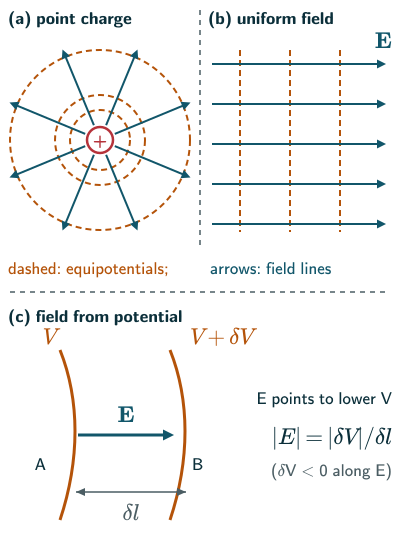
- Point charge: V = q/(4πε0r) is constant wherever r is constant, so the equipotentials of a single point charge are concentric spheres centred on the charge. Its field lines are radial, so they cross every sphere at right angles (NCERT Figure 2.9, page 54).
- The general rule: for any charge arrangement, a smooth equipotential surface is normal to the field wherever the field is nonzero. At a zero-field point the field has no direction. Proof: if the field had a component along the surface, moving a unit test charge against that component would take work. But no work is needed to move a charge between two points of an equipotential surface, since there is no potential difference between them (page 54).
- Uniform field along x: the equipotentials are planes normal to the x-axis, parallel to the y–z plane (NCERT Figure 2.10, page 54).
- NCERT also shows equipotentials for a dipole and for two identical positive charges (Figure 2.11, page 54). For a dipole, the plane bisecting the dipole at right angles is an equipotential with V = 0, since every point on it is equally far from +q and −q (NCERT Section 2.4, page 51). The dipole’s field on that plane is not zero: it is normal to the plane, opposite to p.
- Equipotentials give a second picture of a field, alongside field lines (page 54).
Relation between field and potential
The ratio below is a local derivative: take the limit as the perpendicular spacing tends to zero. For finite spacing it estimates the local field, unless the field is uniform, when it is exact.
Take two close equipotential surfaces, A at potential V and B at V + δV, where δV is the change in V in the direction of E, a perpendicular distance δl apart (NCERT Section 2.6.1, page 55):
- Moving a unit positive charge from B to A along the perpendicular, against the field, takes work |E| δl. That work is the potential difference VA − VB = −δV. So (NCERT Eqs. (2.20)–(2.21)):
Field from potential (NCERT Eq. 2.21)
- δV is negative, because the potential falls in the direction of the field (page 55).
- Two conclusions (page 55):
- The electric field points in the direction in which the potential decreases steepest.
- Its size is the change in potential per unit displacement normal to the equipotential surface at that point.
- So the field is strong where equipotentials drawn at equal steps of V are close together, and weak where they are far apart (reasoned from NCERT Eq. (2.21)).
- In a uniform field, with equipotentials a distance d apart differing by V, this gives E = V/d. This is also why the field can be given in V m−1: 1 V m−1 = 1 J C−1 m−1 = 1 N C−1 (NCERT Chapter 1, page 14, footnote, promises this unit).
- Along a line, the field component is the slope of V with a minus sign: Ex = −dV/dx (reasoned from NCERT Eq. (2.20), letting δl shrink). For example, if V = 4x2 volts (x in m), Ex = −8x V/m. At x = 1 m that is −8 V/m: the field points along −x, towards lower V.
Solved examples
Example 1: Equipotential of a dipole (NCERT Exercise 2.3)
Charges of 2 µC and −2 µC are at points A and B, 6 cm apart. (a) Identify an equipotential surface of the system. (b) What is the direction of the field at every point of this surface?
Answer: (a) the plane through the midpoint of AB, at right angles to AB: every point on it is equally far from the two charges, so their potentials cancel and V = 0 all over it (NCERT Eq. (2.18), page 52). (b) The field is normal to the plane, along the direction from A to B, from the positive charge towards the negative one (NCERT page 54).
Example 2: Potential difference in a uniform field
A uniform field of 500 N/C points along +x. Find V(x = 4 cm) − V(x = 0), the potential difference between two points 4 cm apart along y, and V at (4 cm, 3 cm) minus V at the origin.
Answer: along the field the potential falls by E × distance = 500 × 0.04 = 20 V, so V(4 cm) − V(0) = −20 V. Along y the points lie on the same equipotential plane, so the difference is 0 (NCERT pages 54–55). From the origin to (4 cm, 3 cm), only the 4 cm along the field changes V, so the difference is again −20 V.
Example 3: Field from the spacing of equipotentials
Equipotential surfaces drawn 2.0 V apart have a perpendicular spacing of 5.0 mm in a region. Estimate the field there.
Answer:
pointing towards lower potential, normal to the surfaces (NCERT Eq. (2.21), page 55).
Example 4: Work along an equipotential
How much quasistatic external work does it take to carry a 5 µC charge a quarter of the way round a circle of radius 10 cm centred on a point charge?
Answer: none: the circle lies on an equipotential sphere of the point charge, and no work is needed to move a charge between points at the same potential (NCERT page 54).
Common mistakes to avoid
Common mistake
Drawing field lines along equipotentials
Field lines always cross equipotential surfaces at right angles (NCERT page 54).
Common mistake
Making the field point towards higher potential
The field points the way the potential decreases fastest (NCERT page 55).
Common mistake
Thinking equipotentials can only be spheres
They are concentric spheres for a single point charge, and outside a uniformly charged spherical shell, where V = q/(4πεr) (NCERT Eq. (2.19), page 52); a uniform field has planes, and other arrangements other shapes (NCERT page 54).
Quick revision summary
- Equipotential surface: constant potential at every point; zero electric work in moving a charge on it.
- Point charge: concentric spheres; uniform field: parallel planes normal to the field.
- A nonzero field is normal to a smooth equipotential surface.
- |E| = |δV|/δl: the field points the way V decreases fastest, and its size is the potential change per unit normal distance.
- Equipotentials drawn at equal potential steps crowd where the field is strong; in a uniform field E = V/d.
Formula sheet
- equipotential: V constant on the surface
- E normal to the equipotential, towards lower V
- |E| = −dV/dl along the field; |ΔV|/Δl for close surfaces
- uniform field: E = V/d
- 1 V/m = 1 N/C
Questions students ask
Are equipotential surfaces equally spaced?
Equipotential surfaces drawn at equal steps of potential are equally spaced only where the field has the same strength, as in a uniform field, where they are parallel planes (NCERT page 54); they crowd together where the field is strong and spread apart where it is weak, because the field equals the fall in potential per unit distance across them (NCERT page 55). For a 10 nC point charge, with q/4πε0 = 90 V m, the 45 V, 30 V and 15 V equipotentials are spheres of radius 2.0 m, 3.0 m and 6.0 m: equal 15 V steps, but the gap grows from 1.0 m to 3.0 m as the field weakens.
Is the electric field the same at every point of an equipotential surface?
The electric field need not be the same at every point of an equipotential surface: where nonzero, it is normal to a smooth surface, but its size depends on how close the neighbouring equipotential lies at each point (NCERT pages 54–55). On the spheres round a point charge the size is the same all over, by symmetry, but on the zero-potential plane of a dipole, far from it, the field falls as 1/r with the distance r from the dipole, so at twice the distance it is one-eighth as strong (NCERT Chapter 1, page 24, and page 51). A smooth equipotential fixes the normal axis for a nonzero field, but neighbouring potentials are needed to choose its sense (towards lower V) and determine its strength.
What is the difference between an equipotential surface and a Gaussian surface?
An equipotential surface is fixed by the charges, a surface on which the potential has the same value everywhere (NCERT page 54), while a Gaussian surface is any closed surface we choose in order to apply Gauss’s law, and the potential need not be constant on it (NCERT Chapter 1, page 31; see Gaussian surface). An equipotential need not be closed either: in a uniform field it is an open plane. The two coincide for a sphere centred on a point charge, which is why that sphere is the natural Gaussian surface there: the field is normal to it and the same size all over it.
What is the potential gradient, and how does it give the field in three dimensions?
The potential gradient is the rate at which the electric potential rises with distance, in V m, taken in the direction in which it rises fastest, so the electric field is minus the potential gradient: NCERT’s field points the way V falls steepest, with that rate as its size (NCERT page 55). Beyond the NCERT text, applying that rule along each axis gives each component of the field: for V = (3x + 4y) volts, with x and y in metres, E = −(3î + 4ĵ) V m, of size 5 V m, normal to the equipotential planes 3x + 4y = constant.
Practice questions
Try each question first, then open the answer to check your working.
-
Q1. What shape are the equipotential surfaces of a single point charge?
Show answerHide answer
Concentric spheres centred on the charge (NCERT page 54).
-
Q2. At what angle do field lines cross equipotential surfaces?
Show answerHide answer
At right angles (NCERT page 54).
-
Q3. The potential falls by 30 V over 1.5 cm along the field in a uniform field. What is the field?
Show answerHide answer
E = 30/0.015 = 2000 V/m (NCERT Eq. (2.21), page 55).