Capacitors and capacitance
NCERT Class 12 Physics Chapter 2 Section 2.11
Quick answer
A capacitor is two conductors separated by an insulator, carrying charges Q and −Q with a potential difference V between them. Its capacitance C = Q/V is fixed by the shape, size and separation of the conductors and the insulator between them, not by Q or V; the SI unit is the farad, 1 F = 1 C V, a very large unit. Dielectric strength, about 3 × 10 V m for air, is the largest field an insulator can take before breaking down, and it limits the charge a capacitor can hold.
With your textbook
NCERT Physics Part I (Class 12), Chapter 2 “Electrostatic Potential and Capacitance”, Section 2.11 “Capacitors and Capacitance”, pages 67–68.
Open the official NCERT chapter (PDF, 3.9 MB, ncert.nic.in) (opens in a new tab)
Checked against the 2026-27 reprint on .
What is a capacitor?
The constant-capacitance model assumes fixed geometry and a linear dielectric at fixed operating conditions. Define C by Q = CV, so an uncharged capacitor still has capacitance even though the numerical ratio 0/0 is undefined.
Capacitors and capacitance
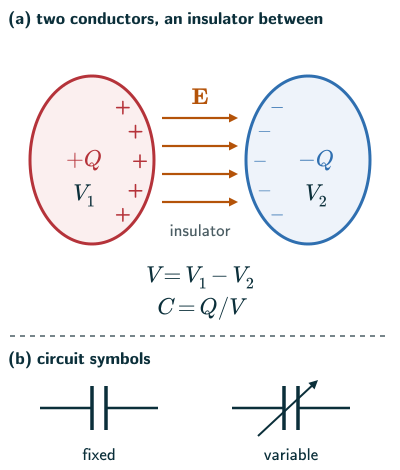
A capacitor is made of two conductors with an insulator between them. In practice the conductors carry charges Q and −Q, with a potential difference V = V1 − V2 between them; Q is called the charge of the capacitor, though its total charge is zero (NCERT page 67). The ratio Q/V is the same whatever the charge:
The constant C is called the capacitance of the capacitor. C is independent of Q or V, as stated above.
NCERT Physics Part I (Class 12), Section 2.11, page 67
In plain words: put charge on two conductors that face each other and a potential difference appears between them. Double the charge and the potential difference doubles too. Capacitance is the fixed ratio of the two: how much charge the pair holds for each volt.
Capacitance C = Q/V
- The conductors can be charged by connecting them to the two terminals of a battery. Even a single conductor can serve as a capacitor, taking the other conductor to be at infinity (NCERT page 67).
- The field between the conductors is proportional to Q: double the charge and the field doubles at every point, by Coulomb’s law and the superposition principle (page 67).
- V is the work done per unit positive charge in taking a small test charge from conductor 2 to conductor 1 against this field. So V is also proportional to Q, and their ratio is a constant (NCERT Eq. (2.38), page 67):
Capacitance (NCERT Eq. 2.38)
- C depends only on the geometry of the two conductors (shape, size, separation) and, as NCERT shows later, on the insulator (dielectric) between them (pages 67–68; see effect of a dielectric).
- For a large C, V is small for a given Q: a capacitor with a large capacitance holds a large charge at a relatively small potential difference (page 68).
Unit: the farad
- The SI unit of capacitance is the farad: 1 F = 1 C V−1 (NCERT page 68). Since 1 V = 1 N C−1 m, this is also 1 C2 N−1 m−1 (page 69).
- The farad is a very big unit. The common units are its sub-multiples: 1 µF = 10−6 F, 1 nF = 10−9 F and 1 pF = 10−12 F (page 68).
- A fixed capacitor is drawn as two short parallel lines, like the plates; a variable capacitor is the same symbol with an arrow drawn across it (page 68).
- Besides storing charge, a capacitor is a key element of most ac circuits, taken up in NCERT Chapter 7 (page 68).
Dielectric strength
- A high potential difference means a strong field around the conductors. A strong field can ionise the surrounding air and drive the ions to the oppositely charged plates, partly neutralising them: the charge leaks away as the medium loses its insulating power (NCERT page 68).
- The dielectric strength of a medium is the largest field it can withstand without breaking down as an insulator. For air a common approximate value is 3 × 10⁶ V m−1; actual breakdown depends on pressure, gap and electrode geometry. For conductors about 1 cm apart, this field corresponds to a potential difference of about 3 × 10⁴ V (page 68).
- So, to store a large charge without leaking, the capacitance must be high enough that the potential difference, and with it the field, stays below the breakdown limit. There is a limit to the charge a given capacitor can store without significant leaking (page 68).
Solved examples
Example 1: Capacitance from charge and voltage
A capacitor holds 6.0 µC when the potential difference across it is 12 V. Find its capacitance, and its charge at 24 V.
Answer: C = Q/V = 6.0 × 10⁻⁶/12 = 0.50 µF. C does not change with V, so at 24 V the charge doubles: Q = CV = 0.50 × 10−6 × 24 = 12 µC (NCERT Eq. (2.38), page 67).
Example 2: An isolated sphere as a capacitor (beyond the NCERT text)
Find the capacitance of an isolated metal sphere of radius R, and its value for a sphere the size of the Earth (R = 6.4 × 10⁶ m).
Answer: treat the sphere as one conductor, with the other at infinity (NCERT page 67). A charge Q on a metal sphere lies on its surface (NCERT Section 2.9, page 62), so the sphere is a charged shell with potential V = Q/(4πε0R) (NCERT Eq. 2.19(b), page 52), so
With 4πε0 = 1/(9 × 109) F m−1, for the Earth C = R/(9 × 109) = 6.4 × 10⁶/(9 × 109) ≈ 7.1 × 10⁻⁴ F, about 710 µF. Even a sphere the size of the Earth falls far short of 1 F.
Example 3: The largest charge on a sphere in air
A metal sphere of radius 10 cm is in air of dielectric strength 3 × 10⁶ V m−1. What is the largest charge it can hold before the air breaks down, and its potential then?
Answer: the field is strongest just outside the surface, where, as for a charged shell, E = kQ/R2, with k = 1/(4πε0) ≈ 9 × 10⁹ N m2 C−2 (NCERT Chapter 1, Eq. (1.34), page 35). Setting E = 3 × 10⁶ V m−1 gives Q = ER2/k = 3 × 106 × 0.01/(9 × 109) ≈ 3.3 × 10⁻⁶ C. The potential is then V = kQ/R = ER = 3 × 10⁵ V (reasoned from NCERT page 68).
Example 4: Breakdown across a small gap
Two conductors are 2.0 mm apart in air, with a roughly uniform field between them. About what potential difference makes the air break down?
Answer: V = Ed = 3 × 106 × 2.0 × 10−3 = 6 × 10³ V. For a 1 cm gap the same reasoning gives NCERT’s 3 × 10⁴ V (NCERT page 68).
Common mistakes to avoid
Common mistake
Thinking capacitance depends on the charge or voltage
C = Q/V is a constant: doubling V doubles Q. C depends on the conductors’ geometry and the insulator between them (NCERT pages 67–68).
Common mistake
Taking the total charge of a capacitor as Q
The two conductors carry +Q and −Q, so the total is zero; Q is the charge on one of them (NCERT page 67).
Common mistake
Reading mF as microfarad
1 µF = 10 F is a microfarad (NCERT page 68). The prefix m means milli, so 1 mF would be a millifarad, 10 F, a thousand times larger.
Quick revision summary
- A capacitor is two conductors separated by an insulator, carrying Q and −Q with a potential difference V; its total charge is zero.
- The field and V are both proportional to Q, so C = Q/V is a constant, set by the conductors’ shape, size and separation and the insulator between them.
- The SI unit is the farad, 1 F = 1 C V = 1 C N m, a very large unit; µF, nF and pF are used in practice.
- Dielectric strength is the largest field an insulator can take without breaking down; for air it is about 3 × 10 V m, which limits the charge a capacitor can hold.
- An isolated sphere is a capacitor with C = 4πεR.
Formula sheet
- C = Q/V
- 1 F = 1 C V = 1 C N m
- 1 µF = 10 F, 1 nF = 10 F, 1 pF = 10 F
- air breaks down at about 3 × 10 V m
- isolated sphere: C = 4πεR
Questions students ask
What are the SI unit and dimensional formula of capacitance?
The SI unit of capacitance is the farad, 1 F = 1 C V (NCERT page 68), and its dimensional formula is [M L T A]: from C = Q/V, charge [A T] divided by potential [M L T A] (see dimensional formulae; beyond the NCERT text, NIST Special Publication 811 gives the farad as m kg s A). The table on NCERT page 78 prints T for capacitance, a misprint; its entry for potential is right. The same units give ε0 in F m: from C = ε0A/d, ε0 = Cd/A = 8.854 × 10 F m (reasoned from NCERT Eq. (2.43), page 69).
What is the difference between a capacitor and capacitance?
A capacitor is a device, two conductors separated by an insulator that carry charges Q and −Q, while capacitance is a property of it, the charge it holds per volt of potential difference between the conductors, C = Q/V, measured in farads (NCERT pages 67–68). Every capacitor has a capacitance fixed by its shape, size, spacing and dielectric, but capacitance does not need a manufactured capacitor: a single conductor has one too, with the other conductor taken at infinity (NCERT page 67), and so does any pair of conductors near each other.
Why does a capacitor use two conductors close together instead of one?
A capacitor uses two conductors close together because the nearby −Q lowers the potential difference needed to hold a given +Q, which raises C = Q/V: NCERT notes that a capacitor confines the field lines to a small region, so even a strong field gives only a small potential difference between the conductors (NCERT Points to Ponder 2, page 78). Beyond the NCERT text, compare an isolated metal sphere of radius 5.0 cm, C = 4πε0R ≈ 5.6 pF, with two plates of 0.010 m facing each other 0.10 mm apart, C = ε0A/d ≈ 890 pF. The plates hold about 160 times as much charge per volt, though their area is smaller than the sphere’s.
What is the difference between dielectric strength and dielectric constant?
Dielectric strength is the largest electric field an insulator can withstand before it breaks down, about 3 × 10 V m, or 3 kV mm, for air (NCERT page 68), while the dielectric constant K is a pure number, the factor by which the medium filling the gap raises a capacitor’s capacitance (NCERT page 70). So dielectric strength limits the voltage a capacitor can take, about strength × gap for parallel plates, while K multiplies the charge it holds per volt. A good capacitor dielectric needs both: a high K and a high strength, so that a thin gap does not break down.
What is the difference between a capacitor and a battery?
A capacitor stores energy by keeping equal and opposite charges apart on two conductors, the energy sitting in the electric field between them, while a cell or battery stores chemical energy and uses it to keep a steady current flowing in a circuit (NCERT pages 73–75; NCERT Chapter 3, pages 93–94; see emf of a cell). As a capacitor discharges, its potential difference falls in step with its charge, V = Q/C, all the way to zero, whereas a cell’s emf is set by its electrodes and electrolyte. A capacitor returns the electric-field energy stored during charging; it does not replenish that energy through a chemical reaction.
What is the difference between a farad and a faraday?
The farad, symbol F, is the SI unit of capacitance: 1 F = 1 C V (NCERT page 68). One faraday is an amount of charge, approximately 96 485 C, the magnitude carried by one mole of electrons. Distinguish this from the Faraday constant, F = NAe, whose unit is C mol: the exact SI values of NA and e give approximately 96 485.33 C mol (NIST SI defining constants). NCERT Chemistry uses about 96 500 C mol in calculations (Class 12, Part I, Unit 2, page 52).
Practice questions
Try each question first, then open the answer to check your working.
-
Q1. A 2.0 µF capacitor is connected across 50 V. What is the charge on it?
Show answerHide answer
Q = CV = 2.0 × 10−6 × 50 = 1.0 × 10⁻⁴ C (NCERT Eq. (2.38), page 67).
-
Q2. Express 1 F in terms of coulombs, newtons and metres.
Show answerHide answer
1 F = 1 C V−1 = 1 C (N C−1 m)−1 = 1 C2 N−1 m−1 (NCERT page 69).
-
Q3. Why does the charge on a capacitor leak away if the potential difference is too high?
Show answerHide answer
The strong field ionises the surrounding air, and the ions are driven to the oppositely charged plates, partly neutralising them (NCERT page 68).