Electrostatics of conductors
NCERT Class 12 Physics Chapter 2 Section 2.9
Quick answer
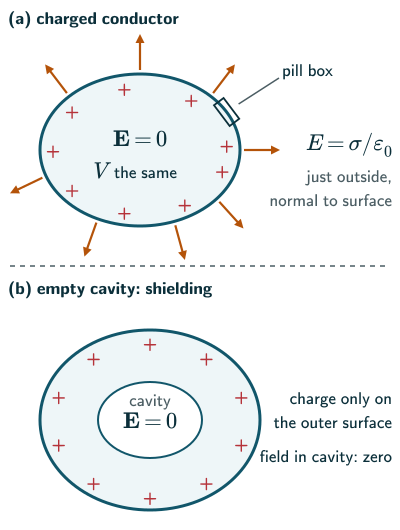
In electrostatic equilibrium, mobile charges have redistributed so that the field inside the metal is zero and there is no net drift current. The conductor is equipotential, excess charge lies on its surfaces, and the field just outside in vacuum has outward normal component σ/ε. A closed, charge-free cavity has zero field despite external electrostatic fields: electrostatic shielding.
With your textbook
NCERT Physics Part I (Class 12), Chapter 2 “Electrostatic Potential and Capacitance”, Section 2.9 “Electrostatics of Conductors”, pages 61–65.
Open the official NCERT chapter (PDF, 3.9 MB, ncert.nic.in) (opens in a new tab)
Checked against the 2026-27 reprint on .
What happens to charge and field in a conductor?
Electrostatics of conductors
A metal conductor has free electrons that drift whenever there is a field inside it. So in the static situation, when there is no net drift current, the field inside is zero. NCERT puts the first result plainly:
Electrostatic field is zero inside a conductor.
NCERT Physics Part I (Class 12), Section 2.9, page 62
From this follow five more results: the field at the surface is normal to it, any excess charge sits on the surface, the potential is the same throughout, the outward normal component of the field just outside in vacuum is σ/ε0, and an empty cavity is shielded (pages 62–64).
In plain words: free electrons in a metal redistribute until their macroscopic electrostatic force vanishes. Their microscopic motion continues, but there is no net drift current. That happens only when the field inside is zero. Everything else about conductors in electrostatics follows from that one fact.
Zero field inside a conductor
- In metals the mobile charge carriers are electrons: the outer electrons leave their atoms and are free to move within the metal, though not to leave it. In an external field they drift against the field. In electrolytic conductors both positive and negative ions move, and the situation is more involved; NCERT restricts itself to metallic solid conductors (NCERT pages 61–62; see conductors).
- Result 1: in the static situation, with no current inside or on the surface, the electrostatic field is zero everywhere inside a conductor, neutral or charged, even in an external field. This can be taken as the defining property of a conductor (page 62).
- Result 2: at the surface of a charged conductor the field is normal to the surface at every point. A tangential part would push the free surface charges along the surface, so in the static situation there is none. (A conductor with no surface charge has zero field even at its surface.) (Page 62.)
Charge resides on the surface
- Result 3: in the static situation the interior has no excess charge; any excess charge sits on the surface (page 62).
- Why, by Gauss’s law: take any small closed surface inside the conductor. The field on it is zero, so the flux through it is zero, so it encloses no net charge. The surface can be made as small as you like, so there is no net charge at any point inside (page 62; for flux, see electric flux).
- Result 4: the potential is constant throughout the conductor and has the same value on its surface, so its surface is an equipotential surface. Inside, E = 0, and on the surface E has no tangential part, so no work is done moving a test charge within the conductor or along its surface. Each conductor in a system has its own constant potential, which may differ from one conductor to another (pages 62–63).
Field just outside the surface
Result 5, just outside a smooth surface in vacuum (NCERT Eqs. (2.35)–(2.36), page 63):
Field just outside a charged conductor (NCERT Eq. 2.35)
directed along the outward normal n̂ for σ > 0 and inward for σ < 0.
- Proof: take a pill box, a short cylinder of cross-section δS and negligible height, straddling the surface at a point P. Inside the conductor the field is zero; just outside it is normal to the surface. So the only flux is through the outer face: EnδS, where En is the signed outward component. The charge enclosed is σ δS, and Gauss’s law gives EnδS = σ δS/ε0 (page 63).
- Compare a thin charged sheet (field of a plane sheet), whose field is σ/2ε0 (NCERT Chapter 1, Eq. (1.33), page 35): its flux leaves through both faces of the Gaussian surface. In the pill box above, flux leaves through the outer face only, because the field inside the metal is zero (reasoned from the two proofs).
Electrostatic shielding
- Result 6: in a conductor with a cavity that holds no charge, the field inside the cavity is zero, whatever the size and shape of the cavity, the charge on the conductor, or the external fields. All the charge, whether put on the conductor or induced by an external field, sits on its outer surface (pages 63–64).
- The field inside a charged spherical shell being zero is a simple case of this; the general result holds for any shape, and NCERT omits its proof (pages 63–64).
- So any cavity in a conductor is shielded from outside electrical influences: this is electrostatic shielding, used to protect sensitive instruments (page 64).
- Not the other way round: put a charge q in the cavity of an isolated, initially neutral conductor. A closed surface drawn within the metal around the cavity has E = 0 on it, so it encloses no net charge. The cavity wall therefore carries −q, and +q appears on the outer surface (reasoned from Gauss’s law, NCERT Chapter 1, Eq. (1.31), page 30). That outer charge sets up a field outside, so the exterior is not shielded (NCERT Points to Ponder 7, page 79).
Solved examples
Example 1: A charged sphere (NCERT Exercise 2.4)
A spherical conductor of radius 12 cm carries 1.6 × 10⁻⁷ C spread evenly on its surface. Find the field (a) inside it, (b) just outside it, (c) 18 cm from its centre.
Answer: (a) zero (NCERT page 62). (b) Outside, the field is as if the charge were at the centre (field of a charged shell; NCERT Chapter 1, Eq. (1.34), page 35), with kq = 9 × 109 × 1.6 × 10−7 = 1.44 × 10³ V m. Just outside, E = 1.44 × 10³/(0.12)2 = 1.0 × 10⁵ N/C. (c) E = 1.44 × 10³/(0.18)2 ≈ 4.4 × 10⁴ N/C. Both point outward.
Check with result 5: σ = q/(4πR2) and σ/ε0 = q/(4πε0R2), the same 1.0 × 10⁵ N/C (NCERT Eq. (2.35), page 63).
Example 2: Everyday static electricity (NCERT Example 2.7)
(a) A comb run through dry hair attracts bits of paper. Why? What happens if the hair is wet, or on a rainy day? (b) Why are aircraft tyres made slightly conducting? (c) Why do vehicles carrying inflammable materials drag metal ropes on the ground? (d) Why can a bird sit safely on a bare high-power line, when a man on the ground touching it gets a fatal shock?
Answer: (a) The comb is charged by friction and polarises the molecules of the paper, which are then attracted. NCERT attributes weaker attraction with wet hair or on a rainy day to reduced friction. More generally, moisture films can increase surface conduction and let charge leak away; zero charging is not guaranteed (beyond NCERT: NBS Circular 438, Section IV.2). (b) To conduct the charge produced by friction to the ground: too much static charge could spark and start a fire. (c) The same reason. (d) NCERT’s answer: current passes only when there is a difference in potential (NCERT page 65). Reasoning from this: both of the bird’s feet are close together on one wire, at nearly the same potential, so little current passes through its body. Contact with another wire or earth would change this situation. The man touches the line while standing on the ground, so the potential difference between line and earth drives a current through him.
Example 3: Surface charge from the field
The field just outside a charged metal plate is 9.0 × 10⁴ N/C, pointing away from it. Find the surface charge density.
Answer: σ = ε0E = 8.854 × 10−12 × 9.0 × 104 ≈ 8.0 × 10⁻⁷ C/m2, positive, since the field points outward (NCERT Eq. (2.35), page 63).
Example 4: Potential of a charged conductor
A metal sphere of radius 10 cm carries 2.0 nC. Find the potential at its surface and at its centre.
Answer: at the surface V = kq/R = 9 × 109 × 2.0 × 10−9/0.10 = 180 V. The potential is the same throughout a conductor, so at the centre it is also 180 V, although the field there is zero (NCERT result 4, page 62; Eq. 2.19(b), page 52).
Common mistakes to avoid
Common mistake
Saying the potential inside a conductor is zero
The field inside is zero; the potential is constant, equal to its surface value, which need not be zero (NCERT page 62).
Common mistake
Using σ/2ε just outside a conductor
That is the field of a thin sheet. Just outside a conductor it is σ/ε, since all the flux leaves through one side (NCERT Eq. (2.35), page 63).
Common mistake
Expecting shielding to work both ways
A cavity is shielded from charges outside; NCERT notes that the outside is not shielded from charges placed inside the cavity (NCERT Points to Ponder 7, page 79).
Quick revision summary
- Inside a conductor in electrostatics, E = 0; this is its defining property.
- At the surface, E is normal to it; any excess charge resides only on the surface.
- The potential is the same throughout the conductor and on its surface.
- Just outside: E = σ/ε, outward for σ > 0 (proved with a pill box).
- An empty cavity in a conductor has E = 0 whatever is outside: electrostatic shielding.
Formula sheet
- inside a conductor: E = 0
- surface field normal; charge only on the surface
- V constant throughout the conductor
- just outside: E = σ/ε
- empty cavity: E = 0 (shielding)
Questions students ask
Is the electric field inside a conductor always zero?
No, the electric field inside a conductor is zero only in electrostatics, when no current flows inside it or on its surface (NCERT page 62). A wire carrying a steady current has a steady field inside it, which keeps its free electrons drifting (NCERT Chapter 3, page 83). And if a charge is placed in a cavity inside a conductor, there is a field in the cavity, though the metal around it still has none (reasoned from NCERT Points to Ponder 7, page 79).
Why is the field inside a conductor exactly zero and not just very small?
The electrostatic field inside a conductor is exactly zero because any field left over, however weak, would still push the free electrons and keep them drifting; their net drift stops only when the field of the charges they have moved cancels the external field at every point inside (NCERT page 62). Ordinary metals have ample mobile charge for screening typical applied fields in this electrostatic model. Beyond the NCERT text, by σ = ε0E, cancelling a field of 5.0 × 10 V m takes about 4.4 × 10 C m, some 2.8 × 10 electrons per square metre, while one layer of copper atoms holds about 2 × 10 free electrons per square metre (from copper’s 8.5 × 10 free electrons per m, NCERT Chapter 3, Example 3.1, page 87).
What is a Faraday cage, and how is it linked to electrostatic shielding?
A Faraday cage is a closed conducting enclosure that gives electrostatic shielding: the field in a charge-free cavity of a conductor is zero whatever lies outside, so outside fields do not reach what it encloses (NCERT pages 63–64). NCERT does not use the name. Beyond the NCERT text, the classic demonstration is Faraday’s own: he built a cube 12 feet (about 3.7 m) on a side from copper-wire network, paper and tin foil, charged its outside until sparks flew off it, went inside and found no electrical effect (Faraday, Experimental Researches in Electricity, Eleventh Series, 1837, paragraphs 1173–1174).
Why does an enclosed metal car protect occupants during lightning?
An enclosed, hard-topped metal vehicle with its windows closed provides protection because the discharge travels mainly through its outer metal shell; rubber tyres are not the protection (US National Weather Service, Lightning and Cars). Occupants should avoid conducting paths to the outside, including metal surfaces and plugged-in equipment; convertibles and open vehicles do not provide this shelter (NWS lightning safety guidance). This resembles the shielding of a hollow conductor, but lightning is a transient current, not a static charge, and the vehicle can still be damaged.
What happens when a charge is placed off-centre inside a hollow metal sphere?
When a charge +q is placed anywhere inside the cavity of an isolated, initially neutral hollow metal sphere with no external field, the cavity wall gets −q, crowded on the side nearest the charge, and the outer surface gets +q, spread evenly wherever q sits (beyond the NCERT text, reasoned from NCERT results 1 and 6, pages 62–64). The reason is that q and the −q on the wall together give zero field everywhere beyond the wall, so the outer +q spreads as on any isolated charged sphere, uniformly. Outside, the field is therefore that of a point charge q at the centre: the metal hides where the charge is, but not how much there is (NCERT Points to Ponder 7, page 79).
Practice questions
Try each question first, then open the answer to check your working.
-
Q1. Where does the excess charge on an isolated conductor reside?
Show answerHide answer
On its surface (NCERT page 62).
-
Q2. The surface charge density on a conductor is 2.0 × 10⁻⁶ C/m2. Find the field just outside.
Show answerHide answer
E = σ/ε0 = (2.0 × 10⁻⁶)/(8.854 × 10−12) ≈ 2.3 × 10⁵ N/C (NCERT Eq. (2.35), page 63).
-
Q3. Why can the field at the surface of a charged conductor not have a part along the surface?
Show answerHide answer
That part would push the free surface charges along the surface, so they would not be at rest (NCERT page 62).