Combination of capacitors
NCERT Class 12 Physics Chapter 2 Section 2.14
Quick answer
For initially uncharged ideal capacitors in series, isolated neutral junctions give equal charge magnitudes and 1/C = 1/C + 1/C + … + 1/C. In parallel, voltage is common and C = C + C + … + C. For two in series C = CC/(C + C), and the smaller capacitor takes the larger voltage.
With your textbook
NCERT Physics Part I (Class 12), Chapter 2 “Electrostatic Potential and Capacitance”, Section 2.14 “Combination of Capacitors”, pages 71–73.
Open the official NCERT chapter (PDF, 3.9 MB, ncert.nic.in) (opens in a new tab)
Checked against the 2026-27 reprint on .
How do capacitors combine?
Combination of capacitors
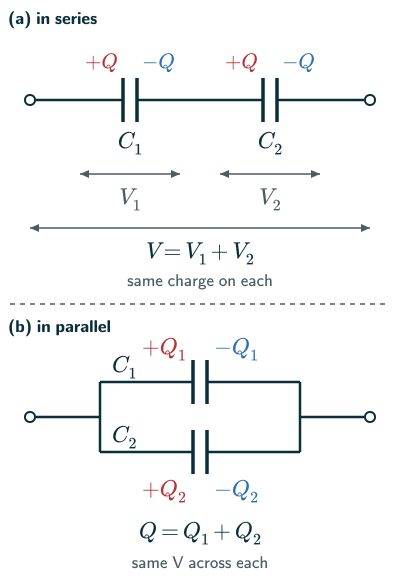
Several capacitors C1, C2, …, Cn can be joined to act as one capacitor with an effective capacitance C, which depends on how they are joined. NCERT takes the two simple cases, series and parallel (NCERT Section 2.14, page 71). The key fact for series is:
Thus, in the series combination, charges on the two plates (±Q) are the same on each capacitor.
NCERT Physics Part I (Class 12), Section 2.14.1, page 71
In plain words: in series, the same charge sits on every capacitor and the voltages add, so the combination is harder to charge than any one of them. In parallel, every capacitor has the same voltage and the charges add, so the combination holds more than any one of them.
Capacitors in series
Assume ideal capacitors initially uncharged, with each intermediate junction isolated and initially neutral. These conditions make the charge magnitudes equal; a junction with pre-existing net charge need not give equal capacitor charges.
- The outer plates (the left plate of C1 and the right plate of C2) are connected to the battery and get charges Q and −Q. The joined inner plates form one isolated conductor whose initial net charge is zero, so its two plate charges sum to zero: −Q and +Q. Charge conservation at this junction is the reason for equal capacitor charge magnitudes; zero field in the joining wire by itself does not require zero net junction charge (clarifying NCERT page 71; see conservation of charge).
- So each capacitor in series has the same charge ±Q, and the potential drops add (NCERT Eq. (2.55), page 72):
- Treating the combination as one capacitor with charge Q and potential difference V, its effective capacitance is C = Q/V (NCERT Eq. (2.57)). Comparing with V/Q = 1/C1 + 1/C2 gives (NCERT Eqs. (2.56)–(2.58), page 72):
Two capacitors in series (NCERT Eq. 2.58)
- The proof goes through for any number of capacitors. For n in series (NCERT Eqs. (2.59)–(2.60), page 72):
- For two capacitors this gives C = C1C2/(C1 + C2). The series combination is always smaller than the smallest capacitance in it (reasoned from NCERT Eq. (2.60)).
Capacitors in parallel
NCERT describes the parallel arrangement:
In this case, the same potential difference is applied across both the capacitors.
NCERT Physics Part I (Class 12), Section 2.14.2, page 72
- The charges need not be the same: Q1 = C1V and Q2 = C2V (NCERT Eq. (2.61), page 72).
- The equivalent capacitor has charge Q = Q1 + Q2 and potential difference V, so CV = C1V + C2V (NCERT Eqs. (2.62)–(2.63)). Cancelling V (NCERT Eq. (2.64), page 72):
Two capacitors in parallel (NCERT Eq. 2.64)
- For n capacitors in parallel, Q = Q1 + Q2 + … + Qn, which gives C = C1 + C2 + … + Cn (NCERT Eqs. (2.65)–(2.67), page 72). NCERT prints Eqs. (2.66) and (2.67) without the last plus sign, as “… CnV” and “… Cn”; the sums do include the last term.
- The parallel combination is always larger than the largest capacitance in it (reasoned from NCERT Eq. (2.67)).
Solved examples
Example 1: A four-capacitor network (NCERT Example 2.9)
Four 10 µF capacitors are connected to a 500 V supply: C1, C2 and C3 in series between A and D, and C4 directly between A and D. Find (a) the equivalent capacitance and (b) the charge on each capacitor.
Answer: (a) C1, C2 and C3 in series give 1/C′ = 3/(10 µF), so C′ = 10/3 µF. This is in parallel with C4, so C = 10/3 + 10 ≈ 13.3 µF.
(b) The three in series carry the same charge Q, and Q/C′ = 500 V, so Q = 500 × (10/3) × 10−6 ≈ 1.7 × 10⁻³ C each. C4 has the whole 500 V: Q′ = 500 × 10 × 10−6 = 5.0 × 10⁻³ C (NCERT page 73).
The charge on a capacitor means the charge on its plate at the higher potential; the other plate has an equal and opposite charge (NCERT page 73).
Example 2: Three equal capacitors in series (NCERT Exercise 2.6)
Three 9 pF capacitors are connected in series. Find the total capacitance, and the potential difference across each when the combination is connected to a 120 V supply.
Answer: 1/C = 3/(9 pF), so C = 3 pF. Each carries the same charge, Q = 3 × 10−12 × 120 = 3.6 × 10⁻¹⁰ C, so each has V = Q/9 pF = 40 V; the three add to 120 V (NCERT Eqs. (2.55) and (2.60), page 72).
Example 3: Three capacitors in parallel (NCERT Exercise 2.7)
Capacitors of 2 pF, 3 pF and 4 pF are connected in parallel. Find the total capacitance and the charge on each across a 100 V supply.
Answer: C = 2 + 3 + 4 = 9 pF. Each has 100 V across it, so the charges are 2 × 10⁻¹⁰ C, 3 × 10⁻¹⁰ C and 4 × 10⁻¹⁰ C, that is 200 pC, 300 pC and 400 pC (NCERT Eqs. (2.61) and (2.67), page 72).
Example 4: Sharing the voltage in series
A 2.0 µF and a 3.0 µF capacitor in series are connected across 100 V. Find the charge and the voltage across each.
Answer: C = (2.0 × 3.0)/(2.0 + 3.0) = 1.2 µF, so Q = 1.2 × 10−6 × 100 = 120 µC on each. Then V1 = 120/2.0 = 60 V and V2 = 120/3.0 = 40 V. In series the smaller capacitor takes the larger voltage (NCERT Eqs. (2.55) and (2.58), page 72).
Common mistakes to avoid
Common mistake
Adding capacitances in series
In series it is the reciprocals that add: 1/C = 1/C + 1/C. Simple addition is for parallel (NCERT Eqs. (2.58) and (2.64), page 72).
Common mistake
Splitting the charge between capacitors in series
Each capacitor in series carries the same charge Q; it is the voltage that is shared (NCERT page 71).
Common mistake
Giving capacitors in parallel the same charge
In parallel the voltage is the same; the charges Q = CV and Q = CV differ unless C = C (NCERT Eq. (2.61), page 72).
Quick revision summary
- Series: the same charge on each, the voltages add, and 1/C = 1/C + 1/C + … + 1/C; C is less than the smallest.
- Two in series: C = CC/(C + C); the smaller capacitor takes the larger voltage.
- Parallel: the same voltage across each, the charges add, and C = C + C + … + C; C is more than the largest.
- The charge on a capacitor is the charge on its higher-potential plate.
Formula sheet
- series: 1/C = 1/C + 1/C + … + 1/C
- series: same Q, V = V + V + …
- two in series: C = CC/(C + C)
- parallel: C = C + C + … + C
- parallel: same V, Q = Q + Q + …
Questions students ask
Why do capacitors combine in series and parallel the opposite way to resistors?
Capacitors combine the opposite way to resistors because capacitance grows with plate area and falls with the gap, C = ε0A/d (NCERT page 69), while resistance grows with length and falls with area, R = ρl/A (see resistance and resistivity). Identical parallel plate capacitors joined in parallel act like one with the plate areas added, so the capacitances add; joined in series, like one with the gaps added end to end, so the reciprocals add (beyond the NCERT text, reasoned from NCERT Eq. (2.43)). Resistors in series add lengths and in parallel add areas, so for them it is the other way round.
Why are capacitors joined in series or in parallel in practice?
Capacitors are joined in parallel to get a larger capacitance at the voltage each can take, and in series mainly to share a voltage higher than any one of them can withstand, keeping each below breakdown (beyond the NCERT text, reasoned from NCERT page 72 and the dielectric strength, page 68). For example, two ideal identical 47 µF capacitors in series give 23.5 µF and share voltage equally. Two real 160 V ratings cannot automatically be added to guarantee 320 V operation: tolerances and leakage can unbalance the voltages, so practical designs require appropriate balancing and rating margins (Vishay, capacitor balancing). Between unequal capacitors in series the smaller one takes the larger share of the voltage, so with equal ratings it breaks down first.
Which capacitor stores more energy in a series or a parallel combination?
In a series combination the smallest capacitor stores the most energy, and in a parallel combination the largest does: in series every capacitor carries the same charge, so U = Q/2C is largest for the smallest C, while in parallel every capacitor has the same voltage, so U = ½CV is largest for the largest C (reasoned from NCERT Eq. (2.69), page 74; see energy stored). For 5.0 µF and 20 µF across 100 V, they store 16 mJ and 4.0 mJ in series but 25 mJ and 100 mJ in parallel. Either way the total is ½CeqV, with Ceq the equivalent capacitance.
How do you find the equivalent capacitance of a network that is not just series and parallel?
A capacitor network that is not just series and parallel groups is solved with charge conservation at each isolated junction and a zero total potential difference round each closed loop (beyond the NCERT text, reasoned from NCERT pages 71–72). A common shortcut is the balanced bridge: with C1 and C2 in series on one arm, C3 and C4 on the other, and a fifth capacitor joining the two midpoints, the fifth carries no charge when C1/C2 = C3/C4, all starting uncharged, and can be removed, the same form as a balanced Wheatstone bridge.
Practice questions
Try each question first, then open the answer to check your working.
-
Q1. Find the equivalent capacitance of 4.0 µF and 12 µF (a) in series, (b) in parallel.
Show answerHide answer
(a) C = (4.0 × 12)/(4.0 + 12) = 3.0 µF. (b) C = 4.0 + 12 = 16 µF (NCERT Eqs. (2.58) and (2.64), page 72).
-
Q2. Two capacitors in parallel carry 30 µC and 50 µC across 10 V. Find each capacitance and the equivalent capacitance.
Show answerHide answer
C1 = 30/10 = 3.0 µF and C2 = 50/10 = 5.0 µF, so C = 8.0 µF (NCERT Eqs. (2.61) and (2.64), page 72).
-
Q3. Why do the joined inner plates of two capacitors in series carry −Q and +Q?
Show answerHide answer
The joined inner plates and wire form an isolated, initially neutral conductor. Its net charge remains zero, so if one inner plate has −Q the other has +Q; this assumes no initial charge on that junction (clarifying NCERT page 71).