Ohm’s law
NCERT Class 12 Physics Chapter 3 Section 3.4
Quick answer
At fixed temperature and physical conditions, Ohm’s law says the potential difference across a conductor is proportional to the current through it, V = RI, where R is its resistance in ohms. Resistance grows with length and falls with cross-section, R = ρl/A, where the resistivity ρ depends on the material and its conditions. For a uniform isotropic conductor, in terms of current density j = I/A, Ohm’s law reads j = σE, where σ = 1/ρ is the conductivity.
With your textbook
NCERT Physics Part I (Class 12), Chapter 3 “Current Electricity”, Section 3.4 “Ohm’s law”, pages 83–85.
Open the official NCERT chapter (PDF, 2.2 MB, ncert.nic.in) (opens in a new tab)
Checked against the 2026-27 reprint on .
What is Ohm’s law?
Ohm’s law
At fixed temperature and physical conditions, for an ohmic conductor carrying a current I, with a potential difference V between its ends, Ohm’s law says that V is proportional to I: V = RI, where the constant R is the resistance of the conductor (NCERT Eq. (3.3), page 83). NCERT adds what R depends on:
The resistance R not only depends on the material of the conductor but also on the dimensions of the conductor.
NCERT Physics Part I (Class 12), Section 3.4, page 83
The SI unit of resistance is the ohm (Ω).
In plain words: push harder (more voltage) and more current flows, in exact proportion. The resistance says how hard the wire resists: a longer wire resists more, a thicker one less, and the material sets the rest through its resistivity.
V = RI
- Ohm’s law was found by G. S. Ohm long before the mechanism of current flow was understood (NCERT page 83). NCERT dates it to 1828; Ohm did the work in 1825–26 and set the law out in full in his book Die galvanische Kette, mathematisch bearbeitet (Berlin, 1827; a first edition is digitised on the Bibliothèque nationale de France’s Gallica library).
- For a conductor with current I and potential difference V across its ends (NCERT Eq. (3.3), page 83):
Ohm’s law (NCERT Eq. 3.3)
- R is the resistance, measured in ohms; 1 Ω = 1 V A−1 (from R = V/I).
- V = RI on its own only defines R = V/I, for a nonzero current; it is then a static ratio even for a non-ohmic device. Ohm’s law is the statement that R does not depend on V, so that the V–I graph is a straight line through the origin; in the form E = ρj, a material obeys it when ρ does not depend on the size or direction of the field (NCERT Points to Ponder 2, page 105).
- Ohm was led to his law by an analogy with the conduction of heat: the electric field plays the part of the temperature gradient, and the current the part of the heat flow (NCERT’s box on Ohm, page 84; see heat conduction). (The box gives his birth year as 1787; standard references, such as Encyclopaedia Britannica, give 16 March 1789.)
Resistance and resistivity
The formula R = ρl/A assumes a uniform wire of constant cross-section and uniform scalar resistivity. The scalar forms E = ρj and j = σE apply to an isotropic material; I/A is the local current density only when the flow is uniform across the section (otherwise it is the cross-sectional average).
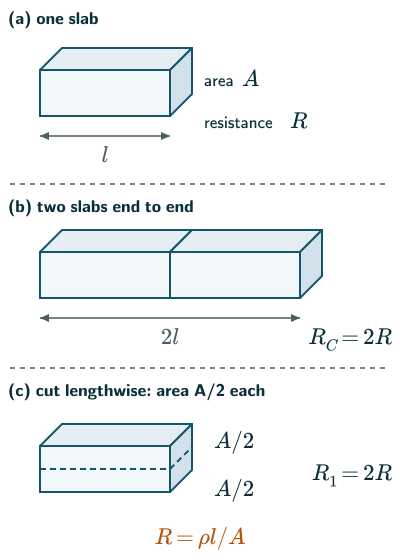
NCERT finds how R depends on the size of a conductor with a slab of length l and cross-section A (NCERT pages 83–84, Figure 3.2):
- Two slabs end to end (length 2l): the same current I flows through both, and the potential differences add to 2V. So the combination has RC = 2V/I = 2R (NCERT Eq. (3.4)). Doubling the length doubles the resistance: R ∝ l (Eq. (3.5), page 84).
- The slab cut lengthwise into two of area A/2: with the same V, each half carries I/2, so each has R1 = V/(I/2) = 2R (NCERT Eq. (3.6)). Halving the area doubles the resistance: R ∝ 1/A (Eq. (3.7), page 84).
- Combining the two, R ∝ l/A (NCERT Eq. (3.8)), so (NCERT Eq. (3.9), page 84):
Resistance from resistivity (NCERT Eq. 3.9)
- The constant ρ is the resistivity. It depends on the material and its temperature, pressure and other physical conditions, but not on the dimensions (page 84; see resistivity of various materials). Its unit is Ω m (from ρ = RA/l). Ohm’s law then reads V = IR = Iρl/A (NCERT Eq. (3.10)).
Current density
NCERT defines it:
Current per unit area (taken normal to the current), I/A, is called current density and is denoted by j.
NCERT Physics Part I (Class 12), Section 3.4, page 84
- Its SI unit is A/m2 (page 84).
- In a uniform field E along a conductor of length l, V = El. Putting this and I = jA into V = Iρl/A gives El = jρl, so E = jρ (NCERT Eq. (3.11), page 85).
- j is a vector along E, so in vector form E = ρj (NCERT Eq. (3.12), page 85).
Conductivity
- The conductivity is σ = 1/ρ, and Ohm’s law can be written (NCERT Eq. (3.13), page 85):
Ohm’s law in terms of current density (NCERT Eq. 3.13)
- This form, j = σE, is often used as an equivalent statement of Ohm’s law, alongside V = RI (page 85). It works at each point inside a conductor, not just between its ends (reasoned from NCERT Eq. (3.12)).
- The unit of σ is Ω−1 m−1 (from σ = 1/ρ).
Solved examples
Example 1: Resistance from voltage and current
A potential difference of 12 V drives 0.50 A through a resistor. Find its resistance.
Answer: R = V/I = 12/0.50 = 24 Ω (NCERT Eq. (3.3), page 83).
Example 2: Resistance of a wire
A wire 10 m long with a cross-section of 1.0 mm2 is made of a metal of resistivity 1.7 × 10⁻⁸ Ω m. Find its resistance.
Answer: A = 1.0 × 10⁻⁶ m2, so R = ρl/A = 1.7 × 10−8 × 10/(1.0 × 10−6) = 0.17 Ω (NCERT Eq. (3.9), page 84).
Example 3: Stretching a wire
A wire is stretched to twice its length, its volume and resistivity staying the same (neglect changes due to strain and temperature). By what factor does its resistance change?
Answer: with the volume lA fixed, doubling l halves A. Then R = ρl/A has l doubled and A halved, so R becomes 4 times as large (reasoned from NCERT Eq. (3.9), page 84). In terms of the radius r, l ∝ 1/r2 at fixed volume, so R ∝ 1/r4; at unchanged resistivity a 1 % stretch raises R by about 2 %.
Example 4: Current density and field
A wire of cross-section 2.0 mm2 and resistivity 1.7 × 10⁻⁸ Ω m carries 3.0 A. Find the current density and the electric field in it.
Answer: j = I/A = 3.0/(2.0 × 10−6) = 1.5 × 10⁶ A/m2. Then E = ρj = 1.7 × 10−8 × 1.5 × 106 ≈ 2.6 × 10⁻² V/m (NCERT Eq. (3.11), pages 84–85). The conductivity is σ = 1/ρ ≈ 5.9 × 10⁷ Ω−1 m−1.
Common mistakes to avoid
Common mistake
Thinking resistivity changes with the size of the wire
Resistance depends on length and area; resistivity depends only on the material, not on the dimensions (NCERT page 84).
Common mistake
Keeping the area fixed when a wire is stretched
Stretching keeps the volume, so the area falls as the length rises; doubling the length makes R four times as large (reasoned from NCERT Eq. (3.9)).
Common mistake
Confusing current density with current
Current density is current per unit area normal to the current, j = I/A, in A/m; it is a vector along E (NCERT pages 84–85).
Quick revision summary
- Ohm’s law: V = RI, with R the resistance in ohms; R depends on the material and on the dimensions.
- Doubling the length doubles R; halving the area doubles R; so R = ρl/A, with ρ the resistivity of the material, in Ω m.
- Current density j = I/A, in A/m, is a vector along E; E = ρj.
- Conductivity σ = 1/ρ, and Ohm’s law can be written j = σE.
- A wire stretched to n times its length, at fixed volume, has n times the resistance (R ∝ 1/r); at unchanged resistivity a 1 % stretch raises R by about 2 %.
Formula sheet
- V = RI
- R = ρl/A
- j = I/A
- E = ρj
- j = σE, with σ = 1/ρ
Questions students ask
What is the difference between resistance and resistivity?
Resistance R belongs to a particular conductor and is measured in ohms, while resistivity ρ, also called specific resistance, belongs to the material and is measured in Ω m: R = ρl/A grows with the conductor’s length and falls with its cross-section, but ρ depends only on the material and on its temperature and pressure (NCERT Eq. (3.9), page 84; NCERT Summary point 4, page 103). Numerically, ρ is the resistance between opposite faces of a cube of the material 1 m on a side, since for that cube l/A = 1 m.
Why is the unit of resistivity Ω m and not Ω per metre?
Resistivity is measured in ohm metres because ρ = RA/l multiplies a resistance by an area and divides by a length, Ω × m/m = Ω m (from NCERT Eq. (3.9), page 84); its dimensional formula, [M L T A], has one more power of L than that of resistance, [M L T A] (NCERT table, page 104; see dimensional formulae). Ω m is the unit of a different quantity, the resistance per unit length of a particular wire, R/l = ρ/A, which still depends on how thick the wire is. A wire of resistivity 1.0 × 10 Ω m has 1.0 Ω m if its cross-section is 1.0 mm, but 4.0 Ω m if it is 0.25 mm.
Is conductance the same as conductivity?
No, conductance and conductivity are different quantities: conductance G = 1/R belongs to a particular conductor and is measured in siemens, 1 S = 1 Ω, while conductivity σ = 1/ρ belongs to the material and is measured in S m, or Ω m (NCERT Eq. (3.13), page 85; NCERT Chemistry Part I (Class 12), Unit 2, page 41). They are linked as resistance and resistivity are, G = σA/l. The table on page 104 of NCERT Physics Part I prints the unit of conductivity as S, the unit of conductance, though the dimensions it gives, [M L T A], are those of S m.
Is Ohm’s law derived from theory or found by experiment?
Ohm’s law was found by experiment: G. S. Ohm discovered it, in 1828 according to NCERT, long before anyone knew how charges move through a metal (NCERT page 83). NCERT later shows that a simple model of electrons drifting between collisions reproduces it, giving j = (neτ/m)E (NCERT Eq. (3.22), page 86), but only by assuming that n and τ do not depend on E (page 87). So the ‘derivation’ explains why many metals obey the law, and where its assumptions fail, so does the law.
Practice questions
Try each question first, then open the answer to check your working.
-
Q1. A 5.0 Ω resistor carries 2.0 A. What is the potential difference across it?
Show answerHide answer
V = RI = 5.0 × 2.0 = 10 V (NCERT Eq. (3.3), page 83).
-
Q2. Two wires of the same material have the same length, but one has twice the diameter of the other. Compare their resistances.
Show answerHide answer
Twice the diameter means four times the area, so the thicker wire has one quarter the resistance (NCERT Eq. (3.9), page 84).
-
Q3. What is the SI unit of current density?
Show answerHide answer
A/m2 (NCERT page 84).