Combination of resistors: series and parallel
Beyond NCERT In the JEE Main and NEET syllabus; the Class 12 book has no section for it.
Quick answer
For two or more positive finite resistances with ideal connecting wires: Resistors in series carry the same current and their voltages add, so Rs = R1 + R2 + R3 + …, more than the largest. Resistors in parallel have the same voltage and their currents add, so 1/Rp = 1/R1 + 1/R2 + …, less than the smallest. Networks built of series and parallel groups are reduced step by step; others need Kirchhoff’s rules.
How do resistors combine?
Combination of resistors
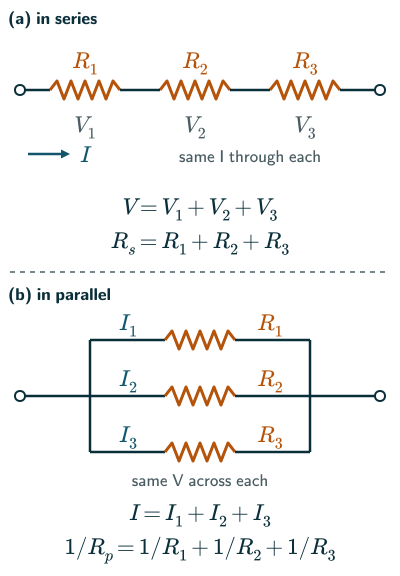
Resistors joined end to end are in series: the same current flows through each, and Rs = R1 + R2 + R3 + …. Resistors joined between the same two points are in parallel: each has the same potential difference, and 1/Rp = 1/R1 + 1/R2 + 1/R3 + …. NCERT’s Class 12 book uses these formulae when it introduces Kirchhoff’s rules:
The formulae we have derived earlier for series and parallel combinations of resistors are not always sufficient to determine all the currents and potential differences in the circuit.
NCERT Physics Part I (Class 12), Section 3.12, page 97
In plain words: in series, one current has to push through every resistor in turn, so the resistances add up. In parallel, the current gets several paths at once, so the combination lets more through and its resistance is less than that of any single path.
A note on NCERT’s wording: the current Class 12 book no longer derives these formulae, although page 97 says “we have derived earlier”. They are derived in NCERT Science (Class 10), Chapter 11, Section 11.6, pages 181–187, and they follow from Ohm’s law and Kirchhoff’s rules, as shown below. The nearest the Class 12 book comes is the slab argument in NCERT Section 3.4 (pages 83–84): two identical slabs end to end have twice the resistance (NCERT Eq. (3.4)), and each half of a slab cut lengthwise has twice the resistance (NCERT Eq. (3.6)).
Resistors in series
- In series there is only one path, so the same current I flows through every resistor: no charge piles up anywhere when currents are steady (Kirchhoff’s junction rule, NCERT Section 3.12, page 98; see conservation of charge).
- The potential differences across the resistors add to the total, V = V1 + V2 + V3: this is the loop rule, since the changes of potential round the circuit add to zero (NCERT page 98).
- By Ohm’s law each Vi = IRi, and the single equivalent resistor must give V = IRs (NCERT Eq. (3.3), page 83). So IRs = IR1 + IR2 + IR3:
Resistors in series
- Rs is greater than the largest resistance in the chain. The total voltage divides in proportion to the resistances: V1 = V × R1/Rs (reasoned from Vi = IRi).
Resistors in parallel
- In parallel each resistor is connected between the same two points, so each has the same potential difference V.
- The total current divides among the branches and the branch currents add: I = I1 + I2 + I3 (junction rule, NCERT pages 97–98).
- By Ohm’s law Ii = V/Ri, and the equivalent resistor must give I = V/Rp. So V/Rp = V/R1 + V/R2 + V/R3:
Resistors in parallel
- Rp is less than the smallest resistance. For two resistors, Rp = R1R2/(R1 + R2), and the current divides inversely as the resistances: I1 = I × R2/(R1 + R2) (reasoned from Ii = V/Ri).
- n equal resistors R give nR in series and R/n in parallel.
- These are the same rules NCERT Science (Class 10) finds by experiment and derives (Section 11.6, pages 181–187). Note that capacitors combine the other way round: they add directly in parallel and as reciprocals in series.
Equivalent resistance of a network
- A network that is built of series and parallel groups can be reduced step by step: replace each group by its equivalent resistor, redraw, and repeat until one resistor is left.
- To spot the groups, label the junctions. Resistors joined to the same two junctions are in parallel. A resistor with a plain wire across its ends is short-circuited: it has no potential difference across it, carries no current and can be removed (reasoned from Ohm’s law).
- Then the total current is I = V/Req, and the currents and potential differences can be worked back through the steps.
- Not every network reduces this way. For those, NCERT uses Kirchhoff’s rules, as in its cube of twelve resistors (NCERT Example 3.5, pages 98–99), where symmetry helps.
Solved examples
Example 1: Three resistors in series
Resistors of 2 Ω, 3 Ω and 5 Ω are joined in series across 20 V. Find the current and the potential difference across each.
Answer: Rs = 2 + 3 + 5 = 10 Ω, so I = 20/10 = 2.0 A. The potential differences are 2.0 × 2 = 4 V, 2.0 × 3 = 6 V and 2.0 × 5 = 10 V, adding to 20 V (from NCERT Eq. (3.3), page 83).
Example 2: Three resistors in parallel (NCERT Science Class 10, Example 11.8)
Resistors of 5 Ω, 10 Ω and 30 Ω are joined in parallel across 12 V. Find the current in each, the total current and the total resistance.
Answer: each has 12 V across it, so I1 = 12/5 = 2.4 A, I2 = 12/10 = 1.2 A and I3 = 12/30 = 0.4 A. The total is 4 A, and 1/Rp = 1/5 + 1/10 + 1/30 = 1/3, so Rp = 3 Ω, which is 12 V/4 A (NCERT Science, Class 10, pages 186–187).
Example 3: Reducing a network (NCERT Science Class 10, Example 11.9)
10 Ω and 40 Ω are joined in parallel; 30 Ω, 20 Ω and 60 Ω are joined in parallel; the two groups are in series across 12 V. Find the total resistance and current.
Answer: first group: 1/R′ = 1/10 + 1/40 = 5/40, so R′ = 8 Ω. Second: 1/R″ = 1/30 + 1/20 + 1/60 = 6/60, so R″ = 10 Ω. In series, R = 8 + 10 = 18 Ω, and I = 12/18 ≈ 0.67 A (NCERT Science, Class 10, page 187).
Example 4: Dividing voltage and current
(a) 4 Ω and 8 Ω in series are across 12 V. Find the potential difference across the 8 Ω resistor. (b) A current of 6.0 A divides between 3 Ω and 6 Ω in parallel. Find the current in each.
Answer: (a) V8 = 12 × 8/12 = 8 V. (b) I3 = 6.0 × 6/9 = 4.0 A and I6 = 6.0 × 3/9 = 2.0 A: the smaller resistance takes the larger current (reasoned from Ohm’s law, NCERT Eq. (3.3)).
Common mistakes to avoid
Common mistake
Adding resistances that are in parallel
In parallel it is the reciprocals that add, 1/Rp = 1/R1 + 1/R2 + …, and Rp is less than the smallest resistance.
Common mistake
Giving resistors in parallel the same current
In parallel the potential difference is the same; the currents differ, with the smallest resistance taking the largest current.
Common mistake
Thinking an extra resistor always raises the total
Added in series it raises the total; added in parallel it opens another path and lowers the total.
Quick revision summary
These rules assume ideal connecting wires and positive finite resistances. A series junction has no third branch. Strictly greater/smaller equivalent-resistance comparisons require at least two resistors; cut-wire arguments also assume a uniform wire with unchanged resistivity.
- Series: the same current through each; the potential differences add; Rs = R1 + R2 + R3 + …, more than the largest.
- Parallel: the same potential difference across each; the currents add; 1/Rp = 1/R1 + 1/R2 + …, less than the smallest.
- Two in parallel: Rp = R1 R2/(R1 + R2); n equal resistors R: nR in series, R/n in parallel.
- Voltage divides in proportion to R in series; current divides inversely as R in parallel.
- Series–parallel networks reduce step by step; others need Kirchhoff’s rules (NCERT Section 3.12).
Formula sheet
- series: Rs = R1 + R2 + R3 + …
- parallel: 1/Rp = 1/R1 + 1/R2 + 1/R3 + …
- two in parallel: Rp = R1 R2/(R1 + R2)
- series divider: V1 = V R1/(R1 + R2)
- parallel divider: I1 = I R2/(R1 + R2)
Questions students ask
Is the combination of resistors in the NCERT Class 12 book and in the JEE and NEET syllabus?
The combination of resistors is in both syllabuses but has no section of its own in the 2026–27 NCERT Class 12 book: the JEE Main syllabus and the NEET (UG) 2026 syllabus list “series and parallel combinations of resistors” in Unit 12, Current Electricity (JEE Main wording), while NCERT Class 12 Physics Part I only uses the formulae, “derived earlier”, when it introduces Kirchhoff’s rules (Section 3.12, page 97). The derivations are in NCERT Science Class 10, Chapter 11, Section 11.6 (from page 181), and on this page from Ohm’s law and Kirchhoff’s rules. So series–parallel networks remain exam topics, though the Class 12 book does not teach them afresh.
Why are resistors joined in series or in parallel in practice?
Resistors are joined in series or in parallel to make a resistance that is not available as a single part, to share out heat that one resistor could not take, or to divide a voltage or a current in a fixed ratio (beyond the NCERT text, reasoned from the combination rules and NCERT Eq. (3.33), page 93). For example, two 1.0 kΩ resistors give 2.0 kΩ in series and 500 Ω in parallel. Four 1.0 kΩ resistors rated 0.25 W each, joined as two parallel pairs in series, act as one 1.0 kΩ resistor that can take about 1 W under each component’s specified cooling and mounting conditions, because the current divides equally and each takes a quarter of the heat.
Are equivalent resistance, effective resistance and total resistance the same thing?
Yes, equivalent, effective, total and net resistance all mean the same thing: the single resistance that, connected between the same two terminals, would draw the same current from the same potential difference, Req = V/I, measured in ohms (reasoned from NCERT Eq. (3.3), page 83). It belongs to a network and a chosen pair of terminals, not to the network alone: 2 Ω, 4 Ω and 6 Ω joined in a triangle give 3.0 Ω between the ends of the 6 Ω resistor, which is then in parallel with 2 + 4 = 6 Ω, but only about 1.7 Ω between the ends of the 2 Ω one.
Why are household appliances connected in parallel and not in series?
Household appliances are connected in parallel so that each gets the full mains voltage and draws the current it is designed for, and so that one can go open-circuit or be switched off without cutting off the others (a short-circuit fault can instead trip a shared protective device): NCERT Science Class 10 notes that gadgets in series would all carry one current, though they need very different currents, and that one failure breaks the whole circuit (Chapter 11, page 187). A 2000 W heater and a 40 W lamp, both rated for 230 V and taken to have fixed resistances of about 26 Ω and 1300 Ω, would pass only about 0.17 A in series on 230 V, leaving the heater under 1 W (reasoned from NCERT Eq. (3.33), page 93).
Practice questions
Try each question first, then open the answer to check your working.
-
Q1. Find the equivalent resistance of 6 Ω and 3 Ω (a) in series, (b) in parallel.
Show answerHide answer
(a) 6 + 3 = 9 Ω. (b) 6 × 3/(6 + 3) = 2 Ω.
-
Q2. Four 8 Ω resistors are joined in parallel. What is the equivalent resistance?
Show answerHide answer
8/4 = 2 Ω.
-
Q3. What stays the same for every resistor (a) in series, (b) in parallel?
Show answerHide answer
(a) The current; (b) the potential difference.