Kirchhoff’s rules
NCERT Class 12 Physics Chapter 3 Section 3.12
Quick answer
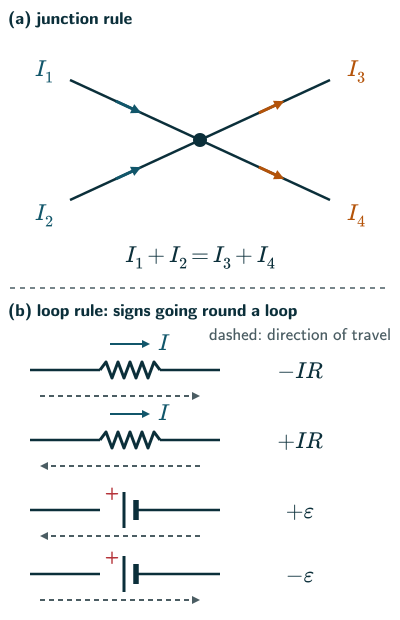
Kirchhoff’s junction rule says the currents entering any junction add up to the currents leaving it, because steady currents do not pile up charge anywhere. His loop rule says the changes in potential round any closed loop add to zero, because potential depends only on position. Going round a loop, a resistor crossed along its current gives −IR and a cell crossed from − to + gives +ε; enough junction and loop equations give every current in a network.
With your textbook
NCERT Physics Part I (Class 12), Chapter 3 “Current Electricity”, Section 3.12 “Kirchhoff’s Rules”, pages 97–100.
Open the official NCERT chapter (PDF, 2.2 MB, ncert.nic.in) (opens in a new tab)
Checked against the 2026-27 reprint on .
What are Kirchhoff’s rules?
Kirchhoff’s rules
Two rules let you find every current in any network of resistors and cells, even one that cannot be broken into series and parallel parts (NCERT Section 3.12, page 97). The first is about junctions:
At any junction, the sum of the currents entering the junction is equal to the sum of currents leaving the junction
NCERT Physics Part I (Class 12), Section 3.12, page 97
The second is about closed loops: the algebraic sum of the changes in potential around any closed loop of resistors and cells is zero (page 98).
In plain words: charge does not pile up anywhere in a steady circuit, so whatever flows into a point flows out again. And potential is like height: walk round any closed path and you come back to the height you started from, however many ups and downs, across cells and resistors, you met on the way.
Labelling currents and cells
- Label the current in each resistor with a symbol and an arrow. If a current comes out positive, it flows the way the arrow points; if negative, it flows the other way (NCERT page 97).
- Label the positive and negative electrodes of each cell, and the current through it. If the current through the cell is taken from N to P, the potential difference is V = V(P) − V(N) = ε − Ir (NCERT Eq. (3.38)); if it is taken from P to N, V = ε + Ir (NCERT Eq. (3.60), page 97).
Junction rule
- The currents entering any junction add up to the currents leaving it (NCERT page 97). It applies equally to a single point in a wire (page 98).
- Why: when currents are steady, no charge accumulates at a junction or at any point in a line, so the rate at which charge flows in must equal the rate at which it flows out (page 98). It is conservation of charge applied to currents.
- In NCERT’s Figure 3.15, the current leaving junction a is I1 + I2 and the current entering is I3, so I3 = I1 + I2; at the point h, the single current in and the single current out are both I1 (NCERT page 98).
- Bending or reorienting the wires does not change the rule (NCERT Points to Ponder 6, page 105).
Loop rule
NCERT states it:
The algebraic sum of changes in potential around any closed loop involving resistors and cells in the loop is zero
NCERT Physics Part I (Class 12), Section 3.12, page 98
- Why: the electric potential depends only on the location of a point. Starting at any point and coming back to it, the total change must be zero (page 98).
- Signs (the usual convention, reasoned from the meaning of potential): going round the loop, a resistor crossed along its current gives a change −IR, and against it +IR; a cell crossed from − to + gives +ε, and from + to − gives −ε.
- Cells with internal resistance: treat the cell as ε in series with r. Crossed from − to + in the direction of its current, it gives +ε − Ir (NCERT Eq. (3.38)). The sign of ε depends only on the direction you cross it, never on the current.
- Exam phrasing: the junction rule is conservation of charge. The loop rule is usually called conservation of energy: a charge taken once round a loop returns to the same potential, and so to the same potential energy (reasoned from NCERT page 98).
- In NCERT’s Figure 3.15, branch a–h–d has 30 Ω, with I1 drawn from a towards h. Branch d–c–b–a has a 45 V cell (positive plate at c), then 1 Ω and 40 Ω, with I3 drawn towards a. Branch a–g–f–e–d has an 80 V cell (positive plate at f), then 1 Ω and 20 Ω, with I2 drawn from a through g, f and e to d.
- Round ahdcba: −30I1, then +45 (cell crossed − to +), then −41I3, so −30I1 − 41I3 + 45 = 0. Round ahdefga: −30I1, then +21I2 (against I2), then −80 (+ to −), so −30I1 + 21I2 − 80 = 0 (NCERT page 98).
- How many equations: use the junction rule to label the branches with as few unknown currents as possible, then write an independent loop equation for each remaining unknown. Further loops give no new information (NCERT pages 99–100).
Solved examples
Example 1: A cube of resistors (NCERT Example 3.5)
Twelve 1 Ω resistors form the edges of a cube, and a 10 V battery of negligible internal resistance is joined across opposite corners A and C′. Find the equivalent resistance and the currents.
Answer: by symmetry the three edges from A carry the same current I, and at each of their far corners it splits equally into two edges carrying I/2. The loop through A, B, C, C′ and the battery gives −IR − ½IR − IR + ε = 0, so ε = (5/2)IR. The total current is 3I, so Req = ε/(3I) = (5/6)R = 5/6 Ω. With ε = 10 V, 3I = 10/(5/6) = 12 A, so I = 4 A in the edges at A and C′ and 2 A in the middle six (NCERT pages 98–99).
Example 2: A network with two cells (NCERT Example 3.6)
In NCERT’s Figure 3.17, AB and AD are 4 Ω and BC and CD are 2 Ω. Branch CA has 1 Ω and a 10 V cell (positive terminal towards A), and branch DEB has a 5 V cell (positive terminal towards B). Take I1 from C to A, I2 from A to B and I3 from D to B. The junction rule then gives I1 − I2 in AD, I2 + I3 in BC and I2 + I3 − I1 in CD. NCERT’s loops ADCA, ABCA and BCDEB give 7I1 − 6I2 − 2I3 = 10, I1 + 6I2 + 2I3 = 10 and 2I1 − 4I2 − 4I3 = −5. Find the current in each branch.
Answer: adding the first two, 8I1 = 20, so I1 = 2.5 A. The third gives I2 + I3 = 2.5, and then the second gives 4I2 = 2.5, so I2 = 5/8 A and I3 = 15/8 A. The branch currents are AB 5/8 A, CA 5/2 A, DEB 15/8 A, AD 15/8 A, CD 0 and BC 5/2 A. The loop BADEB checks out: 5 + (5/8) × 4 − (15/8) × 4 = 0 (NCERT page 100).
Example 3: A bridge-shaped network (NCERT Exercise 3.7)
In NCERT’s Figure 3.20, AB = 10 Ω, BC = 5 Ω and BD = 5 Ω. Calling the unlabelled lower corner D, AD = 5 Ω and DC = 10 Ω. A 10 V cell in series with 10 Ω joins C to A, positive terminal towards A. Find the current in each branch.
Answer: take C as zero potential. The cell branch carries I into A, so VA = 10 − 10I. The junction rule at A, B and D, with Ohm’s law for each branch, gives (after multiplying by 10): at A, 4VA − VB − 2VD = 10; at B, VA − 5VB + 2VD = 0; at D, 2VA + 2VB − 5VD = 0. Adding the last two gives VA = VB + VD. The B equation then gives VD = 4VB/3, and the A equation gives 17VB/3 = 10. So VB = 30/17 V, VD = 40/17 V and VA = 70/17 V. The currents are: cell branch 10/17 A; AB 4/17 A; AD 6/17 A; BC 6/17 A; DC 4/17 A; and 2/17 A from D to B. NCERT’s arrow in BD points from B to D, so for that arrow the current is −2/17 A (NCERT Exercise 3.7, page 106).
Example 4: Solving NCERT’s Figure 3.15 (beyond the NCERT text)
Solve the two loop equations of NCERT’s Figure 3.15 together with I3 = I1 + I2.
Answer: substituting, 71I1 + 41I2 = 45 and −30I1 + 21I2 = 80. Solving, I1 ≈ −0.86 A, I2 ≈ 2.58 A and I3 ≈ 1.73 A. I1 is negative, so about 0.86 A actually flows from h to a, opposite to its arrow (NCERT page 97 on negative currents).
Common mistakes to avoid
Common mistake
Changing a current’s assumed direction halfway through
Keep the arrows you chose; a negative answer simply means the current flows the other way (NCERT page 97).
Common mistake
Getting the sign of IR wrong in a loop
Crossing a resistor in the direction of its current is a drop, −IR; crossing it against the current is a rise, +IR.
Common mistake
Writing more loop equations than unknowns and expecting new information
Once enough independent loops are used, the others are automatically satisfied (NCERT page 100).
Quick revision summary
The junction rule in this form assumes negligible accumulation of charge at the node. More generally, current in minus current out equals dQ/dt. The electrostatic loop statement assumes no unaccounted time-varying magnetic flux; induced emfs must be included when present. A capacitor behaves as an open branch only after a DC transient has settled, in the ideal zero-leakage model.
- Junction rule: the currents entering a junction add up to the currents leaving it; it follows from no charge piling up in steady currents.
- Loop rule: the changes in potential round any closed loop add to zero; it follows from potential depending only on position, and is usually called conservation of energy.
- Signs: along the current through R, −IR; against, +IR; cell from − to +, +ε; from + to −, −ε.
- Label branch currents with the junction rule first; a negative answer means the opposite direction.
- NCERT Examples: cube Req = 5R/6; Example 3.6 gives I1 = 2.5 A, I2 = 5/8 A, I3 = 15/8 A.
Formula sheet
- junction: sum of currents in = sum of currents out
- loop: sum of potential changes = 0
- along I through R: −IR; against: +IR
- cell − to +: +ε; + to −: −ε
- cube of equal R, opposite corners: Req = 5R/6
Questions students ask
Are Kirchhoff’s rules the same as Kirchhoff’s laws, KCL and KVL?
Yes, Kirchhoff’s rules and Kirchhoff’s laws are the same two results under different names: the junction rule, which NCERT also calls his first rule, and the loop rule, his second rule (NCERT Section 3.12, pages 97–100). The JEE Main syllabus and the NEET (UG) 2026 syllabus list them as “Kirchhoff’s laws and their applications” in Unit 12. Beyond the NCERT text, engineers call them Kirchhoff’s current law and voltage law, as the US Department of Energy’s Electrical Systems and Safety Oversight Qualification Standard Reference Guide (2009) does, KCL and KVL for short. There are only these two for circuits; Kirchhoff is mainly known for his work in spectroscopy (NCERT page 97).
Do Kirchhoff’s rules hold for AC circuits and changing currents?
Yes, Kirchhoff’s rules apply to lumped, quasistatic AC circuit models at each instant: NCERT applies the loop rule of Section 3.12 to an AC source and a resistor (NCERT Chapter 7, page 178) and writes it for a series LCR circuit as L di/dt + iR + q/C = v (NCERT Eq. (7.20), page 186). With changing currents the loop rule works when all induced emfs are included, including a coil’s −L di/dt and any externally changing linked magnetic flux (NCERT Eq. (7.10), page 181; see self-inductance). The peak or rms voltages round an AC loop add only as phasors.
What is the resistance of NCERT’s cube of resistors between the ends of one edge or across a face?
For twelve equal resistors R on the edges of a cube, the resistance is 7R/12 between the two ends of one edge and 3R/4 between opposite corners of one face, against 5R/6 between opposite corners of the cube, the case of NCERT Example 3.5 (beyond the NCERT text, found with Kirchhoff’s rules and symmetry). The method is NCERT’s own: edges placed alike with respect to the two terminals carry equal currents, which leaves only a few unknown currents for the junction and loop rules (NCERT pages 98–99). With R = 12 Ω, the three values are 7 Ω, 9 Ω and 10 Ω.
How are Kirchhoff’s rules applied to a DC circuit with a capacitor in it?
Once the currents in a DC circuit are steady, a capacitor’s branch carries no current, so the junction rule puts zero current there, and the loop rule counts the capacitor’s potential difference, q/C, like that of a cell (beyond the NCERT text, reasoned from NCERT page 98 and C = Q/V, NCERT Chapter 2, Eq. (2.38), page 67). For example, an ideal 9.0 V cell in series with 1.0 Ω and 2.0 Ω, with a 2.5 µF capacitor across the 2.0 Ω resistor, drives 9.0/3.0 = 3.0 A; the capacitor has the same 6.0 V as that resistor and holds 2.5 × 6.0 = 15 µC.
Practice questions
Try each question first, then open the answer to check your working.
-
Q1. Currents of 3 A and 2 A flow into a junction; one wire carries 4 A out. What is the current in the only other wire, and which way does it flow?
Show answerHide answer
1 A, flowing out of the junction (junction rule, NCERT page 97).
-
Q2. On which conservation laws are the junction rule and the loop rule based?
Show answerHide answer
The junction rule on conservation of charge: in steady currents no charge accumulates at a junction (NCERT page 98). The loop rule on conservation of energy: a charge taken round a closed loop returns to the same potential, so its energy is unchanged (reasoned from NCERT page 98).
-
Q3. Going round a loop, you cross a 4 Ω resistor in the direction of its 2 A current, then a 12 V cell from − to +. What is the total change in potential so far?
Show answerHide answer
−8 V + 12 V = +4 V (sign convention from the loop rule, NCERT page 98).