Inductance
NCERT Class 12 Physics Chapter 6 Section 6.7
Quick answer
For fixed coil geometry and a linear magnetic medium, flux linkage is proportional to current: NΦB = LI for self-inductance and N1Φ1 = MI2 for mutual inductance. With constant L and M, changing current produces ε = −L dI/dt and ε1 = −M dI2/dt, measured in volts while inductance is in henry. An ideal linear inductor stores W = LI2/2; real ferromagnetic cores can make inductance depend on current and history.
With your textbook
NCERT Physics Part I (Class 12), Chapter 6 “Electromagnetic Induction”, Section 6.7 “Inductance”, pages 165–170.
Open the official NCERT chapter (PDF, 2.4 MB, ncert.nic.in) (opens in a new tab)
Checked against the 2026-27 reprint on .
What is inductance?
Inductance
For fixed geometry and a linear magnetic medium, the flux produced by a coil is proportional to its current. For a closely wound coil of N turns the flux linkage NΦB is proportional to I (NCERT Section 6.7, page 165):
The constant of proportionality, in this relation, is called inductance.
NCERT Physics Part I (Class 12), Section 6.7, page 165
If the flux comes from a current in a nearby coil, the constant is the mutual inductance M; if it comes from the coil’s own current, it is the self-inductance L. Inductance is a scalar, measured in henry (H), with dimensions [M L2 T−2 A−2]. Like capacitance, it depends only on the geometry of the coil and the material inside (NCERT page 165).
In plain words: a coil resists changes in its current. Try to change the current and the coil produces an emf that pushes back, just as a heavy object resists changes in its speed. Inductance measures how hard it pushes back, and a nearby coil can feel the effect too.
Scope: L and M are treated as constants below, with fixed coil geometry and a linear, reciprocal magnetic medium. Beyond the NCERT text: real ferromagnetic cores can saturate (Wikipedia, “Inductance”) and show hysteresis (J. Bahrdt, CERN-2010-004, Fig. 5), so their inductance can depend on current and history (reasoned).
Mutual inductance
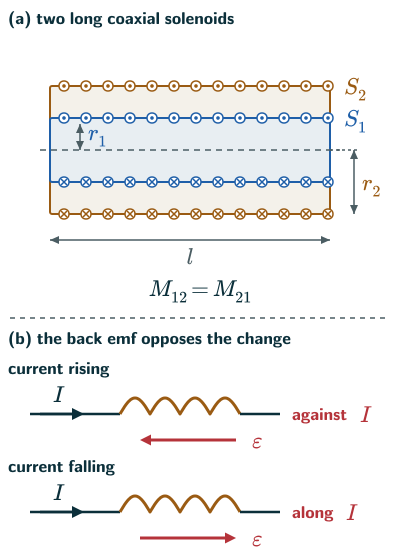
- Two ideal long air-core coaxial solenoids, with end effects neglected and the same length l (NCERT Figure 6.12, page 166): inner S1 with radius r1 and n1 turns per unit length, outer S2 with r2 and n2.
- A current I2 in S2 gives a flux linkage with S1 of N1Φ1 = M12I2 (NCERT Eq. (6.7)). The field of S2, μ0n2I2 (see the solenoid), fills S1, so (NCERT Eq. (6.9), page 166):
Mutual inductance of coaxial solenoids (NCERT Eq. 6.9)
- The other way round, the field of S1 is confined inside S1, so the flux through S2 also uses the area πr12 and M21 comes out the same (NCERT Eq. (6.11)). So M12 = M21 = M, a reciprocity result valid more generally for fixed coils in linear reciprocal media (NCERT Eq. (6.12), page 166). It is useful when one of the two is hard to calculate.
- With a uniform linear medium of constant relative permeability μr filling the long-solenoid magnetic region, M = μrμ0n1n2πr12l. Mutual inductance also depends on the coils’ separation and relative orientation (NCERT page 167).
- A changing current in one coil induces an emf in the other (NCERT page 167):
Mutually induced emf (NCERT page 167)
- If geometry changes, use −d(MI2)/dt, which also contains −I2 dM/dt. For fixed coils this is Experiment 6.3 in numbers: pressing or releasing the key changes I2, and the emf in C1 is M times its rate of change (NCERT pages 167–168).
- NCERT slip: page 166 says “Using Eq. (6.9) and Eq. (6.10), we get M12 = M21”. The two expressions being compared are Eqs. (6.9) and (6.11); Eq. (6.10) only defines M21.
Self-inductance
- A changing current in a coil also changes the flux through the coil itself, inducing an emf in it: self-induction. The flux linkage is proportional to the current (NCERT Eq. (6.13), page 168):
Self-inductance (NCERT Eq. 6.13)
- The induced emf is (NCERT Eq. (6.14), page 168):
Self-induced emf (NCERT Eq. 6.14)
- Ideal long solenoid, neglecting end effects, of length l, cross-section A and n turns per unit length: B = μ0nI, the flux linkage is (nl)(μ0nI)A, so L = μ0n2Al (NCERT Eq. (6.15)). With a uniform filling of constant relative permeability μr, approximating the unsaturated operating range of soft iron, L = μrμ0n2Al (NCERT Eq. (6.16), page 168).
- The self-inductance depends on the coil’s geometry and on the permeability of the medium (NCERT page 168); strictly, it is independent of the current only while that permeability stays constant (reasoned; see the Scope note). Since L ∝ n2, doubling the turns at the same length, area and permeability makes L four times as large (reasoned from NCERT Eq. (6.15)).
If L varies, Faraday’s law gives ε = −d(LI)/dt, including −I dL/dt; the simpler −L dI/dt assumes constant L.
Back emf
- The self-induced emf always opposes any change, increase or decrease, of the current in the coil (NCERT page 168). It is called the back emf (page 168).
- So self-inductance acts like inertia: it is the electromagnetic analogue of mass in mechanics, opposing the growth and the decay of current (NCERT pages 168–169).
- When two coils carry currents at once, the emf in coil 1 has both parts (NCERT page 169):
Two coils together (NCERT page 169)
Energy stored in an inductor
- For an ideal linear inductor with fixed L, work must be done against the back emf to build up a current. At the rate dW/dt = |ε|I = LI dI/dt, the total work to raise the current from 0 to I is (NCERT Eq. (6.17), page 169):
Energy stored in an inductor (NCERT Eq. 6.17)
- This is stored as magnetic energy, and it mirrors ½mv2, with L in the place of m (page 169).
- For a solenoid, put I = B/(μ0n) and L = μ0n2Al into ½LI2: the energy is B2Al/(2μ0). Dividing by the volume Al gives uB = B2/(2μ0) (NCERT Example 6.9 and Eq. (6.18), pages 169–170). It matches the electric energy density ½ε0E2: both grow as the square of the field. Although derived for a solenoid and a parallel plate capacitor, they are general and valid for any region of space in which a magnetic or an electric field exists (NCERT page 170); give that in an exam. Strictly, these are the forms for fields in vacuum (or air): repeating Example 6.9 with L = μrμ0n2Al and B = μrμ0nI gives B2/(2μrμ0) inside a linear magnetic material (reasoned from NCERT Eq. (6.16)).
Solved examples
Example 1: Two concentric coils (after NCERT Example 6.8)
A small single-turn circular coil of radius r1 lies at the centre of a large single-turn coaxial coil of radius r2, with r1 ≪ r2. Find their mutual inductance (NCERT stops at the formula), then its value for r1 = 1.0 cm, r2 = 20 cm.
Answer: a current I2 in the large coil makes B2 = μ0I2/(2r2) at its centre, nearly uniform over the small coil, so Φ1 = πr12B2 and M = μ0πr12/(2r2) (NCERT page 167). Numerically M = 4π × 10−7 × π × (0.010)2/(2 × 0.20) ≈ 9.9 × 10⁻¹⁰ H. For coils of N1 and N2 turns, the field is N2 times larger and the flux linkage N1 times larger, so M = μ0N1N2πr12/(2r2) (reasoned from NCERT Eq. (6.7)).
Example 2: Inductance from a falling current (NCERT Exercise 6.7)
The current in a circuit falls from 5.0 A to 0 in 0.1 s, and the average induced emf is 200 V. Estimate the self-inductance.
Answer: |ε| = LΔI/Δt, so L = 200 × 0.1/5.0 = 4 H (NCERT Eq. (6.14), page 168; Exercise 6.7, page 176).
Example 3: Flux linkage of a coil pair (NCERT Exercise 6.8, with an added emf part)
Two adjacent coils have a mutual inductance of 1.5 H. The current in one rises from 0 to 20 A in 0.5 s. Find the change of flux linkage with the other, and the average emf in it.
Answer: Δ(NΦ) = MΔI = 1.5 × 20 = 30 Wb, and the average emf is 30/0.5 = 60 V (NCERT Eq. (6.7), page 166; Exercise 6.8, page 176).
Example 4: A solenoid’s inductance and energy
A solenoid 0.50 m long has 500 turns and a cross-section of 4.0 cm2. Neglect end effects and find its inductance with air inside and with a uniform core treated as linear with μr = 1000, and the energy stored in the air-cored coil at 2.0 A.
Answer: n = 500/0.50 = 1000 per metre. L = μ0n2Al = 4π × 10−7 × 106 × 4.0 × 10−4 × 0.50 ≈ 2.5 × 10⁻⁴ H; with the core, about 0.25 H. The energy is ½LI2 = ½ × 2.5 × 10−4 × 2.02 ≈ 5.0 × 10⁻⁴ J (NCERT Eqs. (6.15)–(6.17), pages 168–169).
Common mistakes to avoid
Common mistake
Thinking L depends on the current
L = NΦ/I is a constant of the coil: it depends on the geometry and the permeability of the medium inside, not on how much current flows (NCERT pages 165 and 168). Beyond the NCERT text: with a ferromagnetic core, L is only approximately constant, and only while the current is too small to saturate the core; as the core nears saturation, L no longer stays fixed but varies with the current (Wikipedia, “Inductance”).
Common mistake
Thinking the back emf opposes the current
It opposes the change in current. While the current falls, the back emf acts along the current and tries to keep it going (NCERT page 168).
Common mistake
Expecting the two mutual inductances to differ
For fixed coils in a linear reciprocal medium, M12 = M21, even when the two are of very different sizes (NCERT page 166).
Quick revision summary
- In the fixed-geometry linear model, inductance is flux linkage per unit current, NΦB/I; a scalar measured in henry, depending on geometry and material.
- Mutual inductance: N1Φ1 = MI2 and ε1 = −M dI2/dt; M12 = M21; for coaxial solenoids M = μ0n1n2πr12l.
- Self-inductance: NΦB = LI and ε = −L dI/dt; for a long solenoid L = μrμ0n2Al.
- The self-induced (back) emf opposes any change in current: L acts as electrical inertia.
- Energy stored: W = ½LI2; vacuum magnetic energy density B2/(2μ0).
Formula sheet
- mutual: N1Φ1 = MI2, ε1 = −M dI2/dt
- coaxial solenoids: M = μ0 n1 n2 π r12 l
- self: NΦB = LI, ε = −L dI/dt
- solenoid: L = μr μ0 n2 A l
- linear inductor: W = LI2/2; vacuum: uB = B2/(2μ0)
Questions students ask
What is the difference between self-inductance and mutual inductance, and how are they related?
Self-inductance L belongs to one coil and sets the back emf −L dI/dt of its own changing current, while mutual inductance M belongs to a pair of coils and sets the emf −M dI2/dt that a changing current in one induces in the other; both are in henry (NCERT pages 165–168). Beyond the NCERT text, |M| = k√(L1L2), where k from 0 to 1 measures coupling strength. The sign of M depends on the chosen winding/current directions (US Navy, NEETS Module 2, 1998, page 2-16). For NCERT’s coaxial solenoids, Eqs. (6.9) and (6.15) give k = r1/r2, so M = √(L1L2) only if the inner coil fills the outer.
What is the difference between self-induction and self-inductance?
Self-induction is the phenomenon, an emf induced in a coil by a change in its own current, while self-inductance L is the quantity that measures it, the flux linkage per unit current, NΦB = LI, in henry (NCERT page 168). NCERT also calls L the coefficient of self-induction, and in the same way mutual induction is the effect of one coil on another, while mutual inductance M, the coefficient of mutual induction, is its measure (NCERT pages 166 and 168). So ‘a coil’s self-induction is 3 H’ is loose wording: the phenomenon has no unit, and 3 H is the coil’s self-inductance.
What is one henry of inductance?
One henry is the self-inductance of a coil in which a current changing at 1 A s induces an emf of 1 V, so 1 H = 1 V s A; equivalently, the coil’s flux linkage is 1 Wb for each ampere, 1 H = 1 Wb A (reasoned from NCERT Eqs. (6.13)–(6.14), page 168; US Department of Energy, DOE Fundamentals Handbook: Electrical Science, 1992, Module 3). Two coils have a mutual inductance of 1 H when a current changing at 1 A s in one induces 1 V in the other. For example, a 40 mH (0.040 H) coil whose current changes at 45 A s has a back emf of 0.040 × 45 = 1.8 V.
What is the difference between inductance and resistance?
Resistance opposes the current itself and turns electrical energy into heat at the rate IR, while inductance acts only while the current changes, through the back emf L dI/dt, and stores energy ½LI that it returns as the current falls (NCERT pages 168–169). So a steady direct current through a coil meets only the resistance of its wire: with dI/dt = 0 there is no back emf, and the inductance only slows the rise and fall of the current at switching (beyond the NCERT text: US Navy, NEETS Module 2, 1998, Chapter 2). With alternating current the coil also has an inductive reactance.
How do inductances combine in series and in parallel?
Coils too far apart to share flux combine like resistors: in series L = L1 + L2, since the same changing current gives back emfs that add, and in parallel 1/L = 1/L1 + 1/L2, since the same emf acts on both and their rates of change of current add (beyond the NCERT text: US Navy, NEETS Module 2, 1998, pages 2-17 to 2-19; reasoned from NCERT Eq. (6.14)). So 30 mH and 60 mH give 90 mH in series and 20 mH in parallel. Coils in series that share flux through a mutual inductance M give L1 + L2 ± 2M, plus when their fields aid and minus when they oppose (reasoned from NCERT page 169).
Is the energy stored in an inductor deleted from NCERT, and is inductance in the JEE and NEET syllabus?
No, the energy stored in an inductor is not deleted: the 2026–27 NCERT Class 12 book derives W = ½LI in Section 6.7 (Eq. (6.17), page 169) and the magnetic energy density B/(2μ0) in Example 6.9 (pages 169–170). Inductance is in both exams: Unit 14 of the JEE Main syllabus lists “self and mutual inductance”, and Unit 14 of the NEET (UG) 2026 syllabus lists “Self and mutual inductance.” Neither syllabus names the stored energy separately, but it follows directly from self-inductance, in the same NCERT section.
Practice questions
Try each question first, then open the answer to check your working.
-
Q1. What are the SI unit and the dimensions of inductance?
Show answerHide answer
The henry (H); dimensions [M L2 T−2 A−2], those of flux divided by current (NCERT page 165).
-
Q2. The current in a coil of inductance 0.20 H rises at 50 A/s. Find the size of the self-induced emf.
Show answerHide answer
|ε| = L dI/dt = 0.20 × 50 = 10 V (NCERT Eq. (6.14), page 168).
-
Q3. How much energy is stored in a 0.50 H inductor carrying 4.0 A?
Show answerHide answer
W = ½LI2 = ½ × 0.50 × 4.02 = 4.0 J (NCERT Eq. (6.17), page 169).