Faraday’s law of induction
NCERT Class 12 Physics Chapter 6 Section 6.4
Quick answer
Faraday’s law gives induced emf as ε = −dΦB/dt, with the minus sign fixing its direction by Lenz’s law. For N turns sharing the same flux, ε = −N dΦB/dt, and the signed average over an interval is εavg = −N ΔΦB/Δt. In a closed circuit with negligible self-inductance and no other emf, I = ε/R; stored magnetic energy can otherwise make the current lag.
With your textbook
NCERT Physics Part I (Class 12), Chapter 6 “Electromagnetic Induction”, Section 6.4 “Faraday’s Law of Induction”, pages 157–159.
Open the official NCERT chapter (PDF, 2.4 MB, ncert.nic.in) (opens in a new tab)
Checked against the 2026-27 reprint on .
What is Faraday’s law of induction?
Faraday’s law of induction
From his experiments, Faraday concluded that an emf is induced in a coil when the magnetic flux through the coil changes with time (NCERT Section 6.4, page 157). He stated it as a law:
The magnitude of the induced emf in a circuit is equal to the time rate of change of magnetic flux through the circuit.
NCERT Physics Part I (Class 12), Section 6.4, page 158
In symbols, ε = −dΦB/dt (NCERT Eq. (6.3)). The minus sign gives the direction of the emf, which is Lenz’s law. For a closely wound coil of N turns, ε = −N dΦB/dt (NCERT Eq. (6.4), page 158).
In plain words: what drives the current is not how much magnetic flux passes through a circuit but how fast it changes. Change it quickly and the emf is large; hold it steady, however large, and there is no emf at all.
Circuit assumption: when external flux is prescribed and we use I = ε/R below, self-inductance and other emfs are neglected. If an inductor matters, its back emf must also enter the circuit equation; current need not follow the external emf instantly.
Induced emf equals the rate of change of flux
- The emf induced in a circuit is (NCERT Eq. (6.3), page 158):
Faraday’s law (NCERT Eq. 6.3)
- The minus sign gives the direction of the emf, and so of the current in a closed loop; NCERT takes this up as Lenz’s law in the next section (page 158).
- This one rule explains Faraday’s and Henry’s experiments: a moving magnet, a moving current-carrying coil, and a current switched on or off in a nearby coil all change the flux through the coil (NCERT page 157).
- The flux, ΦB = BA cos θ, changes when B, A or θ changes: moving a magnet, shrinking or stretching the coil, or rotating it in the field. An emf results if the combined effect actually changes the linked flux (NCERT page 158).
- Only a changing flux counts. In NCERT Example 6.2 the earth’s field also passes through the loop, but it is steady, so it induces no emf (NCERT page 159).
- Over a finite time Δt, the magnitude of the signed average emf is |ΔΦB|/Δt for one turn. This differs from the average of |ε| when the emf reverses. NCERT’s Examples 6.2 and 6.3 work this way; the instantaneous emf can differ from the average (NCERT page 159).
- In the resistive approximation, if the circuit is closed with resistance R, the induced current is I = ε/R (NCERT Summary point 2, page 173).
Emf of a closely wound coil
- In a closely wound coil of N turns, the flux through each turn changes in the same way, so the emfs of the turns add (NCERT Eq. (6.4), page 158):
Coil of N turns (NCERT Eq. 6.4)
- Here ΦB is the flux through one turn (NCERT Summary point 2, page 173). The product NΦB is the flux linkage of the coil in the fixed-geometry linear model (NCERT Summary point 5, page 173).
- At the same flux change per turn, the induced emf can be increased by increasing the number of turns (page 158).
- NCERT slip: NCERT’s box on Faraday (page 158) says he found that the plane of polarisation is rotated in an electric field. The effect Faraday discovered in 1845 is a rotation in a magnetic field: the rotation is proportional to the part of the magnetic field along the light’s direction (Royal Institution, “Michael Faraday’s magneto-optical apparatus”).
Solved examples
Example 1: A loop in a dying field (NCERT Example 6.2)
A square loop of side 10 cm and resistance 0.5 Ω stands vertically in the east-west plane. A uniform field of 0.10 T, pointing north-east, falls steadily to zero in 0.70 s. Find the induced emf and current.
Answer: the loop’s normal makes 45° with the field, so the initial flux is 0.10 × 0.010 × cos 45° ≈ 7.07 × 10⁻⁴ Wb, and the final flux is zero. ε = ΔΦB/Δt = 7.07 × 10⁻⁴/0.70 ≈ 1.0 mV, and I = ε/R = 1.0 × 10⁻³/0.5 = 2.0 mA (NCERT pages 158–159).
Example 2: Turning a coil in the earth’s field (NCERT Example 6.3)
A circular coil of radius 10 cm, 500 turns and resistance 2 Ω has its plane perpendicular to the horizontal component of the earth’s field, 3.0 × 10⁻⁵ T. It is turned through 180° about a vertical diameter in 0.25 s. Estimate the emf and current.
Answer: each turn’s flux goes from +3π × 10−7 Wb to −3π × 10−7 Wb, a change of magnitude 6π × 10−7 Wb. ε = NΔΦB/Δt = 500 × 6π × 10−7/0.25 ≈ 3.8 × 10⁻³ V, and I = ε/R ≈ 1.9 × 10⁻³ A. These are average values; the instantaneous ones depend on how fast the coil is turning at each moment (NCERT page 159). Had the coil been turned through a full 360°, the flux would end where it began, so the signed average emf and net transferred charge would both be zero in this resistive model, although an emf acts and charge flows alternately in both directions during the turn (reasoned).
Example 3: A loop inside a solenoid (NCERT Exercise 6.3)
A long solenoid with 15 turns per cm has a small loop of area 2.0 cm2 inside it, normal to its axis. The solenoid’s current rises steadily from 2.0 A to 4.0 A in 0.1 s. Find the emf in the loop.
Answer: inside the solenoid B = μ0nI with n = 1500 per metre, so ΔB = 4π × 10−7 × 1500 × 2.0 ≈ 3.77 × 10⁻³ T. ΔΦB = ΔB × A ≈ 3.77 × 10−3 × 2.0 × 10−4 ≈ 7.5 × 10⁻⁷ Wb, so ε = 7.5 × 10⁻⁷/0.1 ≈ 7.5 × 10⁻⁶ V (NCERT Eq. (6.3), page 158; Exercise 6.3, page 176).
Example 4: Reading a flux graph
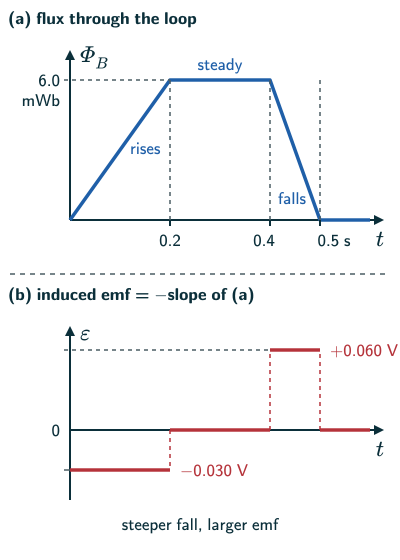
The flux through a single loop rises steadily from 0 to 6.0 mWb in 0.20 s, stays at 6.0 mWb until 0.40 s, then falls steadily to zero by 0.50 s. Find the emf in each stage.
Answer: ε = −dΦB/dt. Rising: slope 6.0 × 10⁻³/0.20 = 0.030 Wb/s (1 Wb/s = 1 V), so ε = −0.030 V. Steady: 0. Falling: slope −6.0 × 10⁻³/0.10 = −0.060 Wb/s, so ε = +0.060 V, twice as large because the change is twice as fast (NCERT Eq. (6.3), page 158).
Common mistakes to avoid
Common mistake
Thinking a large flux means a large emf
The emf depends on how fast the flux changes, not on its size. A large steady flux, such as the earth’s field through a fixed loop, induces nothing (NCERT page 159).
Common mistake
Using the turns count twice, or not at all
BA cos θ is the flux through one turn. Multiply its rate of change by N once to get the emf of the coil (NCERT Eq. (6.4), page 158).
Common mistake
Treating an average emf as the emf at every instant
N|ΔΦB|/Δt gives the magnitude of the signed average emf over the interval. If the flux changes unevenly, as in a rotating coil, the emf at a given instant can be larger or smaller (NCERT page 159).
Quick revision summary
- Faraday’s law: the induced emf equals the rate of change of magnetic flux, ε = −dΦB/dt; the minus sign gives its direction (Lenz’s law).
- For a coil of N closely wound turns, ε = −N dΦB/dt, with ΦB the flux through one turn.
- The flux can be changed through B, A or θ; only a changing flux induces an emf.
- Over a time Δt the signed average emf has magnitude N|ΔΦB|/Δt; in a purely resistive closed circuit I = ε/R.
Formula sheet
- ε = −dΦB/dt
- N turns: ε = −N dΦB/dt
- signed average: εavg = −N ΔΦB/Δt
- resistive approximation: I = ε/R
Questions students ask
What are Faraday’s first and second laws of electromagnetic induction?
Faraday’s first and second laws of electromagnetic induction split NCERT’s single law in two, a convention of many Indian textbooks that is beyond the NCERT text (as in B.L. and A.K. Theraja, A Textbook of Electrical Technology, Volume I): the first is that a changing magnetic flux through a coil induces an emf in it (NCERT page 157), the second that the emf’s magnitude is N|dΦB/dt| for N turns (NCERT page 158). NCERT writes one law, ε = −N dΦB/dt, though its Summary says ‘Faraday’s laws of induction’ (page 173). Neither is one of his two laws of electrolysis (NCERT Chemistry Part I (Class 12), Unit 2, page 51).
Why is there a negative sign in Faraday’s law?
The negative sign in Faraday’s law, ε = −dΦB/dt, gives the direction of the induced emf: the emf drives a current whose own field opposes the change in flux, which is Lenz’s law (NCERT pages 158 and 160). An emf acts one way or the other round a loop, so its sign is read against the loop’s chosen normal: with the right-hand sense round that normal counted positive, a flux growing along the normal gives a negative emf (beyond the NCERT text, the usual sign convention, which gives NCERT’s directions on page 160). NCERT drops the sign when it finds only magnitudes (NCERT Examples 6.2 and 6.3, page 159).
What is the difference between induced emf and induced current?
Induced emf is the work done per unit charge in taking a charge once round a circuit, set only by how fast the magnetic flux changes and by the number of turns, while the induced current is the flow of charge driven by the total circuit emf. In the resistive approximation I = ε/R, so it depends on resistance; with appreciable inductance, stored magnetic energy also affects the current (NCERT pages 158, 163 and 173). The same change of flux that induces 0.12 V round a loop drives 0.75 A if the loop’s resistance is 0.16 Ω, but only 0.075 A at 1.6 Ω. With a gap in the loop the emf is still there but no sustained conduction current flows, though charges can redistribute briefly.
What is the difference between statically and dynamically induced emf?
A dynamically induced emf arises when a conductor moves across a magnetic field, as in a generator, and a statically induced emf in a conductor at rest when the flux linked with it changes as a current changes, as in a transformer (beyond the NCERT text, terms from B.L. and A.K. Theraja, A Textbook of Electrical Technology). NCERT has both cases, not the names: a moving rod gets its motional emf from the Lorentz force, but in a conductor at rest the changing field must produce an electric field (NCERT pages 162–163). A changing coil current gives the important self- or mutual induction.
What is flux linkage, and how is it different from magnetic flux?
Flux linkage is the total flux linked with a coil, NΦB for a closely wound coil of N turns, while the magnetic flux ΦB is the flux through one turn (NCERT pages 165 and 173). Both are measured in webers, since N is a pure number, and the emf of the coil is minus the rate of change of its flux linkage, ε = −d(NΦB)/dt (NCERT page 167). A coil of 250 turns, each with 3.2 × 10 Wb through it, has a flux linkage of 0.080 Wb; self-flux linkage per unit current is the coil’s inductance in the fixed-geometry linear model (NCERT Summary point 5, page 173).
What is the integral form of Faraday’s law, and is it one of Maxwell’s equations?
The integral form of Faraday’s law is ∮ E·dl = −dΦB/dt: for a loop at rest, the emf round it is the line integral of the electric field, and NCERT lists this among Maxwell’s four equations (NCERT Chapter 8, page 205). It says that a magnetic field changing with time gives rise to an electric field (NCERT page 204). As this loop integral is not zero while the flux changes, the induced electric field is not conservative, unlike the field of charges at rest, whose work round a closed path is zero (beyond the NCERT text, reasoned from NCERT pages 45–46 and 163).
Practice questions
Try each question first, then open the answer to check your working.
-
Q1. The flux through each turn of a 50-turn coil changes from 2.0 × 10⁻³ Wb to 5.0 × 10⁻³ Wb in 0.15 s. Find the average emf.
Show answerHide answer
|ε| = NΔΦB/Δt = 50 × 3.0 × 10−3/0.15 = 1.0 V (NCERT Eq. (6.4), page 158).
-
Q2. Why does the earth’s magnetic field through the loop in NCERT Example 6.2 induce no emf?
Show answerHide answer
It is steady: it does not change during the experiment, so it contributes no change of flux (NCERT page 159).
-
Q3. The flux through a loop is ΦB = (4t2 + 2t) mWb, with t in seconds. Find the size of the emf at t = 2 s.
Show answerHide answer
dΦB/dt = (8t + 2) mWb/s, which is 18 mWb/s at t = 2 s, so the emf is 18 mV (NCERT Eq. (6.3), page 158).