The solenoid
NCERT Class 12 Physics Chapter 4 Section 4.7
Quick answer
The magnetic field well inside a long air-core solenoid is approximately uniform and along its axis when the solenoid is long, B = μnI, where n is the number of turns per unit length and I the current, while the field outside is nearly zero. A long solenoid is a closely wound helix of wire whose length is much larger than its radius, and Ampere’s law applied to a rectangle with one side inside gives this result. The direction follows the right-hand rule: curl the fingers along the current and the thumb points along the field.
With your textbook
NCERT Physics Part I (Class 12), Chapter 4 “Moving Charges and Magnetism”, Section 4.7 “The Solenoid”, pages 121–122.
Open the official NCERT chapter (PDF, 3.7 MB, ncert.nic.in) (opens in a new tab)
Checked against the 2026-27 reprint on .
What is a solenoid?
The solenoid
A solenoid is a long wire wound in a helix with its turns closely spaced, so that each turn acts as a circular loop and the field is the vector sum of the fields of all the turns (NCERT Section 4.7, page 121). Inside a long solenoid the field is uniform and along the axis, and Ampere’s circuital law gives its size, B = μ0nI, where n is the number of turns per unit length (NCERT Eq. (4.16), page 122). That is why:
The solenoid is commonly used to obtain a uniform magnetic field.
NCERT Physics Part I (Class 12), Section 4.7, page 122
In plain words: one loop of wire makes a field that is strong at its centre and spreads out. Stack hundreds of loops side by side and their fields line up inside the coil into one strong, even field running along it, while outside they nearly cancel.
Field inside a long solenoid
Unless stated otherwise, these formulas describe an air/vacuum core and the ideal continuous winding. For a finite solenoid, B ≈ μnI applies well inside, away from the ends; a real discrete winding can have local variations close to the wire.
The picture (NCERT pages 121–122, Figures 4.15–4.16):
- A long solenoid is one whose length is large compared with its radius. It is wound with enamelled wire, so that the turns are insulated from each other (page 121).
- Between two neighbouring turns the local contributions from neighbouring wires oppose and cancel at symmetric points in the schematic (NCERT Figure 4.15(a)).
- For a sufficiently long finite solenoid, the field in the central interior region around P is approximately uniform, strong and along the axis. At the exterior mid-point Q it is weak and parallel to the axis, with no normal component; in NCERT Figure 4.15(b) it points the opposite way to the field inside (page 121).
- As the solenoid is made longer it looks like a long cylindrical metal sheet. The field outside approaches zero and is taken as zero, and the field inside becomes everywhere parallel to the axis (NCERT page 122, Figure 4.16).
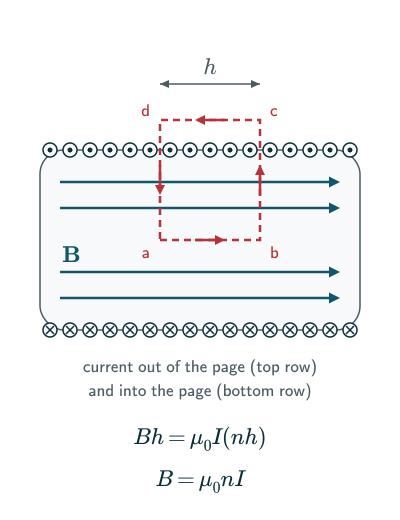
Applying Ampere’s law to a rectangular amperian loop abcd (NCERT page 122):
- The side ab, of length h, runs inside the solenoid parallel to the axis, at any distance from it, where the field is B. The side cd is outside, where the field is zero.
- Along the sides bc and ad, which cross the winding at right angles to the axis, the field has no component along the path, so they add nothing. So the length that counts is L = h.
- With n turns per unit length, the loop encloses nh turns, each carrying the current I, so Ie = I(nh). Then Ampere’s law in the form BL = μ0Ie gives Bh = μ0I(nh), so (NCERT Eq. (4.16), page 122):
Field inside a long solenoid (NCERT Eq. 4.16)
- Signs: go round a → b → c → d, anticlockwise in the figure below. With the right-hand fingers curled that way the thumb points out of the page, so the currents in the top row, which come out of the page, count as positive, and B along ab points along the path. Both sides of Ampere’s law are positive (NCERT Figure 4.16, page 121).
- Direction: by the right-hand rule. Curl the fingers along the current in the turns; the thumb points along the field inside (NCERT page 122).
- In the ideal infinite-solenoid model, B is the same everywhere inside: it does not depend on the distance from the axis or on the radius of the solenoid, only on n and I (reasoned from NCERT Eq. (4.16)).
- If the winding has several layers, n counts all the turns per unit length (reasoned; see Example 2).
- Inserting a soft iron core inside makes a much larger field possible; NCERT takes this up in the next chapter (page 122).
- At an end of a long solenoid the field on the axis is about half the inside value, μ0nI/2 (beyond NCERT, reasoned by superposition: two such halves joined end to end make one long solenoid, and each half gives the same field at the join).
- NCERT slip: Example 4.8 says “we can use the long solenoid formula, namely, Eq. (4.20)” (page 122). The long-solenoid formula is Eq. (4.16); Eq. (4.20), on page 125, is the torque on a current loop.
Solved examples
Example 1: A solenoid (NCERT Example 4.8)
A solenoid 0.5 m long and of radius 1 cm has 500 turns and carries 5 A. Find the field inside.
Answer: n = 500/0.5 = 1000 turns per metre. The length is 50 times the radius, so the long-solenoid formula applies: B = μ0nI = 4π × 10−7 × 103 × 5 ≈ 6.28 × 10⁻³ T (NCERT Eq. (4.16), page 122).
Example 2: Several layers (NCERT Exercise 4.8)
A closely wound solenoid 80 cm long has 5 layers of 400 turns each, and its diameter is 1.8 cm. It carries 8.0 A. Estimate the field inside near its centre.
Answer: the total number of turns is 5 × 400 = 2000, so n = 2000/0.80 = 2500 per metre. Then B = 4π × 10−7 × 2500 × 8.0 ≈ 2.5 × 10⁻² T. The diameter does not enter, since the solenoid is long (NCERT Eq. (4.16), page 122).
Example 3: The current for a given field
A long solenoid has 2000 turns per metre. What current gives a field of 0.10 T inside it?
Answer: I = B/(μ0n) = 0.10/(4π × 10−7 × 2000) ≈ 40 A (NCERT Eq. (4.16), page 122).
Example 4: Centre and end
For the solenoid of Example 1, estimate the field on the axis at one end.
Answer: about half the inside value: 6.28 × 10⁻³/2 ≈ 3.14 × 10⁻³ T (beyond NCERT, from superposition as above).
Common mistakes to avoid
Common mistake
Using the total number of turns for n
n is the number of turns per unit length, N/l, not N. For 500 turns on 0.5 m, n = 1000 per metre (NCERT Example 4.8, page 122).
Common mistake
Expecting the field to depend on the radius
Well inside a long air-core solenoid, B ≈ μnI; radius independence is exact only in the ideal infinite-solenoid limit (NCERT Eq. (4.16)).
Common mistake
Using μnI at the ends or outside
Outside a long solenoid the field is nearly zero (NCERT page 122). On the axis at an end it is about half, μnI/2 (beyond NCERT; see Field inside a long solenoid). Use μnI only well inside.
Quick revision summary
- A long solenoid: closely spaced turns, length much larger than radius; the fields of neighbouring turns cancel between them.
- Inside: uniform, strong and along the axis; outside: nearly zero.
- Ampere’s law on a rectangle with one side inside: Bh = μI(nh), so B = μnI, with n the turns per unit length.
- Direction by the right-hand rule: fingers along the current, thumb along the field.
- At an end, about μnI/2 (beyond NCERT); a soft iron core increases the field.
Formula sheet
- B = μnI
- n = N/l
- Bh = μI(nh)
- at an end: B ≈ μnI/2
- outside a long solenoid: B ≈ 0
Questions students ask
Why is the magnetic field outside a long solenoid nearly zero?
The field outside a long solenoid is nearly zero because the field lines running along the inside must return through the unlimited space outside, where they spread ever more thinly as the solenoid is made longer (beyond the NCERT text, reasoned from NCERT page 122). Ampere’s law agrees: a rectangle wholly outside encloses no current, so the axial field is the same at every distance outside, and as it must die away far off, it is zero outside an ideal solenoid. Strictly, a helical winding also carries I once along its length, adding, before the return lead’s contribution is included, a weak field that circles the solenoid like a long wire’s, μ0I/(2πr), far weaker than μ0nI inside.
What is an ideal solenoid, and how long must a real one be to count as long?
An ideal solenoid is infinitely long and so closely wound that it acts as a continuous cylindrical sheet of current, NCERT’s idealised picture (NCERT page 122, with Figure 4.16 on page 121): its field is exactly μ0nI everywhere inside and zero outside. A real solenoid comes close to this only well inside it, away from its ends. Beyond the NCERT text, adding the fields of the turns gives the field at the centre of a solenoid of length L and radius R as μ0nI × L/√(L + 4R), so a length of 10 radii already gives 98% of the ideal value, but a length of 4 radii only 89%.
How can the magnetic field inside a solenoid be made stronger?
The field inside a long solenoid, B = μ0nI, grows with the turns per metre and with the current, which the heating of the wire limits (NCERT Eq. (4.16), page 122). The biggest gain comes from a soft iron core, which NCERT notes makes a large field possible (page 122): the magnetised iron adds a far larger field of its own, because soft iron can have a large relative permeability; its value depends on field and magnetic history and decreases as saturation is approached (NCERT Chapter 5, page 149). A solenoid with a soft iron core is an electromagnet (NCERT Class 10 Science, Chapter 12, page 201).
What is the difference between a solenoid and a toroid?
A solenoid is a straight coil with two open ends, while a toroid is a solenoid bent round into a closed ring, so its field lines run round inside the winding: “Magnetic lines are completely confined within a toroid” (NCERT Chapter 5, Example 5.3(c), page 144). Beyond the NCERT text, Ampere’s law round a circle of radius r inside the ring gives B = μ0NI/(2πr) for N turns, close to μ0nI for a thin ring, and zero outside in the ideal continuous toroidal winding; real windings can have leakage fields. The current NCERT book has no toroid section, naming it only in Examples 5.1(c) and 5.3(c), and neither the JEE Main nor the NEET (UG) 2026 syllabus lists it.
Practice questions
Try each question first, then open the answer to check your working.
-
Q1. A solenoid 40 cm long has 800 turns and carries 2.0 A. Find the field inside.
Show answerHide answer
n = 800/0.40 = 2000 per metre, so B = 4π × 10−7 × 2000 × 2.0 ≈ 5.0 × 10⁻³ T (NCERT Eq. (4.16), page 122).
-
Q2. The number of turns per unit length of a solenoid is doubled and the current halved. What happens to the field inside?
Show answerHide answer
It stays the same, since B = μnI and the product nI is unchanged (NCERT Eq. (4.16), page 122).
-
Q3. Why do the sides bc and ad of the amperian rectangle add nothing to the line integral?
Show answerHide answer
They run at right angles to the axis, and the field inside is along the axis and zero outside, so B has no component along them (NCERT page 122).