Torque on a current loop and the magnetic dipole
NCERT Class 12 Physics Chapter 4 Section 4.9
Quick answer
A current loop in a uniform magnetic field feels no net force but a torque τ = IAB sin θ, where A is its area and θ the angle between B and the loop’s normal. Defining the magnetic moment m = NIA, along the normal by the right-hand thumb rule, the torque is τ = m × B, which turns m towards B: the parallel position is stable and the antiparallel one unstable. Far away, a current loop produces the field of a magnetic dipole.
With your textbook
NCERT Physics Part I (Class 12), Chapter 4 “Moving Charges and Magnetism”, Section 4.9 “Torque on Current Loop, Magnetic Dipole”, pages 124–129.
Open the official NCERT chapter (PDF, 3.7 MB, ncert.nic.in) (opens in a new tab)
Checked against the 2026-27 reprint on .
What happens to a current loop in a magnetic field?
Torque on a current loop
A loop carrying a steady current I in a uniform magnetic field feels no net force, but it does feel a torque, τ = m × B, where m = IA is the loop’s magnetic moment (NCERT Section 4.9, pages 124–126). The torque tends to turn the loop towards alignment of m with B; settling there requires damping, otherwise it can oscillate, just as an electric dipole lines up with an electric field. NCERT draws the link to magnets:
The presence of this torque is also the reason why a small magnet or any magnetic dipole aligns itself with the external magnetic field.
NCERT Physics Part I (Class 12), Section 4.9.1, page 126
In plain words: the two sides of the loop that cut across the field are pushed in opposite directions, like two hands turning a steering wheel. The pushes cancel as forces but not as a turning effect, so the loop tends to turn towards a plane perpendicular to the field; without damping it can overshoot.
Torque on a rectangular current loop in a uniform magnetic field
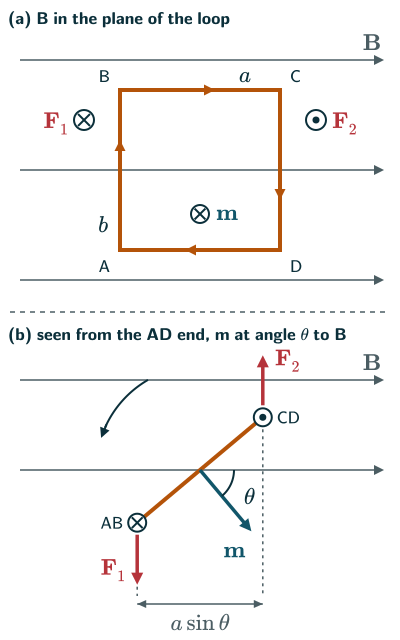
Take a rectangular loop ABCD with arms AB and CD of length b and arms BC and DA of length a, carrying a steady current I in a uniform field B (NCERT pages 124–125, Figures 4.18–4.19):
- Field in the plane of the loop (parallel to AD and BC). The field exerts no force on AD and BC. It is at right angles to AB and CD, and exerts forces F1 = IbB on AB, into the plane, and F2 = IbB = F1 on CD, out of the plane (NCERT page 125).
- The net force is zero, but F1 and F2 form a couple. Each acts at a distance a/2 from the loop’s axis of rotation, the line through its centre parallel to AB and CD, so the torque is τ = F1a/2 + F2a/2 = I(ab)B (NCERT Eq. (4.20), page 125):
Torque, field in the plane of the loop (NCERT Eq. 4.20)
- General case. Let θ be the angle between the field and the normal to the loop (the case above is θ = π/2). The forces on BC and DA are equal, opposite and along the same line, so they give neither force nor torque. The forces on AB and CD are still IbB, but their lines of action are now only a sin θ apart (NCERT page 125):
Torque at angle θ (NCERT Eq. 4.21)
- As θ → 0 the two forces fall on one line and the torque vanishes (NCERT page 126).
- A current loop in a uniform field always has zero net force (NCERT Summary point 10, page 133). Compare the electric dipole, which also feels a torque but no net force in a uniform field (NCERT Section 1.11).
Magnetic moment of a current loop
- NCERT defines the magnetic moment of a current loop as (NCERT Eq. (4.22), page 126):
Magnetic moment (NCERT Eq. 4.22)
- The direction of the area vector A, and so of m, is given by the right-hand thumb rule: fingers along the current, thumb along m (NCERT page 126; Summary point 10, page 133).
- With θ the angle between m and B, Eqs. (4.20) and (4.21) become one vector equation, like τ = pe × E for an electric dipole (NCERT Eq. (4.23), page 126):
Torque on a magnetic dipole (NCERT Eq. 4.23)
- The dimensions of m are [A][L2] and its unit is A m2 (page 126); it can also be written J/T (NCERT table, page 134).
- Equilibrium: the torque is zero when m is parallel or antiparallel to B. Parallel is stable: a small rotation produces a torque that brings the loop back. Antiparallel is unstable: any rotation produces a torque that turns it further (NCERT page 126).
- For a coil of N closely wound turns, m = NIA (NCERT Eq. (4.24), page 126).
- For a rigid loop with a fixed magnetic moment in a prescribed external field, turning it quasistatically against the torque takes work. The potential energy of a magnetic dipole in a field is U = −m·B, lowest when m is along B (NCERT Chapter 5, Eq. (5.3), page 139). So turning m slowly from angle θ1 to θ2 needs work mB(cos θ1 − cos θ2) (reasoned).
- NCERT Example 4.11: a loop lying flat on a horizontal table cannot be made to spin about the vertical by any uniform field, since τ = IA × B always lies in the plane of the loop (NCERT Example 4.11(a), page 128). In stable equilibrium the area vector A points along the external field; the loop’s own field is then in the same direction, both normal to the plane of the loop, giving the maximum flux of the total field (NCERT Example 4.11(b), page 128). A flexible loop of irregular shape takes a circular shape with its plane normal to the field to maximise flux, since for a given perimeter a circle encloses the greatest area (NCERT Example 4.11(c), page 128). Strictly, this is an ideal model with a fixed current and fixed perimeter, neglecting the wire’s stiffness and the forces of its own field; and since a rigid loop’s flux of its own field does not change as it turns, the total and the external flux peak together (reasoned).
Circular current loop as a magnetic dipole
- On the axis of a circular loop, far away (x ≫ R), NCERT Eq. (4.11) gives B = μ0IR2/(2x3). With m = IπR2 this is (NCERT Eq. [4.25(a)], page 128):
Axial field of a magnetic dipole (NCERT Eq. 4.25(a))
- This has exactly the form of the axial field of an electric dipole, 2p/(4πε0x3) (NCERT Eq. (1.20)), with m in place of pe and μ0 in place of 1/ε0 (NCERT pages 128–129).
- In the plane of the loop, far away, the field has size (μ0/4π)m/x3 (NCERT Eq. [4.25(b)], page 129), half the axial value at the same distance. Both results are exact away from the singular origin for a point magnetic dipole (page 129).
- NCERT slip (page 129): in the plane of the loop the field points opposite to m, as the electric field on a dipole’s equatorial plane points opposite to p (NCERT Eq. (1.21) has the minus sign, E = −p/(4πε0r3), and NCERT’s own Chapter 5 table gives −μ0m/(4πr3), page 141). NCERT’s vector Eq. [4.25(b)], B ≃ (μ0/4π)m/x3, and its restatement of Eq. (1.21) on page 129 drop that minus sign. In an exam, give its size as (μ0/4π)m/x3, NCERT’s Eq. [4.25(b)], and its direction as opposite to m.
- Any planar loop is equivalent to a magnetic dipole of moment m = IA (page 129); strictly, the dipole is the leading term of its far field (reasoned).
- One difference: an electric dipole is built from two charges, but a magnetic dipole (a current loop) is itself the most elementary unit; magnetic monopoles are not known to exist (page 129).
- Because a current loop makes a dipole field and feels a torque like a magnetic needle, Ampere suggested that all magnetism is due to circulating currents. This is only partly true: electrons and protons also carry an intrinsic magnetic moment not due to circulating currents (page 129).
Solved examples
Example 1: A rotating coil (NCERT Example 4.10)
A 100-turn coil of radius 10 cm carries 3.2 A. It hangs in a vertical plane, free to turn about a horizontal diameter, in a horizontal field of 2 T. At first the coil’s axis is along the field, and the coil turns through 90°. Find (a) the field at its centre, (b) its magnetic moment, (c) the torque at the start and after it has turned through 90°, (d) its angular speed after 90°, if its moment of inertia is 0.1 kg m2.
Answer: (a) B = μ0NI/(2R) = 4π × 10−7 × 100 × 3.2/0.2 ≈ 2 × 10⁻³ T. (NCERT’s first line of working leaves out the factor N = 100, but its result is right.) (b) m = NIπR2 = 100 × 3.2 × 3.14 × 10−2 ≈ 10 A m2. (c) τ = mB sin θ: 0 at θ = 0 and mB = 10 × 2 = 20 N m at 90°. (d) NCERT sets ½ × 0.1 × ω2 = mB = 20 J, so ω = √(2 × 20/0.1) = 20 s−1 (NCERT page 127). NCERT slip (page 127): with m along B at the start, the torque is zero and the equilibrium is stable. Turning the coil to 90° raises U = −mB cos θ from −20 J to 0, so the field does −20 J of work. As worded, a turn away from alignment needs external work or an initial kinetic energy, so it fixes no angular speed (reasoned). The 20 s−1 is right for the reverse swing: let go at 90°, the coil gains 20 J as m swings into line with B (reasoned from NCERT Eq. (5.3), page 139). In an exam on this example, give NCERT’s 20 s−1, the speed gained as the coil swings back from 90° into line with B.
Example 2: A square coil (NCERT Exercise 4.9)
A square coil of side 10 cm has 20 turns and carries 12 A. Its normal makes 30° with a uniform horizontal field of 0.80 T. Find the torque on it.
Answer: τ = NIAB sin θ = 20 × 12 × 0.010 × 0.80 × 0.5 = 0.96 N m (NCERT Eqs. (4.21) and (4.24), pages 125–126).
Example 3: Shape does not matter (NCERT Exercise 4.13)
(a) A circular coil of 30 turns and radius 8.0 cm carries 6.0 A in a field of 1.0 T making 60° with its normal. Find the counter-torque needed to keep it from turning. (b) Would it change for a planar coil of irregular shape enclosing the same area?
Answer: (a) τ = NIAB sin θ = 30 × 6.0 × π(0.080)2 × 1.0 × sin 60° ≈ 3.1 N m. (b) No: the torque depends only on m = NIA, that is, on the area, not on the shape (NCERT page 129).
Example 4: A dipole’s field
Find the field 0.50 m from the centre of a small coil (radius much less than 0.50 m) of magnetic moment 2.0 A m2, (a) on its axis, (b) in its plane.
Answer: (a) B = (μ0/4π)(2m/x3) = 10−7 × 4.0/0.125 = 3.2 × 10⁻⁶ T, along m. (b) Half as large, 1.6 × 10⁻⁶ T, opposite to m (NCERT Eqs. [4.25(a)]–[4.25(b)], pages 128–129).
Common mistakes to avoid
Common mistake
Measuring θ from the plane of the loop
In τ = mB sin θ, θ is the angle between B and the normal (m), not the plane. With B in the plane of the loop, θ = 90° and the torque is largest (NCERT page 125).
Common mistake
Expecting a net force in a uniform field
A current loop in a uniform field feels only a torque; the forces on opposite arms cancel (NCERT Summary point 10, page 133). In a non-uniform field there can be a net force as well, which is why an iron nail is pulled towards a magnet (NCERT Example 5.1(b), pages 139–140).
Common mistake
Calling the antiparallel position stable
Both m parallel and m antiparallel to B give zero torque, but only the parallel position is stable (NCERT page 126).
Quick revision summary
- A current loop in a uniform field: zero net force, torque τ = IAB sin θ, θ between B and the normal.
- Magnetic moment m = IA (N turns: NIA), direction by the right-hand thumb rule; unit A m.
- τ = m × B: stable equilibrium with m along B, unstable against it; U = −m·B (NCERT Chapter 5).
- A circular loop far away is a magnetic dipole: axial field (μ/4π)(2m/x); in its plane half that, opposite to m.
- The torque depends on the area, not the shape; magnetic monopoles are not known to exist.
Formula sheet
- τ = IAB sin θ
- m = NIA
- τ = m × B
- U = −m · B
- far on the axis: B = (μ/4π)(2m/x)
Questions students ask
Are magnetic moment and magnetic dipole moment the same thing?
Yes, for a current loop the magnetic moment and the magnetic dipole moment are the same quantity, m = IA (NIA for N turns), in A m: NCERT calls it the magnetic moment in Eq. (4.22) (page 126) and the loop’s dipole moment on page 129, and the JEE Main and NEET (UG) 2026 syllabuses use the longer name (Unit 13). The longer name says what it measures: the loop’s strength as a magnetic dipole, which fixes its far field and the torque on it. In chemistry, the spin-only magnetic moment of a first-series transition metal ion with n unpaired electrons, √(n(n + 2)) BM, is the same kind of quantity, in Bohr magnetons (NCERT Class 12 Chemistry Part I, Chapter 4, page 102).
If the field at the centre of a circular loop of area A is B, what is its magnetic moment?
A circular loop of area A producing its own field B at its centre has the magnetic moment m = 2BA√A/(μ0√π), because B = μ0I/(2R) gives I = 2BR/μ0, and then m = IA with R = √(A/π) (NCERT Eq. (4.12), page 116, and Eq. (4.22), page 126). In terms of the radius this is m = 2πBR/μ0, and it holds for a coil of N turns too, since N cancels. For example, a loop of radius 6.0 cm with 1.5 × 10 T at its centre carries about 14 A and has m ≈ 0.16 A m.
Which face of a current loop acts as its north pole?
The face of a current loop out of which its magnetic moment m points acts as its north pole: seen from that face the current flows anticlockwise, and seen from the other face, the south pole, it flows clockwise (beyond the NCERT text, reasoned from the right-hand thumb rule, NCERT page 126). The loop’s field lines come out of its north face and go back in at its south face, as they leave and enter the poles of a bar magnet (NCERT Class 10 Science, Chapter 12, page 197). So two coaxial loops with their north faces turned towards each other repel: seen from one side, their currents flow in opposite senses.
Is the current loop as a magnetic dipole deleted from NCERT Class 12 or the JEE and NEET syllabus?
No, the current loop as a magnetic dipole is still in the 2026–27 NCERT Class 12 Physics Part I, as Section 4.9.2 (pages 128–129), and Unit 13 of the JEE Main and NEET (UG) 2026 syllabuses lists “Current loop as a magnetic dipole and its magnetic dipole moment”. What the book does not have is a subsection on the magnetic moment of an electron going round in an atom; NCERT says only that electrons and protons also carry an intrinsic magnetic moment that circulating currents do not account for (page 129). NCERT Chapter 5 then treats a bar magnet as a magnetic dipole too.
Practice questions
Try each question first, then open the answer to check your working.
-
Q1. A coil of 50 turns and area 2.0 × 10⁻³ m2 carries 4.0 A in a field of 0.25 T parallel to its plane. Find the torque on it.
Show answerHide answer
With B in the plane, θ = 90°: τ = NIAB = 50 × 4.0 × 2.0 × 10−3 × 0.25 = 0.10 N m (NCERT Eq. (4.20), page 125).
-
Q2. For what orientation of a current loop in a uniform field is its equilibrium stable?
Show answerHide answer
When its magnetic moment m points along B (NCERT page 126).
-
Q3. What is the magnetic moment of a single circular loop of radius 5.0 cm carrying 2.0 A?
Show answerHide answer
m = IπR = 2.0 × 3.14 × (0.050) ≈ 1.6 × 10⁻² A m (NCERT Eq. (4.22), page 126).